
















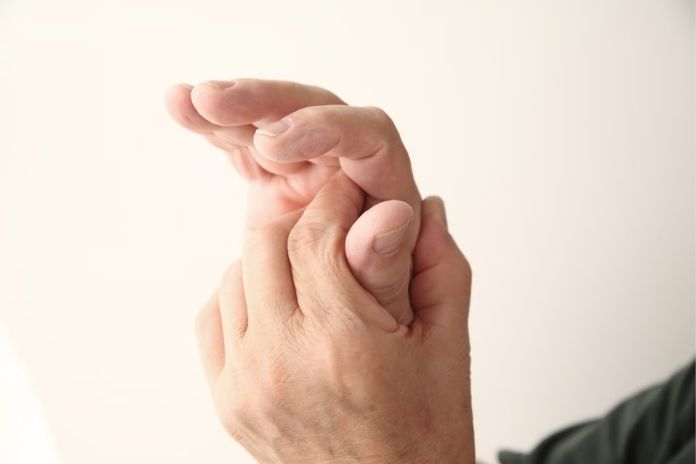
Knowing how to treat a jammed finger quickly and correctly can make a real difference in how fast you recover and whether you avoid long-term problems.
A jammed finger is usually treated with the RICE method (rest, ice, compression, and elevation). Ice the finger for 15 to 20 minutes several times a day, keep the hand elevated, and use buddy taping by securing the injured finger to the one beside it for support.
Most mild to moderate jammed fingers heal within two to four weeks. If the finger looks bent, becomes severely swollen, or does not improve within a few days, get an X-ray to rule out a fracture.
A jammed finger can happen suddenly during sports, a fall, or just an awkward everyday moment. The first question most people ask is whether it is minor or something more serious. Most jammed fingers are ligament sprains around the proximal interphalangeal joint, which is the middle knuckle.
These injuries usually improve with simple first aid. However, some finger injuries involve fractures or significant ligament tears that need medical attention. Knowing the difference matters because early treatment can improve healing and reduce long-term stiffness or joint instability.
- Most jammed fingers are ligament sprains that improve with ice, buddy taping, elevation, and rest within a few weeks.
- A finger that looks bent, becomes severely swollen, or cannot move properly may be broken and needs an X-ray right away.
- Returning to sports too early after a jammed finger can increase the risk of long-term stiffness, instability, and repeat injury.
Read More: Fingernail Problems Not to Ignore: What Your Nails Are Telling You
What a Jammed Finger Actually Is
A jammed finger is a sprain of the proximal interphalangeal joint, also called the PIP joint. This is the middle knuckle of the finger. The injury happens when force pushes the fingertip backward toward the hand, overstretching or partially tearing the ligaments that stabilize the joint. In many cases, the volar plate is also involved. The volar plate is a thick, tough ligament on the palm side of the PIP joint that acts as a stopper to prevent the finger from bending too far backward.
When the finger is jammed, this structure can be strained, partially torn, or in more serious cases, completely ruptured.
This is one of the most common sports injuries, especially in basketball, volleyball, football, and rugby, where the fingertip is often struck directly by a ball or another player.
Jammed finger injuries are graded based on severity. Grade 1 involves mild stretching without instability. Grade 2 involves a partial ligament tear with some looseness in the joint. Grade 3 injuries involve complete ligament tears with significant instability and always require medical assessment. Some Grade 3 injuries need surgical repair.
A related injury worth knowing: mallet finger. If your fingertip droops downward after the injury and you cannot straighten it on your own, that is likely a mallet finger (also called baseball finger), not a standard jammed finger. Mallet finger involves a tear of the tendon at the tip of the finger, not a ligament sprain at the middle knuckle.
If you notice a drooping fingertip that won’t lift on its own, see a doctor promptly, as this injury requires continuous splinting for six to eight weeks and does not respond well to buddy taping alone.
Jammed Finger vs Broken Finger—The Distinction That Changes Everything
A jammed finger and a broken finger can look very similar at first. Both cause pain, swelling, stiffness, and difficulty moving the finger. However, certain signs make a fracture more likely and mean an X-ray is needed right away.
One of the clearest warning signs is a finger that appears visibly bent or angled in a way that is not normal for that joint. This may indicate a fracture or dislocation and needs immediate medical care. Severe swelling that spreads through the entire finger within minutes of injury is also concerning.
A broken finger may make it impossible to straighten or bend the finger normally. The pain is often sharp and localized rather than a general aching soreness. Bruising that develops rapidly, especially on the palm side of the finger, can also suggest a fracture.
Numbness or tingling may indicate nerve involvement. Comparing the injured finger to the same finger on the opposite hand can help identify subtle deformities.
If any of these signs are present, avoid trying to treat the injury at home. Go to an urgent care center or emergency department for an X-ray.
Read More: Trigger Finger vs. Carpal Tunnel: How to Tell the Difference
What to Do in the First 24 Hours — Evidence-Based Steps
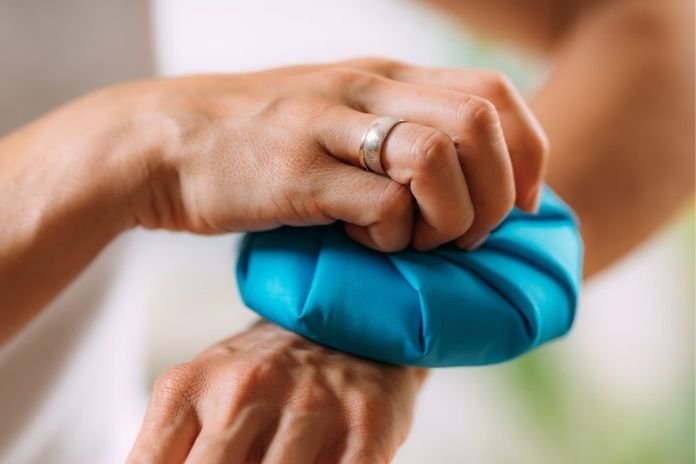
Step 1 — Ice Immediately
Apply an ice pack wrapped in a cloth to the injured finger for 15 to 20 minutes at a time. Repeat this every one to two hours during the first 24 hours after injury. Ice reduces pain and limits initial jammed finger swelling by narrowing blood vessels and slowing inflammatory activity in the injured tissues.
Research primarily supports the use of ice for pain relief in the first 24 to 48 hours after an acute soft tissue injury, with most clinical protocols recommending intermittent 10- to 20-minute applications.
Never place ice directly on the skin, as this can cause skin damage or ice burn. Keep each icing session to 15 to 20 minutes maximum.
Step 2 — Buddy Tape the Finger
Buddy taping is the standard first-line treatment for a jammed finger. Use medical or athletic tape to secure the injured finger to the finger beside it. Place a small piece of gauze or foam padding between the two fingers first to prevent skin irritation.
The healthy finger acts as a natural splint, stabilizing the injured PIP joint while still allowing some hand movement. Tape above and below the PIP joint rather than directly across the middle knuckle.
As a general rule, tape the injured finger to the adjacent finger on the same side as the injury. In a pinch, standard athletic tape from a drugstore works fine, though medical-grade buddy tape or foam-padded athletic tape is more comfortable for extended wear.
If the injury is more severe (significant swelling, difficulty fully bending the finger, or a Grade 2 sprain confirmed by a doctor), an aluminum foam finger splint is a widely available alternative. These are sold at most U.S. pharmacies and provide firmer support than buddy taping alone. Ask your doctor or urgent care provider whether a splint is more appropriate for your injury level.
Compression as part of RICE: The compression step in the RICE method for a finger sprain is largely accomplished by buddy taping itself, which gently limits movement and provides support to the injured joint.
A light elastic wrap (such as Coban) can be applied over the buddy tape for additional compression if swelling is significant, but do not wrap so tightly that the finger turns pale, blue, or numb, as that signals restricted circulation.
Step 3 — Elevate the Hand
Keep the injured hand elevated above heart level whenever possible during the first 24 hours. Elevation reduces jammed finger swelling by limiting fluid buildup in the tissues. At night, rest your hand on a pillow while sleeping.
Step 4 — Use OTC Pain Relief if Needed
Over-the-counter pain relief can help during the early recovery phase. Ibuprofen (Advil, Motrin) and naproxen (Aleve) reduce both pain and swelling because they are nonsteroidal anti-inflammatory drugs (NSAIDs).
For a finger sprain, taking NSAIDs for three to five days following package directions is a common approach, consistent with clinical guidance for acute ligament injuries. Acetaminophen (Tylenol) relieves pain but does not reduce inflammation.
The best choice depends on your medical history and whether you can safely take NSAIDs. People with kidney problems, stomach ulcers, or certain heart conditions should check with a doctor before taking NSAIDs.
Recovery — What to Expect and How Long It Takes
Jammed finger recovery time depends on how severe the injury is.
A mild Grade 1 finger sprain usually improves within one to two weeks when treated with rest, ice, and buddy taping.
A moderate Grade 2 sprain may take three to six weeks to heal fully. Some people benefit from working with a physical therapist or occupational hand therapist to restore range of motion and finger strength once swelling settles.
In the U.S., an occupational hand therapist is often the specialist who manages post-injury finger rehabilitation, and a referral from your doctor can speed up recovery significantly for moderate to severe injuries.
A severe Grade 3 sprain or an injury involving a fracture can take several months or longer to recover from. These injuries often require splinting, supervised rehabilitation, and occasionally surgery.
One common mistake is returning to sports too early because the pain has improved. Pain relief does not mean the ligament has fully healed. Returning to contact sports before strength and stability have returned increases the risk of reinjury and chronic joint instability.
Leaving a severely jammed finger untreated or returning to sport too soon also carries real long-term risks. An undiagnosed fracture or completely torn ligament that does not heal correctly can result in permanent stiffness, persistent instability, or post-traumatic arthritis in the PIP joint.
Post-traumatic arthritis develops when joint damage disrupts the cartilage surface and leads to ongoing pain, swelling, and reduced movement, sometimes years after the original injury. This is the main reason medical evaluation matters even for what feels like a “small” finger injury.
Note: The AAOS reports that PIP joint sprains may take up to 12 months to fully resolve and that swelling can persist for a long time, which surprises many people. This is normal and does not necessarily indicate ongoing damage.
Exercises for Recovery — When and What
Gentle exercises are important once swelling and severe pain begin to improve, usually after three to five days. Early controlled movement helps prevent stiffness and supports long-term recovery. The PIP joint is especially prone to stiffness when immobilized, even briefly, so early movement is important.
Active Flexion and Extension
Slowly bend and straighten the finger through a comfortable range of motion. Repeat 10 times, three times each day. Movement should stay gentle and pain-free. This is the most important early exercise for preventing chronic stiffness in the PIP joint.
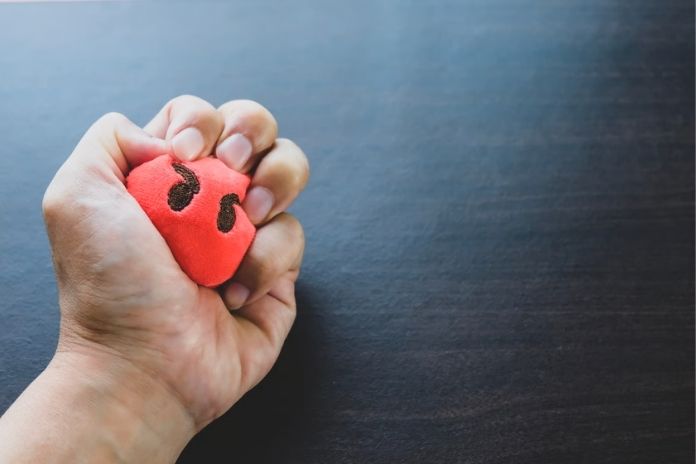
Grip Strengthening
Once pain has improved, gently squeeze a soft foam ball or therapy putty. Start with 10 repetitions and increase gradually over several weeks as strength improves.
Do not force movement while the finger is still significantly swollen or painful. Aggressive early movement can worsen ligament damage and increase the risk of chronic instability.
Read More: 12 Trigger Finger Exercises For Faster and Effective Pain Relief
When to See a Doctor
Seek medical care if the finger looks visibly bent or deformed after injury. Severe jammed finger swelling that does not improve after 48 hours of ice and buddy taping also needs evaluation.
See a doctor if you cannot bend or straighten the finger within several days of injury, or if pain remains severe despite over-the-counter medication.
A pop or crack felt at the moment of injury can suggest a complete ligament tear or a volar plate rupture, both of which typically need clinical assessment and imaging to rule out instability or a fracture fragment. Do not wait to see if this resolves on its own.
Numbness or tingling in the finger or hand should also be assessed promptly.
Children with finger injuries should always be evaluated carefully. Growth plate fractures in children can look like simple sprains on the surface but require different treatment. When in doubt, get an X-ray.
Can I play sports with a jammed finger? For a mild Grade 1 sprain, many athletes return to sport the same day with proper buddy taping, provided the injury has been assessed, and no fracture is suspected.
For a Grade 2 sprain, most sports medicine guidelines recommend staying out of contact sports for two to six weeks. For Grade 3 injuries or those involving a fracture, return-to-play decisions should be made with a doctor. Playing through a more serious injury significantly increases re-injury risk and the chance of developing long-term instability.
Conclusion
Most jammed fingers improve with simple treatment, including ice, buddy taping, elevation, and time. The two biggest mistakes are assuming the injury is not serious without ruling out a fracture, and returning to sports before the ligament has healed completely.
If the finger looks deformed, becomes severely swollen, or does not improve after several days of proper care, a medical assessment and X-ray are the right next steps. Untreated or undertreated finger injuries can lead to lasting stiffness, joint instability, or arthritis, so taking even a minor-seeming jammed finger seriously is always worth it.
FAQs
Q. How do you tell if a finger is jammed or broken?
A jammed finger usually causes pain, swelling, and stiffness, but still allows some movement. Signs that suggest a broken finger include visible deformity, severe swelling that develops very quickly, inability to move the finger at all, rapid bruising (especially on the palm side), and numbness. An X-ray is the only reliable way to confirm whether a fracture is present, and one should be obtained any time fracture signs are visible.
Q. Should you pull a jammed finger to fix it?
No. Pulling on a jammed finger is not recommended and can make the injury significantly worse. It may increase ligament damage, cause joint instability, or worsen an undiagnosed fracture. This is a common folk remedy with no clinical basis. Instead, apply ice, buddy tape the finger, and seek medical care if there is any concern about a fracture or severe injury.
Q. How long should a jammed finger be buddy-taped?
A mild finger sprain may only need buddy taping for one to two weeks. Moderate sprains often require taping for three to six weeks, continuing until full strength and movement return without pain. Returning to contact sports before that point significantly increases the risk of re-injury and long-term instability in the PIP joint.
References
- MedlinePlus. (n.d.). Over-the-counter pain relievers. U.S. National Library of Medicine.
- American Academy of Orthopaedic Surgeons. (n.d.). Sprained finger. OrthoInfo.
- American Academy of Orthopaedic Surgeons. (n.d.). Finger fractures. OrthoInfo.
- American Academy of Orthopaedic Surgeons. (n.d.). Mallet finger (baseball finger). OrthoInfo.
- American Society for Surgery of the Hand. (n.d.). Jammed finger: symptoms and treatment. HandCare.
- Sports-Health. (n.d.). Signs and symptoms of a jammed finger.
- Cleveland Clinic. (n.d.). Jammed finger (sprained finger).
- Cleveland Clinic. (n.d.). Should you still use the RICE method for an injury?
- Cleveland Clinic. (n.d.). How long to ice an injury.
- Norton Healthcare. (n.d.). How long should you ice an injury?
- Penn Medicine. (n.d.). Post-traumatic arthritis: symptoms and causes.
- Pattni A, Jones M, Gujral S. (2016). Volar plate avulsion injury. Eplasty, 16, ic22. PMC4894366.
- Hand Surgery Resource. (n.d.). Sprain, PIP joint.
In this Article