


















You set the treadmill to 12% and knocked out 30 minutes four days in a row. Your calves were burning by day two, your hamstrings felt stiff on day three, and by day four, you were dragging through the session like your legs were filled with wet concrete. You pushed through because incline walking is supposed to be low impact, right? That reasoning is where a lot of people go wrong.
Incline walking does place less stress on the joints than running, but muscle soreness after incline walking is a separate issue entirely, and one that is routinely underestimated. The 24-hour soreness rule offers a straightforward way to assess whether your body is recovering properly from one session to the next.
Understanding this rule and recognizing when it is being violated can be the difference between steady progress and a recurring cycle of fatigue and injury. This article covers how the 24-hour soreness rule applies specifically to incline walking recovery, what warning signs look like, and how to adjust your routine without abandoning the workout.
- Incline walking amplifies eccentric muscle loading across the calves, hamstrings, and glutes, making it far more demanding.
- The 24-hour soreness rule is a practical checkpoint: soreness that lingers beyond the 24 to 48-hour window signals inadequate recovery.
- Warning signs like persistent stiffness, heavy legs, declining performance, and ongoing Achilles tightness are often misread as effort rather than overuse.
- Adjusting frequency, rotating incline levels, and spacing recovery between sessions can protect your progress without sacrificing the benefits.
Read More: Muscle Soreness vs. Injury: Key Differences, Symptoms, and When to Seek Help
What Is the 24-Hour Soreness Rule?
The 24-hour soreness rule is a practical recovery guideline, not a clinical diagnosis. The principle: muscle soreness that begins 12 to 24 hours after a workout and peaks within the 24 to 48-hour window is considered normal delayed onset muscle soreness (DOMS).
This soreness reflects the body’s inflammatory response to microscopic damage in muscle fibers and surrounding fascia caused by demanding exercise. It presents as a dull ache, reduced range of motion, and temporary stiffness, particularly after periods of rest.
What is not normal is soreness that persists meaningfully beyond 48 hours, or soreness that returns before you have fully cleared the previous session. When that pattern repeats, it means the body is not finishing its repair cycle before the next mechanical stress arrives. The result is cumulative tissue strain rather than progressive adaptation.
Soreness itself is not harmful. It is, in many cases, a marker of productive training. The question the 24-hour soreness rule asks is not whether you are sore, but how long it lasts and whether it carries into your next training day.
Why Incline Walking Causes More Muscle Stress Than Flat Walking
Most people assume that because incline walking does not involve running or jumping, the muscular demand is modest. The biomechanics tell a different story.
Increased Eccentric Load on Calves and Hamstrings
Every uphill step requires the calf muscles and hamstrings to both contract and lengthen under tension, a phenomenon known as eccentric loading. Eccentric contractions are the primary driver of DOMS because they generate greater tension per motor unit than concentric movements, producing more microtrauma to muscle fibers and connective tissue.
A 2023 study published in JMIR Formative Research found that uphill walking significantly increased peak hamstring activation by over 100% compared to level walking, with the gastrocnemius also showing marked increases. Repeated daily loading at those magnitudes can exceed the tissue’s recovery capacity, even at a walking pace.
A 2024 imaging study in Insights into Imaging using MRI T2 mapping and shear wave elastography found that deep fascia edema and stiffness were the primary pain generators in post-eccentric DOMS, with soreness peaking at 24 to 48 hours.
The researchers concluded that the deep fascia, not the muscle itself, is the major pain generator of delayed onset muscle soreness, which helps explain why incline walking produces meaningful tissue stress even at moderate walking speeds.
Higher Mechanical Demand on Glutes and Hip Stabilizers
The incline shifts your center of gravity forward and increases hip extension range per stride, elevating demand on the gluteus maximus and hip stabilizers with each step. The steeper the grade, the more those structures work to propel you uphill and control deceleration on landing.
Repetitive Stress Without Enough Variation
One of the subtler contributors to excessive DOMS from incline treadmill training is movement monotony. Walking at the same incline, speed, and duration recruits the same motor units in the same pattern every session. Without variation, those units accumulate fatigue faster than the repeated bout effect can reduce soreness between sessions.
Research in The Journal of Physiological Sciences confirms that DOMS becomes significantly milder after repeated exposures to the same eccentric stimulus, as muscle fibers and satellite cells produce neurotrophic factors that mediate the adaptation. But that protective mechanism requires adequate recovery time between bouts to take hold.
Signs Your Incline Habit May Be Hurting Recovery
Normal DOMS fades meaningfully by the 48-hour mark. If your calves or hamstrings are still noticeably sore 60 to 72 hours after your last session, recovery is incomplete. Training on top of unresolved soreness prolongs inflammation, disrupts muscle recruitment patterns, and raises the risk of compensatory injury in adjacent structures.
Feeling tight before you have even started your next session means the tissues have not completed their repair cycle. Beginning a new bout of eccentric stress on structures still in the inflammatory phase accelerates cumulative damage rather than productive adaptation.
If incline walking at the same settings feels harder than it did two weeks ago, or if your legs feel disproportionately heavy midway through a session, this is often a recovery deficit rather than a motivation issue. Unresolved muscle fiber disruption reduces the contractile efficiency of those tissues over time, making each subsequent session harder than it should be.
Ongoing tightness in the calf or Achilles specifically after incline walking warrants close attention. The Achilles absorbs significant tension during uphill walking due to the increased plantarflexion demand at each step.
The 2024 revised clinical practice guidelines for midportion Achilles tendinopathy from the Academy of Orthopaedic Physical Therapy identify repetitive loading without adequate recovery as a primary contributor to tendon overuse, with morning stiffness and pain with initial activity listed as early warning signs. Feeling unusually drained after what should be a manageable workout is a systemic signal worth taking seriously.
Dr. Jordan Metzl, MD, has explained that when the muscles surrounding a joint are consistently under-recovered, a cascade of compensatory weakening follows: “when the muscles around a joint are weak, the joint gets sore,” making it progressively harder to rebuild. That pattern commonly begins as what looks like ordinary post-workout fatigue.
Normal Muscle Soreness vs. Warning Signs of Overuse
Normal DOMS presents as diffuse, bilateral achiness across the worked muscle groups, stiffness that eases with gentle movement, and tenderness on palpation that does not interfere with basic walking mechanics. It resolves without medical intervention, typically within two to five days.
Warning signs that suggest something more significant include sharp or localized pain rather than diffuse aching, swelling, or visible inflammation around a joint or tendon, soreness concentrated on one side of the body, and any discomfort that alters the way you walk.
These shift the picture from productive adaptation to potential structural injury. Gradual progression remains the primary structural safeguard.
Research from the Journal of Applied Physiology found that repeated eccentric walking on a 25% treadmill gradient reduced DOMS and serum markers of muscle damage over eight weeks, but with different adaptation timelines for subjective soreness versus objective tissue indicators. The body repairs at a structural level long after the ache fades, which is why the absence of pain does not guarantee full tissue readiness.
How Often Should You Do Incline Walking for Optimal Recovery?
People new to incline walking should begin with two to three sessions per week at grades between 3% and 6%, with flat or complete rest days in between. This spacing allows damaged muscle fibers and fascia to repair before they are loaded again, giving the repeated bout effect time to reduce soreness with each subsequent session.
For regular exercisers at moderate inclines of 6% to 10%, three to four sessions per week is a reasonable ceiling, provided soreness resolves within the 48-hour window. High-incline training above 10% is demanding enough that many people benefit from treating it similarly to a moderate resistance training day: one or two sessions on, one day off.
Rotating between incline sessions and flat walking, cycling, or swimming reduces cumulative eccentric load on the calves and hamstrings while maintaining cardiovascular output. Dr. Karin Van Baak, MD, has pointed out that most athletes she treats need at least one full rest day per week, emphasizing that “days of doing nothing are really important” and that misconceptions about passive recovery routinely lead recreational exercisers into unintended overtraining.
Factors That Make Incline Soreness Last Longer
Jumping from a 4% grade to a 12% grade without gradual progression is one of the most common triggers for prolonged DOMS. The muscle and tendon tissues have not adapted to the new mechanical demands, and the spike in eccentric loading overwhelms the repair system before any protective adaptation can take hold. Duration compounds incline-related muscle stress significantly.
Many people increase both incline and session length simultaneously when seeking to progress, which multiplies eccentric volume without proportional recovery capacity. Changing one variable at a time is the safer approach. A warm-up improves muscle extensibility and blood perfusion before eccentric loading begins, reducing the severity of the initial stimulus.
Skipping a cool-down slows the clearance of inflammatory byproducts from worked tissue. Both omissions reliably extend recovery duration. Muscle protein synthesis, the biological process by which damaged fibers are repaired, occurs primarily during sleep. Inadequate sleep slows this process at a hormonal and cellular level.
On the nutrition side, insufficient dietary protein leaves the repair mechanism without the amino acids it requires. Targeting 1.4 to 1.6 grams of protein per kilogram of body weight on training days supports tissue remodeling without the need for supplementation.
Existing calf tightness or prior Achilles issues significantly raise the risk of prolonged soreness from incline walking. Tight calf muscles transfer more mechanical strain to the Achilles tendon on each step, reducing the total loading tolerance before cumulative tissue stress begins to accumulate.
Read More: 10 Best Fitness Gadgets of 2025 That Actually Work
How to Adjust Your Incline Habit Without Losing Benefits
Cutting from five sessions per week to three, while keeping incline settings consistent, often resolves persistent soreness without sacrificing the cardiovascular or muscular benefits. The training stimulus is preserved; the recovery window is simply widened to match what the tissues actually need.
Alternating between a high-incline day and a low-to-moderate incline day varies the eccentric demand on the posterior chain. A session at 4% following a day at 12% keeps movement volume up without repeating the same muscular pattern on tissue that has not fully recovered.
If soreness is consistently carrying past 48 hours, reducing session duration at steep grades from 40 minutes to 20 to 25 minutes, while keeping frequency steady, distributes the total eccentric volume more evenly across the week.
Flat, easy-paced walking at low intensity promotes circulation through recovering tissue without generating new eccentric damage. It maintains training consistency and keeps the movement pattern intact without adding to the cumulative load that is slowing your recovery.
Practical Recovery Strategies if You’re Always Sore
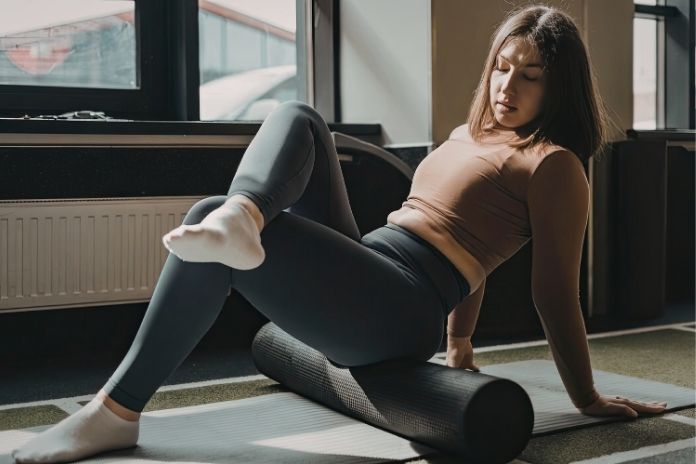
Light movement on rest days consistently outperforms complete inactivity for managing DOMS from incline treadmill workouts. Easy flat walking, gentle cycling, or low-intensity yoga promotes blood flow through the recovering tissue without generating new eccentric stress.
Gentle calf and hip mobility work performed daily reduces baseline tension in the structures most stressed by incline walking. Standing calf stretches, hip flexor stretches, and ankle circles keep the posterior chain more pliable and reduce the severity of next-session stiffness.
Keeping the movement pattern alive while load decreases allows tissue recovery without the deconditioning that comes from complete cessation. Foam rolling the calves and hamstrings after incline sessions provides modest but consistent benefits. Ten to fifteen minutes of foam rolling immediately post-session is a reasonable home application.
Dr. David Geier, MD, an orthopedic surgeon and sports medicine specialist, advises that when overuse symptoms appear, athletes should modify activity rather than stop completely. Avoiding the specific movement that causes pain while staying active in other ways can support recovery without full deconditioning.
A 2025 randomized controlled trial published in Frontiers in Physiology found that massage therapy, which operates through similar mechanisms of tissue mobilization and enhanced blood flow, significantly reduced muscle stiffness markers at 24 and 48 hours post-eccentric exercise compared to control conditions.
When Persistent Soreness May Need Medical Evaluation
Pain that lasts beyond five to seven days from a single incline session, particularly if it does not respond to rest and light movement, warrants professional evaluation. Localized swelling, reduced ankle range of motion, or pain that changes the mechanics of your walking pattern indicate that structural tissue injury, not simple DOMS, may be involved.
People with a history of Achilles tendinopathy or calf strains should be especially cautious with high-incline frequency. The 2024 Academy of Orthopaedic Physical Therapy guidelines are explicit: when loading consistently exceeds recovery capacity, the Achilles tendon’s ability to function is compromised.
High-frequency, steep incline walking without rest creates precisely that scenario. Persistent soreness accompanied by systemic fatigue, mood changes, or declining performance across multiple weeks may suggest overreaching, a state in which training load and recovery are chronically imbalanced.
A sports medicine physician or orthopedic physical therapist can assess loading patterns, gait mechanics, and tissue health to determine whether structural issues are driving the prolonged recovery timeline.
Read More: How to Prevent DOMS (Delayed Onset Muscle Soreness) Without Skipping Gains
The Takeaway: Using the 24-Hour Rule to Balance Progress and Recovery
The 24-hour soreness rule gives you a concrete way to assess whether incline walking recovery is actually working. Mild soreness that peaks within a day or two and clears before your next session means the training stimulus was productive. Soreness that lingers, stacks session to session, or returns before you have finished warming up is telling you the timeline is off.
Muscle soreness after incline walking is expected, especially when grades are steep or the habit is new. What it should not be is a persistent daily state. Incline walking places a meaningful eccentric demand on the calves, hamstrings, and hip stabilizers regardless of how manageable the pace feels.
Recognizing that reality and scheduling your sessions with adequate recovery built in is what separates long-term consistency from the kind of accumulated fatigue that eventually forces a longer break.
Adjust frequency before eliminating the workout. Rotate incline levels to vary the eccentric demand. Monitor how completely you recover between sessions. The clearest signal you have is not how hard a session felt in the moment, but how fully your body recovered from it.
References
- Fu, C., Xia, Y., Wang, B., et al. (2024). MRI T2 mapping and shear wave elastography for identifying main pain generator in delayed-onset muscle soreness: muscle or fascia? Insights into Imaging, 15, 67.
- Lu, C., Al-Juaid, R., & Al-Amri, M. (2023). Gait stability characteristics in able-bodied individuals during self-paced inclined treadmill walking: Within-subject repeated-measures study. JMIR Formative Research, 7, e42769.
- Mizumura, K., & Taguchi, T. (2016). Delayed onset muscle soreness: Involvement of neurotrophic factors. The Journal of Physiological Sciences, 66(1), 43-52.
- Clarkson, P. M., & Tremblay, I. (1993). Effect of training on eccentric exercise-induced muscle damage. Journal of Applied Physiology, 75(4), 1545-1551.
- Chimenti, R. L., Neville, C., Houck, J., et al. (2024). Achilles pain, stiffness, and muscle power deficits: Midportion Achilles tendinopathy revision 2024. Journal of Orthopaedic and Sports Physical Therapy, 54(12), CPG1-CPG32.
- Cheung, K., Hume, P. A., & Maxwell, L. (2003). Delayed onset muscle soreness: Treatment strategies and performance factors. Sports Medicine, 33(2), 145-164.
- NordicTrack. (n.d.). Incline treadmill benefits: Why it works better than flat walking.
- Peak Primal Wellness. (n.d.). Treadmill incline walking benefits.
- Kim, J. (2021). Correlation between cardiopulmonary metabolic energy cost and lower-limb muscle activity during inclined walking.
- Yoon, S. K., et al. (2021). Correlation between cardiopulmonary metabolic energy cost and lower-limb muscle activity during inclined walking. Annals of Rehabilitation Medicine.
- Hinge Health. (n.d.). Incline walking: Benefits and how to do it safely.
- Tata 1mg. (n.d.). Inclined walking vs running: Which is better for weight loss?
- iScooter Global. (n.d.). What incline should I walk on a treadmill? The complete guide for beginners.
In this Article