




















The difference between vitamin D and vitamin D3 confuses many people, as supplement labels lack clarity. Vitamin D is the umbrella term covering all forms of the nutrient. Vitamin D3 (cholecalciferol) is the form your skin produces in sunlight and the form found in animal foods.
Vitamin D2 (ergocalciferol) is the plant-derived alternative. The vitamin D2 vs D3 distinction is important since the two forms differ in how efficiently they raise blood vitamin D levels, and understanding that helps you choose the right vitamin D supplement form.
Here’s the thing: most people buying a vitamin D supplement assume all versions are equivalent. Research over the past five years suggests they aren’t, and the differences are worth knowing.
This article explains both forms, what the evidence shows about effectiveness, what supplement labels actually mean, and which form makes the most sense for different people.
- ‘Vitamin D’ is the umbrella term for all forms of the nutrient. The two main supplemental forms are vitamin D2 (ergocalciferol), derived from plants and fungi, and vitamin D3 (cholecalciferol), derived from animal sources or synthesized by the skin in sunlight.
- D3 is the form the human body makes naturally and the form that raises and sustains blood vitamin D levels more effectively than D2.
- For most people, D3 is the preferred form of supplement. For vegans, algae-derived D3 or D2 are both suitable options.
The Two Forms of Vitamin D: D2 and D3 Explained
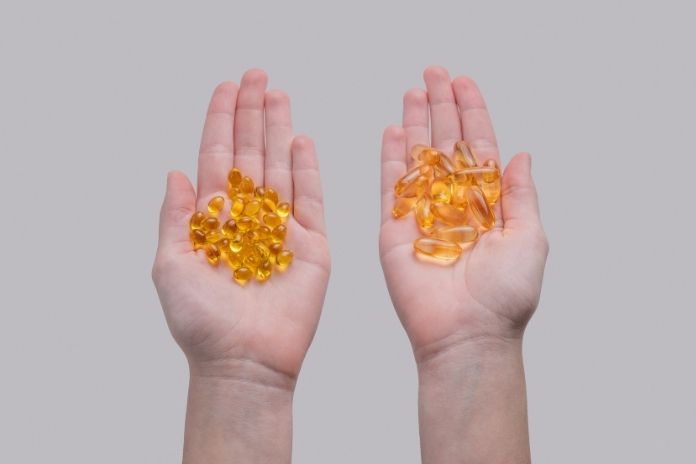
In foods and dietary supplements, vitamin D appears in two chemically distinct forms that differ in their molecular side-chain structures.
Vitamin D2 (ergocalciferol) is produced by plants, fungi, and yeast when exposed to UV light. It’s the form found naturally in UV-exposed mushrooms and the form historically used in prescription-dose vitamin D products in the United States. All D2 is plant or fungi-derived, making it inherently vegan.
Vitamin D3 (cholecalciferol) is produced in human skin when UVB (ultraviolet B, the shorter-wavelength component of sunlight that penetrates the skin’s outer layers) radiation converts 7-dehydrocholesterol into previtamin D3.
Thereafter, this previtamin D3 converts spontaneously to D3. It’s also found in fatty fish, egg yolks, and liver. Most D3 supplements are derived from lanolin (the waxy secretion from sheep’s wool), though algae-derived and lichen-derived vegan D3 supplements are now widely available.
Both forms require the same two-step conversion. The liver converts D2 and D3 into 25(OH)D (calcidiol, the main circulating storage form measured in blood tests). The kidneys then convert it into calcitriol (1,25(OH)2D), the biologically active form. The conversion pathway is identical, efficiency differs.
Vitamin D2 vs D3: Which Form Is More Effective in Raising Blood Levels?

The evidence consistently shows D3 raises and sustains blood 25(OH)D levels more effectively than D2 in people with normal body weight. A 2024 meta-analysis of 20 clinical studies found that D3 produces a consistently greater increase in 25(OH)D than D2 at equivalent daily doses across multiple study populations.
Earlier research (RCTs) established the core finding: D3 and D2 produce similar initial rises in 25(OH)D shortly after dosing, but D3 continues to rise and sustains levels for significantly longer. D2 returns toward baseline much faster. The Armas trial found D3 raised 25(OH)D approximately 87% more than D2 over 12 weeks. The 2024 meta-analysis replicated these findings at scale.
A 2025 study found D3 more efficient than D2 at inducing gene expression for calcium absorption and increasing calcium transport to bone. A separate 2025 Nutrition Reviews meta-analysis raised an additional finding: D2 supplementation may increase metabolic clearance of 25(OH)D3, meaning taking D2 could slightly lower the D3 already circulating in your system.
One nuance worth noting: this potency difference largely disappears in people with a body mass index (BMI) above 25 kg/m². In overweight individuals, D2 and D3 perform more similarly. Body fat sequesters fat-soluble vitamins, which appears to narrow D3’s absorption advantage at higher BMIs.
Why Vitamin D3 Is the Form Your Body Makes Naturally
D3 isn’t just more effective in studies; it’s the physiologically native form. Your skin makes D3, not D2, when exposed to UVB light. Your body’s entire vitamin D transport and storage system evolved around it.
The key mechanism is DBP (vitamin D binding protein, the transport protein that carries vitamin D through the bloodstream). D3 binds to DBP with higher affinity than D2, meaning it stays in circulation longer before being cleared. This explains why D3 raises and sustains 25(OH)D more effectively, even at the same dose: it isn’t just absorbed better; it also lasts longer once absorbed.
The destination is the same; the efficiency differs. Most clinical guidelines now identify D3 as the preferred daily maintenance form for this reason.
When Vitamin D2 Is Used and When It Still Makes Sense

In the United States, high-dose prescription vitamin D has historically been D2 (ergocalciferol). This was because D2 was the only approved pharmaceutical-grade form for decades, not because it performs better. The standard 50,000 IU prescription capsule is most often D2. It remains clinically effective for correcting severe deficiency and is still widely prescribed.
D2 is equally effective as D3 for treating rickets (a bone-softening condition in children caused by severe vitamin D deficiency) and correcting frank deficiency at therapeutic doses. Both forms raise 25(OH)D sufficiently in these clinical scenarios.
For vegans, D2 is the default choice because it’s always plant- or fungi-derived. That’s no longer the only option. Algae-derived and lichen-derived D3 supplements are now widely available, produced without animal products, and research shows they raise 25(OH)D equivalently to lanolin-sourced D3. Vegans now have access to a more effective form.
What ‘Vitamin D’ on a Supplement Label Actually Means
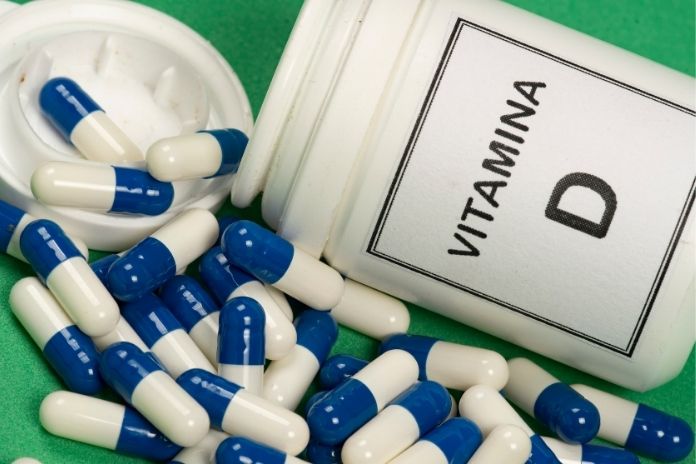
When a supplement label says ‘Vitamin D’ without specifying the form, check the ingredient list. It will say either ergocalciferol (that’s D2) or cholecalciferol (that’s D3). These are the two forms used in all vitamin D supplements, and knowing which one you have is more useful than the generic ‘Vitamin D’ heading on the front.
The majority of over-the-counter vitamin D supplements now contain D3. As D3 became more widely produced and cost-competitive with D2, manufacturers shifted. Most standard 1,000-5,000 IU supplements you’ll find at a pharmacy or grocery store today are D3 unless the label specifically states otherwise.
Prescription megadose vitamin D (typically 50,000 IU) is often D2 in the US. It’s clinically effective for correcting deficiency at that dose, but research suggests an equivalent high dose of D3 would raise 25(OH)D levels higher.
Regardless of which form you take, absorption of all vitamin D forms improves significantly when taken with a fat-containing meal. Fat stimulates bile secretion, and bile is required to solubilize and help absorb fat-soluble vitamins from the intestinal lining.
Which Vitamin D Supplement Form Should You Take? A Practical Summary

For most adults: D3 is the evidence-supported choice. It raises and sustains 25(OH)D more effectively than D2, is widely available at low cost, and is the form your body produces naturally. Standard daily doses of 1,000 to 2,000 IU cover most adults’ baseline needs, though optimal dosing depends on your initial blood level.
For vegans: Algae- or lichen-derived vitamin D3 is a preferred option. It performs comparably to lanolin-derived D3, offering the more effective form without the use of animal products. Vitamin D2 remains a suitable vegan alternative, though it is generally less potent per dose for daily maintenance.
Get your 25(OH)D level tested before starting high-dose supplementation. The NIH defines sufficiency as 50 nmol/L (20 ng/mL) or above. Many people, particularly those in northern climates or with limited sun exposure, fall below this threshold and need more than a standard maintenance dose to correct it.
Always take vitamin D with a fat-containing meal, regardless of which form you use. Fat substantially enhances the absorption of both D2 and D3. This single habit enhances the clinical effectiveness of any form you take.
Final Word
The difference between vitamin D and vitamin D3 is simpler than most supplement labels suggest. D3 is the form your body was built around; it’s what your skin makes, what binds most efficiently to your transport proteins, and what the most recent clinical evidence consistently supports for daily supplementation.
Read the ingredient list, not just the front label. Cholecalciferol or ergocalciferol, the two words that tell you everything you need to know.
- Vitamin D3 and D2 are both forms of vitamin D. D3 is what your body makes naturally and absorbs more efficiently for daily maintenance.
- D3 raises and sustains blood 25(OH)D levels more effectively than D2 at equivalent doses, particularly in people with normal body weight.
- D3 raises and sustains blood 25(OH)D levels more effectively than D2 at equivalent doses, particularly in people with normal body weight.
References
- Nair, R., & Maseeh, A. (2012). Vitamin D: The ‘sunshine’ vitamin. Journal of Pharmacology and Pharmacotherapeutics, 3(2), 118–126.
- Tripkovic, L., Lambert, H., Hart, K., Smith, C. P., Bucca, G., Penson, S., & Lanham-New, S. Comparison of vitamin D2 and vitamin D3 supplementation in raising serum 25-hydroxyvitamin D status: A systematic review and meta-analysis. American Journal of Clinical Nutrition, 116(5), 1151–1161.
- Vaes, A. M. M., Tieland, M., de Regt, M. F., Wittwer, J., van Loon, L. J. C., & de Groot, L. C. P. G. M.. Dose-response effects of supplementation with calcifediol versus vitamin D3 on serum 25-hydroxyvitamin D levels in older adults. Clinical Nutrition, 40(3), 1589–1597.
- Ghaderi, A., Banafshe, H. R., Mirhosseini, N., Moradi, M., Karimi, M. A., Mehrzad, F., & Asemi, Z. (2019). Clinical and metabolic response to vitamin D plus probiotic in schizophrenia patients. BMC Psychiatry, 19(1), 77.
- Jolliffe, D. A., Greiller, C. L., Mein, C. A., Hoti, M., Bakhsoliani, E., Kebadze, T., & Martineau, A. R. (2018). Vitamin D receptor genotype influences risk of upper respiratory infection. British Journal of Nutrition, 125(9), 1023–1034.
- Pludowski, P., Takacs, I., Boyanov, M., Belaya, Z., Diaconu, C. C., Mokhort, T., & Pilz, S. (2022). Clinical practice in the prevention, diagnosis and treatment of vitamin D deficiency: A Central and Eastern European Expert Consensus Statement. Nutrients, 14(7), 1483.
- Amrein, K., Scherkl, M., Hoffmann, M., Neuwersch-Sommeregger, S., Kostner, K., Tmava-Berisha, A., & Pieber, T. R. (2020). Vitamin D deficiency 2.0: An update on the current status worldwide. European Journal of Clinical Nutrition, 74(11), 1498–1513.
- Martineau, A. R., Thummel, K. E., Wang, Z., Jolliffe, D. A., Boucher, B. J., Griffin, S. J., & Forouhi, N. G. (2019). Differential effects of oral boluses of vitamin D2 vs vitamin D3 on vitamin D metabolism: A randomised controlled trial. JCEM, 104(12), 5831–5842.
- National Institutes of Health, Office of Dietary Supplements. (2023). Vitamin D: Fact sheet for health professionals.
In this Article