












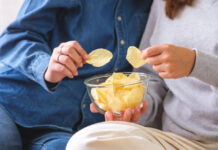


You finish a stressful work call, and within minutes, you are standing in the kitchen reaching for something you were not hungry for an hour ago. Or it is 10 p.m., you already ate dinner, and a craving for something sweet has moved from background noise to the only thing you can focus on. For millions of Americans, the gap between craving and action collapses so fast that there is barely a decision happening at all.
Learning how to sit with food cravings is not about white-knuckling through them or pretending they do not exist. The Somatic Pause, a body-based awareness technique grounded in interoceptive science and mindful eating research, offers a practical middle path. Instead of reacting automatically or suppressing the urge, you pause long enough to understand what the craving is actually signaling, then decide what to do with that information.
This article covers what the Somatic Pause is, why intense food cravings feel so biologically urgent, how to apply the three-step method in real situations, and when cravings may point to something that needs more than a pause. Whether you are dealing with late-night snacking, stress eating, or post-meal sugar urges, this framework gives you a repeatable, body-centered tool for responding with awareness instead of urgency.
- The Somatic Pause is a body-based technique that creates a conscious gap between a food craving and your response, giving you time to assess what your body actually needs before acting.
- It works in three steps: notice the craving without judgment, scan your body for physical and emotional signals, then make a deliberate choice rather than a reactive one.
- The method is not about avoiding food or testing willpower. It builds interoceptive awareness so you can distinguish true hunger from stress, boredom, or habit.
- Used consistently, the Somatic Pause reduces impulsive eating, supports emotional regulation, and shifts your relationship with food from urgency-driven to intention-driven.
What Is a Somatic Pause?
The term “somatic” comes from the Greek word “soma,” meaning “body.” Somatic awareness is the practice of reading internal signals, including muscle tension, breath patterns, hunger cues, and emotional states, as useful data rather than noise to ignore. It is the difference between eating on autopilot and eating with even a baseline level of self-knowledge.
In eating behavior, a somatic pause is a deliberate window, typically 30 to 90 seconds, in which you redirect attention inward before deciding whether and how to act on a craving. This is not suppression. Suppression treats a craving as a problem to be eliminated and often backfires, intensifying the urge through a rebound effect well-documented in psychological research.
The Somatic Pause acknowledges the craving fully while slowing the automatic move from urge to action. That gap changes the decision from reactive to intentional. Most people find that simply naming and observing a craving, without fighting it, reduces its felt urgency within 60 to 90 seconds.
Read More: What Is Somatic Yoga? A Beginner’s Guide to This Gentle Movement Practice
Why Intense Food Cravings Feel So Urgent

Cravings are not a character flaw. They are the output of layered biological, emotional, and behavioral systems that evolved long before processed food existed. At the brain level, food cravings engage the mesolimbic dopamine pathway, the reward circuitry involved in motivation and anticipation.
A study published in Trends in Neurosciences found that dopamine neurons fire most intensely not during consumption but during the anticipation of reward, which explains why the craving can feel more urgent than the actual eating. The brain generates a false emergency signal that feels physically real even when the underlying need is not hunger.
Cortisol compounds the problem. Research published in Biological Psychiatry has shown that elevated cortisol is directly associated with increased appetite for high-fat, high-sugar foods, independent of actual caloric need. Stress does not just make you want to eat. It narrows the craving toward specific high-reward targets and makes resisting those targets feel physiologically difficult.
Then there are habit loops. Ann Graybiel, PhD, a professor at MIT’s McGovern Institute for Brain Research and a leading researcher on habit formation, has described how repeated cue-behavior-reward sequences become encoded in the brain as automatic routines.
“Habits are encoded in brain circuits,” she has noted in her published research, “and those circuits can be remarkably resistant to change.” A cue like sitting on the couch after dinner activates the full behavioral sequence neurologically, often before conscious awareness catches up.
Understanding this biology does not make cravings disappear, but it reframes them as predictable physiological events rather than personal failures, which is exactly the mindset the Somatic Pause requires.
Read More: Craving Sweets? Try These Delicious Low-Sugar Desserts!
The 3-Step Somatic Pause Method

Step 1: Notice the Craving Without Judgment
Most people experience a craving and immediately shift into evaluation mode, asking whether they should or should not act. That evaluative jump skips the most important step: recognizing that a craving is present without attaching a verdict to it.
Name the craving specifically. Is it a pull toward something sweet, salty, crunchy, or creamy? Where do you feel it in your body? Is there a hollow sensation in your stomach, a restlessness in your chest, a tightening in your throat?
Getting specific reduces the craving’s sense of overwhelming urgency and is supported by affect labeling research, which shows that naming internal states activates the prefrontal cortex and dampens the intensity of the limbic response driving the urge.
Judson Brewer, MD, PhD, has studied craving behavior extensively. He notes that “getting curious about a craving activates a different part of the brain than the one driving the urge,” a principle central to his research on mindfulness-based approaches to habit change. Curiosity, not combat, is what Step 1 is asking for. You are not trying to defeat the craving. You are trying to see it clearly.
Step 2: Scan Your Body for Signals
Once the craving is acknowledged without judgment, spend 30 to 60 seconds on a rapid body scan. This is the information-gathering phase, and it is where the Somatic Pause does most of its practical work.
Start with physical hunger markers: a hollow or gnawing sensation in your stomach, noticeably low energy, or more than three hours since your last meal. These point toward genuine physiological hunger and call for a direct response.
Then assess your emotional and nervous system state. Are you stressed, bored, lonely, anxious, or exhausted? Is there physical tension in your shoulders, jaw, or chest? Are you breathing shallowly? These are signs of nervous system activation that frequently generate cravings identical in feel to hunger but originating from a completely different source.
Eating may briefly soothe that activation, but it does not resolve the underlying driver, and the craving typically returns within the hour.
Michelle May, MD, founder of the Am I Hungry? Mindful Eating program and author of multiple books on eating behavior, frames the central question plainly: “The question isn’t whether you should eat. It’s whether eating is actually the answer to what you’re feeling right now.” That distinction between physical hunger and emotional hunger is exactly what this step is designed to reveal.
Step 3: Choose a Response Intentionally
By Step 3, you have more information than you had 90 seconds ago. You know whether the craving feels physical or emotional, whether your nervous system is activated, and roughly what the craving is asking for. From that position, you make a deliberate choice.
That choice might be to eat. If the scan revealed genuine hunger or the food will bring real satisfaction, eating is a completely appropriate response. The Somatic Pause is a decision-making tool, not a restriction strategy, and yes, it is a fully valid answer. Eating intentionally after a pause is a fundamentally different act than eating reactively before one, even when the food and portion are identical.
Alternatively, you might delay by 10 to 15 minutes, address the emotional need through movement or rest, reduce the portion while still satisfying the craving, or choose something that satisfies the taste without the same reward intensity. The specific choice matters less than the fact that you are making one consciously, and that distinction, practiced consistently, is what gradually reshapes the habit.
How the Somatic Pause Reduces Impulsive Eating
Impulsive eating operates almost entirely below conscious awareness. The cue triggers the craving, the craving drives the behavior, and the loop reinforces itself within seconds. A pause interrupts that loop at its most vulnerable point and gives the reflective brain a chance to participate before the reward system takes over.
This builds interoceptive awareness over time, the capacity to accurately perceive and interpret internal body signals. Research published in Appetite found that individuals with higher interoceptive sensitivity demonstrated less emotional eating and a greater ability to distinguish physical hunger from emotionally triggered urges.
People who read their own bodies more accurately make different eating decisions, not because they try harder, but because they are working with better information.
Evelyn Tribole, MS, RDN, co-author of Intuitive Eating and a registered dietitian nutritionist with decades of clinical experience in eating behavior, describes this shift as moving from policing food to partnering with your body.
“Interoceptive awareness is a skill that can be developed,” she has noted in her clinical writing, “and it fundamentally changes how you experience hunger, fullness, and satisfaction.” The Somatic Pause builds that skill through low-stakes, repeatable practice spread across dozens of craving moments each week.
Read More: Why You Can’t Stop Craving Junk Food — Your Gut Bacteria May Be to Blame
Physical vs. Emotional Cravings: How to Tell the Difference

One of the most practically useful outcomes of practicing the Somatic Pause is developing a more reliable ability to distinguish physical from emotional cravings. They can feel nearly identical, but reliable patterns separate them. Physical hunger builds gradually, arrives a few hours after a meal, brings stomach-level sensations, and can be satisfied by a range of foods.
Emotional cravings arrive fast, feel urgent and specific, and often follow a stressful event or mood shift. They tend to persist past physical fullness because the underlying emotional need remains unaddressed.
Tracking patterns informally through a brief cravings log reveals consistent triggers that make future pauses faster and more accurate. Most people find their strongest cravings cluster predictably around specific times, situations, or emotional states.
When to Use the Somatic Pause
The Somatic Pause is most effective in predictable high-craving windows. Late-night cravings after dinner frequently reflect fatigue or habit rather than hunger, and a brief pause often shows the urge fades without action. Stress-related urges respond well because the body scan surfaces the emotional driver clearly.
Post-meal sweet cravings are often blood sugar rhythms and habits rather than hunger. Habit-driven afternoon snacking is another prime use case: pausing before entering the kitchen introduces enough friction to make the behavior conscious rather than automatic.
What the Somatic Pause Is Not
It is not a diet rule. No eating behavior is prohibited. Its only function is to make the decision conscious. It is not a willpower test: willpower operates through resistance and typically rebounds, while the pause operates through awareness and produces information. And it is not designed to eliminate cravings, which are a normal feature of human neurobiology.
The goal is not to stop wanting food but to relate to those wants with enough clarity that your responses serve you better over time.
Practical Tips to Make the Pause Easier
Set a timer for 60 to 90 seconds. Most people are surprised by how much urgency softens within that window. Take four slow breaths before or during the scan: slow breathing activates the parasympathetic nervous system and counteracts craving-driven urgency. Keep a brief cravings log and reduce screen stimulation during the pause, since body awareness requires attentional bandwidth that competing inputs eliminate.
When Cravings May Signal Something Else

Persistent cravings sometimes reflect issues that the pause alone cannot address. Chronic undereating is one of the most common drivers: when caloric intake is consistently low, the brain ramps up reward-seeking behavior as a biological corrective. Poor sleep elevates ghrelin while suppressing leptin, and a single night of inadequate sleep can produce craving patterns that mimic emotional eating.
If cravings come with significant guilt, loss of control, or compensatory behaviors afterward, a registered dietitian or therapist specializing in somatic or cognitive behavioral approaches can provide support well beyond any self-directed technique.
Read More: What Your Cravings Say About Your Nutritional Deficiencies
Key Takeaway: Pause First, Then Decide
Intense food cravings feel urgent for a reason. Your brain is wired to push you toward quick relief, and that pressure can make the urge feel non-negotiable. But urgency is not the same as necessity. Just because it feels immediate doesn’t mean it needs to be acted on right away. The Somatic Pause creates a small but powerful gap between the craving and your response.
In that gap, your nervous system begins to settle, and your thinking brain has a chance to step in. Instead of reacting on autopilot, you give yourself the option to respond with awareness. This practice isn’t about denying yourself food or forcing control. It’s about shifting from impulsive eating to intentional eating. After a pause, you may still choose to eat, but the decision comes from clarity, not compulsion. That difference matters more than the choice itself.
Over time, this simple habit starts to change how you experience cravings. You begin to notice patterns, what triggers them, what emotions sit underneath them, and when they pass on their own. The urge loses some of its intensity because it’s no longer running the show unchecked. Managing cravings is not about willpower or personality. It’s a skill built through repetition.
Each pause strengthens your ability to stay present, understand your body, and make decisions that actually align with what you need. You don’t have to fight your cravings. You just have to slow down long enough to understand them.
Pause first. Then decide.
FAQs
What is the Somatic Pause technique for food cravings?
The Somatic Pause is a three-step body-based method: notice the craving without judgment, scan your body for physical and emotional signals, and make a conscious choice about how to respond. It is an awareness tool, not a restriction strategy.
How do I know if my craving is physical hunger or emotional?
Physical hunger builds gradually and brings stomach-level sensations. It can be satisfied by various foods. Emotional cravings arrive suddenly, feel specific and urgent, and often follow stress or a mood shift. They may persist past fullness because the underlying emotional need remains unaddressed.
How long does the Somatic Pause take?
The pause takes 30 to 90 seconds. A timer helps when first learning the technique. With regular practice, the process becomes faster and more intuitive.
Can the Somatic Pause help with late-night eating?
Yes. Late-night cravings frequently reflect fatigue or habit rather than hunger, and a brief pause often reveals the urge fades within a minute or two without requiring any action.
Is the Somatic Pause suitable for people with disordered eating?
The framework aligns with intuitive eating principles, but anyone with a history of disordered eating should work with a qualified professional rather than relying solely on self-directed techniques.
References
- Brewer, J. A., Mallik, S., Babuscio, T. A., Nich, C., Johnson, H. E., Deleone, C. M., Minnix-Cotton, C. A., Byrne, S. A., Kober, H., Weinstein, A. J., Carroll, K. M., & Rounsaville, B. J. (2011). Mindfulness training for smoking cessation: Results from a randomized controlled trial. Drug and Alcohol Dependence, 119(1-2), 72-80.
- Graybiel, A. M. (2008). Habits, rituals, and the evaluative brain. Annual Review of Neuroscience, 31, 359-387.
- Herbert, B. M., & Pollatos, O. (2012). The body in the mind: On the relationship between interoception and embodiment. Topics in Cognitive Science, 4(4), 692-704.
- Macht, M. (2008). How emotions affect eating: A five-way model. Appetite, 50(1), 1-11.
- Schultz, W. (2007). Behavioral dopamine signals. Trends in Neurosciences, 30(5), 203-210.
- Sinha, R., & Jastreboff, A. M. (2013). Stress as a common risk factor for obesity and addiction. Biological Psychiatry, 73(9), 827-835.
- Alitus. (n.d.). Fear of fullness.
- Embodied Healing KC. (n.d.). Somatic experiencing and intuitive eating: Reconnecting with your body’s wisdom.
- Fay Nutrition. (n.d.). Somatic therapy and disordered eating.
- Johns Hopkins Medicine. (n.d.). Somatic self-care.
- Kindful Body. (n.d.). Using somatic therapy to process food-related anxiety.
- Nourished Nervous System. (n.d.). Somatic pause.
- Willems, A. E. M. (2022). Self-initiated dietary changes reduce general somatic and mental symptoms.
In this Article