


















For a long time, discussions about weight loss stayed stuck in the same place. Eat less. Move more. Try harder. When people failed, the failure was treated as personal, not medical.
That thinking has changed. Slowly, but clearly.
Today, doctors are finally accepting what patients have known for years: obesity behaves like a chronic disease. It has memory. It fights back. And it rarely responds to advice alone.
That shift has opened the door to two significant medical options, GLP-1 medications and bariatric surgery. Both are effective. Both can improve health beyond weight. And both demand respect, not casual decision-making.
The difficult part is not choosing what “works.” The difficult part is choosing what fits your body, your life, your tolerance for change, and your long-term reality.
This article is written for that decision. To help you think clearly about your weight loss options.
GLP-1 Medications: What They Actually Do (Without the Marketing)
GLP-1 medications do not force weight loss. They do not burn fat. They do not override biology.
They work with it.
These drugs influence gut-brain signalling. Hunger becomes quieter. Fullness arrives earlier. The constant background noise of food, planning, and cravings reduces for many people.
Clinicians hear this description repeatedly. “Anecdotally, people with food addiction who find GLP-1s helpful in this regard talk about how the medication turns down the volume of ‘food noise’ in the brain, by which they mean the constant thoughts and cravings for certain types of food,” says Stanford Medicine psychiatrist Dr. Anna Lembke.
That reduction matters more than people realise.
For someone who has spent years negotiating with their appetite, the change feels less like dieting and more like relief. Eating becomes simpler. Portions reduce without effort. Emotional eating does not disappear, but it loses intensity.
Some people respond strongly. Some modestly. Some struggle with side effects enough to stop.
There is no personality type that predicts success. Biology decides more than discipline.
Living on a GLP-1: The Early Reality
Starting a GLP-1 is not dramatic. There is no “day one transformation.”
Doses begin low. They increase slowly. Weekly injections become routine, not eventful. The body still resists weight loss; it just argues less.
The first 4-6 weeks are usually uncomfortable, but not dramatic.
Food feels heavier. Meal sizes shrink. Certain smells or textures suddenly feel unpleasant. Nausea can appear, usually around dose increases, and then fade. For some, it does not fade, and that becomes the deciding factor. Some people interpret this as “medicine working.” Others stop early because it disrupts their daily routine.
What matters here is not willpower, but tolerance. If your body accepts the medication, the process feels manageable. If it doesn’t, no motivation can compensate.
What Results Look Like With GLP-1s

Progress with GLP1s tends to be steady, not aggressive. Clothes loosen before numbers drop. Energy often improves as blood sugar stabilises. Sleep, joints, and daily comfort may improve even before visible weight change.
Some people lose significant weight. Others lose enough to feel healthier without a dramatic transformation. Both outcomes are valid.
One important reality needs to be acknowledged: results usually depend on continued use. When medication stops, appetite signalling often returns to baseline. That does not mean the drug “failed.” It means it was doing real physiological work.
Stopping is not failure. But stopping has consequences that must be understood upfront.
Bariatric Surgery: What Changes, Really

Bariatric surgery is not cosmetic, and it is not simply “a smaller stomach.” It is permanent metabolic re-engineering.
Surgery changes how hunger hormones behave, how quickly food moves through the digestive system, how insulin responds, and how the brain interprets fullness and satiety. That is why results are often stronger and faster than medication alone.
Procedures like the gastric sleeve or the gastric bypass permanently alter anatomy. The two most common procedures differ in the extent to which they change anatomy.
“One type of metabolic and bariatric surgery is the gastric sleeve, where they take off the greater curvature of the stomach,” says Dr. Ethan Lazarus, a family and obesity medicine physician.
“The other procedure that’s commonly done is called a gastric bypass. That’s basically a very short sleeve, about the size of a golf ball, plus they bypass a small part of the small intestine, so you can’t absorb your food as efficiently.”
Adjustable bands exist but are far less common now, for good reason. largely because they produce less consistent weight loss and have higher long-term complication and removal rates compared with sleeve gastrectomy and gastric bypass. Issues such as band slippage, erosion, and the need for repeat procedures led many surgeons to abandon them.
Bariatric surgery is not a temporary intervention. It is a structural one.
The Surgical Path: Before, During, After

Surgery is not chosen in one appointment. There are assessments, waiting periods, counselling, and preparation. That process itself filters people, not by worth, but by readiness.
The operation day is usually short. Recovery is not trivial, but for many, it is manageable. The real work begins after discharge.
Eating must be relearned. Protein matters. Supplements are mandatory. Hydration requires intention. Ignoring follow-up can lead to deficiencies that cause real harm.
In the early months, weight loss can feel fast, sometimes faster than expected. That speed can be encouraging and unsettling at the same time.
Surgical Results: The Pattern Most People See
Weight loss after surgery tends to be more pronounced, especially in the first year. Health improvements, particularly in type 2 diabetes, can be dramatic.
But surgery does not erase the relationship with food. It reshapes it.
Some people feel freed from hunger. Others struggle with new discomforts. A small number experience regret, not because surgery “failed,” but because the permanence felt heavier than anticipated.
The body adapts. Weight can stabilise. In some cases, regain occurs, especially without follow-up care. Surgery is powerful, but it is not immune to biology either.
GLP-1 Medications vs. Bariatric Surgery: A Side-by-Side Look
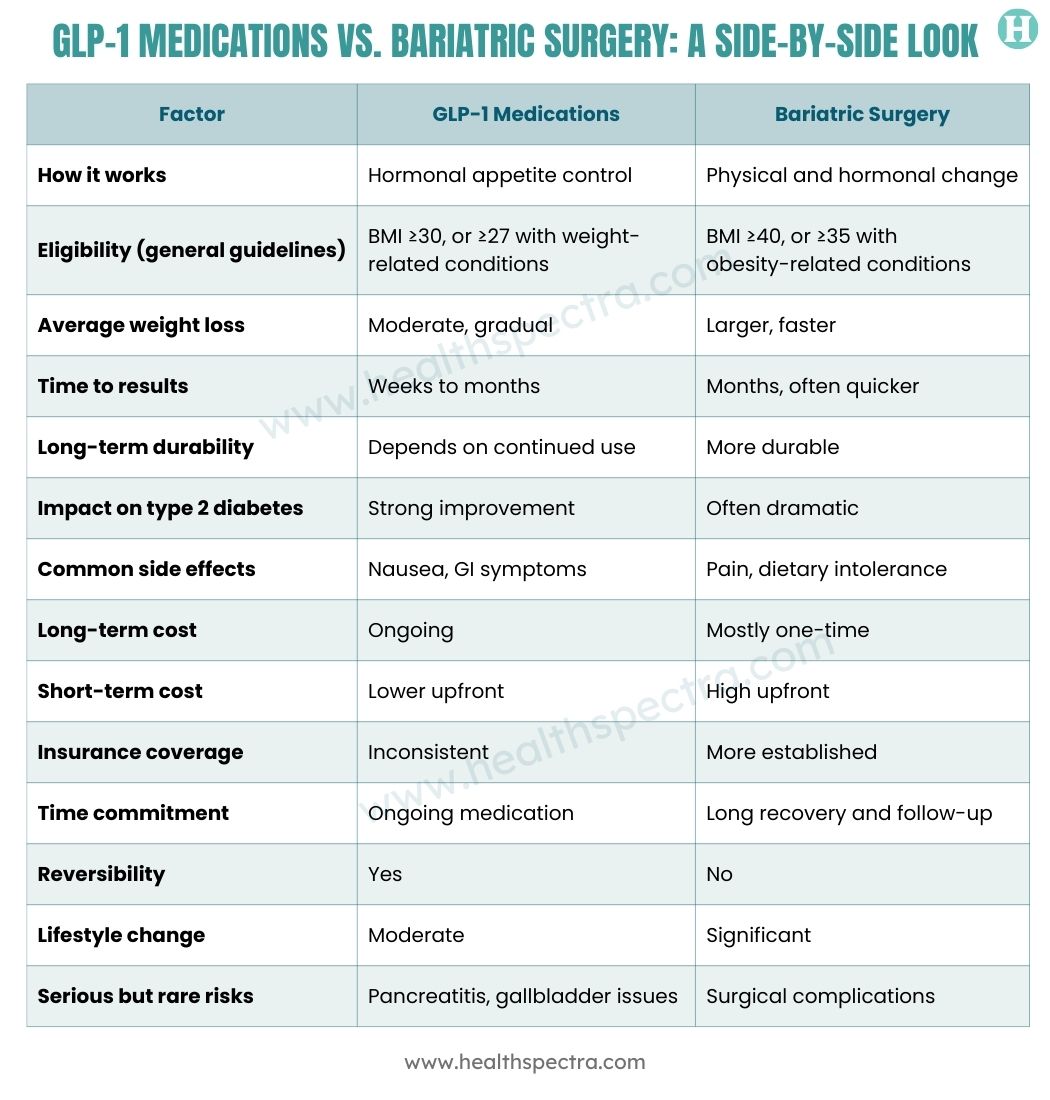 This table is the reference point for comparisons. Details below add context.
Eligibility matters, and it is not identical for both options.
GLP-1 medications are typically prescribed for adults with a body mass index (BMI) of 30 or higher, or 27 or higher if weight-related health conditions such as type 2 diabetes, hypertension, or sleep apnea are present. Some clinicians may prescribe them outside these ranges based on individual risk, but insurance coverage often follows these thresholds closely.
Bariatric surgery has more formal eligibility criteria. It is generally reserved for individuals with a BMI of 40 or higher, or 35 or higher when significant obesity-related medical conditions are present. Because surgery permanently alters anatomy, most programs also require evidence of prior weight-loss attempts, medical clearance, and psychological readiness.
These cutoffs are guidelines, not judgments. They exist to balance benefit and risk, not to measure effort or worth.
Cost, Insurance, and the Part People Underestimate

Many people compare numbers and miss patterns.
GLP-1 medications may look affordable initially, especially with insurance. Without coverage, commonly prescribed GLP-1s often cost $199 per month for Ozempic or Wegovy injections, or $149 for the Wegovy pill (available only for certain doses). After that, most ongoing fills are $299 or $349 per month. Injections of Wegovy cost $349 per month, depending on the drug and dose. Even with partial coverage, out-of-pocket costs can remain significant, and insurance decisions can change with little notice.
Bariatric surgery looks expensive upfront, but costs are usually more predictable once approved. In the U.S., the one-time cost typically ranges from $15,000–$25,000 without insurance, depending on procedure type and location. When covered, patient responsibility is often limited to deductibles and co-pays, though approval criteria can be strict.
The real financial question is sustainability. Not what you can afford today, but what you can carry for years.
Time, Work, and Real Life

GLP-1s usually interfere less with daily life. Travel is possible. Work schedules remain intact. Social eating adjusts, but does not collapse.
Surgery demands more early disruption and long-term attention. Meals must be planned. Supplements must not be forgotten. Follow-up is not optional.
People with chaotic schedules often struggle more with surgery than expected, not because they lack discipline, but because structure is essential.
Risks Associated with GLPs and Bariatric Surgery
People who opt for GLP-1s experience nausea, vomiting, diarrhea, constipation, and potential pancreatitis as some of the commonly associated risks, while those who opt for surgery usually face risks like infection, bleeding, blood clots, leaks, dumping syndrome, and nutritional deficiencies.
GLP-1 risks are usually front-loaded and manageable. Most are uncomfortable but not known to be dangerous. Rare complications exist and deserve monitoring, not fear.
Surgical risks are real but have decreased significantly with experience and technique. Most serious risks occur early. Later risks are often related to nutrition neglect, not the surgery itself.
In both cases, risk increases when follow-up decreases.
Reversibility: Why This Question Is Emotional, Not Logical
Stopping a medication feels psychologically safer. Knowing you can stop matters, even if you don’t plan to.
Surgery removes that option. For some, that permanence feels grounding. For others, it feels like pressure.
There is no correct emotional response here. Only honest ones.
Who Might Be a Better Fit for Each Option?
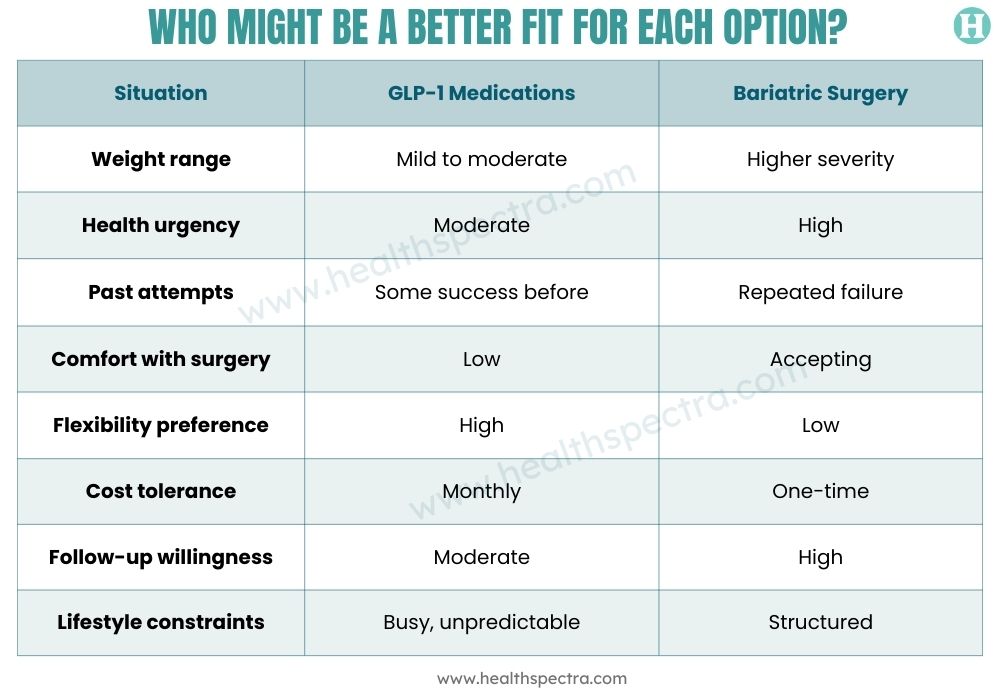 No table can replace clinical judgment, but it can expose mismatches early.
When Waiting Is the Smarter Choice
Unstable mental health, untreated eating disorders, or major life upheavals can make both options unsafe or ineffective.
Sometimes the best decision is not “no,” but “not yet.”
Read More: Supplements That Increase GLP-1: What the Science Really Shows
Making the Decision Without Noise
Ask your doctor questions that apply to you, not averages.
- Based on my health, which option reduces risk sooner?
- What results do people like me usually see?
- What happens if insurance changes?
- What are my personal risk factors?
- Can I switch or combine approaches later?
Then ask yourself one uncomfortable question: Which difficulty am I more willing to live with?
Read More: Ozempic vs. Wegovy: What’s the Difference, and Which One Is Right for You?
It Is Not Always Either-Or
Some people use GLP-1s before surgery. Some after. Some never need surgery. Some wish they had chosen it earlier. Modern treatment is not linear. Changing course is not defeat.
Read More: 10 Foods That Boost GLP-1: The Hormone Ozempic Mimics to Curb Hunger
Final Thoughts
GLP-1 medications and bariatric surgery are both effective treatment options when it comes to managing obesity. However, both come with their own set of benefits and cons and are planned for you by your healthcare provider, based on your specific health conditions.
Neither is a shortcut. Neither is a guarantee. Both can change lives when chosen with clarity.
The right decision is very personal, the one that you can sustain when motivation fades.
- Obesity treatment now focuses on our unique biology.
- GLP-1s and bariatric surgery are both effective and valid treatment options for managing obesity, but both solve different problems in different ways
- Its best to choose an option that is sustainable with your lifestyle and finances
- Take an informed decision by discussing with your healthcare provider which option works for your specific health conditions.
- Long-term research on combining both approaches is still limited
FAQs
1. Can I stop GLP-1 after reaching goal weight?
Biologically, weight regain risk remains.
2. Is bariatric surgery more effective than GLP-1s?
Often, but not always, effectiveness depends on the person. You should explore your options with your doctor.
3. Will weight return after stopping GLP-1 medication?
Often, unless great behavioural changes are in place.
4. Is bariatric surgery dangerous today?
Risks exist, but safety has improved significantly.
5. Do I have to choose GLP-1s forever?
No. Treatment paths can change.
References
- Cabou, C., & Burcelin, R. (2011). GLP-1, the Gut-Brain, and Brain-Periphery Axes. The Review of Diabetic Studies, 8(3), 418–431.
- Cătoi, A. F., Pârvu, A., Mironiuc, A., Galea, R. F., Mureşan, A., Bidian, C., & Pop, I. (2016). Effects of sleeve gastrectomy on insulin resistance. Medicine and Pharmacy Reports, 89(2), 267–272.
- Filippatos, T. D., Panagiotopoulou, T. V., & Elisaf, M. S. (2015). Adverse Effects of GLP-1 Receptor Agonists. The Review of Diabetic Studies, 11(3-4), 202–230.
In this Article