




















Fiber is one of the most under-consumed nutrients; not by a little, but by a lot. Most adults get about 16–17 grams per day, while recommendations sit between 25 and 38 grams. That means the average intake is roughly half of what it should be. About 95% of people don’t meet the recommended fiber amount, which makes this less of a small nutrition gap and more of a widespread pattern.
Fiber affects far more than digestion. It plays a role in heart health, blood sugar control, gut health, and long-term disease risk. Getting enough doesn’t require a complicated diet, but it does need understanding the numbers and making deliberate choices.
- Most people get only about half the fiber they need, making it a widespread gap with real health impact.
- Your fiber target should scale with calories (about 14 grams per 1,000 calories), not just fixed daily numbers.
- Increasing fiber gradually from whole foods supports heart, metabolic, and gut health, and even small improvements make a difference.
Read More: 10 Fiber Superfoods to Lower Blood Pressure Naturally (Without Changing Your Meds)
How Much Fiber Do You Actually Need?

Fiber needs are often given as fixed numbers: around 34 grams per day for men and 28 grams per day for women. While those are useful benchmarks, they don’t explain why the numbers differ or how to adjust them to your diet.
A more practical way to think about it is the 14 grams per 1,000 calories rule. Fiber needs to scale with how much you eat. If your intake increases or decreases, your fiber target should change with it. For someone eating 2,000 calories per day, that works out to about 28 grams of fiber. It increases to about 35 grams at 2,500 calories. At 1,600 calories, it drops to roughly 22 grams.
This approach makes fiber intake more flexible and easier to apply in real life. It also explains why recommendations are lower for older adults. That is not because their bodies need less fiber per unit of food, but because they typically consume fewer calories.
For most adults, a realistic and useful target falls between 25 and 35 grams of fiber per day. Importantly, you don’t have to reach that number immediately. Even moving closer to it provides measurable benefits.
Where Most People Actually Are — The 94% Problem
Despite clear recommendations, most people are not even close to meeting them. Average intake sits at about 16–17 grams per day, and only a small fraction of adults reach the recommended range.
This gap is largely driven by the way modern diets are structured. Many commonly eaten foods, especially refined grains and processed products, contain very little fiber because it is removed during processing. As a result, it’s possible to eat enough calories while still being significantly deficient in fiber.
The difference becomes clearer when you look at actual foods. Refined options like white bread or pasta contribute very little fiber. In contrast, whole foods such as legumes, vegetables, fruits, and whole grains provide much higher amounts in relatively small portions. A single half-cup serving of lentils, for example, can provide nearly half of what many people currently get in an entire day.
This is why increasing fiber is less about eating more and more about choosing differently.
Read More: Why Your Fiber Supplement Might Be Making Your Heart Meds Less Effective
Soluble vs Insoluble—Two Types, Two Different Jobs
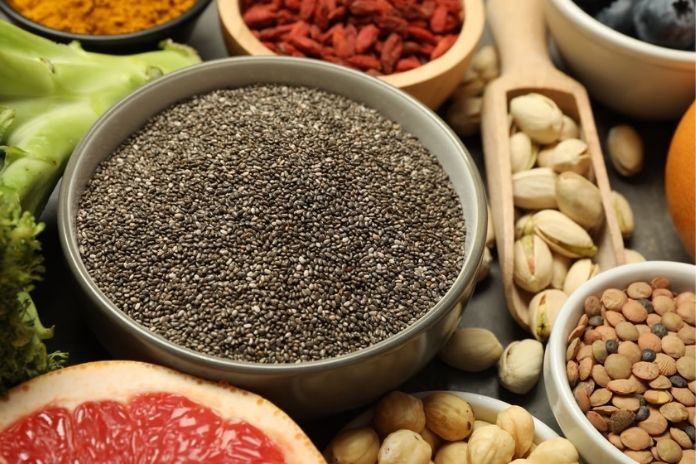
Soluble Fiber — The Metabolic Worker
Soluble fiber dissolves in water and forms a gel-like substance in the digestive tract. This physical property gives it many of its benefits. By slowing the digestion and absorption of carbohydrates, it helps reduce spikes in blood sugar after meals. This makes it especially important for metabolic health and diabetes prevention.
It also plays a role in lowering cholesterol. Soluble fiber binds to bile acids in the gut, which are then excreted. The body replaces these bile acids by using cholesterol from the bloodstream, which helps reduce LDL levels.
Another key function is its interaction with the gut microbiome. Soluble fiber is fermented by gut bacteria, producing short-chain fatty acids such as butyrate. Butyrate is particularly important because it fuels the cells lining the colon, supports the gut barrier, and helps regulate inflammation.
Foods like oats, beans, lentils, chia seeds, apples, and citrus fruits are rich in soluble fiber and are especially useful for supporting metabolic and cardiovascular health.
Insoluble Fiber — The Transit Specialist
Insoluble fiber works in a more mechanical way. It does not dissolve in water but instead adds bulk to stool and helps move food through the digestive system more efficiently. This makes it essential for preventing constipation and maintaining regular bowel movements.
Its benefits extend beyond digestion. Insoluble fiber, especially from whole grains, has been consistently linked to a lower risk of colorectal cancer. The relationship appears to be dose-dependent, meaning that higher intake is associated with greater protection.
Because insoluble fiber is less fermentable than soluble fiber, it tends to produce less gas. This often makes it easier to tolerate when increasing fiber intake, particularly in the early stages.
Good sources include whole wheat, vegetables, nuts, seeds, and fruit skins. Together with soluble fiber, it forms a complementary system, one supporting metabolic health and the other supporting digestive function. A balanced intake typically includes both, with a greater proportion coming from insoluble sources.
Why Fiber Matters — The Evidence Is Stronger Than People Realise
Fiber stands out in nutrition because of how consistent the evidence is across different areas of health. Higher fiber intake is linked to lower risk of cardiovascular disease, type 2 diabetes, colorectal cancer, and overall mortality.
An important aspect is that the benefits extend beyond individuals who achieve ideal intake levels. Improvements occur across a range of intakes, meaning that even modest increases can have measurable effects. Adding just a few extra grams per day can improve cholesterol levels, support better blood sugar control, and contribute to long-term disease prevention.
This dose-response relationship makes fiber particularly practical from a public health perspective. You don’t have to be perfect to benefit; you just have to move in the right direction.
The Microbiome Connection — Why Butyrate Is the Mechanism That Matters

A large part of fiber’s impact comes from what happens after it reaches the colon. There, gut bacteria ferment certain types of fiber and produce short-chain fatty acids. Among these, butyrate plays a central role.
Butyrate acts as the main energy source for the cells lining the colon, helping maintain the integrity of the gut barrier. It also has anti-inflammatory effects and influences processes that are linked to chronic disease.
However, the ability to produce butyrate depends on both diet and the composition of the gut microbiome. Diets low in fiber reduce the populations of bacteria that produce these beneficial compounds. Increasing fiber intake can rebuild these populations, but the process takes time and consistency.
This is why regular, varied intake of fiber-rich foods is more effective than occasional high-fiber meals. The microbiome adapts gradually, and its benefits build over time.
How to Actually Get There — A Practical Ramp-Up Guide
The Microbiome Adaptation Window—Why Bloating Is Not A Reason To Stop
One of the most common reasons people struggle with increasing fiber is the digestive discomfort that can appear early on. Bloating and gas are often considered signs that fiber “doesn’t work” for them, but in most cases, they reflect a temporary imbalance between fiber intake and the gut microbiome’s ability to process it.
When fiber intake increases quickly, bacteria produce more gas as they ferment the additional material. Over time, however, the microbiome adapts by increasing the number of fiber-digesting bacteria, making the process more efficient and reducing symptoms.
This adaptation typically takes a few weeks. Increasing fiber gradually, by about 3 to 5 grams per week, allows this adjustment to happen more comfortably. Drinking enough water is also important, as fiber absorbs fluid and needs it to move effectively through the digestive system.
From a practical standpoint, increasing fiber usually requires adding specific high-fiber foods rather than relying on general dietary changes. Foods like legumes, whole grains, fruits, vegetables, and seeds provide the most efficient way to increase intake. Even small, consistent changes, such as adding beans to one meal per day or switching to whole grains, can significantly reduce the gap over time.
Read More: Too Much Fiber in Your Diet? Tips to Balance Your Intake
Food vs Supplements — When Psyllium or Other Supplements Are Useful

Whole foods remain the best source of fiber because they provide a combination of nutrients that work together. In addition to fiber, they contain vitamins, minerals, and plant compounds that support overall health and influence the gut microbiome.
That said, supplements can be helpful in certain situations. Psyllium, for example, is a soluble fiber with strong evidence supporting its ability to lower cholesterol and improve blood sugar control. Other types of fiber supplements may be easier to tolerate for people who experience digestive discomfort.
However, supplements do not fully replicate the effects of whole foods, particularly in supporting a diverse and healthy microbiome. They are best used as a complement to a fiber-rich diet rather than a replacement.
Conclusion
Fiber is one of the few nutrients with a large, clear gap between intake and recommendation, and the solution is simple. The 14 grams per 1,000 calories rule provides a simple way to personalize your target, while understanding the different roles of soluble and insoluble fiber helps guide food choices.
Closing the gap doesn’t require drastic changes. It requires consistent, intentional adjustments and a gradual approach that allows the body to adapt. Even small increases can lead to meaningful improvements in health, making fiber one of the most practical areas to focus on.
References
- National Center for Biotechnology Information. (2024). Dietary fiber and health outcomes.
- Harvard Health Publishing. (n.d.). Psyllium fiber: Regularity and healthier lipid levels.
- North-West University. (n.d.). How fiber can help you shed those pounds.
- UCLA Health. (n.d.). Increasing fiber in your diet may increase gas.
- ScienceDirect. (2022). Dietary fiber and health outcomes: A review.
- National Center for Biotechnology Information. (2018). Dietary fiber: Essential for health.
- StatPearls Publishing. (2023). Dietary fiber.
In this Article