



















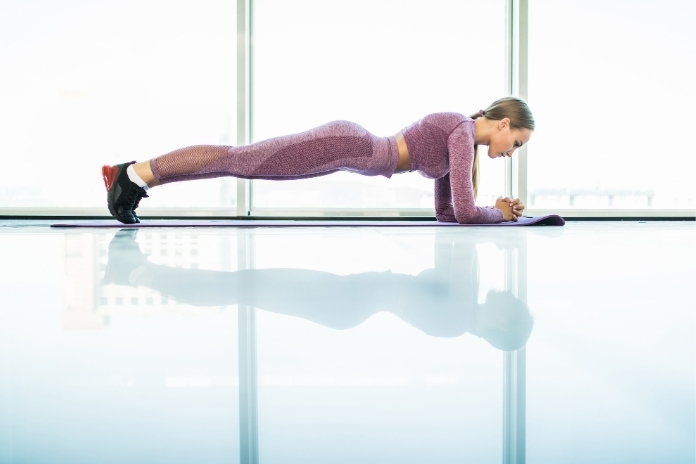
Most people approach the plank like a competition: feet together, forearms planted, eyes on the clock. Getting past two minutes feels like a milestone, and anything beyond that feels like proof of a strong core. But that logic has a significant flaw. If your goal is genuine core strength and spinal stability, duration alone is not the most reliable measure of a worthwhile plank.
In fact, a 20-second active tension plank, executed with deliberate full-body engagement, may deliver more meaningful muscular stimulus than several minutes of passive holding where the body gradually compensates its way through. The active tension plank is a specific technique that transforms a familiar exercise into something far more demanding.
Rather than simply maintaining position, you generate intentional tension throughout your abs, glutes, and shoulders simultaneously, turning a static hold into a concentrated isometric effort. Plank quality vs. duration is a real and important distinction, one that exercise science has been quietly supporting for years.
This article breaks down what active tension actually means in practice, why longer planks can become counterproductive, how to perform this method correctly, who benefits most, and when longer holds still have a legitimate place in training.
- The active tension plank prioritizes full-body muscular engagement over duration, making short holds more demanding and productive.
- Long planks often lose effectiveness as fatigue sets in, shifting load from muscles to joints and ligaments.
- Research supports short, high-quality isometric holds, while spine experts recommend sets of 10 seconds to maximize neuromuscular output.
- Beginners, people with lower back discomfort, and busy individuals benefit most from this approach.
Read More: Isometric vs. Dynamic Exercises: Which One Is Better for Strength?
What Does “Active Tension” Mean in a Plank?
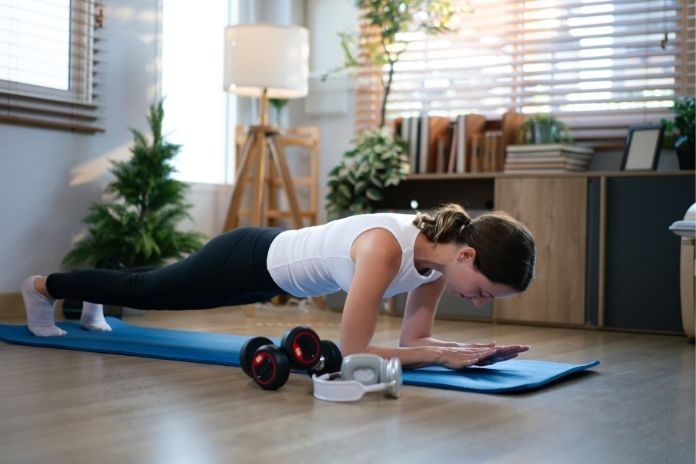
An active tension plank is not a different exercise. It is a different intention applied to the same exercise. When most people hold a standard plank, they focus primarily on not collapsing. The body is “up” and technically in position, but many of the muscles that should be working are at partial effort.
The abdomen may be slightly soft, the glutes may be relaxed, and the shoulders may be passively bearing weight rather than actively driving into the floor. Active tension changes all of that.
The concept involves creating simultaneous, deliberate muscular engagement throughout the entire kinetic chain during the hold. This includes bracing the core as if preparing to absorb a punch, squeezing the glutes to stabilize the pelvis, pushing the forearms forcefully into the ground, and pulling the elbows toward the feet without actually moving them.
The result is a whole-body isometric contraction that turns every muscle group from passenger to participant. This approach is closely aligned with what spine biomechanics researchers call abdominal bracing.
According to a 2023 study published in Medicine, abdominal bracing increases spinal stabilization by activating the deep abdominal muscles, including the internal oblique and transverse abdominis, while simultaneously elevating intra-abdominal pressure. That pressure is precisely what stiffens and protects the lumbar spine during loaded movement and isometric effort.
The difference between a passive and an active plank, then, is the difference between being in a position and owning it.
Why Long Planks Can Become Less Effective
The assumption that more time always equals more benefit breaks down when fatigue enters the equation. During a prolonged plank hold, the stabilizing muscles responsible for core activation, particularly the transverse abdominis and internal obliques, begin to fatigue. As that happens, the body compensates.
Load subtly shifts from the muscular system to the passive structures: joints, ligaments, and connective tissue. The hips may drop slightly, the lumbar spine may shift out of neutral, and the shoulders may begin to collapse inward. None of this is immediately painful, but it signals that the training stimulus has migrated away from where it was intended.
A study in the International Journal of Health Sciences and Research (2026) confirmed that plank exercises activate the transverse abdominis as the primary stabilizer of the lumbar spine, but only when form is maintained. The moment alignment breaks, the targeted muscles reduce their contribution.
Dr. Stuart McGill, PhD, a professor emeritus of spine biomechanics at the University of Waterloo and author of Low Back Disorders, has long argued that shorter holds with high intensity outperform long passive holds.
As summarized across his published research and clinical guidance, McGill’s position is that there is “no utility other than claiming a record” for plank holds that extend well beyond what the individual can sustain with genuine engagement. His protocol, repeated widely in physical therapy and performance settings, calls for sets of 10-second holds that prioritize the quality of each second rather than the accumulation of minutes.
Diminishing returns are real. Once the stabilizing muscles fatigue, the exercise increasingly trains the wrong system for the wrong purpose.
How Active Tension Changes the Exercise
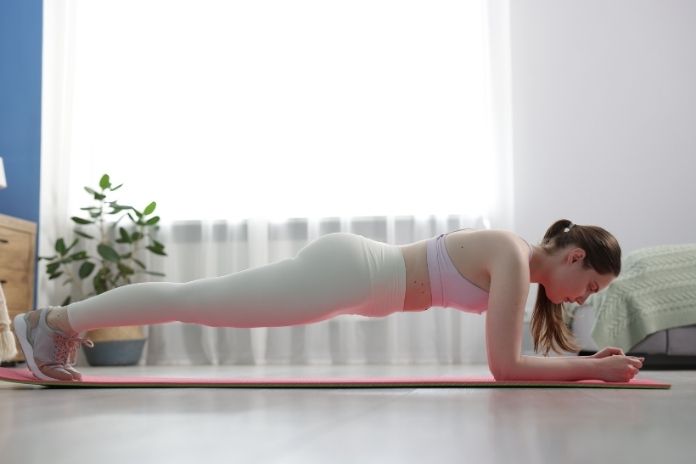
Shifting from passive to active engagement measurably changes what happens inside the body during a plank. The most significant change is increased core activation.
Research published in the Journal of Functional Morphology and Kinesiology (2024) compared activation maneuvers during core stability exercises and found that intentional engagement techniques significantly increased the relative thickness of the transverse abdominis, internal oblique, and lumbar multifidus muscles compared to passive holding. These are the deep stabilizers that matter most for spinal health and injury prevention.
Improved spinal stability follows directly from that activation. A study in PubMed demonstrated that elevated intra-abdominal pressure, which results directly from deliberate core bracing, increases the stiffness of the lumbar spine by a measurable degree, providing a natural internal support structure during loaded tasks.
When you generate active tension in a plank, you are effectively creating that same supportive pressure from the inside out. The neuromuscular benefits are also worth noting. Short, intense isometric contractions develop what researchers call neuromuscular coordination: the ability of the nervous system to recruit the right motor units at the right time.
This has direct carryover to athletic performance, lifting mechanics, and injury prevention in daily life. Shorter holds with genuine effort, done repeatedly, train the neural pathways for that precision in ways that passive endurance holds simply do not.
Signs You’re Doing a Passive (Low-Tension) Plank
The distinction between passive and active planking is not always obvious in the moment, particularly when fatigue makes reduced effort feel like sustained effort. Several reliable signs indicate a plank has drifted into low-tension territory.
Minimal abdominal engagement is the most common marker. If you can breathe deeply and comfortably with no sensation of outward abdominal pressure, the core bracing is insufficient. Relaxed glutes are another reliable indicator: the glutes should feel contracted throughout, not passive. If the hip flexors are doing all the work of keeping the pelvis in line, the glutes have checked out.
Shoulder position is also telling. When the forearms are planted, but the shoulder blades are allowing the upper back to sag between them, the upper body has gone passive. And perhaps the clearest sign of all: if you can hold the position for several minutes without it becoming genuinely difficult, the neuromuscular demand is low. A properly executed active tension plank is hard. It should feel hard.
Bret Contreras, PhD, CSCS, an exercise scientist and founder of the Glute Lab in San Diego, conducted EMG testing on plank variations and found that planks performed with intentional full-body tension, including deliberate glute engagement, showed substantially higher muscle activation than standard passive holds.
His research reinforced that “planks done properly build a foundation for all movement, from lifting weights to running”, but the “done properly” condition is non-negotiable.
How to Perform an Active Tension Plank
Set up in a standard forearm plank: elbows under shoulders, body in a straight line:
- Before timing, create full-body tension.
- Brace your core like you’re about to take a hit. Don’t suck inward; push outward to build pressure.
- Squeeze your glutes to keep your hips neutral.
- Drive your forearms into the floor to engage your upper back.
- Then imagine pulling your elbows toward your feet to fire up your lats. Hold this tight, active position for 10 to 20 seconds, then rest.
Read More: Full-Body Pilates: 6 Dynamic Moves for a Total-Body Workout
How Long Should an Active Tension Plank Last?
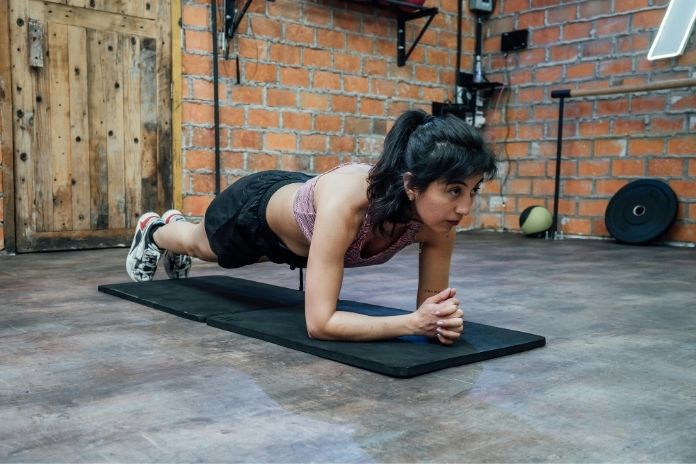
With maximum engagement applied, 10 to 30 seconds is a sensible and research-supported target range for most people. This is not a limitation of effort. It reflects the physiology of high-output isometric contraction.
When every muscle group is genuinely firing at elevated intensity, the neuromuscular system fatigues meaningfully within that window. Resting between sets, typically 20 to 40 seconds, allows partial recovery so the next hold can be executed at the same quality.
Dr. Stuart McGill’s clinical protocols advocate for a descending pyramid structure: beginning with more repetitions per set and reducing as the session progresses while keeping each hold in the 8 to 10 second range.
The Squat University, which has documented McGill’s approach extensively, notes that this framework “enhances stability without fatiguing and overworking the body” and that as the pyramid rep scheme becomes easier, the appropriate progression is more repetitions, not longer individual holds.
The practical implication: three to five sets of 15 to 20-second active tension holds, separated by rest, deliver a more meaningful training stimulus than a single two-minute passive hold where the body has long since stopped working at its productive threshold.
Benefits of Active Tension Over Long-Duration Planks
The shift from duration-focused to tension-focused planking carries several concrete advantages. More efficient core strengthening is the most immediate. Because every second of an active tension hold recruits the deep stabilizers at meaningful intensity, the workout per minute is substantially higher.
People who train with time constraints gain disproportionately from this approach. Reduced risk of lower back strain follows from better mechanics.
A prospective randomized study in Medicine (2023) found that adding abdominal bracing to spinal stability exercises improved lumbar lordosis angle, spine extensor strength, and functional outcomes in people with chronic low back pain over 24 weeks. Passive holding, without bracing, did not produce the same degree of benefit.
Improved posture support is another practical gain. The muscles trained most directly by active tension planking, including the transverse abdominis, lumbar multifidus, and internal oblique, are the same muscles responsible for maintaining upright posture during sitting, standing, and loaded movement.
Training them with intentional engagement builds the kind of endurance that carries over into real life. Better transfer to athletics and daily movement is the fourth benefit. Neuromuscular control developed through short, maximal-effort isometric holds translates to faster, more accurate muscle recruitment during dynamic tasks.
Lifting, running, and even extended sitting require the core to activate quickly and sustain output, both of which are trained directly by this method.
Read More: One-and-Done: Total-Body Workout You Can Do 2x a Week
Sample Active Tension Plank Routine
This structure is appropriate for most fitness levels. Beginners should start at the lower end of each range. Perform 3 to 5 sets of 15 to 20-second active tension holds.
Rest 20 to 40 seconds between sets. Apply the full activation sequence before the clock starts on each set. Once 5 sets of 20 seconds with full engagement feels manageable, add a set or reduce rest time rather than extending hold duration.
For frequency, two to three sessions per week is sufficient for continued adaptation, with at least one rest day between sessions to allow neuromuscular recovery. This can slot into a broader workout as a standalone finisher or as core preparation before compound lifts.
Brad Schoenfeld, PhD, CSCS, professor at Lehman College and one of the most published researchers in exercise science, has written that the core’s primary function during most activities is resisting movement rather than creating it.
His published work on core training program design, co-authored with Bret Contreras, argues that exercises should be selected based on the specific demands they place on the muscles, and that isometric anti-extension work, like the plank, when performed with genuine tension, directly addresses the anti-movement function the core performs in real life.
Who Benefits Most From This Approach
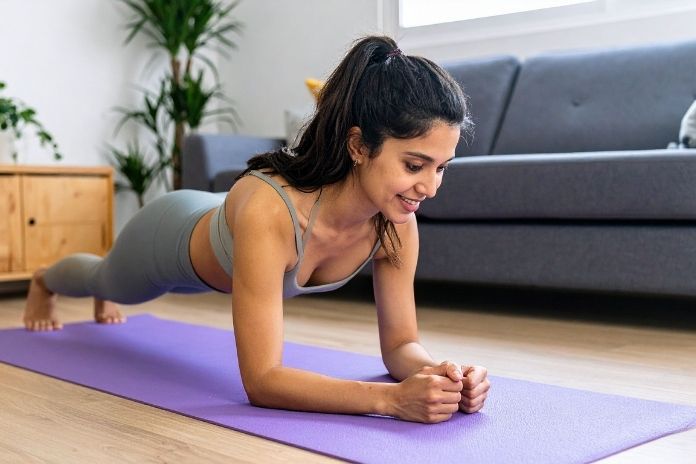
The active tension method is broadly applicable, but certain groups see the most dramatic return on this investment. Beginners learning how to engage the core properly often develop strong compensation habits early, relying on lower back extension or shoulder collapse to sustain a plank.
Short, active holds give beginners a focused window in which to practice correct engagement without the compensations that fatigue invites. People with lower back discomfort benefit because the method emphasizes bracing rather than passive loading.
A 2025 study in the Journal of Clinical Medicine confirmed that core stabilization exercises, including planks, are regularly prescribed in rehabilitation settings to improve neuromuscular control and spinal support, and that their effectiveness depends heavily on how well the individual engages during the exercise.
Busy individuals benefit from the time efficiency. Three to five sets of 20-second holds, including rest intervals, take roughly four to six minutes. That is a meaningful core training session by any standard. Athletes focused on stability and force transfer also gain from this approach because it directly targets the neuromuscular coordination that underlies explosive and reactive movement.
Common Mistakes to Avoid
Breath-holding is the most common mistake. It spikes blood pressure and disrupts core coordination, so keep your breathing steady even under tension. Another issue is over-squeezing. Active tension doesn’t mean clenching everything as hard as possible; it’s about controlled, balanced engagement.
Alignment is where most people go wrong. If your hips are too high, you lose glute activation; if they sag, your lower back takes the load. Staying neutral is non-negotiable. And finally, going back to long, passive holds out of habit defeats the purpose. Time isn’t the goal; quality is.
When Longer Planks Still Make Sense
Longer planks aren’t useless; they just have a different purpose. They matter in situations where endurance is being tested, like military or first-responder standards. They also work for advanced athletes who can maintain full-body tension without their form breaking down.
For most people, the smarter approach is balance. Use short, high-tension holds to build strength and control, and mix in occasional longer holds for endurance. The key is knowing why you’re doing each set instead of just chasing a longer timer.
Read More: Top 5 Pilates Balls for Core Strengthening and Rehabilitation
Key Takeaway
Active tension prioritizes full-body engagement and core activation over simply holding a plank longer. Shorter, high-quality planks with intentional tension may build strength more effectively than passive multi-minute holds by training the deep stabilizers, improving intra-abdominal pressure mechanics, and developing the neuromuscular coordination that translates directly to real-world movement.
The better question to ask during a plank is not “how long can I hold this?” It is “How well am I holding this?” That shift in focus, from the clock to the contraction, is where the active tension plank method produces its results.
References
- Park, J., Lee, S., & Kim, H. (2023). Effect of adding abdominal bracing to spinal stabilization exercise on lumbar lordosis angle, extensor strength, pain, and function in patients with non-specific chronic low back pain: A prospective randomized pilot study. Medicine, 102(41).
- Tsartsapakis, I., & Bagioka, I. (2024). A comparison between core stability exercises and muscle thickness using two different activation maneuvers. Journal of Functional Morphology and Kinesiology, 9(2), 70.
- Hodges, P. W. (2005). Intra-abdominal pressure increases stiffness of the lumbar spine. PubMed.
- Jung, S. W., Seong, J. Y., & Jae, S. Y. (2025). Acute effects of isometric plank exercise on 24-hour ambulatory blood pressure in young adults with prehypertension: A randomized cross-over trial. Clinical Hypertension, 31, e40.
- Krishnan, V. (2026). Plank exercises: They do train the core! International Journal of Health Sciences and Research, 16(1).
- Schoenfeld, B., & Contreras, B. (2011). Strategies for optimal core training program design. NSCA’s Performance Training Journal.
- Zemková, E. (2024). Core stability training and its role in athletic performance and injury prevention. International Journal of Environmental Research and Public Health.
- Men’s Health UK. (2025). What is the ideal plank time for core strength?
- Lea Genders Fitness. (n.d.). Plank stronger, not longer.
- Physiopedia. (n.d.). Plank exercise.
- Solan, M. (2019, November 13). Straight talk on planking. Harvard Health Publishing.
- Madbarz. (n.d.). How long should you hold the plank?
- Myprotein. (n.d.). Everything to know about plank exercises.
- Cleveland Clinic. (n.d.). Plank exercise benefits.
In this Article