















Yes, gaining muscle in a calorie deficit is possible, but it is highly dependent on the situation. It works best for beginners, people returning after time away from training, individuals with higher body fat percentages, and people who are overweight.
A 2025 review of studies published between 2019 and 2024 found that muscle maintenance or gain during caloric restriction is achievable when resistance training and high protein intake are combined. Lean, advanced athletes face much tighter limitations.
- Gaining muscle in a calorie deficit is possible, especially for beginners, overweight individuals, and people returning to training, when resistance training and high protein intake are combined.
- Research supports moderate calorie deficits of about 300 to 500 calories below maintenance, since larger deficits are much more likely to cause muscle loss.
- High protein intake, progressive strength training, and realistic expectations are the key factors that determine whether body recomposition will work successfully.
Read More: Intermittent Fasting vs Calorie Deficit: Which One Actually Drives Fat Loss?
Can You Gain Muscle in a Calorie Deficit? What the Research Actually Shows

Building muscle in a calorie deficit has traditionally been considered impossible because muscle gain is usually linked to eating in a calorie surplus. Fitness advice has long separated “bulking” and “cutting” into different phases. But newer research has complicated that idea.
Studies now show that some people can lose fat and gain muscle at the same time through a process called body recomposition.
This does not mean everyone can easily build muscle while dieting. Body recomposition is still metabolically challenging because fat loss and muscle growth involve competing processes in the body.
Still, under the right conditions, muscle gain and calorie deficit strategies can work surprisingly well. Research now clearly identifies who is most likely to succeed and what factors matter most.
The Science of Body Recomposition — Why It Is Possible at All
Understanding body recomposition starts with understanding where the energy for muscle building comes from.
Muscle protein synthesis, often called MPS, is the process of building new muscle tissue. It requires amino acids from protein and a strong mechanical training stimulus from resistance exercise. Contrary to popular belief, it does not strictly require a calorie surplus.
When you are in a calorie deficit, the body can partially compensate for lower food energy intake by mobilizing stored body fat. This is the main reason body recomposition calorie deficit strategies are physiologically possible. Stored fat can help provide the energy needed for muscle-building processes.
Muscle mass changes based on the balance between muscle protein synthesis and muscle protein breakdown. A calorie deficit increases the risk of breakdown, but it does not automatically cause muscle loss if protein intake and training quality remain high enough.
The amount of stored body fat matters greatly. People with higher body fat percentages have a larger energy reserve available to support muscle building during fat loss. That is why recomposition tends to work better in overweight individuals than in already lean athletes.
Who Can Build Muscle in a Calorie Deficit and Who Cannot

Not everyone has the same ability to gain muscle and lose fat at the same time. Research consistently shows that recomposition potential depends heavily on training status and body fat levels.
The groups most likely to succeed include:
Beginners
Beginners have the highest recomposition potential. When someone starts resistance training for the first time, the body responds rapidly to the new stimulus. Muscle protein synthesis rises sharply, even in a calorie deficit. Because the training is so new, muscle growth can happen even without extra calories.
People Returning After a Training Break
People who previously trained and lost muscle often regain it faster than they originally built it. This is commonly referred to as muscle memory. Myonuclear retention allows the body to rebuild lost muscle tissue efficiently, even during caloric restriction.
People With Higher Body Fat Percentages
People carrying more body fat have more stored energy available to support muscle-building processes during a deficit. Their bodies can rely more heavily on fat stores to cover energy demands while maintaining muscle protein synthesis.
Overweight Individuals Starting Resistance Training
This group combines two major advantages: beginner status and higher body fat availability. Research shows this combination creates one of the strongest environments for body recomposition.
For lean, highly trained individuals, the situation is very different. Once someone is near their genetic ceiling for muscularity, gaining muscle in a deficit becomes extremely difficult. In these cases, maintenance calories and very high protein intake are often more realistic than an actual calorie deficit.
Read More: Low Impact Workouts That Burn Calories: 10 Exercises That Torch Fat
How Large Should the Deficit Be?
Deficit size is one of the clearest findings in recomposition research.
The Murphy and Koehler 2022 analysis found a linear relationship between the size of the calorie deficit and muscle mass loss. Deficits smaller than 500 calories below maintenance still generally allowed some subjects to gain fat-free mass. Larger deficits were much more likely to cause muscle loss.
The practical tip is easy. A moderate deficit of about 300 to 500 calories below maintenance seems to be the best range for calorie-deficient muscle building.
This range is large enough to support meaningful fat loss while still preserving enough energy availability to support muscle protein synthesis.
Aggressive deficits larger than 750 to 1000 calories per day are much more likely to lead to muscle loss. In these situations, muscle protein breakdown tends to exceed muscle protein synthesis because the body lacks enough available energy to maintain muscle tissue efficiently.
The Protein Requirement — the Most Important Variable
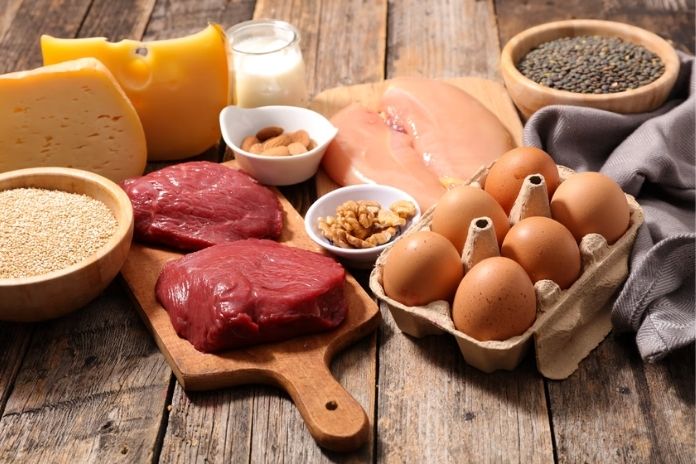
Protein intake and muscle deficit research are remarkably consistent. High protein intake is the single most important nutritional factor for preserving or building muscle during caloric restriction.
Studies support a daily intake of approximately 1.6 to 2.4 grams of protein per kilogram of body weight for people trying to maintain or gain muscle in a deficit.
For advanced trainees using aggressive cuts, some research suggests protein intake may need to rise as high as 3.0 g/kg to reduce muscle loss risk.
Meal distribution also matters. Around 0.4g of protein per kilogram of body weight per meal seems enough to maximize muscle protein synthesis during each eating occasion. Spreading protein intake across three to four meals during the day supports repeated stimulation of MPS rather than concentrating protein into one or two large meals.
High-protein, calorie-deficient muscle strategies consistently outperform lower-protein approaches for body recomposition.
Training Requirements for Recomposition — What Actually Drives It
Protein and calorie control alone are not enough. Resistance training is the actual driver of muscle retention and growth during a deficit.
To build muscle in a deficit, training must provide a strong enough signal for the body to keep investing resources into muscle tissue.
The most important training principles include:
Progressive Overload
Muscles need increasing challenges over time to continue adapting. Simply maintaining the same weights indefinitely does not create a strong enough signal for continued muscle growth.
Proximity to Failure
Sets performed close to muscular failure stimulate the strongest muscle protein synthesis response, even during calorie restriction.
Compound Movements
Exercises that train multiple muscle groups at once provide the most efficient stimulus during a deficit, when recovery resources are more limited.
Moderate Volume
Research generally supports about 10 to 20 sets per muscle group per week for body recomposition. Extremely high training volume during a deficit can impair recovery and increase the risk of muscle loss.
Strength training calorie deficit approaches work best when recovery demands remain manageable.
What to Expect — Realistic Outcomes and Timeline
Realistic expectations are important because body recomposition is usually slower than traditional muscle gain in a calorie surplus. It varies if you are a beginner or a pro.
The value of recomposition is not just muscle growth itself. It is the combination of muscle retention or gain alongside fat loss that improves overall body composition.
Many people notice their body fat percentage decreases and muscle definition improves, even when the scale weight changes very little.
The scale is often a poor way to measure recomposition progress. Strength improvements, body measurements, clothing fit, and body fat percentage trends provide far better indicators.
Read More: 7 Flavor-Packed Spices That Won’t Add Calories
Conclusion
Can you gain muscle in a calorie deficit? The research says yes, but only under specific conditions. Beginners, people returning to training, and individuals with higher body fat levels have the strongest body recomposition potential.
The evidence also clearly supports moderate deficits of 300 to 500 calories, high protein intake of 1.6 to 2.4 g/kg daily, and progressive resistance training as the key requirements. When these conditions are met, building muscle in a calorie deficit is both realistic and one of the most effective ways to improve body composition and overall health.
References
- Wu, J. H. Y., Micha, R., Imamura, F., Pan, A., Biggs, M. L., Ajaz, O., Djoussé, L., Hu, F. B., & Mozaffarian, D. (2012). Omega-3 fatty acids and incident type 2 diabetes: A systematic review and meta-analysis. The American Journal of Clinical Nutrition, 95(6), 1437–1449.
- Forouhi, N. G., Misra, A., Mohan, V., Taylor, R., & Yancy, W. (2018). Dietary and nutritional approaches for prevention and management of type 2 diabetes. BMJ, 361, k2234.
- Lima, J. G., Krause, M., Gerchman, F., & Leitão, C. B. (2022). Lifestyle interventions and diabetes prevention: Current evidence and future directions. Diabetology & Metabolic Syndrome, 14(1), 48.
- Ley, S. H., Hamdy, O., Mohan, V., & Hu, F. B. (2014). Prevention and management of type 2 diabetes: Dietary components and nutritional strategies. The Lancet, 383(9933), 1999–2007.
In this Article