





















Saw palmetto enlarged prostate treatments are widely promoted as a natural way to ease urinary symptoms. Many men take it hoping it will reduce frequent urination, improve urine flow, and shrink the prostate without needing prescription medication. It is one of the most commonly used supplements for benign prostatic hyperplasia, or BPH, across the world.
This article will guide you through the process step by step. First, we will explain what an enlarged prostate is and why it causes symptoms. Then we will look at why saw palmetto was believed to work, followed by what the strongest clinical trials actually found.
We will also address common misunderstandings about PSA testing, review safety in a balanced way, and explain what treatments are proven to help. This will help you understand where saw palmetto stands today based on evidence.
- Saw palmetto is widely used for enlarged prostate symptoms, but clinical trials show no improvement in urinary symptoms or prostate health.
- Early studies suggested benefits due to its effect on DHT, but larger and better-designed research consistently found no meaningful difference compared to a placebo.
- While generally safe, saw palmetto is not an effective treatment for BPH.
Read More: Prostate Massage: Benefits, Risks, and How It’s Done (Medically Explained)
What Is An Enlarged Prostate—and Why Do Men Get Urinary Symptoms?
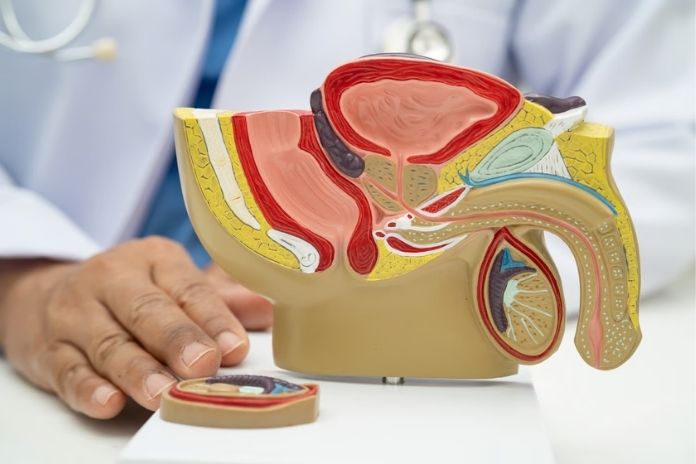
An enlarged prostate, or BPH, is a non-cancerous growth of the prostate gland. It is extremely common as men age and is considered part of normal aging for many. The main biological driver is a hormone called dihydrotestosterone, or DHT. This hormone is produced when testosterone is converted by an enzyme called 5-alpha-reductase inside the prostate.
DHT is more potent than testosterone in prostate tissue and stimulates cell growth over time, leading to enlargement. As the prostate grows, it sits just below the bladder and surrounds the urethra. When it enlarges, it can squeeze or partially block the urethra. It can also affect how the bladder muscle works.
Together, these changes lead to lower urinary tract symptoms, also called LUTS. Common symptoms include:
- Difficulty starting urination
- A weak, slow, or interrupted stream
- Dribbling at the end of urination
- Frequent urination, especially at night
- Sudden urgency to urinate
- A feeling that the bladder has not fully emptied
These symptoms can vary in severity. Some men have mild symptoms, while others find them significantly disruptive to sleep and daily life. BPH is very common. Around 25 percent of men in their 50s have symptoms. This rises to about one third in their 60s and up to half or more in older age groups.
By age 85, nearly all men exhibit some enlargement when examining prostate tissue under a microscope. A key point is that LUTS are not specific to BPH. Similar symptoms can be caused by urinary tract infections, bladder dysfunction, kidney issues, or prostate cancer.
Because of this overlap, it is important not to assume the cause and to seek medical evaluation before starting any treatment.
Why Saw Palmetto Was Thought to Work — The Mechanism and the Early Evidence
Saw palmetto is a supplement made from the berries of the plant Serenoa repens. It has been used for many years as a herbal approach to urinary symptoms linked to prostate enlargement. The reason it gained attention is that it appears to act on the same biological pathway as some prescription medications.
Laboratory studies suggest that saw palmetto:
- Inhibits the enzyme 5-alpha-reductase
- Reduces levels of DHT in prostate tissue
- Has anti-inflammatory effects
- May influence androgen receptors
This approach is similar in concept to medications like finasteride, which are proven to reduce prostate size by lowering DHT levels. Because the mechanism seemed logical, clinical trials were conducted. Early studies appeared promising.
A 1998 review published in the Journal of the American Medical Association analyzed multiple trials and found that saw palmetto improved urinary symptoms and urine flow. The results seemed comparable to prescription medications, with fewer side effects.
These findings led to rapid adoption. In some countries, saw palmetto became one of the most commonly used treatments for BPH. However, there was a major limitation. Many of these early studies were small, short-term, and did not use strict methods such as proper blinding or standardized outcome measures. This increased the risk of bias and overestimation of benefits.
What the Better Evidence Found — The NIH Trials and the Cochrane Review
As interest grew, researchers conducted larger and more rigorous studies to test whether saw palmetto truly works. The first major turning point came with a 2006 trial published in the New England Journal of Medicine.
This study included 225 men with moderate BPH symptoms and followed them for one year. Participants were randomly assigned to receive either saw palmetto at 320 mg per day or a placebo.
The results showed no meaningful difference between the two groups. Saw palmetto did not improve symptom scores, urinary flow rate, prostate size, or PSA levels. Importantly, the study was designed to detect even modest improvements, and none were found.
To test whether higher doses might be more effective, the CAMUS trial was conducted and published in 2011 in the Journal of the American Medical Association. This study included 369 men and lasted 18 months. It used increasing doses of saw palmetto, up to 960 mg per day, which is three times the standard dose.
Even at these higher doses, there was still no improvement compared to placebo. Symptoms, urine flow, and other clinical measures remained unchanged. The most comprehensive analysis comes from a review by the Cochrane Collaboration. This review included 27 randomized controlled trials with a total of 4,656 participants.
The conclusion was consistent and clear. Saw palmetto provides little or no benefit for improving urinary symptoms or quality of life in men with BPH. The American Academy of Family Physicians reviewed this evidence and assigned it its highest level of confidence. This conclusion indicates strong, consistent findings across multiple high-quality studies.
This is the most important takeaway. Early positive results were not confirmed by subsequent studies.
Read More: Prostate Cancer Awareness Month: History, Progress, and Challenges
The Hexane Extract Argument — Does It Change the Answer?
Some supporters of saw palmetto argue that the negative results are due to differences in how the supplement is prepared. They suggest that specific extracts, especially hexane extracts such as Permixon, are more effective. Researchers have directly tested this claim.
The 2023 Cochrane review compared studies using hexane extracts with those using other types of preparations. It found no meaningful difference in outcomes between them. The National Center for Complementary and Integrative Health also states that the type of extract does not change the overall conclusion.
While some smaller studies have suggested benefits with certain formulations, these studies tend to be less rigorous. When all evidence is considered together, extract type does not meaningfully change effectiveness.
The PSA Question — And Why the Common Warning Is Wrong
A common concern is that saw palmetto may lower PSA levels and make it harder to detect prostate cancer. This concern is based on confusion with medications like finasteride, which are known to reduce PSA levels by about 50 percent.
Saw palmetto does not have this effect. The CAMUS trial specifically measured PSA levels and found no significant change, even at high doses. The National Center for Complementary and Integrative Health confirms that saw palmetto does not appear to affect PSA readings. This means it does not interfere with prostate cancer screening.
Safety — What’s Documented, What’s Theoretical, and What to Tell Your Doctor

What The Trials Show—Mostly Well-Tolerated
Saw palmetto is generally considered safe for most men based on clinical trial data. Side effects are usually mild and may include:
- Nausea
- Abdominal discomfort
- Diarrhea
- Headache
- Fatigue
In large studies, serious side effects occurred at similar rates in the saw palmetto and placebo groups. Long-term studies, including those lasting up to three years, have not shown major safety concerns. Overall, it has a favorable safety profile.
The Bleeding And Interaction Concerns — Calibrated Correctly
Earlier case reports raised concerns about bleeding risk, including during surgery. However, later randomized trials that specifically examined this issue did not find a significant increase in bleeding.
Recent reviews suggest that saw palmetto is low risk for surgical bleeding. Additionally, there is a chance that it will interact with blood thinners like warfarin. This concern is based mainly on theoretical mechanisms and limited reports rather than strong clinical evidence.
The practical tip is:
- Inform your doctor if you are taking saw palmetto
- Mention it if you are on blood thinners
- Tell your surgeon before any procedure
These are standard precautions and not reasons for alarm.
What Actually Works for BPH — and When to See a Doctor
Strong evidence supports several treatments for BPH. Alpha-blockers such as tamsulosin and alfuzosin work by relaxing the muscles in the prostate and bladder neck. This helps improve urine flow and reduces symptoms, often within days to weeks.
5-alpha reductase inhibitors such as finasteride and dutasteride reduce DHT levels and gradually shrink the prostate. These medications are especially helpful in men with larger prostates but take several months to show full benefit.
Combination therapy is often used when both symptom severity and prostate size are significant. For more severe cases, surgical options are available. The most important step is to seek medical evaluation if you have urinary symptoms. These symptoms may have different causes, and a proper diagnosis ensures appropriate treatment.
Read More: The Importance of Regular Check-ups: Men’s Health Screening Guide
Conclusion
Saw palmetto became popular because its mechanism made sense, and early studies suggested it might help. It also appeared to be a safe, natural alternative to medication. However, larger and more reliable studies have shown that it does not significantly improve symptoms of an enlarged prostate.
While it is generally safe, it is not an effective treatment for BPH. Men experiencing urinary symptoms should consult a doctor and explore treatments backed by robust clinical evidence.
References
- Barry, M. J., Meleth, S., Lee, J. Y., Kreder, K. J., Avins, A. L., Nickel, J. C., Roehrborn, C. G., Crawford, E. D., Foster, H. E., Kaplan, S. A., McCullough, A. R., & Andriole, G. L. (2011). Effect of increasing doses of saw palmetto extract on lower urinary tract symptoms: A randomized trial. Journal of the American Medical Association, 306(12), 1344–1351.
- Kane, C. J. (2006). Saw palmetto for benign prostatic hyperplasia.
- Kumar, V., et al. (2009). A prospective randomized study comparing alfuzosin and tamsulosin in the management of patients suffering from acute urinary retention caused by benign prostatic hyperplasia.
- MacDonald, R., Tacklind, J., Rutks, I., & Wilt, T. J. (2023). Serenoa repens for the treatment of lower urinary tract symptoms due to benign prostatic enlargement: An updated Cochrane review. Cochrane Database of Systematic Reviews.
- McVary, K. T. (2021). Benign prostatic hyperplasia. In StatPearls. StatPearls Publishing.
- National Center for Complementary and Integrative Health. (n.d.). Saw palmetto. U.S. Department of Health and Human Services.
- Tacklind, J., MacDonald, R., Rutks, I., Stanke, J. U., & Wilt, T. J. (2023). Serenoa repens for benign prostatic hyperplasia. Cochrane Database of Systematic Reviews.
- Wilt, T. J., Ishani, A., Stark, G., MacDonald, R., Mulrow, C., & Lau, J. (1998). Saw palmetto extracts for treatment of benign prostatic hyperplasia: A systematic review. Journal of the American Medical Association, 280(18), 1604–1609.
In this Article