

















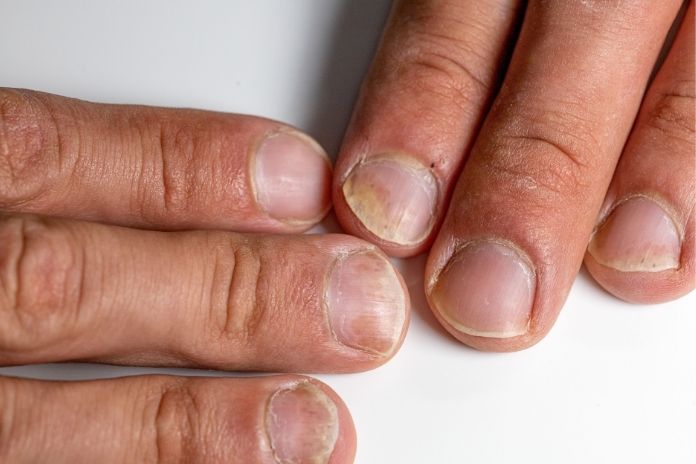
Nails are not only an aesthetic feature of the body; they are also the biological records. The use of nails as diagnostic aids began as far back as Hippocrates, who made the first description of nail clubbing more than 2,500 years ago. Nails grow at an average rate of about 3 mm per month, which implies that most of the abnormalities seen now happened weeks or even months ago inside the body.
Most of the nail problems are harmless. Aging, minor injuries, and the effects of dry air constitute the vast majority. Some nail abnormalities, however, are different because they persist, are puzzling, or are changing. They can even be the only sign of diseases such as lung cancer, liver failure, melanoma, and iron deficiency.
In this article, we will focus on important nail changes. Each nail abnormality will be discussed in terms of its significance, origin, and, especially, its urgency.
- Nails act as biological records. While most changes are harmless, some can signal serious conditions like subungual melanoma, liver disease, or iron deficiency.
- The key is urgency: new dark streaks, unexplained clubbing, or persistent changes need prompt evaluation, while common findings like ridges or white spots are usually harmless.
- Nails grow slowly, so visible changes today often reflect past health events—giving you a valuable window to catch and act on problems early.
How to Read This Guide — The Urgency Framework
Before diving into individual nail signs, it’s important to understand one key principle: not all nail changes carry the same level of risk. Most articles present them as a flat list, but clinically, there is a clear urgency hierarchy that determines what needs immediate attention versus what can be safely observed.
At the highest level are nail changes that need prompt attention, ideally within days to a week. These include a new dark streak with suspicious features or newly formed nail clubbing in an adult without a prior history of cardiopulmonary disease. These signs are uncommon but carry a higher likelihood of serious underlying pathology, which is why early evaluation matters.
The second category includes findings that need a scheduled GP visit. These are not emergencies, but they do require investigation. Examples include newly developed white nails linked to systemic disease, spoon-shaped nails without a known iron deficiency, or Beau’s lines appearing without any clear preceding illness.
Finally, some changes fall into the monitor-at-home category. These are extremely common and usually benign. Vertical ridges, white spots from minor trauma, or brittle nails during dry weather. These only become clinically relevant if they are new, rapidly worsening, or accompanied by other symptoms.
Read More: What Your Fingernails Reveal About Your Health: 11 Key Indicators
Dark Streak Under the Nail — The One That Needs Urgent Attention
A dark vertical streak, known as longitudinal melanonychia, runs from the base to the tip of the nail and is the single most important nail finding to evaluate promptly. While many such streaks are benign, particularly in people with darker skin tones, a subset represents subungual melanoma, a rare but potentially aggressive cancer arising under the nail.
What makes subungual melanoma particularly dangerous is its tendency to be missed or misdiagnosed. It is frequently mistaken for a bruise, fungal infection, or harmless pigmentation, leading to delays in diagnosis that can significantly worsen outcomes. Although it accounts for only a small percentage of all melanomas, it represents a disproportionately higher share in people of African, Asian, and Native American descent.
An important detail often overlooked is that not all cases are dark. Approximately 15-33% of subungual melanomas are amelanotic, meaning they lack pigment entirely. Instead of a black or brown band, they may present as a pink or reddish streak, nail thickening, or even progressive nail destruction. Such variability makes relying solely on “dark color” misleading.
The ABCDEF Rule—How Dermatologists Assess A Dark Streak
Dermatologists evaluate nail streaks using the ABCDEF framework, which helps distinguish benign pigmentation from suspicious changes. Age and ancestry provide context, as risk increases in certain populations and age groups.
The width of the band is important, as bands wider than 3 mm or occupying a large portion of the nail are more concerning. Change over time is a critical factor; any streak that is widening, darkening, or evolving should raise suspicion.
The digit involved also plays a significant role, as malignant cases more commonly affect the thumb and index finger. Hutchinson’s sign, which is when pigment spreads from the nail to the skin around it, is one of the most important warning signs. This differs from pseudo-Hutchinson’s sign, where pigment is simply visible through the cuticle (a benign finding, especially in darker skin tones).
Family history of melanoma further increases concern.
Urgency: Any new or changing streak in an adult should be considered an urgent need to visit a dermatologist, even if it appears subtle.
Read More: How to Remove White Spots on Nails
Clubbing—The Slowest Sign With the Most Serious Associations
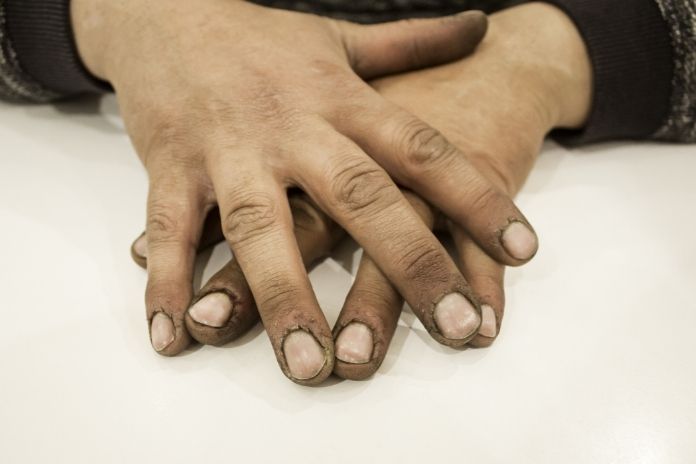
Nail clubbing is a structural change where the fingertips enlarge, and the nails curve downward, creating a bulbous, rounded appearance. Unlike many nail changes, clubbing develops gradually over weeks, months, or even years.
A simple clinical check is the Schamroth window test. When two corresponding fingernails are pressed together, a small diamond-shaped gap is normally visible between them. In clubbing, this gap disappears due to changes in the soft tissue beneath the nail.
The underlying mechanism is more complex than just “low oxygen levels.” In reality, it involves megakaryocytes bypassing the normal filtration system of the lungs and releasing growth factors such as PDGF and VEGF in the distal digits. These signals stimulate connective tissue and vascular proliferation, leading to the characteristic enlargement of the fingertips.
In adults with newly developed, unexplained clubbing, lung malignancy is the most common underlying cause, accounting for approximately 90% of cases. While clubbing itself is present in only a minority of lung cancer patients, its appearance in someone without a prior history of lung or heart disease is a strong signal that should not be ignored.
Other causes include chronic lung diseases like pulmonary fibrosis, infections such as endocarditis, and gastrointestinal conditions like inflammatory bowel disease and liver cirrhosis.
Urgency: New clubbing in an adult warrants prompt medical evaluation, typically including chest imaging.
Beau’s Lines — The Nail’s Record of Past Illness
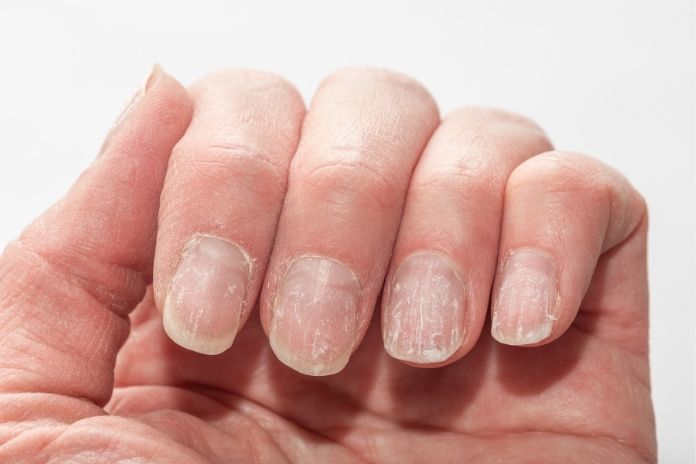
Beau’s lines are horizontal grooves that run across the nail plate, rather than along its length. They form when the nail matrix, the area responsible for nail growth, temporarily slows or stops due to systemic stress.
Since nails grow at a predictable rate, Beau’s lines act almost like a timeline. A groove located midway along the nail typically reflects an event that occurred roughly three months earlier. This makes them uniquely useful in retrospectively identifying physiological stress.
Common triggers include severe febrile illnesses, uncontrolled diabetes, chemotherapy, significant psychological stress, and conditions like Raynaud’s disease. A more recent and relevant addition is COVID-19, with emerging evidence showing Beau’s lines can appear 1–4 months after severe infection.
Urgency: If Beau’s lines follow a known illness, they are generally less concerning. If they appear without any clear trigger, a GP evaluation is appropriate to rule out underlying causes.
Terry’s Nails—When White Isn’t Nothing
Terry’s nails have a striking appearance: most of the nail looks white or opaque, with only a narrow band of pink or reddish color at the tip. This pattern reflects changes in the blood vessels beneath the nail rather than the nail itself.
Terry’s nails are strongly linked with systemic disease, particularly liver cirrhosis, where they may be present in a significant proportion of patients. They are also linked to congestive heart failure and type 2 diabetes. However, they can occasionally occur with aging, which makes interpretation dependent on the broader clinical context.
Differentiating Terry’s nails from other causes of pale nails is important. Anemia tends to produce a uniform pale pink appearance rather than a stark white nail with a defined band. Residual nail polish or cosmetic damage usually appears patchy and uneven rather than smooth and consistent.
Urgency: When this pattern appears in someone without a known underlying condition, it should prompt a GP visit for systemic evaluation.
Spoon Nails (Koilonychia)—Usually Iron Defficiency, Sometimes More
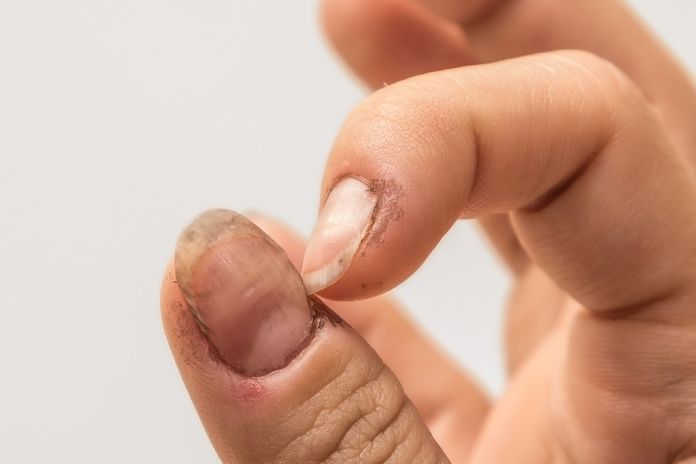
“Koilonychia” refers to nails that curve upward at the edges, creating a concave surface that can resemble a spoon. This shape develops due to structural changes in the nail plate, most commonly driven by iron deficiency.
Iron plays a key role in maintaining the integrity of the nail matrix and plate. When levels are low, the nail becomes thinner and more prone to deformation, eventually taking on a concave shape.
While iron deficiency anemia is the most common cause, the opposite condition, hemochromatosis, where the body absorbs too much iron, can also produce similar changes, though less common. In infants and young children, spoon nails may appear as a normal developmental variant and typically resolve without intervention.
Urgency: In adults, especially those without a known history of iron deficiency, spoon-shaped nails should prompt blood tests, including a full blood count and iron studies.
Read More: Health Tips for Stronger Nails
Nail Pitting, Onycholysis, and Yellow Nails — Three Signs That Point to Specific Conditions
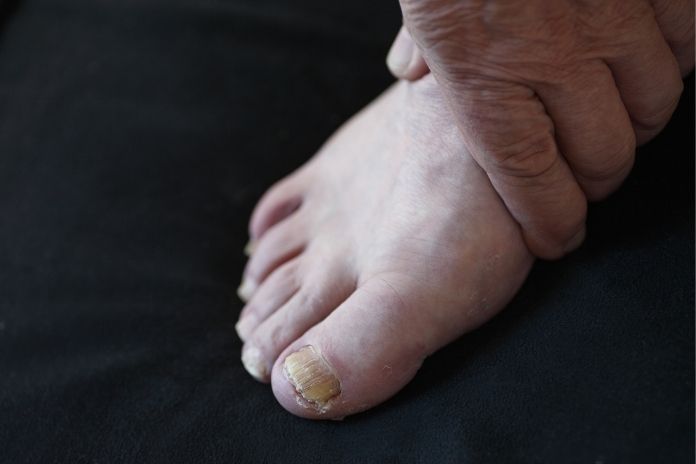
These three nail findings are less about general health signals and more about pointing toward specific underlying conditions, particularly dermatological or endocrine disorders.
Nail Pitting And Onycholysis—The Psoriasis Connection
Nail pitting appears as small, sharply defined depressions scattered across the nail surface, giving it an “ice-pick” texture. It is strongly associated with psoriasis and may even precede visible skin lesions. It can also occur in conditions like alopecia areata and reactive arthritis, but psoriasis remains the most common link.
Onycholysis is a condition where the nail separates from the underlying nail bed, starting at the tip, and has a broader differential. It is frequently associated with psoriasis but can also occur in hyperthyroidism, fungal infections, and certain medications, particularly those that increase photosensitivity.
When multiple nails are affected without an obvious external cause, it is a signal to investigate systemic or dermatological conditions rather than attributing it to trauma.
Yellow Nails
Continuous yellow nails are most commonly caused by fungal infection, which is widespread and generally treatable. However, when yellowing persists despite treatment and is accompanied by slow nail growth and absent cuticles, it may indicate Yellow Nail Syndrome, a rare condition associated with lymphatic dysfunction and chronic respiratory diseases.
A particularly important clinical clue is the combination of yellow nails with respiratory symptoms such as chronic cough, which should prompt further investigation.
What’s Almost Always Nothing
One of the major gaps in most nail health guides is the lack of reassurance around what is normal. Without such information, it’s easy to overthink harmless changes.
Vertical ridges running from the base to the tip of the nail are almost always a normal part of aging, similar to wrinkles in the skin. They do not indicate deficiency or disease unless they appear suddenly or change dramatically.
White spots, often thought to reflect calcium or zinc deficiency, are in fact usually the result of minor trauma to the nail matrix. The injury may have occurred weeks earlier, making the connection simple to miss.
Mild brittleness, especially during colder months, is typically due to environmental dryness rather than an internal health issue. Similarly, subtle horizontal lines that are evenly distributed across all nails often reflect normal variation rather than systemic disease.
The key principle is consistency and context. Harmless changes tend to be stable, symmetrical, and understandable. Concerning changes are new, evolving, or unexplained.
Conclusion
Most nail changes are benign. But the ones that matter follow a pattern; they are new, persistent, changing, or unexplained.
A widening dark streak, new-onset clubbing in an adult, unexplained white nails, or spoon-shaped nails without a known cause are all signals worth acting on.
Nails grow slowly, which means they offer something rare in medicine: a visible timeline. What you notice today may reflect a process that began weeks or months ago. That delay isn’t a disadvantage; it’s a chance to recognize early warning signs and take action while it still matters.
References
- Cheslock, M., et al. (2022). Yellow nail syndrome. In StatPearls. StatPearls Publishing. Retrieved from
- Gollins, C. E., & de Berker, D. (2021). Nails in systemic disease. Clinical Medicine, 21(3), 166–169.
- Rowe, E., & Zubek, A. E. (2025). Nail disorders as clues to systemic disease. Clinical Dermatology, 43(2), 191–200.
- Star Health. (n.d.). Beau’s lines: Symptoms, causes, and treatment. Retrieved from
- Patel, N. (2012). Digital clubbing. Lung India, 29(4), 354–362. Retrieved from
- Health.com. (2024). How fast do nails grow? Retrieved from
In this Article