



















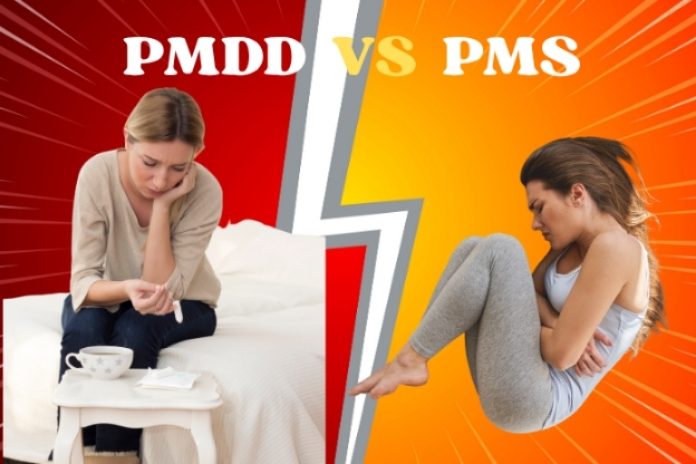
Around 75–90% of people who menstruate experience PMS symptoms, such as bloating, fatigue, and mood changes before their period. Most manage these symptoms without major disruption. For a smaller group, about 3–8%, the experience is far more severe. This is where the discussion of PMDD vs PMS and the difference between PMDD and PMS begins.
The difference is not just intensity. It lies in functional impact. PMS may be uncomfortable, but premenstrual dysphoric disorder (PMDD) can interfere with work, relationships, and daily activities.
Despite this, PMDD diagnosis often takes years. The condition is frequently misidentified as depression or generalized anxiety or dismissed as normal hormonal changes, which delays appropriate treatment.
It is also important to recognize that PMDD can be associated with suicidal thoughts. In the United States, anyone experiencing these thoughts can call or text 988 (Suicide and Crisis Lifeline) at any time. You do not have to be in an immediate crisis to reach out.
This article explains the science behind PMDD, how doctors diagnose it, and which PMDD treatment options are supported by evidence.
- PMDD (premenstrual dysphoric disorder) is a diagnosable (DSM-5) depressive disorder, not just “bad PMS,” affecting about 3 to 8% of menstruating individuals; it causes cyclical mood symptoms so severe that they stop you from functioning every single month.
- The clearest difference between PMDD and PMS is functional impairment: PMS is uncomfortable; PMDD meets clinical criteria for disrupting daily life, relationships, work, and parenting every cycle.
- Tracking symptoms for two cycles using tools like the DRSP helps confirm a diagnosis and effective and evidence-based treatment exists: SSRIs (including luteal-phase dosing), hormonal therapy, and CBT to manage PMDD symptoms.

What Are PMS and PMDD? A Quick Overview

PMS (premenstrual syndrome) refers to a group of emotional and physical symptoms that appear during the luteal phase (the second half of the menstrual cycle after ovulation, typically days 14 to 28). Typical PMS symptoms include:
- Bloating
- Breast tenderness
- Fatigue
- Mild irritability
- Headaches
Symptoms improve once menstruation begins.
Now consider PMDD (premenstrual dysphoric disorder).
PMDD follows the same timing, same luteal phase, and same resolution when the period arrives, but the impact is categorically different. It is not a more intense version of PMS. It is a distinct psychiatric diagnosis in the DSM-5 (Diagnostic and Statistical Manual of Mental Disorders, 5th edition), classified under depressive disorders and classified as a functional impairment.
PMS vs PMDD Symptoms: Side-by-Side Comparison
Understand the Difference
PMS vs PMDD: Side-by-Side
| Feature | PMS | PMDD |
|---|---|---|
| Timing | Luteal phase (days 14–28) | Luteal phase (days 14–28) |
| Resolves at | Period onset | Period onset |
| Mood | Mild irritability, moodiness | Rage, severe depression, hopelessness |
| Functional impact | Uncomfortable but manageable | Stops daily functioning (DSM-5) |
| Diagnosis | No formal criteria | 5+ symptoms tracked over 2 cycles |
| Treatment | Lifestyle, OTC options | SSRIs, hormonal therapy, CBT |
Emotional and Mood Symptoms
PMS often causes mild emotional shifts. You may feel irritable or slightly overwhelmed. But you still recognize your emotional baseline. PMDD mood symptoms cross into psychiatric territory.
DSM-5 PMDD criteria require at least one core mood symptom, such as:
- Severe irritability
- Marked anxiety or tension
- Depressed mood or hopelessness
- Affective lability (rapid mood swings)
Many people describe PMDD episodes as feeling like a different person takes over during the luteal phase.
As Dr. Tory Eisenlohr-Moul, assistant professor of psychiatry and psychology at the University of Illinois at Chicago (UIC) and associate director of translational research in women’s mental health and postdoctoral fellow in pathophysiology of reproductive mood disorders and suicide for women’s mood disorders, explains, “PMDD is not simply bad PMS but a cyclical mood disorder tied to hormone sensitivity.” Her research highlights how hormonal changes can trigger severe mood shifts in susceptible individuals.
Imagine your brain’s emotional volume knob turning up suddenly every month. That’s how many patients describe it.
Physical Symptoms
Physical PMS symptoms and PMDD symptoms look almost identical. Both conditions can produce:
- Bloating
- Headaches
- Fatigue
- Appetite changes
- Breast tenderness
But physical symptoms alone cannot distinguish PMDD from PMS. The difference lies in the emotional intensity and life disruption accompanying them.
The One Difference That Matters Most: Functional Impairment
The clearest difference between PMDD and PMS involves daily functioning. PMS feels uncomfortable but manageable. PMDD interferes with normal life. DSM-5 criteria require symptoms to cause clinically significant distress or impairment in work, relationships, or social activities.
Ask yourself a simple question: Do my symptoms stop me from living my normal life every month, every single cycle? If the answer is yes, that question, answered honestly, is the PMDD threshold.
Why Do Some Women Get PMDD and Not Just PMS?

Most people assume PMDD comes from abnormal hormone levels. That assumption turns out to be wrong.
Studies show that estrogen and progesterone levels appear normal in people with PMDD.
The difference lies in how the brain reacts to hormonal shifts. A key player is allopregnanolone (a neurosteroid produced from progesterone). In most people, this compound activates GABA receptors (brain receptors that regulate calm and relaxation). That interaction creates a soothing effect.
In PMDD, the brain reacts differently. Instead of calming the nervous system, the same chemical can trigger anxiety, irritability, and emotional instability. Research also shows serotonin levels drop more sharply during the luteal phase in individuals with PMDD. This explains why SSRIs (selective serotonin reuptake inhibitors, antidepressant medications) work so effectively for PMDD treatment.
Studies show that central serotonin function fluctuates cyclically, with increased serotonin transporter (SERT) density and reduced extracellular serotonin in the late luteal phase correlating with symptom severity in PMDD. This serotonergic dysregulation is why SSRIs (often given only in the luteal phase) are among the first‑line treatments for PMDD.
Risk factors include a personal or family history of depression or anxiety, a history of trauma, and genetics. But risk factors do not guarantee PMDD, and their absence does not rule it out.
Risk factors include:
- Personal or family history of depression
- Trauma exposure
- Genetic predisposition
Studies estimate PMDD may be 30–80 percent heritable. The key takeaway: your brain reacts differently to normal hormonal changes.
How Is PMDD Diagnosed? And Why Does It Take So Long?

Unlike many medical conditions, PMDD diagnosis does not rely on a blood test. Doctors diagnose it through symptom patterns and timing. DSM-5 criteria require the following:
- At least five symptoms from a list of eleven
- At least one core mood symptom
- Symptoms appearing in the week before menstruation
- Symptoms improve after menstruation begins
- Doctors also require prospective tracking for two menstrual cycles.
- The most widely used tool is the DRSP (Daily Record of Severity of Problems).
This 24-item questionnaire allows patients to record daily symptoms and their severity. Clinical validation studies show DRSP reliably identifies PMDD patterns.
The Misdiagnosis Problem and How to Advocate?
PMDD often gets mistaken for other psychiatric disorders. A review published in American Family Physician found that more than 25 percent of PMDD patients initially receive a different diagnosis, including anxiety or major depression.
Another condition complicates diagnosis. PME (premenstrual exacerbation) occurs when an existing mental health condition worsens before menstruation but remains present throughout the month. PMDD symptoms, in contrast, disappear after menstruation begins.
Symptom tracking helps doctors tell the difference.
Managing PMS: Lifestyle and OTC Options

If symptoms fall within typical PMS ranges, lifestyle changes often help. Research supports several strategies:
- Exercise regularly: Aerobic activity improves mood and reduces PMS severity.
- Increase calcium intake: A randomized clinical trial showed that 1,200 mg of calcium daily reduces PMS symptoms.
- Reduce caffeine and alcohol: Both can worsen irritability and sleep disturbances.
- Take NSAIDs: Nonsteroidal anti-inflammatory drugs like ibuprofen for cramps and headaches.
- Track your menstrual cycle using apps or symptom journals.
Once you know when symptoms arrive, you can prepare. If symptoms begin interfering with work or relationships, consult a healthcare professional.
Read More: The Luteal Phase Low: Why Your Blood Sugar Crashes Right Before Your Period
Treating PMDD: From Lifestyle Changes to Medication
SSRIs And the Luteal-Phase Dosing Option
SSRIs remain the first line of treatment for PMDD. Common options include:
- Fluoxetine
- Sertraline
- Paroxetine CR
Here is something many patients never hear. Doctors sometimes prescribe luteal-phase dosing, which means taking the medication only during the second half of the cycle rather than every day. Because PMDD responds quickly to SSRIs, this targeted strategy works well for many patients.
Hormonal Treatments, Therapy, and Escalation
Hormonal therapy addresses the trigger itself. Oral contraceptives containing drospirenone (a synthetic progesterone used in some birth-control pills) help stabilize hormone fluctuations. Studies show drospirenone pills reduce PMDD symptoms for many patients.
Psychological support also helps. Cognitive behavioral therapy (CBT) teaches coping strategies for severe mood symptoms. In severe cases, doctors may consider the following:
- GnRH agonists (gonadotropin-releasing hormone medications that suppress ovulation)
- Surgical removal of ovaries (rare last-resort treatment)
As Dr. Kimberly Yonkers, professor of psychiatry at Yale School of Medicine, explains, “PMDD responds well to targeted treatment once the correct diagnosis is made.” Her research on menstrual mood disorders highlights effective therapies for this condition.
Read More: 9 Best PMS Supplements That May Help with Mood Swings and Bloating
PMDD and Perimenopause: Why Symptoms Often Get Worse in Your 40s
Hormone fluctuations are commonly experienced during perimenopause (the transition before menopause). Estrogen levels rise and fall unpredictably. For people already sensitive to hormonal shifts, this can intensify PMDD symptoms.
Some individuals also experience new-onset PMDD symptoms during their 40s. The reassuring news: PMDD usually disappears after menopause because ovulation stops. Without cyclical hormone changes, the trigger disappears. Tracking symptoms remains important during perimenopause, since irregular cycles can mask the patterns.
Read More: 7 PMS and Cycle-Tracking Mistakes We Wish We’d Fixed Earlier
Final Word Regarding PMDD vs PMS
Many people spend years wondering why their emotional world shifts dramatically every month.
Sometimes it is PMS. Sometimes it is PMDD. The difference matters because PMDD responds well to treatment once recognized. Track your cycle, trust what your body tells you, and seek support if symptoms affect your life.
Understanding the pattern is the first step toward relief.
- PMDD is not simply severe PMS.
- It represents a diagnosable mood disorder triggered by sensitivity to normal hormonal changes.
- If your symptoms consistently disrupt daily life, track them for two cycles and share that information with a healthcare provider.
- Effective treatments exist, and many people experience significant relief once they receive the correct diagnosis.
- If suicidal thoughts occur at any time, contact the 988 Suicide & Crisis Lifeline immediately.
FAQs
1. Why do I feel like a completely different person before my period every month? Is that PMDD?
Many people ask this exact question online. Severe mood changes that occur during the luteal phase and disappear after menstruation strongly suggest PMDD rather than PMS. Doctors confirm this pattern using symptom tracking tools like the DRSP and DSM-5 diagnostic criteria.
2. How long do PMDD symptoms last?
PMDD symptoms usually begin 7–14 days before menstruation and improve shortly after bleeding begins. Studies on menstrual mood disorders show symptoms typically disappear during the follicular phase of the cycle.
3. Can I treat PMDD without taking antidepressants every day?
Yes. Doctors often prescribe luteal-phase SSRI dosing, meaning medication only during the second half of the cycle. Research shows this targeted approach works well for many PMDD patients.
4. Is there a PMDD vs. PMS quiz online that can diagnose me?
Online quizzes can raise awareness but cannot diagnose PMDD. Clinicians rely on the DRSP tracking tool and DSM-5 criteria to confirm diagnosis.
5. Does PMDD get worse with age?
Symptoms often intensify during perimenopause because hormonal fluctuations become more unpredictable. However, PMDD typically resolves after menopause.
References
- Mishra, S., Elliott, H., & Marwaha, R. (2023). Premenstrual dysphoric disorder. In StatPearls. StatPearls Publishing.
- Cleveland Clinic. (n.d.). Premenstrual dysphoric disorder (PMDD). Cleveland Clinic.
- Dickerson, L. M., Mazyck, P. J., & Hunter, M. H. (2003). Premenstrual syndrome. American Family Physician, 67(8), 1743–1752.
- Bixo, M., Ekberg, K., Poromaa, I. S., & Hirschberg, A. L. (2017). Premenstrual dysphoric disorder: Pathophysiology and treatment. International Journal of Women’s Health, 9, 335–345.
- Eisenlohr-Moul, T. A., et al. (2020). Toward the reliable diagnosis of premenstrual dysphoric disorder: A review of current evidence. Frontiers in Psychiatry.
- Reilly, T. J., Patel, S., Unachukwu, I. C., Knox, C. L., Wilson, C. A., Craig, M. C., Schmalenberger, K. M., Eisenlohr-Moul, T. A., & Cullen, A. E. (2020). The prevalence of premenstrual dysphoric disorder: A systematic review and meta-analysis. Journal of Affective Disorders.
- Halbreich, U., Borenstein, J., Pearlstein, T., & Kahn, L. S. (2003). The prevalence, impairment, impact, and burden of premenstrual dysphoric disorder (PMDD). Psychoneuroendocrinology, 28(Suppl 3), 1–23.
- Halbreich, U., Borenstein, J., Pearlstein, T., & Kahn, L. S. (2003). The prevalence, impairment, impact, and burden of premenstrual dysphoric disorder (PMS/PMDD). Psychoneuroendocrinology, 28(3), 1-23.
- Epperson, C. N., Steiner, M., Hartlage, S. A., Eriksson, E., Schmidt, P. J., Jones, I., & Yonkers, K. A. (2012). Premenstrual dysphoric disorder: Evidence for a new category for DSM-5. American Journal of Psychiatry, 169(5), 465-475.
- Eisenlohr-Moul, T. A. (2019). Toward a comprehensive model of premenstrual change. Current Psychiatry Reports, 21(1).
- Pearlstein, T. B., & Steiner, M. (2008). Premenstrual dysphoric disorder: Burden of illness and treatment update. Journal of Psychiatry and Neuroscience, 33(4), 291-301.
In this Article