




















You did everything right. You put your phone away. You dimmed the lights. You got into bed at a reasonable hour. And now you’re lying there, completely awake, cycling through the argument from this morning, the email you forgot to send, the thing someone said three weeks ago that shouldn’t still bother you but does.
The body is horizontal. The mind is conducting a board meeting.
This is one of the most common sleep complaints there is, and it has a very specific name in psychology: rumination. Not just thinking, but looping, the same tracks playing over and over without resolution. And bedtime, that quiet, dimly lit, distraction-free window, is where rumination thrives.
The mindfulness sleep ritual described in this article, known as the “Wash Away” technique, is a stress relief visualization built specifically for this problem. It doesn’t try to empty the mind, which is both impossible and beside the point. It redirects it. It gives the brain a sensory task that’s incompatible with worry, and in doing so, creates the physiological conditions that sleep actually requires.
Read More: Lying in Bed for Hours and Can’t Sleep? Here’s What Sleep Experts Recommend
Why the Mind Struggles to “Shut Down” at Night

The Mental Loop of Overthinking
The brain doesn’t have an off switch. During the day, external demands, conversations, tasks, and stimuli keep cognitive activity anchored in the present. When all of that disappears at bedtime, the default mode network, the brain’s system for self-referential thought, activates. This is where rumination lives.
What makes stopping overthinking at night so difficult is that the brain interprets the problem-solving loop as a useful activity. You’re not just worrying pointlessly. Some part of you believes that if you think about it enough, you’ll arrive at a solution, a resolution, a feeling of completion that will finally allow you to rest. It never comes. The loop just runs again.
Dr. Ethan Kross, PhD, describes this pattern with clinical precision: “Chatter is a term I use to refer to getting stuck in a negative thought loop. This perseverative circularity… rumination tends to be about dwelling on the past. Worry is more about what’s happening in the future. But the common theme across both of those different states is this negative circularity.”
That circularity, he adds, is a transdiagnostic risk factor for anxiety, depression, and a range of other mental health outcomes. It’s not benign mental noise. It’s a pattern that costs you.
The difference between productive thinking and bedtime rumination is forward movement. Useful cognitive work generates new information, leads somewhere, and eventually resolves. Rumination circles.
The most reliable sign you’re in a loop is that you’re revisiting the same ground without getting anywhere new. Recognizing that signal, and having a reliable technique to interrupt it, is what bedtime mindfulness technique practice is designed to provide.
The Role of Stress in Sleep Interruption
Rumination isn’t purely psychological. It has biochemistry. When the mind locks onto an unresolved stressor, the hypothalamic-pituitary-adrenal axis stays partially activated, maintaining elevated cortisol in the bloodstream.
Cortisol is fundamentally incompatible with sleep. It increases alertness, raises core body temperature, and suppresses melatonin production. The result is the infuriating state many people know well: tired but wired.
A randomized clinical trial published in JAMA examining mindfulness-based interventions for sleep disturbances found that participants in the mindfulness program showed significant improvement in sleep quality scores compared to a structured sleep hygiene education group, with effect sizes of 0.89, as well as secondary reductions in insomnia symptoms, depression, and fatigue.
The mechanism is not sedation. It’s the regulation of the cognitive and physiological arousal that prevents sleep onset.
The practical implication is that relaxation before bed works when it shifts the brain from evaluative, verbal, problem-solving mode into sensory, embodied, present-moment awareness. That shift deactivates the arousal systems maintaining cortisol elevation. Visualization meditation is one of the most reliable ways to make that shift deliberately.
Read More: How Sleep Affects Hypertension: Tips for Better Rest
The Science Behind the “Wash Away” Ritual

Turning Abstract Stress into Physical Imagery
One of the central challenges with stress is that it’s formless. The tension in your shoulders has a cause, but that cause is a conversation, a deadline, a relationship dynamic, something that exists as language and memory, not as physical matter you can act on. The mind keeps returning to it precisely because it hasn’t been resolved.
Stress relief visualization works by giving that formless tension a form. When you visualize stress as something physical, in this ritual, it becomes gray dust or silt resting on your skin, you create the psychological distance that direct cognitive engagement can’t achieve. The abstract becomes concrete. And concrete things can be acted on. They can be washed away.
This is the principle Dr. Ethan Kross calls distancing. When we zoom in on a stressor, we get tunnel vision. When we give it a physical form and a narrative, we engage the same brain regions that process real sensory experience. We stop analyzing the problem and start processing it differently.
A randomized trial published in Sensors examining guided imagery’s effects on stress, brain function, and attentional control found that guided imagery for relaxation reduced stress levels and increased alpha wave activity in the brain. Alpha waves are associated with wakeful relaxation, the mental state that bridges alert wakefulness and sleep onset.
The Power of Progressive Relaxation and Sensory Grounding
Progressive relaxation addresses the body while visualization addresses the mind, and in the “Wash Away” ritual, both run simultaneously. Body scanning, the deliberate mental attention to each physical region from head to toe, reduces muscle tension by bringing conscious awareness to areas of chronic holding.
Most people are carrying significant muscle tension without realizing it because the tension has become baseline. Sensory grounding works through a complementary mechanism. By feeding the brain specific sensory inputs, warmth, pressure, and the sound of flowing water, it occupies the attentional channels that would otherwise be running the rumination loop.
The brain cannot fully focus on both a rich sensory experience and an abstract verbal worry simultaneously. Visualization meditation exploits this competition for attentional resources.
Dr. Andrew Huberman, PhD, is direct about the role of visualization meditation in sleep preparation: “A mind walk for me was very, very powerful,” he told the Modern Wisdom podcast. “One of the prerequisites for falling asleep is that you forget about your body position. You shut down proprioception.”
The body scan component of the Wash Away ritual does exactly this: it redirects proprioceptive attention from an arousal state into a progressively relaxing one, creating the physiological transition the nervous system needs to initiate sleep.
Step-by-Step Guide to the Mindfulness “Wash Away” Ritual
Step 1: Preparation (“The Vessel”)
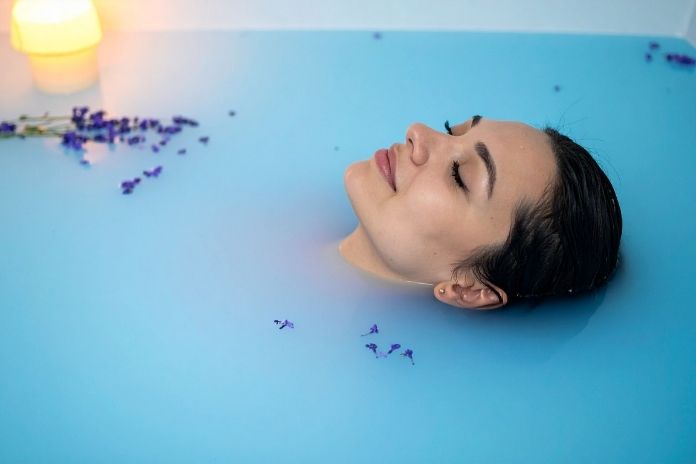
Do this either in bed before sleep or in a warm shower. The shower adds real warmth as a sensory anchor. The bed version is simpler and works if you wake up at night.
If you’re in bed, darken the room or use an eye mask. Reduce visual input. Lie on your back if possible, arms slightly away from your sides, legs uncrossed. A relaxed, open posture makes the body easier to scan.
Set aside five to ten minutes. Duration matters less than consistency.
Step 2: Identify the “Silt” (Your Stress Points)
Slowly scan from the top of your head down. Don’t fix anything. Just notice. Where is there tightness? Jaw, neck, shoulders, chest, hips.
Give each area of tension a visual form: gray dust resting over that part of the body. No analysis. Just: this is tension in my shoulders. It looks like gray dust.
This creates distance. The tension becomes something you observe, not something you are trapped inside.
Step 3: Activate the Flow (The Cleansing Stream)
Now imagine warm, golden water flowing from above your head. Steady, gentle, like a comfortable shower.
Feel it touch the scalp, move down the neck, and across the shoulders. Focus on sensation, not narration. Pair the image with a slow inhale as the water arrives. This helps shift the nervous system toward parasympathetic calm.
Step 4: The Wash Away (Letting Go Visually and Physically)
As the water passes over each area of gray dust, see it dissolve and wash downward. Shoulders soften. Chest loosens. Let each exhale be slightly longer than the inhale. The longer out-breath supports the nervous system downshifting.
If your mind drifts, notice it briefly and return to the water. That return is the practice.
Step 5: The Drain (Symbolic Release)
As the water reaches your feet, imagine it carrying the dissolved dust away into the ground or down a drain. The image doesn’t matter. The sense of completion does.
Then rest. Notice the physical lightness. You don’t need perfect calm. The goal is simple: a body that is less activated than it was five minutes ago.
Who Is This Technique For?
The Wash Away ritual is suitable for most adults who experience general stress, racing thoughts, or difficulty winding down before sleep. It requires no special training or equipment, and most people can start seeing a calming effect within the first few sessions.
That said, a few groups should approach it more thoughtfully. People with a trauma history, particularly those who experience intrusive imagery or hypervigilance, may find that body-focused visualization activates rather than calms the nervous system. If this happens, it’s not a sign that something is wrong with you; it’s worth discussing with a trauma-informed therapist who can adapt or replace the technique with something better suited.
Similarly, people with clinical insomnia or suspected sleep disorders such as sleep apnea should consult a healthcare provider before relying solely on self-directed practices. The Wash Away ritual can complement professional treatment, but it is not a substitute for it.
Expert Tips to Deepen the Ritual
Match Breathing with Visualization
The physiological mechanism behind the ritual is parasympathetic activation, the nervous system state that enables sleep. Breathing is the most direct lever for shifting between sympathetic, alert, and reactive, and parasympathetic, calm, and restorative states.
As you imagine the warm water arriving at each new region, inhale. As you exhale, visualize the water washing the silt away from that region. Inhale: arrival. Exhale: release. This synchronization is not strictly necessary for the visualization to work, but it deepens the physiological effect and gives the mind a rhythm to follow that interrupts rumination more completely.
Sensory grounding through breath rhythm is a core mechanism of most sleep meditation techniques. The breath gives the attentional system something simple, repetitive, and physical to track, which is exactly what’s needed to displace the evaluative verbal processing that how to stop overthinking at night practitioners consistently identify as the barrier to sleep onset.
Anchor the Experience with Scent
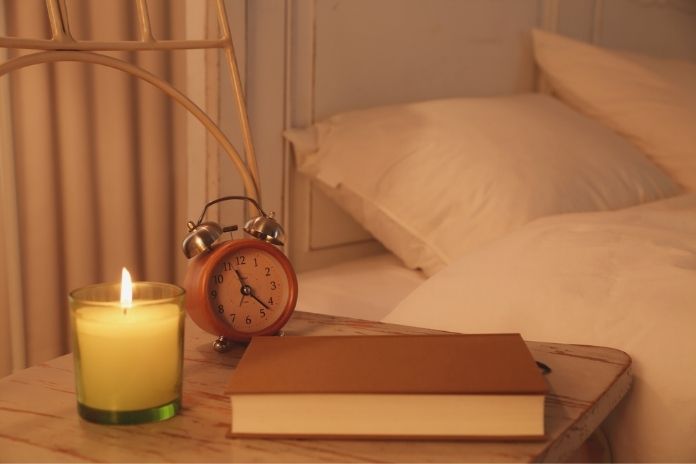
Memory and emotion are processed in the same limbic structures that handle olfactory information. Scent reaches the brain faster than almost any other sensory input and is less filtered by the prefrontal cortex than visual or auditory information. This makes it a powerful anchor for ritual states.
Using a consistent scent as part of your pre-sleep mindfulness sleep ritual creates a conditioned association over time. Your nervous system begins to associate that scent with relaxation before you’ve consciously started the practice. The scent becomes a cue that precedes and accelerates the shift you’re trying to make.
Lavender and cedarwood are the most studied options for sleep support. A 2024 meta-analysis published in Holistic Nursing Practice reviewing 11 randomized controlled trials found that lavender essential oil produced a significant improvement in adult sleep quality across a variety of populations.
A systematic review published in Sensors confirmed that multi-sensory grounding approaches, combining guided imagery for relaxation with anchoring stimuli, produced more robust reductions in anxiety and rumination than single-channel interventions. Adding a scent anchor to a visualization meditation practice is exactly this kind of multi-sensory layering.
Practice Without Judgment
Intrusive thoughts during mindfulness exercises for stress relief are not evidence that you’re doing it wrong. They’re evidence that you’re human. The brain’s default mode network generates approximately 6,000 thoughts per day. Many of them will surface during a ten-minute visualization practice. This is normal.
The instruction to practice without judgment means treating each intrusive thought not as a disruption but as more silt. You noticed it. You name it. You return the warm water to wherever it was in the visualization and continue. Each time you do this, you’re practicing the redirection skill that is the actual point of the practice.
Dr. Shelby Harris, PsyD, DBSM, a licensed clinical psychologist, states: “I prefer that people use meditation and mindfulness to be aware of their anxious, alert thoughts to help focus the brain and quiet things overall, and then get into bed.” Meditation is not a sedative, she emphasizes. It’s a mental training practice that changes your relationship to the thoughts that are keeping you awake. That reframe matters.
What If It’s Not Working?
If the first few attempts feel frustrating or ineffective, that’s completely normal and not a reason to give up. A few common adjustments help.
If your mind keeps wandering: shorten the practice. Start with just the first two steps — scanning for tension and giving it a visual form — and gradually add the water imagery over several nights. You’re building a mental skill, not passing a test.
If the imagery feels flat or hard to hold, try practicing it in a warm shower first, with your eyes closed. Real warmth gives your brain something concrete to attach the visualization to, and most people find that the mental imagery becomes easier over time.
If you’re still lying awake after the practice, resist the urge to repeat it aggressively. Trying hard to fall asleep creates arousal, which works against sleep. Instead, let the body rest even if the mind is still active. Rest without sleep is genuinely restorative, and the visualization has still served its purpose by reducing physiological tension.
Most people notice a meaningful difference in how they feel at bedtime within two to four weeks of nightly practice. Some feel a shift within the first week. The nervous system learns through repetition, so consistency matters more than perfection on any given night.
Why Visualization Works for Sleep and Stress Relief
Mental Imagery and Neural Reset
Visualization meditation activates the brain’s sensory processing regions in ways remarkably similar to real sensory experience. When you vividly imagine warm water flowing over your skin, the same neural circuits that process real tactile warmth are partially engaged. The brain is not indifferent to imagined experience. It responds to it.
This is why guided imagery for relaxation can produce real physiological changes. Skin temperature can increase during warm water visualization. Heart rate variability improves. Cortisol drops. These are measurable biological changes driven by imagined sensory input, which is the entire basis for the Wash Away ritual’s mechanism.
A systematic review published in PMC on neurobiological changes from mindfulness practice found that MBSR and related mindfulness interventions reduce amygdala reactivity, increase prefrontal regulatory activity, and improve connectivity between the brain’s emotional and executive regions.
These structural and functional changes explain why consistent mindfulness and sleep practice produce durable improvements in sleep quality, not just acute relaxation on the nights you practice.
Complementary to Other Sleep Habits
The Wash Away ritual works best as one element within a broader pre-sleep routine. Paired with consistent sleep and wake times, a dimly lit environment in the hour before bed, reduced screen exposure, and physical signals like a consistent scent or a warm shower, it becomes part of a system that cues the nervous system toward sleep well before you’ve done the first breath of the visualization.
It also complements other well-established, non-pharmacological sleep strategies. Cognitive behavioral therapy for insomnia (CBT-I) is currently the first-line clinical treatment for chronic insomnia, recommended by the American Academy of Sleep Medicine, and it addresses the unhelpful thought patterns and sleep habits that perpetuate poor sleep.
The Wash Away ritual aligns naturally with CBT-I principles: it targets cognitive arousal, reinforces a calming pre-sleep routine, and builds a conditioned association between the bed and relaxation rather than wakefulness.
If you’re already using white noise, sleep restriction therapy, or other structured sleep interventions, the Wash Away ritual can be added to any of them without conflict. It occupies a different mechanism, sensory redirection rather than cognitive restructuring, which means the two approaches are complementary, not competing.
Dr. David S. Black, PhD, MPH, in research found that participants in the mindfulness program showed significant improvement in sleep quality with an effect size of 0.89, along with reductions in insomnia symptoms, depression symptoms, and fatigue, compared to a structured sleep hygiene education group.
“The use of a community-accessible MAPs intervention resulted in improvements in sleep quality at immediate postintervention, which was superior to a highly structured SHE intervention,” the study concluded, adding that the effect appeared to carry over into reducing sleep-related daytime impairment. Mindfulness and sleep are not merely compatible. They’re synergistic.
Sleep meditation techniques work best when they are practiced consistently rather than deployed only on bad nights. The nervous system learns through repetition. A body that has performed the Wash Away ritual 30 times begins to begin relaxing as soon as the first breath of the practice arrives, before the visualization has even started. That’s the conditioning effect that makes the practice progressively more effective over time, not less.
Read More: The Man’s Guide to a Restful Night: 8 Sleep Hacks for Better Sleep
Key Takeaway: Let the Water Carry It Away
Mindfulness and sleep don’t intersect by accident. The same attentional capacities that make mindfulness effective for stress, the ability to notice, label, and redirect without getting pulled into identification with a thought, are exactly what’s needed to interrupt the bedtime rumination loop.
The Wash Away ritual works because it gives the brain a richer sensory experience to inhabit than the abstract verbal loop it keeps returning to. It doesn’t suppress stress or deny it. It gives it a form, a visual representation that can be released, and a mechanism, the warm flowing water, that does the releasing.
The stress relief visualization isn’t magic. It’s a trained response. The first few nights, the mind will wander. You’ll lose the water somewhere around your shoulders and find yourself back in the argument from work. That’s fine. Find the water. Continue. Each return is a repetition.
Over weeks of consistent practice, the bedtime association shifts. The ritual becomes the cue. The nervous system stops treating the pillow as an invitation to process the day’s unresolved business and starts treating it as something else: a place where the water arrives, the silt dissolves, and rest follows.
References
- Black, D. S., O’Reilly, G. A., Olmstead, R., Breen, E. C., & Irwin, M. R. (2015). Mindfulness meditation and improvement in sleep quality and daytime impairment among older adults with sleep disturbances: A randomized clinical trial. JAMA Internal Medicine, 175(4), 494-501
- Calderone, A., Latella, D., Impellizzeri, F., de Pasquale, P., Famà, F., Quartarone, A., & Calabrò, R. S. (2024). Neurobiological changes induced by mindfulness and meditation: A systematic review. Biomedicines, 12(11), 2613.
- Huberman, A. (2026). How to reclaim your brain in 2026. Modern Wisdom Podcast, Episode 1042
- Kross, E. (2024). Befriending your inner voice. Hidden Brain Podcast.
- Marchand, W. R. (2014). Neural mechanisms of mindfulness and meditation: Evidence from neuroimaging studies. World Journal of Radiology, 6(7), 471-479.
- Tang, Y. Y., Hölzel, B. K., & Posner, M. I. (2015). The neuroscience of mindfulness meditation. Nature Reviews Neuroscience, 16(4), 213-225.
- Zemla, K., Sedek, G., Wróbel, K., Postepski, F., & Wojcik, G. M. (2023). Investigating the impact of guided imagery on stress, brain functions, and attention: A randomized trial. Sensors (Basel), 23(13), 6210.
- [LINK ISSUE: Bio Conferences Aquaculture 2024 PDF — this citation is from an aquaculture science conference and has no relevance to stress, sleep, or visualization. Recommend removing entirely]
- Body & Brain Yoga Tai Chi. (n.d.). Visualization for stress relief.
- Cleveland Clinic. (n.d.). Guided imagery
- Headspace. (n.d.). Visualization meditation.
- Lillehei, A., & Halcon, L. (2014). The sleep-enhancing effect of lavender essential oil in adults: A systematic review and meta-analysis. Holistic Nursing Practice, 2024.
- Mayo Clinic. (n.d.). Meditation: A simple, fast way to reduce stress.
- Meditopia. (n.d.). Visualization exercise.
- MentalHealth.com. (n.d.). Visualization and guided imagery for stress reduction.
- Mindletic. (n.d.). Visualization method for stress management.
- National Institute of Mental Health. (2021). Guided visualization: Dealing with stress.
- Ottman, E. (n.d.). Reclaiming restful sleep: Using visualization to prevent nightmares.
- PositivePsychology.com. (n.d.). Visualization meditation: A complete guide.
- ScienceDirect. (2022). [Abstract article].
- Start My Wellness. (2025). The power of visualization in mental health recovery.
In this Article