


















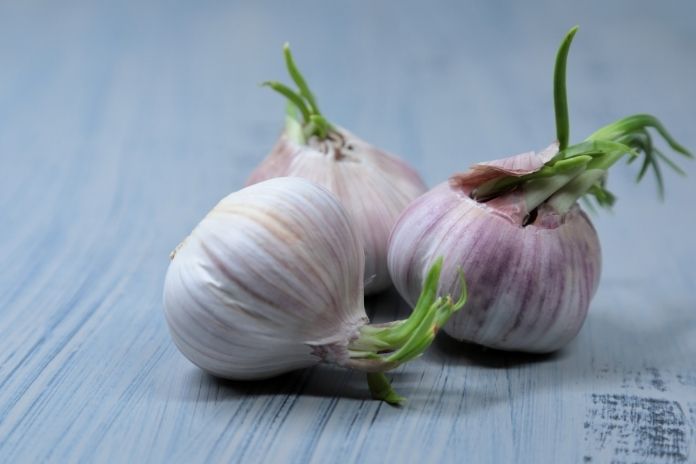
Open your kitchen basket, and you find it: a garlic bulb with thin green shoots coming out from the center. Most people pause for a second. Some throw it directly into the dustbin. Some quietly cut the green part and continue cooking. There is also a belief floating in many homes that sprouted garlic becomes “toxic” or “too heating” for the body.
The truth is much less dramatic and also more interesting.
Sprouted garlic is not a spoiled food by default. It is a living clove that has moved from storage mode to growth mode. The change affects flavor, texture, cooking behavior, and even how the nutrients behave inside the clove. This is what rarely gets discussed.
This article looks at sprouted garlic from a practical kitchen angle, not from fear-based food rules.
What Does It Mean When Garlic Sprouts?
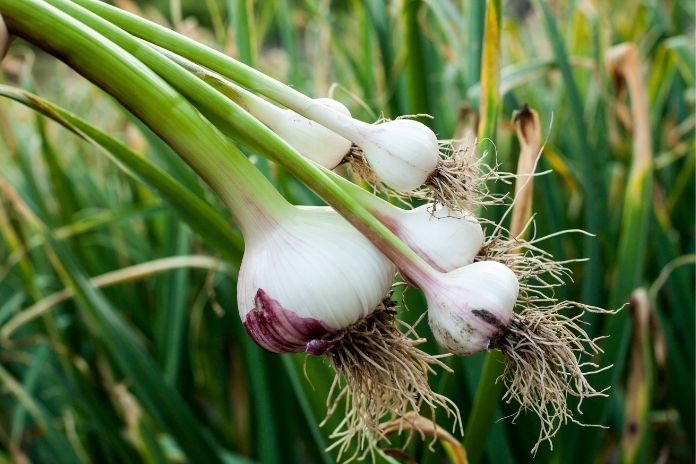
Garlic is a bulb made of individual cloves. Each clove is technically a seed.
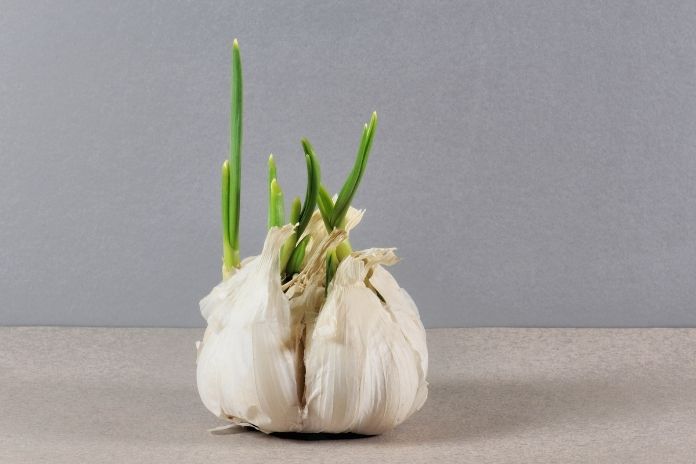
When storage conditions change, mainly temperature and moisture, the clove receives a biological signal that winter is over. The internal hormones shift, and the clove starts pushing out a green shoot from the center.
This shoot is called the sprout. It is not mold. It is not rotten.
A sprouted garlic clove usually means the following:
- The garlic has been stored for a longer time
- The storage temperature has become warmer
- Humidity is slightly higher
- The clove is still biologically active
An important detail most people do not notice: the sprout always grows from the center core. The outer flesh can still be firm, juicy, and usable.
Sprouting is a sign of age, not a sign of contamination.
Is Sprouted Garlic Safe to Eat?
Yes. In normal kitchen conditions, “sprouted garlic is fine to eat!” as stated by Taste senior food editor Elisa Pietrantonio.
There is no scientific classification of sprouted garlic as unsafe food. As registered dietitian Bonnie Taub-Dix explains, “Sprouted garlic is never unsafe to eat—but it may not taste its best.” And this distinction matters. Safety and quality are not the same thing.
Food safety agencies like the U.S. Food and Drug Administration and the United States Department of Agriculture treat sprouting in vegetables as a quality issue, not a safety issue, unless there is visible spoilage.
The risk does not come from the sprout. It comes from decay.
If the clove is:
- Firm
- Not slimy
- Not smelling sour or fermented
- Not showing fuzzy growth
then it is safe.
A common confusion happens because people mix up sprouted garlic with sprouted potatoes. Potatoes form glycoalkaloids (bitter-tasting poison) when sprouting. Garlic does not behave in that same chemical way.
Garlic does not produce toxic compounds just because it sprouts.
Does Sprouted Garlic Taste Different?
Yes, and this is where most cooking problems start.
Sprouted garlic becomes the following:
- Sharper on the tongue
- Slightly bitter, especially near the green core
- Less sweet after frying
This is not imagination. Inside the clove, stored sugars are being converted into energy for the growing shoot. At the same time, certain sulfur compounds become more concentrated near the center.
The result is
- Stronger raw heat
- Quicker bitterness when sautéed
- A thin, grassy note when eaten uncooked
Interestingly, the bitterness is not uniform. It is mostly concentrated in the green shoot and the central germ.
For slow-cooked dishes, the difference becomes less noticeable. For quick stir-fry, relish, garlic paste, and raw dips, it becomes very obvious.
Is Sprouted Garlic More or Less Nutritious?
This part is rarely explained properly.
When garlic sprouts, the clove is no longer only a storage unit. It becomes a source plant feeding a growing shoot. That means internal metabolism changes.
Some changes that happen:
- A small reduction in stored carbohydrates
- An increase in certain antioxidant activity
- Modification of sulfur compounds such as alliin and related molecules
Early laboratory work has shown that young garlic sprouts and germinated garlic extracts can show higher antioxidant behavior than dormant cloves. But the catch is important.
These studies are done using controlled germination and laboratory extraction. They are not based on:
- Half-sprouted garlic lying in your kitchen basket
- Mixed-age cloves
- Different storage conditions
So practically:
Sprouted garlic is not a nutrition miracle. It is also not nutritionally dead.
From a home cooking point of view, the difference in nutrition is small and unpredictable. The bigger real-world change is flavor and cooking response, not vitamin content.
When You Should Throw Garlic Away
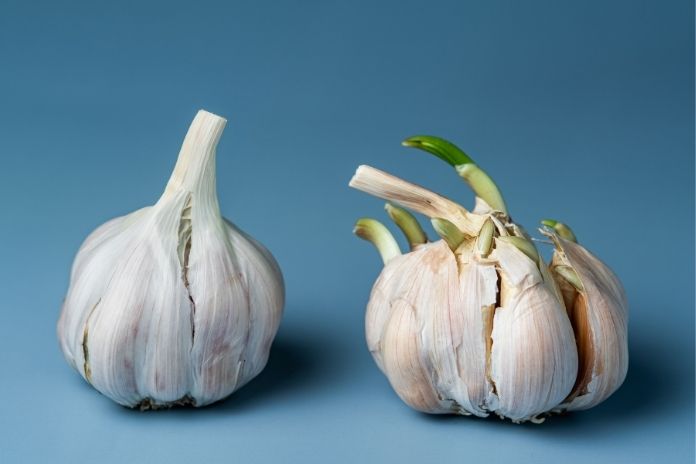
Do not throw garlic just because it has green shoots. Throw garlic only when you see real spoilage signs:
- Soft and collapsing clove
- Slimy surface
- Brown watery patches
- Sour or alcohol-like smell
- White, green, or grey fuzzy growth
Another clear sign is when the outer papery skin slips off very easily, and the clove underneath feels hollow or rubbery.
One more point most people ignore: if the base plate (the flat bottom where roots emerge) is dark and mushy, discard the whole bulb. That part controls moisture movement inside the bulb.
Sprouting alone is not a discard rule. Structural breakdown is.
Should You Remove the Green Sprout Before Cooking?
This is a practical kitchen decision, not a health rule. Removing the green shoot helps in two situations:
- When using garlic raw
- When doing fast cooking (tempering, stir-frying, garlic chips)
The green core is more bitter and sharper than the rest of the clove. Removing it softens the flavor profile.
However, in slow cooking lentils, gravies, stews, and braises, removing the sprout makes very little difference. Heat and moisture break down the sharper compounds.
There is no health necessity to remove it. It is only about taste management.
A small trick that works well: If the clove is small and the sprout is very thin, do not waste time removing it. The bitterness contribution is almost negligible.
Read More: How To Use Garlic Oil To Treat An Ear Infection
How to Store Garlic to Prevent Sprouting
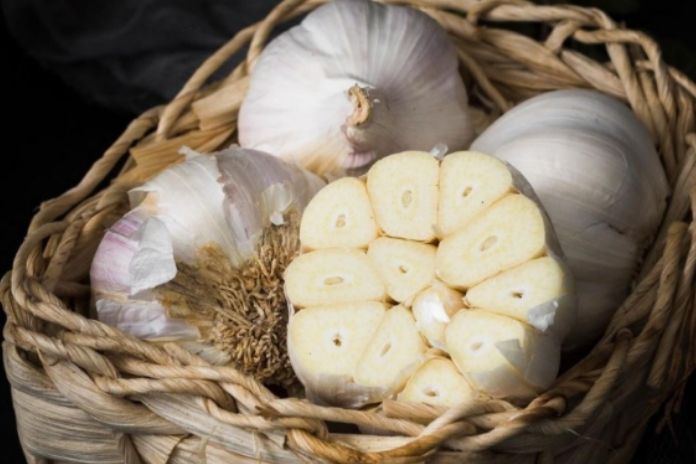
Most home storage advice is copied from cold-climate countries. In warm and humid kitchens, those methods fail.
Good storage for garlic focuses on three things:
- Airflow
- Moderate temperature
- Low surface moisture
Practical home method:
- Keep garlic in an open mesh basket or perforated container
- Do not store near the stove or the window
- Never store inside closed plastic containers
- Avoid the refrigerator unless your kitchen is extremely hot
Refrigeration increases moisture around the clove surface. That accelerates the sprout trigger once the garlic comes back to room temperature.
Another overlooked habit: mixing fresh new garlic with older garlic in the same container. Fresh garlic releases more moisture. That moisture shortens the dormancy of older bulbs.
Keep newer and older bulbs separate if you buy in bulk.
Read More: Benefits And Limitations of Chinese Garlic
Can Sprouted Garlic Make You Sick?
Sprouted garlic itself does not cause food poisoning. Illness risk only comes from:
- Bacterial contamination due to damaged tissue
- Fungal growth in very moist storage
- Improper storage of garlic in oil (separate issue)
A dangerous situation is not sprouting; it is garlic stored in oil at room temperature. That is a known risk environment for bacterial growth if not acidified properly.
The sprout has no connection with that risk.
So to answer clearly: Eating a normal, firm sprouted garlic clove will not make you sick.
Read More: Can Garlic Really Boost Your Immunity or Is It Just Hype?
Final Thoughts
Sprouted garlic is mainly a quality shift, not a safety failure. The green shoot is simply the garlic deciding to grow instead of waiting in your pantry.
If your dish depends heavily on clean garlic sweetness, for example, garlic butter, garlic relish, or raw dressings, sprouted cloves will slightly disappoint you.
If your dish is slow-cooked and layered with spices and aromatics, you will hardly notice any difference.
Treat sprouted garlic as an ingredient with changed behavior, not as a rejected ingredient. That small shift in thinking avoids unnecessary food waste and also improves cooking control.
- Sprouting in garlic reflects a hormonal change inside the clove, not microbial activity. Most kitchen safety confusion comes from mixing biological growth with spoilage.
- The bitterness of sprouted garlic is spatially concentrated in the central germ, which means flavor control can be achieved by selective trimming instead of full discard.
- Current nutrition claims around sprouted garlic are based mostly on controlled laboratory germination, not real household storage conditions. There is a clear research gap in studying the nutrient behavior of garlic sprouted naturally in domestic environments.
- Storage humidity plays a bigger role than temperature alone in triggering sprouting, especially in non-air-conditioned kitchens.
- Culinary suitability, not health fear, should guide the decision to use or avoid sprouted garlic in different dishes.
FAQ
1. Can I eat garlic with its long green shoots?
Yes! if the clove is still firm and not spoiled. Remove the green shoots if you feel bitterness.
2. Is there no medicinal value of sprouted garlic?
No clear evidence shows any loss. Some antioxidant activity may just increase, but results vary widely.
3. Is sprouted garlic harder to digest?
No. Digestibility is mainly affected by the cooking method, not by the presence of a sprout.
4. Can I plant sprouted garlic from my kitchen?
Yes. Sprouted cloves can grow into garlic plants if planted in soil, though the final bulb size depends on variety and season.
5. Should sprouted garlic be avoided for children or elderly people?
No special restriction is required. Only avoid spoiled garlic, not sprouted garlic.
References
- El‐Mesery, H. S., Husein, M., Hu, Z., & Elabd, M. A. (2025). Postharvest Stability of Peeled Garlic Cloves (Allium sativum L.): A Study on Packaging Materials and Shelf‐Life Environmental Interactions. Food Science & Nutrition, 13(11).
- Woo, J. E., Seo, J. Y., Kim, J. H., Shin, J.-H., Cho, K. M., & Kim, J.-S. (2016). Soy products fermented with sprouted garlic have increased neuroprotective activities and restore cognitive functions. Food Science and Biotechnology, 25(1), 301–309.
- Zakarova, A., Seo, J. Y., Kim, H. Y., Kim, J. H., Shin, J.-H., Cho, K. M., Lee, C. H., & Kim, J.-S. (2014). Garlic Sprouting Is Associated with Increased Antioxidant Activity and Concomitant Changes in the Metabolite Profile. Journal of Agricultural and Food Chemistry, 62(8), 1875–1880.
In this Article