





















For years, orange juice has been the ultimate symbol of a healthy breakfast. It’s linked to vitamin C, immunity, freshness, and the concept of a clean slate to start the day. It’s healthy-looking, it’s healthy, and it comes with the emotional component of years of health-related marketing.
Americans love their orange juice and often see it as a symbol of healthy eating. For many people, however, a pattern repeats every day. They feel sharp and focused early on, but by mid-morning their concentration fades, motivation drops, and hunger kicks in. Getting anything done suddenly feels harder.
This isn’t random, and it’s not always about stress or poor sleep. For many, it starts with how orange juice affects blood sugar, energy levels, and brain function in the morning.
Orange juice is not as healthy as we think. It’s actually a quick sugar rush followed by a crash, which sets off a domino effect that leads to brain fog, exhaustion, and a lack of cognitive function by 10 AM.
However, by understanding what happens and using a simple timing trick called the 15-minute rule, you can turn your mornings around.
In this article, let’s understand how orange juice impacts blood sugar and liver metabolism and why it often leads to mid-morning energy crashes. We’ll also compare juice with whole fruit and share simple ways to keep your energy steady.
Why Your Morning Orange Juice Is Hurting Your Focus

The Rapid Blood Sugar Spike and Crash
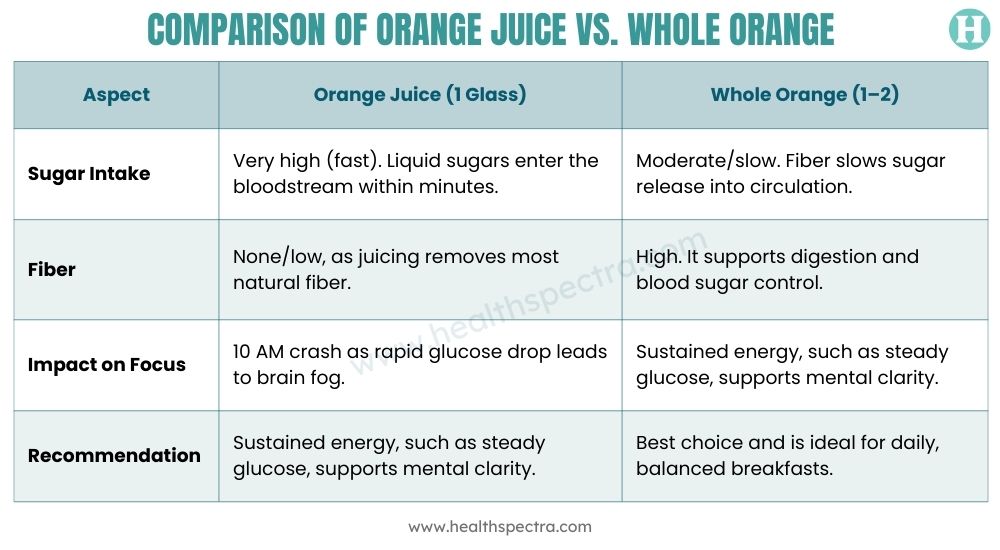
When orange juice is consumed on an empty stomach, it is absorbed by the body at its fastest rate of absorption. One glass of orange juice may contain a significant amount of sugar, but with none of the natural fiber that would slow down digestion.
The blood sugar levels begin to surge within 15 to 30 minutes. This rapid increase triggers an equally rapid insulin response as the body tries to compensate for the imbalance. Insulin regulation is a normal body function, but the rapidity and extremity of the response are what create problems.
This is why the classic pattern of glucose surge and crash is produced, which is the basis of the orange juice blood sugar crash. Approximately one to two hours after ingestion, the blood sugar levels may crash rapidly, starving the brain of a constant energy source.
Since the brain uses glucose in large amounts, this directly impacts brain function. The result is predictable: reduced concentration, mental fatigue, irritability, hunger, and the familiar mid-morning energy collapse. This is why many people notice that morning orange juice undermines focus and energy levels, even though it initially feels stimulating.
The Low-Fiber, High-Acidity Problem

Orange juice doesn’t affect blood sugar simply because it contains sugar, but because of the form that sugar takes. Oranges, as a whole fruit, contain fiber that helps regulate sugar absorption, modulates digestion, and maintains healthy blood sugar levels.
Fiber serves as a physiological buffer, both physical and hormonal, that slows down the absorption of sugar into the bloodstream. Juicing strips the fruit of almost all this fiber. Without it, sugar is absorbed quickly and unregulated into the bloodstream. Even fresh-squeezed juice has a different metabolic profile than the whole fruit.
Acidity is also a factor. Orange juice has a pH level of 3.5-4.1, and is extremely acidic. Long-term consumption, especially on an empty stomach, can irritate the stomach lining and degrade dental enamel. Hence, orange juice is more of a sugar and acid concentrate than a gentle hydrating agent.
“Orange juice is a double whammy on teeth: It has a high sugar content and is acidic,” said Dr. Elizabeth V. Simpson, D.M.D., a general dentist and faculty member at Indiana University School of Dentistry.
Read More: The Healthiest Part of an Orange Isn’t the Juice — It’s the White Pith
The Liver Overload Effect
Fructose in orange juice makes this process harder for the body to manage. Unlike glucose, fructose is processed almost exclusively by the liver. When a large dose of fructose surges all at once, as when drinking a glass of orange juice, the liver must go into overdrive to process it.
This is often compared to how alcohol is metabolized, not because fructose is equally harmful, but because the liver has to process it first. A sudden spike in fructose can briefly disrupt the usual metabolic current, pulling energy away from other bodily functions.
This “liver overload” can leave you feeling groggy and mentally cloudy in the morning. Over time, repeated fructose spikes can make blood sugar crashes stronger and more frequent.
The 15-Minute Rule — A Simple Fix for Steady Energy

What the 15-Minute Rule Means
It’s not about erasing what’s there. It’s about sequencing. The 15-minute rule is based on when your metabolism is active, not on reducing the number of calories.
In reality, orange juice doesn’t go into an empty stomach. You begin with breakfast that includes protein, healthy fats, or fiber. It isn’t until this groundwork is laid that you add juice, which is usually 15 to 30 minutes later.
This brief delay changes the absorption of sugar into the bloodstream and how the body processes it.
Why It Works
Protein, fat, and fiber act as a brake on digestion, moderate the rate at which the stomach empties, and reduce the rate at which sugar is absorbed. This leads to a more gentle and controlled increase in blood sugar and insulin. Rather than a peak and then a trough, blood sugar levels rise and remain level.
This helps to protect against the mid-morning slump that can undermine productivity. Those who apply the 15-minute rule to breakfast tend to experience more consistent focus, improved mood, reduced cravings, and more balanced energy levels throughout the morning.
It is possible to avoid the mid-morning slump without sacrificing the foods you love. This 15-minute rule is sometimes a part of the 30-30-30 method (30 g of protein within 30 minutes and 30 minutes of light exercise). This has been shown to assist in weight loss and metabolic health.
Read More: 6 Invigorating Orange Essential Oils to Uplift Your Mood
Smarter Morning Alternatives
Reducing serving sizes significantly impacts your body’s processes and what you are putting into your system. A 4-ounce serving of orange juice contains much less sugar than a full glass. Adding water or sparkling water to your juice will reduce the glycemic index without affecting the taste.
Juices that are vegetable-based are also a great choice, providing hydration and nutrients without causing a big spike in blood sugar.
Eat the Fruit Instead

Biologically speaking, eating whole fruit is generally the better option. Consider whole oranges, for instance. The fiber in them delays the digestion process, ensuring that the blood sugar levels remain stable, and then there’s the constant trickle of energy.
Rather than an instant sugar rush, the body receives a steady supply of glucose, allowing you to concentrate for a longer period of time. This is why whole fruit is as effective as a low-glycemic breakfast food, particularly when combined with protein or healthy fats.
Long-Term Benefits of Stabilizing Morning Blood Sugar
When your mornings are consistent with stable blood sugar, the positive effects extend far beyond the meal. Your thinking becomes clearer faster, your moods remain more consistent, and there are fewer cravings. Furthermore, your energy levels become dependable instead of a roller coaster ride.
In the long run, this consistency supports your metabolic function, reduces the risk of insulin resistance, and protects you from chronic fatigue.
Read More: Foods That Make Acid Reflux Worse (And What to Eat Instead)
Takeaway
It’s not the orange juice that’s the problem, but when and how you consume it that makes all the difference. Drinking it alone on an empty stomach can cause sugar levels to skyrocket, trigger insulin surges, overburden your liver, and cause brain fog by morning, leaving your focus drifting by 10 a.m.
You can modify it with a quick fix of the 15-minute rule, have the orange juice with a healthy breakfast, be mindful of your portions, or opt for whole fruits instead. And you can enjoy your orange juice without compromising your mental acuity and energy.
Sometimes, the best health improvements aren’t about eliminating foods from your diet but about timing, routine, and a more intelligent metabolism.
References
- Continental Hospitals. (n.d.). Fruit juice often has more sugar than soda. Continental Hospitals Blog.
- Mason Consolidated Schools. (2018). Orange juice cup, 4 oz high school nutrition facts. District School Nutrition and Fitness.
- Oteiza, J. M., Prado-Silva, L. do, Caturla, M. Y. R., Barril, P. A., Giannuzzi, L., & Sant’Ana, A. S. (2024). Variability in the acid adaptation of ten different O157:H7 and non-O157 Escherichia coli strains in orange juice and the impact on UV radiation resistance. Food Microbiology, 124, Article 104610.
- American Dental Association. (n.d.). Is orange juice good for you? ADA News.
- Worth, T. (2024, December 20). Orange juice: Health benefits and nutrition. WebMD.
In this Article