


















Let’s be honest – most of us don’t have fancy home gyms or endless motivation. Some days, even finding a yoga mat feels like a workout.
But you want to feel strong, not just “less unfit.” You want to do something real for your body, something that lasts beyond one random 30-day challenge that ends with sore knees and guilt.
The good news? You don’t need machines, dumbbells, or a gym card you’ll never swipe again. You can build serious strength with just your body, floor space, and a bit of patience.
Science agrees. Real progress happens when you train smart, not when you chase trends.
This isn’t another “10 best push-up variations” list. Let’s talk about how bodyweight strength training actually works at home, how to make it progressive overload bodyweight, and, more importantly, how to keep doing it without burning out.
The Science Behind Equipment-Free Strength Training
Strength isn’t magic. It’s your muscles learning to handle more work every week.
When you do push-ups or squats, you may get microtears. According to Dr. Michael Karns, who is an orthopedic surgeon, these microtears are the microscopic damage that your tiny fibers in your muscles experience. During rest, your body repairs them stronger than before. That’s muscle hypertrophy – the fancy term for growing stronger muscles.
Now, many people assume that only lifting heavy weights causes this. Not true. Research shows that training close to muscular failure – even with bodyweight – triggers similar muscle growth as lifting dumbbells, as long as the intensity and progression are right.
So, What’s the Real Difference Between At-Home and Gym Workouts?
In the gym, you manipulate external load – dumbbells, barbells, machines – to progressively challenge your muscles. At home, you manipulate body position, leverage, tempo, and volume to create that same overload. The science is identical: your muscles respond to tension, not the object creating it.
For example, a weighted bench press and a slow, decline push-up both engage your chest, shoulders, and triceps under resistance. The gym version utilizes external weights; the home version employs gravity and body angle. The underlying mechanism – mechanical tension, metabolic stress, and muscle fiber recruitment – remains the same.
In the first 3-4 weeks, most changes are neurological – your brain gets better at recruiting the right muscle fibers. That’s why your form improves, and exercises start feeling smoother. Visible muscle definition usually begins to appear around week 8 to 12, depending on your consistency.
The key takeaway: your body doesn’t know whether the resistance comes from a barbell or from your body. It only knows effort. That’s why bodyweight workouts, when done close to fatigue, can match – and sometimes even surpass – the benefits of many gym sessions, especially for functional strength, balance, and endurance.
So, if you’ve been underestimating push-ups and squats, it’s time to rethink. These are not “beginner fillers.” They’re the foundation of lifelong strength.
Read More: Chair Exercises: Strengthen Your Legs with These Simple At-Home Workouts
Essential Bodyweight Exercises for Full-Body Strength
Let’s not complicate this. The best exercises are simple ones you can do anywhere, anytime – bedroom, balcony, or even in between work calls.
Upper Body
- Push-ups: Can’t do full push-ups yet? Start with the wall or knee pushups. Keep your body straight, go slow, focus on form, not showing off.
- Pike Push-ups: Bend from the hips, try to make that upside-down V shape, then lower your head down – shoulders will feel it right away.
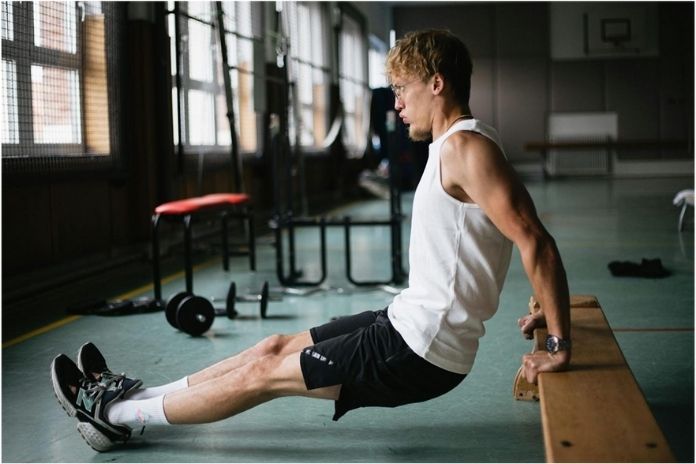
- Tricep Dips: Grab a chair that does not move, or you can use a bed edge, drop down, and push back up. Simple but hits hard.
Lower Body
- Squats: Feet shoulder-width apart, back neutral. Sit like there’s an invisible chair behind you.
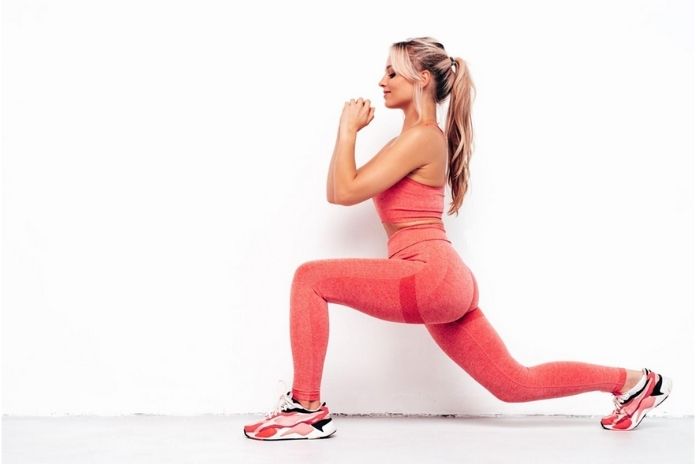
- Lunges: Forward, backward, or side – they all target legs differently. Go slow, not bouncy.
- Glute Bridges: Lie down, keep your feet flat, lift your hips up, and squeeze your glutes at the top. This one looks easy, but if you do it for 20 seconds, you may find it hard.
- Calf Raises: Simple but powerful. Do them while brushing teeth – yes, really.
Core
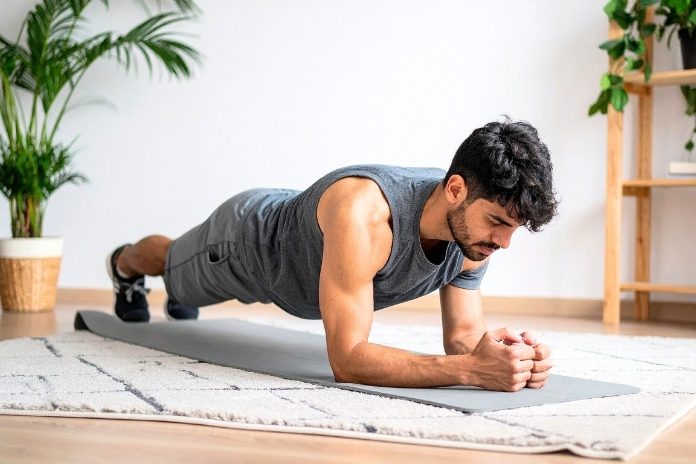
- Planks: Don’t aim for 2 minutes straight. Start with 20-30 seconds, but keep your form like a board.
- Dead Bugs: Sounds weird, works deep core muscles. The opposite arm and leg move together while lying flat.
- Mountain Climbers: Great mix of cardio and core.
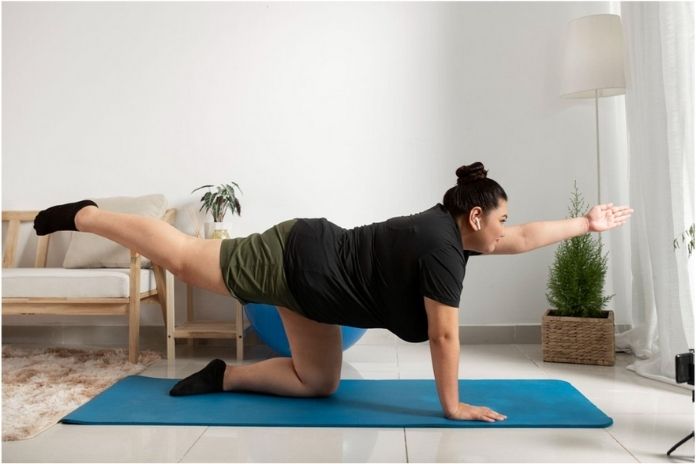
- Bird Dogs: Perfect for spine stability.
Compared to gym isolation machines, these moves recruit multiple muscles at once, teaching your body to stabilize and move as a unit. That’s why bodyweight training often builds more real-world strength and coordination than machine-based workouts.
These basics are enough to build a full-body, no-equipment-at-home workout routine. No need to chase every TikTok move you see. Simplicity is underrated.
Read More: Movement That Soothes: Exercises That Lower Cortisol Naturally
Building a Sustainable Strength Routine
Let’s make this practical. You don’t need two hours daily. You need structure and honesty.
- Beginners: Start with 2-3 days per week, full-body sessions.
- Intermediate: 3-4 days per week, maybe upper/lower splits.
Each session:
- 6–8 exercises
- 3 sets of 8–15 reps
- 30–90 seconds rest
A 20–30 minute sustainable fitness routine is perfect. Here’s an example:
Day 1 (Full Body):
- Push-ups – 3×10
- Squats – 3×12
- Glute Bridges – 3×15
- Plank – 3×30 sec
- Mountain Climbers – 2×20 (each leg)
Done. No apps, no gym, no noise.
The key isn’t intensity – it’s repeatability. If you can’t stick to a plan for three months, it doesn’t matter how “hardcore” it sounds on paper. Fitness is not punishment; it’s maintenance.
Read More: Strengthen Your Pelvic Floor: 6 Recommended Kegel Exercise Devices
Progressive Overload Without Equipment
Here’s where most home routines die – doing the same push-ups forever and wondering why nothing changes.
Your body adapts. You have to progressively overload it. You don’t need heavy weights to build muscle – research shows even light weights or bodyweight work if you push hard enough (like close to failure) and keep making progress.
Here’s how you can make it tougher, no weights needed:
- Do more reps. If 10’s easy, do 12 next time. Simple, but it works.
- Rest less. 60 sec too long? Try 40. You’ll feel it fast.
- Change the move. Wall push-up → knee → normal → decline → one arm. Keep moving up.
- Slow it down. Take 3 sec going down, pause, then push back up. Burns good.
- Instability or Range: Single-leg squats, elevated feet, wider or narrower hand placements.
You don’t need to change everything weekly. Choose one progression every 2–3 weeks. Small, measurable changes keep your muscles guessing – and growing.
If you can do 15 push-ups easily with clean form, you’re ready for the next level. That’s how you measure strength, not by mirror selfies.
Read More: Best Exercises to Strengthen Your Joints Without Stressing Them: Low-Impact Moves That Work
Recovery: The Silent Part of Growth
Everyone talks about functional strength training; few talk about resting. But here’s the truth – muscles grow during rest, not while you’re sweating.
After training, your body takes around 48–72 hours to repair muscle fibers. That’s why rest days matter. Overtraining doesn’t make you stronger; it makes you tired, sore, and unmotivated.
If your joints ache or you’re always exhausted, you’re not being “disciplined” – you’re ignoring your body’s warning. Recovery tips that actually work:
- Sleep 7–9 hours. Growth hormone does its best work when you’re sleeping.
- Light movement on rest days. Stretching, walking, or gentle yoga.
- Hydration and protein. Around 1.6–2g of protein per kg body weight helps recovery.
And know the difference between soreness and pain. Soreness fades in a day or two; sharp pain means stop. No exercise is worth an injury.
Read More: Strength Exercises to Make Your Daily Walks More Powerful (and Protect Your Joints)
Staying Consistent: The Real Game
This is where people fail – not because of difficulty, but because of life.
Work deadlines, holidays, relatives visiting, mood swings… There will always be reasons to skip. So stop chasing perfection. Build systems instead.
- Habit stacking: Tie workout to stuff you already do. After tea? Do squats.
- Micro workouts: 10 min is fine. Lunch break – 2 rounds of squats, push-ups, planks – done.
- Visual cues: Keep your mat where you can see it. Out of sight = forget it.
- Progress tracking: Write down reps. Watching numbers grow feels good.
- Travel-friendly mindset: No gym? Fine. Hotel room floor still works.
- Family inclusion: Involve your partner or kids. Makes it fun, not a chore.
Don’t aim for motivation – aim for momentum. One small action every day beats one heroic session every Sunday.
Read More: How to Get Toned Arms Without Bulking Up: A Woman’s Guide to Sculpted Strength
Overcoming Common Roadblocks
Let’s tackle the excuses (we’ve all got them):
“I have no time.”
You scroll for 30 minutes daily. A 15-minute workout session fits fine.
“I don’t have space.”
You only need a yoga mat’s worth of space. I’ve done squats between my bed and chair.
“I get bored.”
Mix things up – circuit training, new variations, or music you like.
“I hit a plateau.”
Change one overload factor. Try tempo work or one-legged versions.
“I lose motivation.”
Stop relying on feelings. Use a schedule and habits. The best athletes never wake up excited every day, either.
Remember: sustainable fitness is about identity, not just goals. Don’t say “I want to work out.” Say “I’m someone who moves daily.” That small shift matters more than any pre-workout supplement ever will.
Read More: Strength Exercises to Make Your Daily Walks More Powerful (and Protect Your Joints)
The Realistic Timeline of Results
- Week 1–4: Your brain learns. You feel more stable, coordinated.
- Week 4–8: Strength increases. Clothes fit differently.
- Week 8–12: Visible muscle tone starts showing.
- Beyond 12: You become that “fit friend” who doesn’t need a gym.
This is the natural curve. Not Instagram-speed progress. Science backs this up – most visible changes take 8–12 weeks of consistent home workouts. If you stick with it that long, you’ll never stop again.
Read More: Staying Active: Fun and Effective Exercises for Every Stage of Life
Start Where You Are
You don’t need to “feel ready.” You just need to start.
Pick 3 moves today – push-ups, squats, planks. Do 15 min. repeat tomorrow. In a month, you’ll feel stronger, you will also find it easy to move, and in fact, you will sleep better. In the next 3 months, you’ll wonder why you waited to make this change.
Fitness is never just a phase. Your body’s your gear for life – use it.
So, roll out that mat (or towel), silence your phone, and begin.
No gym. No excuses. Just you, gravity, and persistence.
Read More: 15-Minute Wall Pilates Routine to Build Strength After 40 (No Gym Needed, Doctor-Approved)
Final Thoughts
Building strength at home isn’t about chasing six-packs or 10,000-step targets. It’s about taking control – quietly, consistently, and scientifically.
You don’t need perfection. You just need one small win today.
Because your sustainable strength journey starts with a single push-up.
And if you do it again tomorrow, you’ll be stronger than you were yesterday.
Read More: Simple At-Home Fitness Tests That Reveal How Well You’re Aging
References
- https://pmc.ncbi.nlm.nih.gov/articles/PMC6950543
- https://pubmed.ncbi.nlm.nih.gov/37133323/
- https://pmc.ncbi.nlm.nih.gov/articles/PMC8449772
- https://www.mdpi.com/2075-4663/9/2/32
- https://pmc.ncbi.nlm.nih.gov/articles/PMC8126497/
- https://pubmed.ncbi.nlm.nih.gov/37133323/
- https://journals.lww.com/nsca-jscr/fulltext/2010/10000/the_mechanisms_of_muscle_hypertrophy_and_their.40.aspx
In this Article