


















- High-dose vitamin A accelerates cell turnover before lipids mature, disrupting barrier structure, increasing water loss, and causing structural fragility rather than healthy renewal.
- Persistent dryness, peeling, and cracked lips may signal internal vitamin A excess (hypervitaminosis A), in which barrier disruption stems from systemic overload, not from surface dehydration.
- Chronic intake above 3000 mcg RAE of preformed vitamin A accumulates in the liver, gradually disrupting skin barrier balance without obvious toxicity.
Vitamin A has a reputation problem. It is worshipped in skincare and quietly feared in medicine. Dermatology prescribes it. Wellness industry sells it. Supplements normalize it. But almost nobody discusses what actually happens to the skin barrier when vitamin A levels exceed physiological comfort.
The conversation usually stops at: “Dryness and peeling are normal.” Normal for what? For renewal? Or for injury?
The skin barrier can’t be protected or maintained by enthusiasm. It is built on balance. And high-dose vitamin A disrupts that balance in a very specific way, not just by increasing turnover, but by disturbing how the barrier assembles itself.
This is not about acne. Not about anti-aging. This is about architecture.
What Is Vitamin A and Why Is It Important for Skin?
Vitamin A is not one single molecule. It is a family:
- Retinol
- Retinal
- Retinoic acid
- Retinyl esters
- Provitamin A carotenoids
Inside the body, vitamin A acts like a regulator of instruction. It binds to nuclear receptors and changes which genes turn on and off. This is why it is powerful. It doesn’t “moisturize.” It changes the behaviour of cells.
In skin, vitamin A:
- Controls how keratinocytes (a cell type found in the outermost skin) mature
- Regulates how fast they move upward
- Influences sebum production
- Affects immune signalling
In the normal range, it maintains order. In high doses, it accelerates without waiting for structure to catch up.
What Is the Skin Barrier?
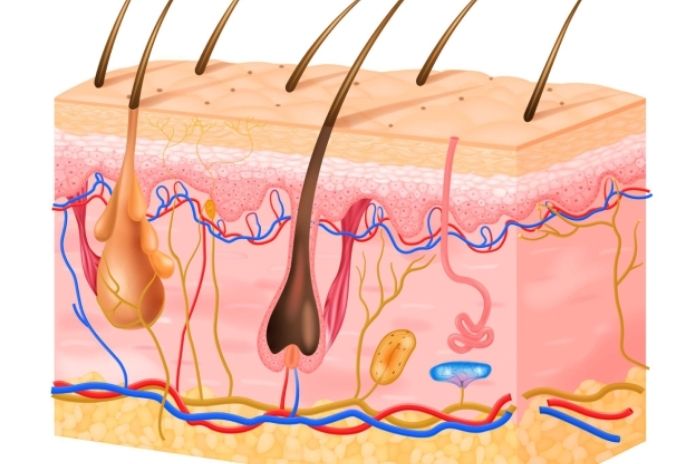
The skin barrier is not just the outer layer. It is a living process that ends in a dead structure.
The topmost layer, stratum corneum, is made of flattened cells glued together by lipids. But those lipids are not accidental. They are synthesized, packaged into lamellar bodies (a layered sheet-like structure), secreted, and arranged in layers.
Barrier integrity depends on three things happening in sync:
- Proper cell differentiation
- Proper lipid production
- Proper shedding
If turnover speeds up but lipid synthesis does not increase proportionally, the barrier becomes thin and leaky.
High-dose vitamin A creates exactly this mismatch.
How Normal Vitamin A Supports Skin Health
At physiological levels, vitamin A prevents hyperkeratosis (excess keratin production). It ensures that cells don’t stick together and become clogged. It improves epidermal repair. It keeps differentiation orderly. Think of it as supervision. Not domination.
When vitamin A stays within nutritional range, the barrier is stable, elastic, and well-sealed. Water loss remains controlled. The microbiome stays relatively undisturbed.
The problem begins when supervision becomes pressure.
What Happens When You Take High-Dose Vitamin A?
When intake exceeds the tolerable upper limit, especially with preformed retinol, the body cannot simply ignore the excess (a condition also called hypervitaminosis A).
Because vitamin A is a fat-soluble vitamin, it accumulates. The liver stores it. Circulating levels affect epithelial tissues throughout the body, such as the skin, lips, eyes, and even mucous membranes.
In skin, high-dose exposure causes:
- Reduced sebaceous gland (secreting sebum, oily substance) output
- Increased epidermal turnover
- Altered keratinocyte differentiation
- Impaired intercellular lipid organization
Most articles stop at “faster turnover.” But the deeper issue is this: Turnover increases before lipid scaffolding adapts. The wall is being rebuilt too fast. Mortar is not set.
Effects of Vitamin A Toxicity on Skin Barrier
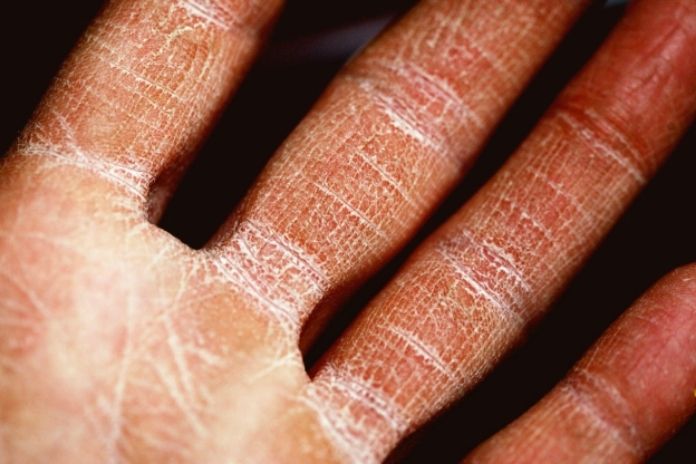
Too much vitamin A symptoms are:
1. Increased Dryness
Dryness from vitamin A excess feels different from winter dryness. It is persistent. It does not fully respond to moisturiser. Skin feels thin, stretched, almost papery.
Why? Because sebum decreases. But more importantly, ceramide balance shifts. Lamellar lipid layers become disorganized. Transepidermal water loss increases.
This is structural dehydration, not just surface dryness.
2. Peeling and Flaking
Peeling is often shown as a renewal of skin. But under high-dose vitamin A, peeling means corneocytes are separating before they are fully mature.
The glue between cells, corneodesmosomes, degrades early. The lipid matrix is incomplete. You see flakes because the epidermal barrier (the topmost layer of the skin that we can touch and feel) cannot keep its outermost layer intact.
This is not controlled exfoliation. It is a cohesion failure.
3. Skin Sensitivity and Irritation
When lipid layers thin out:
- Irritants penetrate more easily
- Nerve endings are closer to the surface
- Inflammatory signals increase
Even water can sting.
Some people describe it as “my skin cannot tolerate anything now.” That sentence is accurate. The tolerance threshold has reduced because epidermal barrier resistance has reduced.
This is not an allergy. It is a vulnerability.
4. Cracking of Lips and Corners of Mouth
The lips often show vitamin A excess before blood tests do.
They lack a thick stratum corneum. They lack robust sebaceous support. So when systemic retinoid effect begins, lips crack first.
Persistent cheilitis (inflamed lips) is not a cosmetic inconvenience. It is an early systemic signal.
These are some of the excess vitamin A side effects you can experience if your intake of the vitamin is on the higher end.
Topical Retinoids vs Oral Vitamin A
Topical retinoids act locally, and the dose is controlled at the skin surface. Oral high-dose vitamin A:
- Circulates everywhere
- Influences liver metabolism
- Alters all epithelial tissues
- Cannot be “buffered” by moisturiser
With topical retinoids, barrier damage is local and reversible, quickly resolving after stopping. With chronic high oral intake, barrier disruption is systemic. Recovery depends on how long tissues were exposed and how much accumulated in storage. This difference is often underestimated.
Signs of Vitamin A Toxicity Beyond Skin

Skin is visible. Liver is not. Other symptoms may include:
- Persistent headache
- Nausea
- Bone tenderness
- Hair thinning
- Visual disturbance
- Elevated liver enzymes
The skin sometimes becomes the first warning organ.
Who Is at Higher Risk of Vitamin A Overexposure?

- People stacking supplements unknowingly
- Those taking cod liver oil daily with a multivitamin
- Acne patients adding oral vitamin A on top of prescription retinoids
- Individuals with compromised liver function
- Pregnant women
Toxicity is not always dramatic. Sometimes it is slow and subtle. Chronic dryness that does not resolve. Lips that keep cracking. Skin that reacts to everything.
This pattern reflects a broader issue in supplement culture. As a nutritionist, Johanna Dwyer has cautioned, “Most people don’t realize there’s no real advantage to taking more than the recommended amounts of vitamins and minerals, and they don’t recognize there may be disadvantages.”
Vitamin A is a clear example of that imbalance, where biological regulation is mistaken for enhancement.
Read More: Can Too Many Skincare Actives Damage Your Skin Barrier?
How Much Is Considered “High Dose Vitamin A”?
Recommended intake for adults: around 700–900 mcg RAE daily. Upper tolerable limit: 3000 mcg RAE (preformed vitamin A). Long-term intake above this increases risk.
The issue is not one capsule. The issue is cumulative exposure. Because vitamin A stores. And the skin barrier feels that storage.
True overt toxicity remains uncommon in the general population. As a preventive medicine physician, Dr. David Katz explains, “I have not seen someone off the street who was taking a toxic level of vitamin A or D — those are very unusual. What I’m more likely to see is a person with a dosing level of supplements that’s higher than optimal.”
That distinction matters. Most people are not in acute toxicity. They are in biological excess, where intake exceeds physiological need without reaching dramatic clinical thresholds.
Read More: How Often Should You Use Retinol? A Dermatologist-Guided Schedule For Every Skin Type
Can Epidermal Barrier Damage Be Reversed?
In most cases, yes. When excess intake stops:
- Sebaceous function slowly normalizes
- Lipid layers rebuild
- Sensitivity reduces
- Peeling stabilizes
As. Dr. Lesley Motheral, a pediatrician, says. “Recovery for patients with acute toxicity can be rapid when the vitamin is discontinued.”
But recovery is not instant. The skin barrier needs complete renewal cycles to reorganize the lipid matrix.
Supportive care should focus on minimalism. No aggressive exfoliation. No additional activities. Just allowing structure to restore. The barrier heals when pressure is reduced.
Read More: 7 Surprising Health & Skin Benefits of Using Calendula Daily (Backed by Science)
Final Thoughts
Vitamin A is not the problem. But its excess is. The skin barrier is an engineering system. It depends on timing, sequencing, and proportion. High-dose vitamin A disrupts sequencing.
The damage is rarely too prominent at first. It is cumulative, quiet, and visible mostly as “my skin is not the same.” The lesson is simple but rarely said clearly: Acceleration without structure leads to fragility.
- High-dose vitamin A disrupts lipid assembly, not just cell turnover; barrier damage begins at the structural level.
- Persistent dryness despite moisturising may indicate internal retinoid overload rather than simple dehydration.
- Lips are often early biological markers of systemic excess..
- There is limited long-term research measuring TEWL and ceramide changes in non-prescription supplement users; most evidence comes from pharmaceutical retinoid data.
- Recovery timelines after chronic dietary excess are poorly studied compared to isotretinoin (vitamin A derivative) therapy, representing a significant research gap.
References
- Al Tanoury, Z., Piskunov, A., & Rochette-Egly, C. (2013). Vitamin A and retinoid signaling: genomic and nongenomic effects. Journal of Lipid Research, 54(7), 1761–1775
- Everts, H. B. (2012). Endogenous retinoids in the hair follicle and sebaceous gland. Biochimica et Biophysica Acta, 1821(1), 222–229.
- Olson, J. M., & Goyal, A. (2023). Vitamin A Toxicity. PubMed; StatPearls Publishing.
In this Article