


















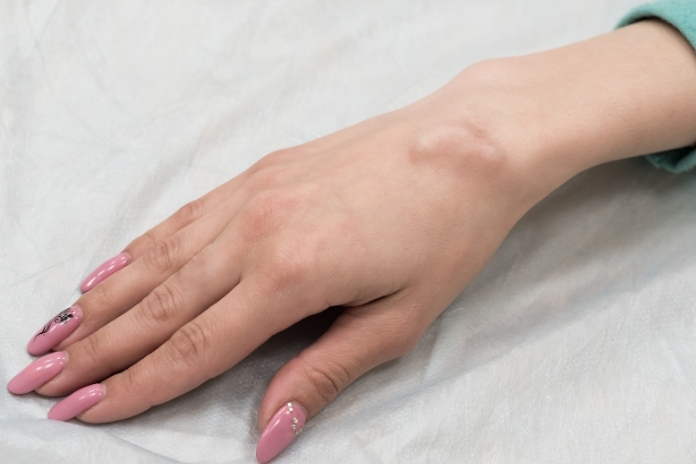
Ganglion and synovial cysts often look almost the same when you first see them: smooth, round, and usually not very painful. Even experienced doctors sometimes need imaging or some extra tests to tell them apart. Both show up as a fluid-filled lump near a joint or tendons.
But the way they form and what they mean for your joint health can be quite different. It’s just a harmless little pocket of fluid, not really a big deal. However, it may point to bigger problems, like your joints wearing down or not staying stable. They can seem pretty similar at first glance, but what’s happening inside tells a different story.
Telling them apart isn’t just splitting medical hairs. It actually shapes how doctors treat you, whether the problem comes back, and if there’s something deeper in your joint that needs attention. In this article, we’ll break down the main differences between ganglion and synovial cysts, where they show up, what sets them apart, and why that matters.
Read More: Fibroids vs. Ovarian Cysts: Know the Difference
Why Distinguishing Between Ganglion and Synovial Cysts Matters
Initially, both cysts appear to be harmless. They are fluid-filled, benign, and frequently grow slowly. They have different origins, though, and this discrepancy has significant clinical ramifications.
The synovial membrane, which lines the joint and secretes synovial fluid, is the source of synovial cysts. They are typically associated with arthritis or joint deterioration. Tissue usually covers synovial cysts that form around larger joints like the knee, hip, shoulder, or spine. They might or might not be attached to the cavity of a joint.
Ganglion cysts typically originate from the tendon sheath or joint capsule lining that connects to the joint cavity. In contrast to synovial cysts, these are noticeable lumps that develop on the hands, wrists, or feet nearer the skin’s surface; they can also appear elsewhere. Ganglion cysts contain a jelly-like material that resembles synovial fluid.
“Ganglion cysts usually form due to an underlying issue in the joint or tendon,” said Dr. Tolga Turker, MD, an orthopedic surgeon with Banner University Medicine. He adds, “Treating the root cause can help prevent them from coming back.”
Both types of cysts can produce similar symptoms, such as pain or discomfort, and are usually benign. These can be mistaken for a carpal boss, which appears as a very similar mass.
Because misidentification can conceal more serious issues, this distinction is important. Recurrence or worsening of symptoms may result from treating the cyst alone and ignoring the joint issue.
The Presence (or Absence) of a Synovial Lining

Synovial Cysts Have a True Cellular Lining
Usually, synovial cysts develop close to joints as joint fluid expansions. The fact that they originate from the synovial lining is important since it distinguishes them from other collections of juxta-articular fluid. Consider a water-filled balloon.
When you press on one side, the water moves and may cause a bulge or extension on the other side, which is similar to how synovial cysts form. The popliteal cyst, also known as a Baker cyst, is the most prevalent form, and it develops behind the knee when joint fluid leaks into the surrounding tissues through a tiny opening.
Ganglion Cysts Do Not Have This Lining
Each ganglion cyst has a distinct history. Instead of showing up at a joint like synovial counterparts, they typically show up along tendons or joints in your hands or feet. Ganglion cysts are isolated formations that contain a thick, jelly-like fluid, in contrast to synovial cysts, which communicate with joints through holes.
Why This Difference Is Easy to Miss
Due to their infrequency and lack of knowledge, ganglion and synovial cysts are often used interchangeably, which may be very confusing. However, ganglion and synovial cysts are distinct pathological processes that can be differentiated histologically by the presence or absence of synovial lining.
Although this structural difference appears important, it is difficult to detect without microscopic inspection. Several instruments will be employed during your appointment to establish a diagnosis and a course of treatment.
A CT scan, which is also known as a computed tomography scan, is a kind of imaging produced by combining multiple X-ray images captured by a rotating scanner. A computer combines these X-rays to display soft tissues and organs. Tumors, infections, and bleeding can all be detected using a CT scan.
An MRI, or magnetic resonance imaging scan, is a non-invasive imaging technique that creates images of soft tissues by passing a radiofrequency current through your body with magnetic fields. Physicians can detect anomalies such as aneurysms and damage to muscles or ligaments using MRI. There is no radiation exposure during an MRI.
An X-ray is a particular kind of image produced by electromagnetic radiation that travels through your body. To aid in diagnosing anomalies or injuries, these waves capture images of bones, organs, and tissues.
Read More: Heal Sebaceous Cysts Naturally: 18 Effective Home Remedies
Location and Underlying Joint Association

The cyst’s location on the body can provide important clues about its type.
Synovial Cysts Appear in Arthritic or Degenerative Joints
As you age, you may develop synovial cysts and have associated degenerative changes. Those over 65 are more likely to experience them. The facet joints of the spine, which are situated between the bony projections at the rear of the vertebrae, are where the cysts develop.
They appear when a cyst forms from the accumulation of synovial fluid, a viscous substance that lubricates your joints. In an effort to keep your aging joints lubricated, your body may produce more synovial fluid; this excess can lead to the formation of a cyst. Joint conditions like rheumatoid arthritis can also lead to synovial cyst formation, which is not malignant.
Ganglion Cysts Favor Smaller Joints
Usually found along the tendons or joints of the hands or wrists, ganglion cysts are bumps. They can also happen to the feet and ankles. Usually circular or oval, ganglion cysts contain a jelly-like substance. They’re not cancer.
Pea-sized ganglion cysts are possible. They can shift size. If a ganglion cyst presses against a neighboring nerve, it may cause pain. They can occasionally impair joint mobility.
A medical professional may use a needle to drain a problematic ganglion cyst.
Overlap That Causes Confusion
Things aren’t always clear-cut, even with these general patterns. Cysts pop up around tendons that cross a few joints or in tricky spots like the ankle or the back of the hand. When that happens, telling a ganglion apart from a synovial cyst isn’t so easy.
How Doctors Tell Them Apart (and Why It’s Tricky)
You may note down the cyst’s exact spot, its size, and whether it looks the same from edge to edge. Examine the surrounding tissues and observe how blood flows through the area. Moreover, if the mass is filled with fluid and you are experiencing pain, seek medical attention immediately.
You need both imaging and a good hands-on exam to really tell these cysts apart. MRI gives you clearer images, especially when the cyst hides deep in a joint or near the spine. It helps identify exactly where the cyst started and whether the nearby joints are breaking down.
When to See a Specialist

If your joints hurt or swell, or if you spot a lump on your skin that won’t go away, don’t wait around hoping it’ll fix itself. See your doctor. Catching it early prevents it from becoming bigger issues, like cysts. Your doctor will advise you to get started on the right treatment so you can start feeling better.
Read More: Water on the Knee: Causes, Symptoms, and How to Treat It
Conclusion
Ganglion and synovial cysts might look alike, but they’re pretty different once you dig in. Synovial cysts actually come from the joint lining itself and often show up when there’s some degeneration or instability in the joint.
Ganglion cysts, on the other hand, usually pop up near smaller joints and are filled with a thick, jelly-like fluid. They are more reactive than a direct extension of the joint. Knowing the difference really does help when figuring out how to treat them, whether that means draining the fluid, keeping an eye on it, or addressing bigger joint issues.
Even though most cysts aren’t dangerous, don’t ignore pain, swelling, or any weird nerve symptoms. Those are signs indicating you must visit your doctor promptly.
References
- UK HealthCare. Ganglion & synovial cysts.
- UK HealthCare. Ganglion & Synovial Cysts Diagnosis.
- Alabama Neurological Surgery & Spine. (2023, June 1). Synovial cysts—A lesser-known cause of back pain.
- UPMC. (2025, June 26). Synovial cyst: Causes, symptoms, and treatments.
- Mayo Clinic Staff. (2023, January 12). Ganglion cyst: Symptoms and causes.
In this Article