

















Your first period can feel exciting, confusing, and a little intimidating. If you’re noticing first period signs, wondering what to expect during your first period, or seeing vaginal discharge before your period, you’re not alone.
Many teens search for questions like “first period age,” “first period color,” or “how to prepare for first period” because early changes in your body can feel unpredictable. Doctors call this milestone menarche (the first menstrual period in a person’s life).
It usually happens between ages 9 and 15 and signals that your reproductive system has begun its natural cycle. And here’s the reassuring truth. Almost every person with a uterus goes through this stage, and most of the worries you might have are completely normal.
This guide walks you through the real science behind your first period. You’ll learn the timeline of puberty changes, what first-period blood actually looks like, why early cycles can be irregular, how to choose period products, and when it’s worth talking to a doctor.
- Your first period usually arrives between ages 9 and 15 and may start as light spotting that lasts a few days.
- Early cycles often remain irregular because the hypothalamic-pituitary-ovarian (HPO) axis, which controls ovulation, takes time to mature.
- Prepare with a simple period kit, start tracking cycles early, and remember the 7-2-1 rule for heavy bleeding.
Read More: What No One Tells You About Your First Period After Pregnancy
Signs Your First Period Is Coming and How to Read the Timeline
Puberty rarely starts with a period. Your body usually sends signals years beforehand. Think of puberty like a domino chain. One change nudges the next. The first visible step often involves the larche (the start of breast development). This typically appears about two to two and a half years before the first period, according to pediatric endocrinology research.
Next comes a growth spurt. Many teens shoot up several inches in height during the year before their first period. Body hair follows. Pubic and underarm hair usually appear as adrenarche (activation of adrenal hormones during puberty) progresses.
Then comes one of the clearest signals. You may notice vaginal discharge before your period, often white, clear, or slightly yellowish. This discharge reflects rising estrogen levels and normal vaginal cell turnover. Most teens get their first period six to twelve months after discharge begins, according to pediatric gynecology data (American Academy of Pediatrics).
In the days before your first period, you might notice:
- Mild cramps
- Bloating
- Breast tenderness
- Mood swings
Not everyone follows the exact same timeline. Bodies move at their own pace.
As Dr. Julie Strickland, pediatric gynecologist at the University of Missouri School of Medicine, explains, “Puberty unfolds in predictable stages, but the exact timing varies widely. What matters more than the exact age is whether development progresses steadily.” Her observation reflects clinical research on puberty progression.
When Does the First Period Usually Happen? (First Period Age)
Most first periods appear between ages 9 and 15. In the United States, the average first period age sits around 12 to 12.5 years, according to epidemiologic data. Nearly 98 percent of people experience menarche by age 15. Still, there is no single “correct” age. Family history often offers clues. If your mother started menstruating at 13, your timing may fall near that range.
Several factors influence when periods begin:
- Body weight and nutrition
- Genetics
- Stress levels
- Intense athletic training
Doctors recommend evaluation if no period appears by age 15 or if no signs of puberty appear by age 13. Physicians call this primary amenorrhea (absence of menstruation by the expected age of puberty). Most of the time, delayed periods simply reflect slower development. But checking ensures no underlying hormonal issues exist.
What Your First Period Looks and Feels Like
What Period Blood Looks Like—Color, Clots, and What’s Normal
Many people expect bright red blood. But the first period color often surprises people, which is mostly brown. And that’s completely normal. Brown blood means the blood moved slowly through the uterus and oxidized when exposed to oxygen. Doctors call this oxidized menstrual blood, and it commonly appears at the beginning or end of a cycle.
During one period, the color may shift from brown to bright red, then to dark red and brown again. These color changes reflect different flow speeds. You might also see small clots or stringy tissue. Those pieces represent the endometrium (the uterine lining that thickens each month) shedding.
Small clots up to about 1 inch in diameter remain normal. Research on menstrual physiology confirms that clotting occurs when menstrual flow briefly pools before exiting the uterus (NIH menstrual physiology review).
As Dr. Karen Tang, gynecologic surgeon and educator at Mount Sinai Hospital, explains, “Many teens worry when their first period looks brown or spotty. In reality, light brown spotting is one of the most common ways periods start.”
How Long It Lasts and What It Feels Like
A first period usually lasts between two and seven days. But many first cycles stay lighter and shorter. Some last only one to three days. Cramps can appear, too. Doctors call them dysmenorrhea (painful uterine contractions during menstruation). The uterus releases prostaglandins (hormone-like chemicals that trigger muscle contractions) to shed its lining.
That contraction creates the familiar cramping sensation. You might also notice:
- Lower back discomfort
- Fatigue
- Headaches
- Bloating
- Breast tenderness
Most people change pads or tampons three to six times on the heaviest day. Heat packs and ibuprofen (a non-steroidal anti-inflammatory drug that blocks prostaglandins) often provide the strongest relief according to clinical trials.
Why Your First Few Periods Will Probably Be Irregular — and Why That’s Fine
Here’s the part many articles skip. Early periods rarely follow a predictable schedule. During the first one to two years after menarche, cycles often stay irregular. Some arrive after 25 days. Others show up after 40.
This happens because the hypothalamic-pituitary-ovarian axis (HPO axis, the hormonal communication network controlling ovulation) still matures. The brain, ovaries, and pituitary gland must learn to coordinate hormone signals.
Until that happens, cycles often remain anovulatory cycles (menstrual cycles without ovulation). Research shows that up to half of cycles during the first year after menarche do not involve ovulation.
Think of it like learning to ride a bike. The system wobbles at first. Then it stabilizes. During these early years, a normal cycle range sits between 21 and 45 days according to adolescent health guidelines (ACOG guidance). Start tracking periods early. A simple calendar or tracking period app, teen version, helps you notice patterns.
See a doctor if:
- Cycles stay irregular beyond three years
- You miss three periods in a row
- Cycles regularly fall shorter than 21 days or longer than 45 days
Period Products — Which One to Start With and How They Compare
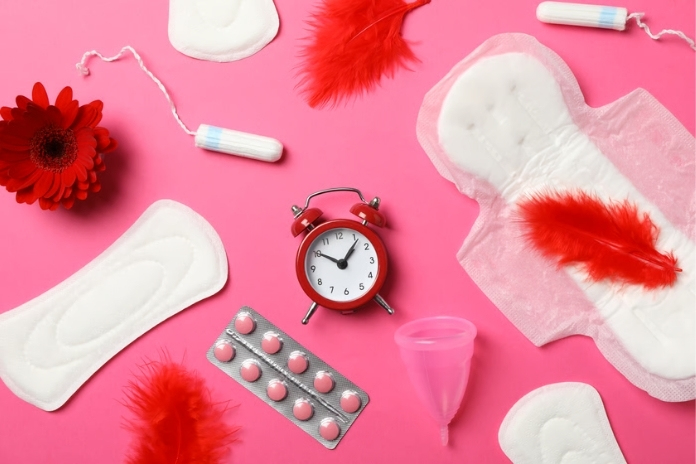
Walking into the menstrual product aisle can feel overwhelming. Pads, tampons, cups, discs, period underwear. So many options. Start simple. Pads usually work best for the first period. They stick to underwear and collect menstrual flow without insertion. They also allow you to monitor flow easily.
Period underwear offers comfort and reusability. But many pairs absorb only 1 to 3 milliliters of fluid, far less than the up to 30 milliliters typical for a full menstrual cycle, according to menstrual product research (NIH absorbency review). That means underwear works best as backup protection rather than your only product on heavy days.
Tampons also remain safe for teens. Choose slim or “junior” versions with applicators. Change them every 4 to 8 hours to prevent TSS (toxic shock syndrome, a rare bacterial infection) according to CDC safety guidelines. Menstrual cups and discs hold larger volumes of fluid and can stay in place for up to 12 hours.
Many teens try them later once they feel comfortable with internal products. A helpful strategy combines products. Tampon or cup for flow, period underwear for backup.
Your Period Is a Health Signal — Here’s Why Tracking It Matters
Doctors increasingly view the menstrual cycle as a health indicator. The American College of Obstetricians and Gynecologists describes menstruation as a “vital sign” in adolescents, similar to pulse or blood pressure (ACOG clinical opinion), since menstrual changes often signal underlying health conditions.
Irregular cycles can sometimes reflect:
- Thyroid disorders
- PCOS (polycystic ovary syndrome, a hormonal disorder causing irregular ovulation)
- Iron-deficiency anemia
Tracking cycles takes less than a minute each month. Mark the first day of bleeding. Note flow intensity and symptoms. That simple record can provide one of the most useful clues during a doctor’s appointment.
When to Talk to a Doctor About Your Period
Most first periods fall completely within the normal range. Still, some patterns deserve attention. Doctors often use the 7-2-1 rule as a screening tool for heavy bleeding:
- Periods last 7 days or longer regularly
- You must change products every 2 hours for several hours
- Clots appear larger than 1 inch
These patterns can signal menorrhagia (abnormally heavy menstrual bleeding). In some teens, heavy bleeding from the very first period suggests a bleeding disorder such as VWD (von Willebrand disease, the most common inherited bleeding disorder). Research estimates up to 20 percent of adolescents with heavy menstrual bleeding have an underlying bleeding disorder.
Treatment often works well once doctors identify the cause. You should also speak to a doctor if:
- Severe cramps make you miss school
- No period appears by age 15
- You miss three periods in a row
- Periods cause dizziness or fainting
Asking questions early helps doctors protect your long-term health.
How to Prepare for First Period — Building a Period Kit
Preparation removes most of the stress around a first period. A small period kit for teens makes everything easier. Wear dark underwear on days you expect your period. Many schools now keep menstrual products in bathrooms or nurses’ offices. Asking for them feels normal.
Think of a period kit like carrying an umbrella. You hope you won’t need it that day. But it feels great knowing it’s there.
Read More: Did Your Grandma Just Have ‘Bad Periods’? How to Recognize Hidden Endometriosis in Your Family Tree
Final Word
Your first period isn’t just a one-time event; it marks the beginning of a natural rhythm your body will learn to regulate over time. In the early months, cycles may feel irregular, light, or unpredictable, and that’s completely normal.
Instead of aiming for perfect cycles, focus on understanding your body’s patterns. Simple habits like tracking your period and keeping a basic period kit can make a big difference. Over time, you’ll become more confident in recognizing what’s typical for you.
Remember, your period is also a useful health signal, not just a monthly inconvenience.
If something feels unusual, like very heavy bleeding or severe pain, it’s always okay to seek medical advice. With time and awareness, this once-confusing experience becomes just another manageable part of your routine.
- Your first period marks the start of a natural body process, not a medical problem.
- Most early cycles look irregular, lighter, or browner than expected.
- Track your cycles, keep a simple period kit ready, and remember the 7-2-1 rule for heavy bleeding. Knowledge makes this milestone far less mysterious.
FAQs
1. Is it normal for my first period to be brown instead of red?
Yes. Brown blood appears when menstrual blood oxidizes before leaving the body. Early cycles often start with light brown spotting, which research on menstrual physiology identifies as a common pattern (NIH menstrual physiology review).
2. How long does a first period last?
Most first periods last between two and seven days. Some teens experience only light spotting for one to three days because hormone levels still stabilize during early cycles (ACOG adolescent guideline).
3. My cycle is totally random after my first period. Is that normal?
Yes. Many early cycles remain anovulatory, meaning the body skips ovulation while the hormonal system matures. Research shows irregular cycles commonly occur during the first two years after menarche.
4. What period products should teens start with?
Pads often work best for beginners because they require no insertion. Tampons and menstrual cups remain safe options once you feel comfortable, as long as you follow recommended usage guidelines.
5. Why do I get cramps during my first period?
Cramps happen when prostaglandins trigger uterine contractions to shed the lining. Anti-inflammatory medications like ibuprofen reduce prostaglandin production and help relieve pain.
References
- American College of Obstetricians and Gynecologists. (2015). Menstruation in girls and adolescents: Using the menstrual cycle as a vital sign.
- Fraser, I. S., et al. (2015). Normal and abnormal uterine bleeding. Lancet, 385(9980), 1481–1491.
- Hillard, P. J. A. (2014). Menstruation in adolescents: What’s normal and what’s not. Annals of the New York Academy of Sciences, 1135, 29–35.
- Klein, D. A., & Poth, M. A. (2013). Amenorrhea: An approach to diagnosis and management. American Family Physician, 87(11), 781–788.
- Kouides, P. A., et al. (2009). Gynecologic and obstetric morbidity in women with von Willebrand disease. Haemophilia, 15(5), 1155–1160.
- Proctor, M., et al. (2009). Nonsteroidal anti-inflammatory drugs for primary dysmenorrhea. Cochrane Database of Systematic Reviews.
- Sommer, M., et al. (2019). Menstrual hygiene management and product absorbency research. PLOS One.
- Stricker, T., et al. (2010). Pubertal development and timing of menarche. Pediatrics.
In this Article