














Marcus had been going to the same park three mornings a week for six months. He’d hit the air walker for fifteen minutes, do a few chin-ups until his arms gave out, then call it a session. After half a year, he looked the same. The equipment wasn’t the problem. His approach was. Park workout for muscle gain is not about showing up consistently to the same low-intensity movement patterns.
It is about applying the same principles that drive growth in a gym: mechanical tension, progressive overload, sufficient volume, and structured recovery, applied to a different set of tools. This guide, built on the principles of physical therapy and exercise science, explains exactly how to do that.
- Park workout for muscle gain works by applying the same principles that drive gym-based hypertrophy: mechanical tension, progressive overload, training volume, and recovery.
- Muscle hypertrophy is load-independent when sets are taken close to failure, meaning bodyweight on park equipment is a legitimate stimulus for growth.
- Most park workouts fail to build muscle because they rely on cardio-focused equipment, lack progressive overload, and accumulate insufficient weekly volume per muscle group.
- Pull-up bars, parallel bars, and park benches cover every major muscle group when used with structured tempo, unilateral loading, and systematic progression.
Can You Actually Build Muscle Using Outdoor Park Equipment?
Yes. The biological requirements for muscle hypertrophy do not change based on whether you are gripping a barbell or a pull-up bar. What drives muscle growth is mechanical tension, progressive challenge, adequate training volume, and recovery time. Park equipment, used correctly, delivers all four. Mechanical tension is the primary driver of muscle growth.
It occurs when a muscle generates force under load, triggering the cellular stress that initiates protein synthesis. Progressive overload means that the stimulus must increase over time for adaptation to continue. Volume, measured in working sets per muscle group per week, needs to reach a sufficient threshold. And recovery, encompassing sleep, nutrition, and rest between sessions, is when the adaptations actually take hold.
A 2021 systematic review and network meta-analysis published in Medicine and Science in Sports and Exercise found that improvements in muscle hypertrophy are load-independent when sets are performed to volitional failure. Low, moderate, and heavy loads all produce comparable muscle growth when effort is held constant.
This finding is directly applicable to bodyweight training: the absence of external weight does not prevent hypertrophy. What matters is proximity to failure and sufficient total volume.
Bodyweight functions as scalable resistance through leverage and position. A push-up becomes significantly harder when the feet are elevated on a bench. An inverted row becomes easier when the feet are grounded versus raised. Tempo manipulation adds mechanical tension without altering load; slowing the eccentric phase of a pull-up to four seconds dramatically increases time under tension.
Single-limb loading, such as a Bulgarian split squat with the rear foot on a bench, concentrates nearly your full bodyweight through one leg. Range-of-motion adjustments, such as deepening a squat or performing a full dip, increase mechanical stimulus at the muscle’s lengthened position, where the growth signal is strongest.
Why Most Park Workouts Fail to Build Muscle
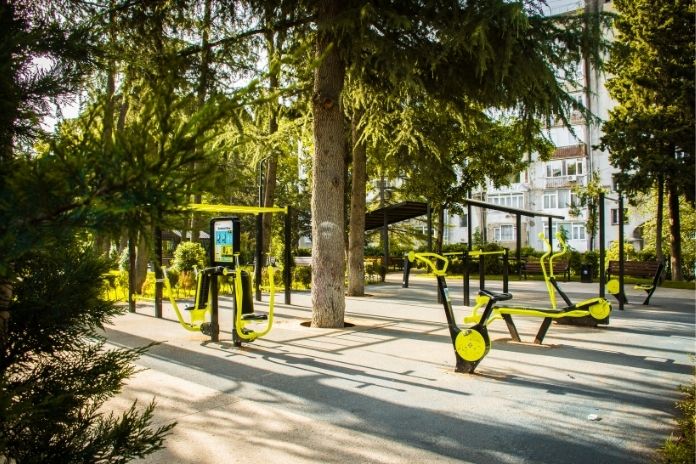
The air walker is a warm-up tool, not a hypertrophy tool. It creates minimal mechanical tension in any major muscle group. Using it as the centerpiece of a session will maintain light cardiovascular fitness and nothing else. Doing the same number of pull-ups in the same way for months does not provide a sufficient growth signal. The body quickly adapts to a stimulus.
Without systematic progression through reps, tempo, reduced rest, or increased exercise difficulty, there is no reason for the muscle to grow. Most casual park users hit one or two movements without tracking sets, without organizing push, pull, and leg work, and without accumulating enough weekly sets per muscle group.
A 2022 systematic review in the Journal of Human Kinetics found that 12 to 20 weekly sets per muscle group may represent the optimal range for maximizing hypertrophy in trained individuals. That requires structure, not improvisation.
Key Hypertrophy Principles Applied to Park-Based Training
Progressive Overload Without Adding Weights
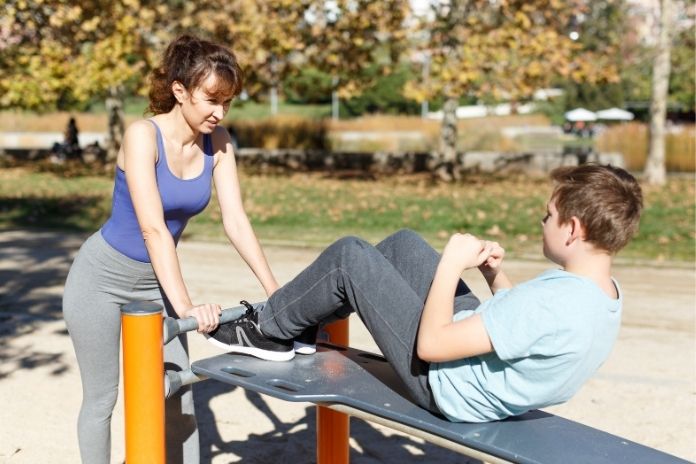
In the gym, progressive overload means adding weight to the bar. At the park, it means systematically increasing challenge through reps, sets, reduced rest, tempo, and harder variations. Adding one rep per set per week across a six-week block is meaningful progression.
Slowing the lowering phase from two seconds to four seconds doubles the time under tension without changing the exercise. Moving from a two-leg squat to a Bulgarian split squat, from a standard pull-up to a slow-tempo chin-up, or from a flat push-up to a decline push-up are all legitimate overload strategies.
Increasing Time Under Tension
Time under tension refers to the total duration a muscle is loaded during a set. Longer sets at controlled tempo increase both metabolic stress and mechanical tension. At the park, this is your primary tool for making accessible exercises genuinely hard.
A two-second pause at the bottom of a dip, a three-second eccentric on every inverted row, or a deliberate four-count descent on a Bulgarian split squat all produce significantly greater growth stimulus than moving at a casual pace.
Using Unilateral Movements for More Load
Unilateral exercises are one of the most underused tools in outdoor hypertrophy training. A Bulgarian split squat loads the front leg with nearly your entire bodyweight while simultaneously demanding hip stabilizer engagement. Single-leg hip thrusts off a bench are genuinely challenging even for experienced trainees.
Archer push-ups, in which one arm extends laterally while the other presses, shift the load significantly toward one side. These movements allow bodyweight to function like a much heavier load.
Training Close to Muscle Fatigue Safely
A 2022 meta-analysis in the Journal of Sport and Health Science found no significant difference in hypertrophy between training taken to full volitional failure and stopping two to three reps short, when total volume is matched. The practical implication is clear: you do not need to grind every set to absolute failure, but you need to come close.
Completing a set of pull-ups with five easy reps left in reserve does not constitute a meaningful hypertrophic stimulus. Aiming for one to three reps in reserve on most sets, with occasional sets pushed to or near failure, is the evidence-based target.
Dr. Brad Schoenfeld, PhD, Professor of Health Sciences at CUNY Lehman College and one of the world’s most-cited researchers in muscle hypertrophy, has stated that resistance training, including exercises performed against one’s own body weight, exerts powerful forces on the muscle that are entirely capable of stimulating meaningful adaptation.
Best Park Equipment for Building Muscle (And How to Use It)
Pull-Up Bars for Upper Body Hypertrophy
The pull-up bar is the most effective piece of equipment in any outdoor park for upper-body muscle development. Standard pull-ups and chin-ups train the latissimus dorsi, biceps, and rear deltoids through a long range of motion. Inverted rows, performed by lying under a low bar and pulling the chest up to it, train the same muscle groups at adjustable difficulty based on foot position.
Hanging knee raises recruit the rectus abdominis and hip flexors under load. As strength increases, progressions include slow-tempo pull-ups, archer variations, and weighted pull-ups using a loaded backpack.
Read More: Biceps vs. Triceps: Which Muscle Group Really Makes Your Arms Look Bigger?
Parallel Bars for Push and Core Strength
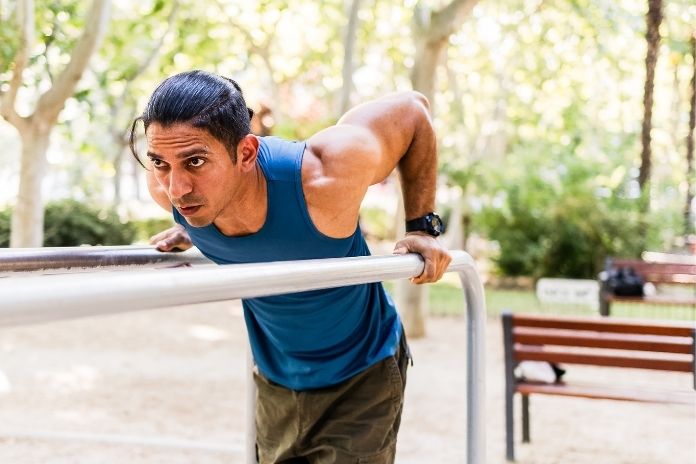
Parallel bars allow for deep-range pressing that floor push-ups cannot replicate. Dips with an upright torso primarily train the triceps and anterior deltoids. Leaning the torso forward during the movement shifts more load onto the pectorals.
L-sit holds, in which you support your body between the bars with legs extended horizontally, create intense isometric core demand and build pressing-muscle endurance simultaneously. Decline push-ups with feet elevated target the upper chest and anterior deltoid more directly than flat push-up variations.
Read More: What Happens When You Do 20 Push-Ups Every Morning? 10 Surprising Benefits
Benches for Lower Body Development
A standard park bench unlocks legitimate lower-body hypertrophy work. Bulgarian split squats, performed with the rear foot elevated on the seat, train the quadriceps, glutes, and hip stabilizers through a full range of motion with concentrated load.
Step-ups target the same muscle groups with a slightly different motor pattern and allow progression through step height or controlled tempo. Single-leg hip thrusts with the upper back on the bench produce strong glute activation that bilateral variations rarely match.
Monkey Bars for Grip and Back Activation
Monkey bars develop grip strength and scapular stability, both of which carry over directly to pull-up performance and overall upper-body health. Dead hangs, scapular retractions, and bar-to-bar transitions build the foundational shoulder and back endurance that makes heavier pulling work safer and more productive over time.
The Air Walker: When It Is Useful and When It Is Not
The air walker is an effective warm-up tool. It moves the hips and shoulders through a broad, low-impact range of motion and gently elevates heart rate before more demanding work. It does not create meaningful mechanical tension in any major muscle group and should not constitute more than three to five minutes of a session if hypertrophy is the goal.
Sample Full-Body Park Hypertrophy Workout
This session uses three to four sets per exercise, with 60 to 90 seconds of rest, and a two-second concentric and a three-second eccentric on all movements.
- Lower Body: Bulgarian split squats, 4 sets of 8 to 10 reps per leg. Step-ups with a three-second lowering phase, 3 sets of 10 to 12 reps per leg. Single-leg hip thrusts on the bench, 3 sets of 10 to 12 reps per leg.
- Upper Body Push: Dips with a three-second lowering phase, 4 sets of 8 to 10 reps. Decline push-ups, 3 sets of 12 to 15 reps. Incline push-ups as a finishing burnout, 2 sets to near failure.
- Upper Body Pull: Inverted rows with a two-second pause at the top, 4 sets of 8 to 12 reps. Pull-ups or chin-ups with a four-second eccentric, 3 sets of 5 to 8 reps, or as many as possible with controlled form.
- Core and Stability: Hanging knee raises, 3 sets of 12 reps. Plank hold, 3 rounds of 45 seconds. L-sit hold for 10 to 20 seconds, 3 rounds.
How to Progress Your Park Workouts Week to Week
Track every set, rep, and tempo. Each session should show at least minor improvement over the previous one, even if that means one additional rep on a single exercise. When you can complete the full top of a rep range across all sets with good form, advance the difficulty through slower tempo, reduced rest, or a harder exercise progression.
Signs that the muscle is not being sufficiently challenged include completing every set without meaningful fatigue near the end, consistently hitting the top of the rep range without effort, and flat performance across multiple consecutive sessions. These are signals to advance the progression, not to add more sets of the same exercise.
Injury Prevention Tips from a Physical Therapist
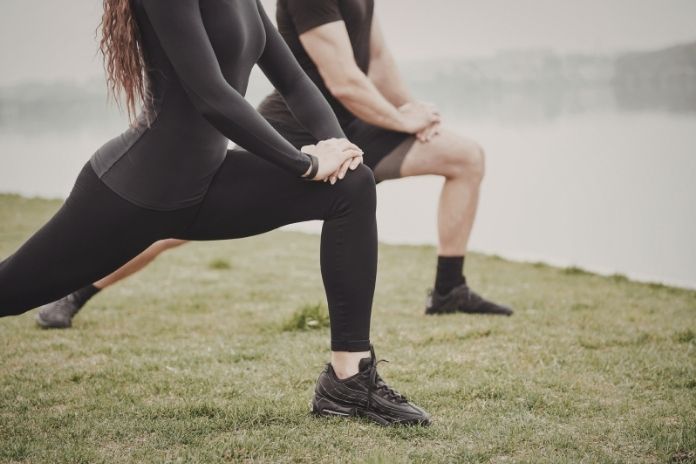
Before any pulling or pressing work, spend five minutes on dynamic movement. Hip circles, arm circles, scapular wall slides against any available surface, and bodyweight squats through full range prime the joints for loaded work. Rushing from the car directly to a pull-up bar is how shoulder impingement develops.
Samantha Stewart, PT, DPT, a physical therapist at Hinge Health, has noted that if your shoulders are not strong enough to support the demand placed on them, surrounding muscles must work harder to compensate, which leads to strain and irritation.
For pull-ups, this means initiating with scapular retractions before pulling and maintaining active shoulder engagement throughout the set. For dips, keeping the elbows tracking back rather than flaring wide protects the anterior capsule.
Not every person can load a deep Bulgarian split squat from the start. Reducing the range of motion, elevating the front foot slightly, or beginning with step-ups before progressing to split squats allows the knee to adapt progressively without pain.
Renee Bullis, PT, DPT, a physical therapist at Hinge Health, has noted that bodyweight exercises offer many different ways to vary movements and make them appropriate regardless of the fitness level, and that varying the stimulus is just as important as maintaining consistency.
Training the same push, pull, and leg patterns daily without rest can lead to overuse injuries. Two to three sessions per week with at least one rest day between same-muscle sessions is the evidence-supported structure.
Read More: 11 Energizing Squat Alternatives for Bad Knees
Who Benefits Most from Park-Based Hypertrophy Training?
Beginners building foundational strength gain significantly from park-based training because bodyweight movements produce sufficient mechanical tension for meaningful adaptation at lower strength levels. People without gym access get a complete outdoor gym environment for hypertrophy at no cost.
Travelers can maintain training continuity across any geography. Individuals returning to exercise after a break find park movements accessible and adjustable. Those combining cardiovascular and strength work outdoors can structure a park session to accomplish both efficiently.
When Park Training May Not Be Enough for Muscle Growth
Advanced trainees who can comfortably perform 15 or more controlled pull-ups, multiple heavy sets of deep dips, and loaded Bulgarian split squats close to failure have extracted most of the hypertrophy potential from unloaded bodyweight training.
At that point, adding external resistance through a weighted vest, loaded backpack, or resistance bands becomes necessary. Lower body development is particularly constrained by bodyweight alone, as the legs are accustomed to carrying full bodyweight and need significantly more load to keep responding.
Dylan Peterson, PT, DPT, former physical therapist at Hinge Health, has stated that “not moving is riskier than moving despite some pain,” and that consistent progressive movement matters more than waiting for perfect conditions or equipment.
Read More: Resistance Bands for Arm Strength: A Beginner’s Guide
Practical Takeaway: How to Turn Any Park Into a Muscle-Building Gym
The park workout for muscle gain is not defined by what equipment is available. It is defined by how the equipment is used. Prioritize progressive overload by advancing reps, tempo, or exercise difficulty every one to two weeks. Use unilateral movements to concentrate the load per limb. Train close to fatigue on every working set.
Track your performance across sessions. Prioritize consistency over equipment variety. A pull-up bar, a park bench, and a structured plan are sufficient to produce real, measurable muscle growth for the vast majority of people who use them correctly.
References
- Bernárdez-Vázquez, R., Raya-González, J., Castillo, D., & Beato, M. (2022). Resistance training variables for optimization of muscle hypertrophy: An umbrella review. Frontiers in Sports and Active Living, 4, 949021.
- Baz-Valle, E., Balsalobre-Fernández, C., Alix-Fages, C., & Santos-Concejero, J. (2022). A systematic review of the effects of different resistance training volumes on muscle hypertrophy. Journal of Human Kinetics, 81, 199–210.
- Grgic, J., Schoenfeld, B. J., Orazem, J., & Sabol, F. (2022). Effects of resistance training performed to repetition failure or non-failure on muscular strength and hypertrophy: A systematic review and meta-analysis. Journal of Sport and Health Science, 11(2), 202–211.
- Lopez, P., Radaelli, R., Taaffe, D. R., Newton, R. U., Galvão, D. A., Trajano, G. S., Teodoro, J. L., Kraemer, W. J., Häkkinen, K., & Pinto, R. S. (2021). Resistance training load effects on muscle hypertrophy and strength gain: Systematic review and network meta-analysis. Medicine and Science in Sports and Exercise, 53(6), 1206–1216.
- Peterson, D. (n.d.). Physical therapy for shoulder pain: Tips and best exercises. Hinge Health.
- Schoenfeld, B. J. (n.d.). Faculty profile. CUNY Lehman College, Department of Health Sciences.
- Schoenfeld, B. J. (2019). The mechanisms of muscle hypertrophy and their application to resistance training.
- Science for Sport. (n.d.). Hypertrophy training.
- National Academy of Sports Medicine. (n.d.). Defining muscular hypertrophy and training for growth: Best practices.
- National Strength and Conditioning Association. (2016). Trainer tips: Hypertrophy training.
- Myprotein. (n.d.). What is hypertrophy training? Building muscle science.
- Papadopoulos, C., et al. (2024). Nutritional strategies and muscle hypertrophy. Nutrients, 17(22), 3603.
- Ben Jane Fitness. (n.d.). Hypertrophy: Anatomy and physiology.
- Chen, W., et al. (2025). Nutritional interventions in muscle hypertrophy research. Sports Medicine.
In this Article