













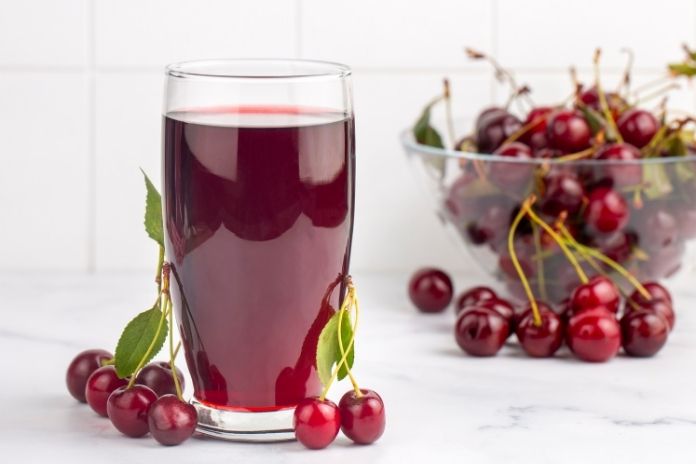
- Yes, cherry juice before bed can help you sleep. Studies show improvements in sleep duration and efficiency, but results vary from person to person.
- It works through multiple pathways: not just tart cherry melatonin, but also anthocyanins (anti-inflammatory) and tryptophan (supports serotonin and melatonin production).
- Best for mild sleep issues, not severe insomnia. Most benefits are seen in healthy adults; effects may be minimal in people with obesity or complex sleep disorders..
Yes, drinking cherry juice before bed does help with sleep — but the benefits are more specific, and more modest, than most wellness headlines suggest.
A January 2025 systematic review examining seven interventional studies found that three reported significant improvements in sleep indicators, including duration, efficiency, and onset time. Three of those studies also found measurable increases in melatonin levels after tart cherry consumption. That’s a real signal.
But the review also flagged large differences in dose, study duration, and participant populations across those trials, which is exactly why the results are promising but not definitive.
This article breaks down what the research actually found, who is most likely to benefit, and how to use tart cherry juice practically if you decide to try it.
The honest frame: the evidence is worth taking seriously, but it comes with meaningful caveats around small sample sizes, dose variability, and population differences.
Read More: Tart Cherry Health Benefits: 7 Evidence-Backed Reasons It’s More Than Just a Sleep Aid
What’s in Tart Cherry That Affects Sleep
Three Active Compounds: Not Just Melatonin
Most coverage of this topic reduces the story to melatonin alone. The research shows three distinct sleep-relevant mechanisms working together.
- Melatonin: The Sleep Signal
Consuming tart cherry juice concentrate increases exogenous melatonin in the body, which helps improve sleep duration and quality in healthy adults.
However, there’s an important caveat: cherry juice increased melatonin intake by approximately 85 micrograms per day, while the dose typically used to treat insomnia ranges from 0.5 to 5 milligrams per day — six to sixty times higher. This means tart cherry melatonin alone cannot account for the full sleep benefit.
- Anthocyanins: The Anti-Inflammatory Pathway
Tart cherries are rich in anthocyanins, potent antioxidant compounds that may improve sleep quality through anti-inflammatory mechanisms. Pro-inflammatory markers, including TNF and IL-1β, are elevated in people with sleep deprivation and insomnia, and tart cherry’s antioxidant activity may partially counter this inflammatory cycle.
- Tryptophan: The Serotonin Precursor
A 2018 pilot study found that a high dose of tart cherry juice increased tryptophan availability and reduced inflammation, both of which can support better sleep. Tryptophan is the dietary precursor to serotonin and melatonin, creating an upstream pathway through which tryptophan-cherry juice compounds may support sleep architecture beyond direct melatonin supplementation.
Notably, the effective dose in that study was derived from approximately 100 grams of cherries — the amount that delivers a biologically relevant combination of melatonin, anthocyanins, and tryptophan.
The interaction of these three pathways is what makes Montmorency cherry sleep research interesting: it’s not a single-ingredient story, which partly explains why results differ across studies that vary the dose and form of the supplement.
What the Clinical Research Actually Found
The Key Trials: What Changed and By How Much
The strongest evidence for tart cherry juice as a sleep aid comes from a randomized, double-blind, placebo-controlled crossover trial of 20 healthy adults aged 18 to 40. Participants consumed 30 mL of tart cherry juice concentrate twice daily for seven days. The results were statistically significant.
It’s important to distinguish between two separate metrics that are often conflated. Participants spent an additional 25 minutes in bed and gained an additional 34 minutes of total sleep time. These are two different measures. Sleep efficiency, which is the percentage of time in bed that you’re actually asleep (rather than lying awake), improved by 5 to 6 percent.
In older adults with insomnia, tart cherry juice showed the biggest improvement on the “waking after sleep onset” subscale of the Insomnia Severity Index. In other words, it was most helpful for people who fall asleep but wake during the night, rather than those who struggle to fall asleep in the first place.
This distinction matters when deciding whether cherry juice insomnia approaches might apply to your situation.
Where It Did Not Work: The 2024 Null Result
Not all studies support the idea that tart cherry juice sleep benefits are universal. A November 2024 randomized controlled crossover trial investigated whether Montmorency tart cherry powder improved sleep in people who were overweight or obese.
Researchers measured total sleep time, deep sleep, REM sleep, and nighttime awakenings. None of these measures improved compared to placebo after 14 days.
Why does this matter? Most studies supporting tart cherry juice’s benefits for sleep were conducted in healthy people or those with mild insomnia. The 2024 findings suggest that natural sleep aid approaches using cherry may not have the same effect in metabolically complex populations.
Read More: 7 Science-Backed Black Cherry Juice Benefits That Will Transform Your Health
How to Use It — Dose, Timing, and What Form to Choose
What the Research Protocols Actually Used
The studies that produced positive results used specific protocols, not a generic splash of juice. Here’s what actually appeared in the published trials:
Sleep Optimization
Tart Cherry Protocol
| Parameter | Research-Supported Approach |
|---|---|
| Type | Montmorency (Prunus cerasus) tart cherry. Not sweet cherry or generic cherry juice |
| Form | Juice concentrate or whole juice. Both have been studied with positive results; powder showed null results in overweight adults |
| Dose | 240 mL (8 oz) juice 30 mL concentrate twice daily |
| Timing | Once in the morning, once 1–2 hours before bed. This is the protocol used in the most cited trials |
| Duration | 7–14 Days At least 7 days before expecting measurable sleep change; up to 2 weeks for best results |
One important practical note: tart cherry juice is high in natural sugar, typically 25–30 grams per 240 mL serving. If you’re managing blood sugar, have diabetes, or are watching your caloric intake, factor this into your daily totals and consider talking with a registered dietitian before adding it regularly to your routine.
Who Is Most Likely to Benefit — And Who May Not
The Population Picture
Based on the trial populations where benefits were consistently observed, the evidence suggests that tart cherry juice sleep strategies work best for specific groups.
Most likely to benefit: healthy adults with mild sleep disruption, particularly those who wake during the night; and older adults with insomnia as measured by the Insomnia Severity Index, who showed meaningful improvements in cherry juice sleep efficiency and reduced nighttime awakenings.
Less clear evidence exists for people with overweight or obesity, those with moderate-to-severe clinical insomnia, people with sleep apnea, and athletes post-exercise.
One randomized controlled trial in elite female hockey players found that short-term tart cherry juice intake improved certain sleep quality variables but did not change melatonin or cortisol levels. A mixed result that illustrates how inconsistently the juice performs outside of the core healthy-adult population.
Tart cherry juice is not a replacement for evaluated and treated sleep disorders. If you consistently struggle with sleep, it works best as a complement to professional assessment, not a substitute for it.
Read More: Easy Guide To Start Vegan Diet For A Week—Make It Simpler
Conclusion
Tart cherry juice is one of the few natural sleep aid cherry options that has actually been tested in controlled clinical trials. The evidence shows it can increase total sleep time and improve sleep efficiency, but the effects are modest, population-dependent, and dose-specific.
Most of the positive studies were done on small groups of healthy or mildly insomniac adults, and the 2024 null result in overweight populations is a meaningful limitation that the research still needs to address.
The bottom line: if you’re a healthy adult with mild sleep issues and no blood sugar concerns, drinking 240 mL of Montmorency cherry sleep juice one to two hours before bedtime for at least two weeks is a low-risk, evidence-based option worth trying. Start with the concentrated form, which has the most consistent trial support, and give it a full two weeks before drawing conclusions.
References
- Losso, J. N., Finley, J. W., Karki, N., Liu, A. G., Pan, W., Prudente, A., Tipton, R., Yu, Y., & Greenway, F. L. (2018). Pilot study of tart cherry juice for the treatment of insomnia and investigation of mechanisms. American Journal of Therapeutics, 25(2), e194–e201.
- Tucker, R. M., et al. (2024). Commonly used dose of Montmorency tart cherry powder does not improve sleep or inflammation outcomes in individuals with overweight or obesity. Nutrients.
- Pigeon, W. R., Carr, M., Gorman, C., & Perlis, M. L. (2010). Effects of a tart cherry juice beverage on the sleep of older adults with insomnia: A pilot study. Journal of Medicinal Food, 13(3), 579–583.
- Howatson, G., Bell, P. G., Tallent, J., Middleton, B., McHugh, M. P., & Ellis, J. (2012). Effect of tart cherry juice (Prunus cerasus) on melatonin levels and enhanced sleep quality. European Journal of Nutrition, 51(8), 909–916.
- Barforoush, F., Ebrahimi, S., Karimian Abdar, M., Khademi, S., & Morshedzadeh, N. (2025). The effect of tart cherry on sleep quality and sleep disorders: A systematic review. Food Science & Nutrition, 13(9), e70923.
- Losso, J. N., et al. (2017). Pilot study of tart cherry juice for insomnia and mechanisms. PubMed Central.
In this Article