

















Strong, healthy bones are essential for overall health, especially as we age. Our bones provide the structural support that allows us to walk, ride a bike, and hold a child. They also store and release calcium while protecting our vital organs.
Calcium is crucial for cellular health throughout the body and plays a vital role in developing and maintaining healthy bones. However, certain individuals are more susceptible to osteoporosis—a condition characterized by bone thinning—because their bone metabolism results in excessive bone loss without adequate bone regeneration.
While exercise and a healthy diet are fundamental for bone health, they alone cannot address underlying metabolic issues. The National Institutes of Health (NIH) reports that half of Americans over 50 have compromised bone density. Fortunately, numerous strategies exist to prevent bone loss and promote new bone growth, regardless of age.
This article provides essential information about who should undergo bone density testing, how frequently these tests should be performed, and what to expect from the results.
Read More: 5 Essential Nutrients for Women’s Bone Health After 40
What is Bone Density Testing?
A bone density scan, also called a DEXA or DXA scan, is a low-dose X-ray that measures the amount of calcium and other minerals in your bones. Bones with higher mineral content are denser, stronger, and less susceptible to fractures. This measurement helps determine your bone thickness and strength, commonly referred to as bone density or bone mass.
As we age or develop certain medical conditions, our bones naturally become thinner. When bones become thinner than normal, the condition is called osteopenia. Bone density testing can identify osteoporosis, a more severe condition that makes bones extremely fragile and prone to breaking.
Osteoporosis is a progressive condition that causes bones to become dangerously thin and brittle. It primarily affects women over 65 and older adults in general, significantly increasing the risk of fractures, particularly in the wrists, hips, and spine.
Alternative names for this test include dual-energy X-ray absorptiometry scan, bone densitometry, dual X-ray absorptiometry, bone mineral density test (BMD), and DEXA scan.
Who Should Consider Bone Density Testing?
Healthcare providers recommend DEXA scans for women at age 65 and men at age 70. However, younger individuals between ages 50-69 should consider testing if they have risk factors for significant bone loss. Patients should always discuss the benefits and risks with their healthcare providers before deciding.
The U.S. Preventive Services Task Force currently does not recommend routine bone density testing for men, citing insufficient evidence that osteoporosis medications can prevent fractures in males. Men typically have larger baseline bone mass and experience slower bone loss with age, making fractures less likely compared to women.
However, other medical associations disagree and recommend testing for men over 70. Bone density testing may benefit men at risk for osteoporosis, enabling them to make lifestyle modifications to preserve bone strength and improve overall health.
According to Dr. Marcella Donovan Walker, an endocrinologist and medicine professor at Columbia University Vagelos College of Physicians and Surgeons, “A very high percentage of people—more women than men—have osteoporosis or low bone mass in older age. One in three women over 50 will suffer an osteoporosis-related fracture at some point in their lives.”
Additional risk factors include medications that impair bone regeneration, such as steroid drugs like prednisone and immunosuppressive medications used following organ or bone marrow transplants.
Read More: Plant-Based Eating and Bone Health: Are You Getting Enough Nutrients?
How Often Should Bone Density Testing Be Done?

Experts recommend routine bone density testing for older women to screen for osteoporosis, but the optimal frequency for repeat testing remains under study. Recent research involving nearly 5,000 women suggests that individuals with normal bone density on their initial test could safely delay rescreening for up to 15 years.
Osteoporosis affects approximately 40 million Americans who either have the condition or are at heightened risk due to poor bone mineral density (osteopenia). Often called a “silent disease,” osteoporosis typically develops gradually without symptoms until a fracture occurs. Early detection through screening allows individuals to preserve bone health and reduce fracture risk through lifestyle modifications and treatments.
What to Expect During a Bone Density Test
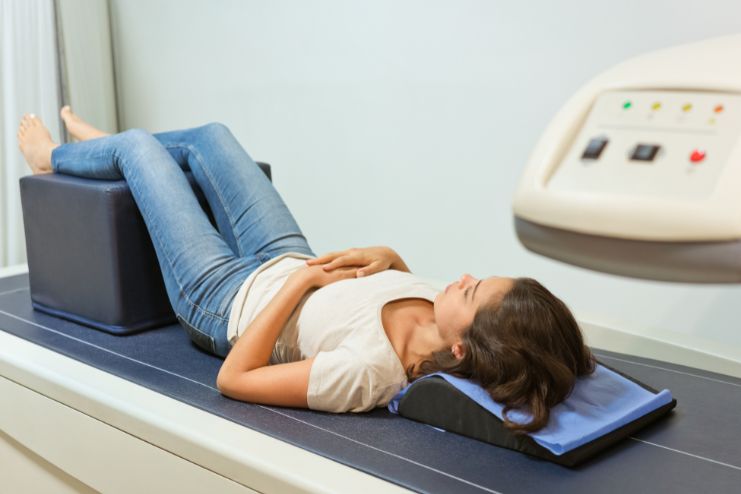
A DEXA scan typically takes about 10-15 minutes. You won’t need to change clothes unless they contain metal buttons, snaps, or zippers—cotton hospital gowns are available if needed. During the test, you’ll lie on a comfortable, padded table while the device’s scanner arm glides above you to examine your hip and spine.
The procedure is completely non-invasive, and the equipment is open—you won’t feel confined. The technologist will position you properly, which may involve placing your legs on a square cushion or moving your arms above your head. The table may shift occasionally for optimal positioning.
“To capture clear images, the technician will carefully position your legs, typically placing a foam block between your knees to help rotate your hips properly,” explains Dr. Corinne Ancona-Young, a family medicine physician with Sharp Community Medical Group.
You’ll need to remain still while the scanner arm passes over your hips and lower spine, capturing images of your bone structure with minimal radiation exposure. The test is quick, simple, and completely painless. The X-ray machine automatically transmits data to a computer, which calculates your bone tissue density.
Read More: 9 Astounding Foods For Stronger Bones
Understanding the Results
Bone density tests reveal age-related changes in your bones that occur naturally over time or due to other conditions. Bone mass typically decreases with aging, particularly in postmenopausal women, and excessive bone loss increases the risk of developing bone diseases.
Your results will include T-scores and Z-scores—two statistical measurements that compare your bone density to others of the same sex using standard deviation (SD) units.
The T-score compares your bone density to that of a healthy 30-year-old adult of the same sex, serving as the primary assessment tool. Healthcare professionals use this score to diagnose osteoporosis and osteopenia.
The Z-score compares your bone density to the average for people of your specific age and sex. For example, a Z-score of -1 or -2 SD indicates your bones are less dense than typical for your age group.
Z-scores are particularly useful for evaluating bone density in children, adolescents, premenopausal women, and men younger than 50. They can also help identify secondary osteoporosis caused by specific diseases, medications, or lifestyle factors.
Importance of Bone Density Testing

Bones are living tissues that undergo constant breakdown and regeneration. Osteoporosis develops when the body loses bone minerals (like calcium) faster than it can replace them. Fortunately, measuring bone strength allows doctors to detect and treat bone loss before it becomes problematic.
Bone density measurements help physicians determine if a patient has osteoporosis and faces an increased risk of dangerous fractures. Additionally, these measurements serve as crucial metrics for guiding future treatment decisions, especially when new complications arise.
“We can better assess a patient’s bone health through bone density testing,” says Dr. Erica Weitzner, an endocrinologist at Summit Health. “If a patient has osteoporosis, we can immediately explore treatment options to help prevent fractures. Our goal is to test people well before they experience any fractures.”
Read More: Yoga Positions To Strengthen Bones And Cure Osteoporosis
Conclusion
Bone density testing serves as an invaluable tool for detecting osteoporosis and maintaining preventive health. It plays a crucial role in early detection for postmenopausal women, older adults, and individuals with a family history of osteoporosis or related medical conditions.
Regardless of your test results—whether showing normal density, osteopenia, or osteoporosis—the information provides essential data for developing personalized treatment plans. Understanding these results can significantly improve your quality of life, enhance mobility, and prevent future complications.
While bone-related issues commonly arise as people age and seek to maintain muscle mobility and independence, early communication with healthcare professionals about potential bone problems can be life-saving. Taking the right approach to bone health management through early testing and intervention makes a significant difference in long-term outcomes.
References
- https://orthoinfo.aaos.org/en/staying-healthy/bone-health-basics/
- https://www.mayoclinic.org/healthy-lifestyle/adult-health/in-depth/bone-health/art-20045060
- https://www.mayoclinic.org/tests-procedures/bone-density-test/about/pac-20385273
- https://lpi.oregonstate.edu/mic/health-disease/bone-health-in-brief
- https://odphp.health.gov/myhealthfinder/doctor-visits/screening-tests/get-bone-density-test
- https://www.mayoclinic.org/tests-procedures/bone-density-test/about/pac-20385273
- https://www.hopkinsmedicine.org/health/treatment-tests-and-therapies/bone-density-test
- https://medlineplus.gov/lab-tests/bone-density-scan/
- https://www.hqsc.govt.nz/assets/Resource-library/Choosing-Wisely/Publications-resources/Bone-density-scans_NZ-2.pdf
- https://www.columbiadoctors.org/news/when-should-i-get-bone-density-test
- https://newsnetwork.mayoclinic.org/discussion/mayo-clinic-q-and-a-who-should-have-a-bone-density-test/
- https://www.health.harvard.edu/staying-healthy/should-i-get-a-bone-density-test
- https://www.hopkinsmedicine.org/health/treatment-tests-and-therapies/bone-density-test
- https://www.webmd.com/osteoporosis/video/siris-bone-density-test-frequency
- https://www.nih.gov/news-events/nih-research-matters/how-often-should-women-have-bone-tests
- https://www.rwjbh.org/rwjbarnabas-health-ambulatory-care-center/treatment-care/imaging-radiology/bone-density-test-dexa/what-to-expect-during-the-dexa-exam/
- https://www.sharp.com/health-news/when-should-you-get-a-bone-density-test
- https://www.hackensackmeridianhealth.org/en/healthu/2022/08/01/how-a-bone-density-test-is-performed-and-when-you-should-get-one
- https://my.clevelandclinic.org/health/diagnostics/10683-dexa-dxa-scan-bone-density-test
- https://www.pockethealth.com/patient-resources/bone-density-scan-t-score-vs-z-score/
- https://www.summithealth.com/health-wellness/why-bone-density-important
- https://odphp.health.gov/myhealthfinder/doctor-visits/screening-tests/get-bone-density-test
In this Article