














- Persistent lower-body fat that remains even after weight loss may sometimes indicate lipedema, a chronic adipose tissue disorder rather than simple obesity.
- Key lipedema symptoms include symmetrical leg enlargement, painful or tender leg fat, easy bruising, and leg fat that does not reduce with dieting or exercise.
- Early lipedema diagnosis and supportive treatment options – such as compression therapy, appropriate exercise, and medical evaluation – can help manage symptoms and improve quality of life.
Many women spend years trying to lose stubborn leg fat. They diet, exercise, and even lose weight – but their thighs and calves seem unchanged.
They reduce rice intake, stop sugar, wake up early for walks, join a gym, and even lose 8-10 kilos. But when they look in the mirror, their thighs and calves look almost the same. The upper body becomes smaller. Face becomes sharp. But legs? Still heavy. Still wide. Still painful.
For many women, it feels like leg fat that won’t go away, no matter how much weight they lose.
For some women, this becomes the turning point where the question changes from “Why can’t I lose leg fat?” to “Could something else be happening in my body?
People call it “stubborn fat.” Trainers say, “Do more squats.” Family says, “It is genetic.” Doctors sometimes say, “Just lose more weight.”
But sometimes, it is not about discipline. It is not about laziness. It is not even about metabolism. It can be a medical condition called lipedema. And the problem is, most people don’t even know this word.
What Is Lipedema, and Why Dieting Doesn’t Fix It
Lipedema is a chronic adipose tissue disorder that affects how fat is distributed in the body. It mostly affects women. “Lipedema is more common than people would guess,” Dr. Gregory Piazza, a cardiovascular medicine specialist, says. “We really don’t have a sense of how common it is, but we know it’s underdiagnosed. Not a tremendous amount is known about lipedema—research is only getting started now in earnest.”
In this condition, fat accumulates abnormally mainly in the hips, thighs, and buttocks, creating the characteristic appearance often referred to as lipedema legs. But this is not normal body fat.
In lipedema:
- Fat cells increase in number and size.
- Tissue becomes inflamed.
- Micro blood vessels become fragile.
- Fluid can accumulate between fat cells.
Researchers believe mild lymphatic dysfunction may also contribute to fluid accumulation between fat cells.
That is why dieting doesn’t fix it. When someone with lipedema loses weight:
- Face becomes thinner.
- The chest becomes smaller.
- Waist reduces.
- But legs remain disproportionately large.
It creates frustration. And more dangerous, guilt. Many women think they are not trying hard enough. But lipedema fat is resistant to calorie restriction. This is not a motivation issue. It is a biological pattern.
Researchers are still studying the exact cause. Hormones play a role in this abnormal hormonal fat distribution, and genetics may also contribute. It often appears or worsens during puberty, pregnancy, or menopause.
Recognizing early lipedema symptoms can help people seek the right medical advice instead of blaming themselves for something that may not be within their control.
5 Signs Your “Leg Fat” Could Actually Be Lipedema
1. Fat Distribution Is Symmetrical but Stops at the Ankles
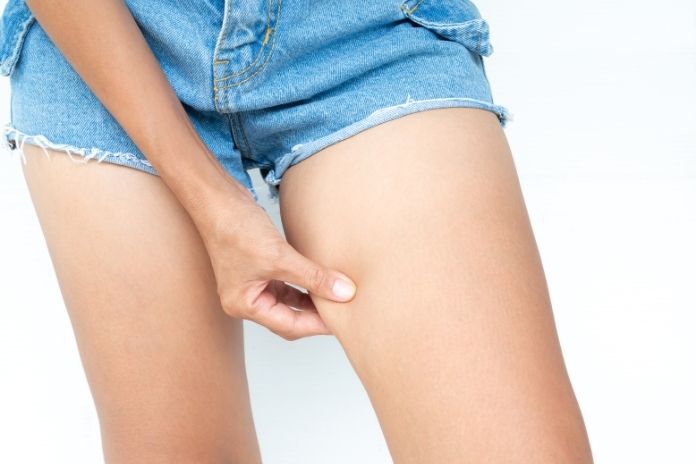
One of the classic features or signs of lipidemia is symmetrical leg fat. Both legs look similar. Not one bigger than the other. But fat often stops abruptly at the ankles, creating a visible “cuff” appearance.
Feet usually remain normal. This is an important difference.
In simple obesity, fat spreads more evenly across the body. In lipedema, there is lower-body dominance. The upper body can be small, but the lower body appears disproportionate. If you see a clear boundary at the ankle, that is not a typical pattern of weight gain.
2. Your Legs Feel Painful, Tender, or Heavy
Normal fat does not hurt. But in lipedema, fat can be painful to touch or feel tender.
Some women describe:
- Dull ache
- Burning sensation
- Sensitivity when pressing
- Heaviness by evening
It is not dramatic pain. It is persistent discomfort. By evening, legs feel tight, like they are carrying weight even when body mass index (a measure of body fat) is normal.
This pain is due to inflammation and pressure inside the fat tissue. Many doctors ignore this complaint because lab reports are normal. But pain in the fat tissue is not imaginary.
3. You Bruise Easily, Even Without Injury
Another overlooked sign is tenderness or bruising easily. You bump lightly on the table, and the next day, a purple mark appears. Sometimes you don’t even remember the injury.
Why? In lipedema, capillaries (small blood vessels) are fragile. They leak more easily. So bruising becomes common.
This is not always a vitamin deficiency. It is a structural issue in the tissue. If bruising is frequent and mainly on the legs, it should not be ignored.
4. Your Weight Loss Doesn’t “Reach” Your Legs
This is an emotionally exhausting part. Someone has reduced 12 kilos. Clothes size changes on top. But jeans are still tight at the thighs. This is a classic complaint in lipedema.
Fat in this condition is resistant to calorie deficit. Even intense cardio doesn’t proportionally shrink legs. Many women then:
- Over-exercise
- Over-restrict food
- Develop an unhealthy relationship with eating
But the issue is not discipline. It is a disease pattern.
5. Family History or Hormonal Triggers
Lipedema often runs in families.
If mother or aunt had:
- Large painful legs
- Similar shape
- Complaints of heavy lower body
There may be a link. Also, the onset commonly happens:
- During puberty
- After pregnancy
- Around menopause
These are hormonal transitions. Estrogen seems to influence fat deposition in lipedema. But research is still incomplete.
This is important because many women notice “sudden leg growth” during their teenage years and assume it is a normal puberty change. Sometimes it is not.
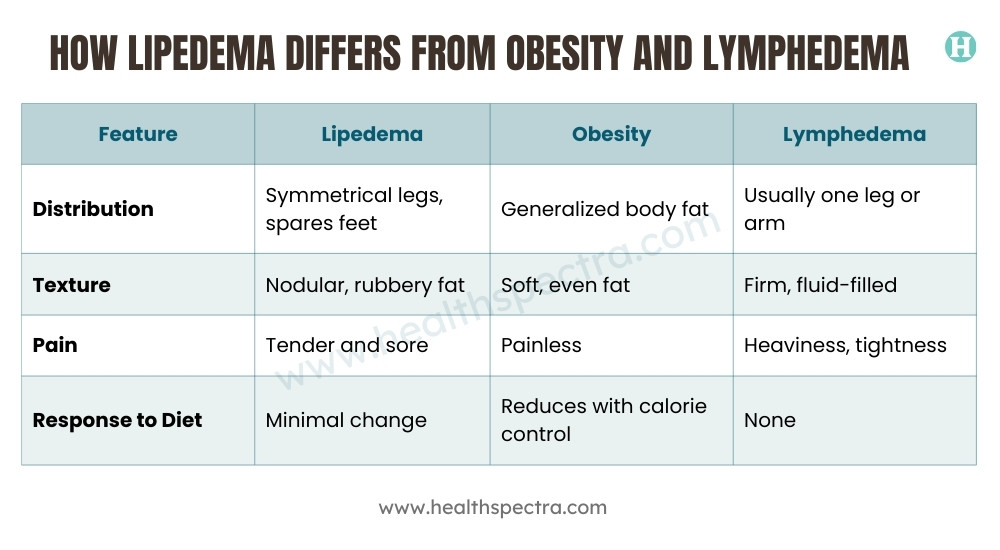
How Lipedema Differs from Obesity and Lymphedema
Three conditions are often confused:
1. Lipedema vs Obesity
Obesity:
- Fat is distributed more generally
- Weight loss reduces fat proportionally
- Fat is usually not painful
Lipedema:
- Disproportionate lower body
- Painful, tender tissue
- Resistant to diet
- Easy bruising
A person can have both obesity and lipedema. That makes diagnosis harder.
2. Lipedema vs Lymphedema
Lymphedema is swelling caused by a blockage of lymphatic fluid. In lymphedema:
- One leg can be larger than the other.
- Feet are often involved.
- Skin may become thickened.
- Pressing a finger leaves a pit (pitting edema).
In lipedema:
- Feet are usually spared.
- Swelling is fatty, not fluid-heavy.
- Early stages do not show pitting.
However, advanced lipedema can lead to secondary lymphedema (sometimes called lipo-lymphedema). So conditions can overlap. Lipedema diagnosis is usually made through a clinical examination based on fat distribution patterns, pain, bruising history, and exclusion of other conditions. There is no single blood test.
 What to Do If You Suspect Lipedema

First, do not panic. Second, do not self-diagnose based only on online information.
If you suspect:
- Consult a physician familiar with lipedema (often a vascular specialist, dermatologist, or endocrinologist).
- Document your symptoms, pain, tenderness, or bruising, and family history.
- Take photographs over time for comparison.
Unfortunately, awareness is still low. Many patients get misdiagnosed for years. If one doctor dismisses you, it does not mean symptoms are invalid. But the evaluation should be proper, not based on an internet checklist.
Read More:8 Powerful Yoga Poses to Melt Stubborn Belly Fat Fast
Evidence-Based Lipedema Treatment Options

There is no permanent “cure” currently. But symptoms can be managed.
1. Compression Therapy
Medical-grade compression garments can:
- Reduce discomfort
- Improve circulation
- Prevent worsening swelling
They do not remove fat. But they reduce heaviness and pain.
2. Low-Impact Exercise
High-impact workouts may worsen discomfort. Better options:
- Swimming
- Walking
- Cycling
- Resistance training with moderation
Movement improves lymph flow and muscle tone, even if fat volume does not reduce drastically. The goal is function, not just size.
3. Anti-Inflammatory Eating Pattern
Crash dieting is not useful. Instead:
- Balanced protein
- Fiber-rich vegetables
- Omega-3 fats
- Reduced ultra-processed foods
Some women report symptom relief with lower-carb or anti-inflammatory diets, but research is still limited. No universal lipedema diet exists.
Important: extreme calorie restriction can harm metabolic health without changing leg size.
4. Manual Lymphatic Drainage
Specialized massage techniques may help fluid movement and reduce tightness. It should be done by a trained professional.
5. Liposuction (Specialized Technique)
In selected cases, tumescent liposuction designed for lipedema can remove diseased fat. This is not cosmetic liposuction. It requires an experienced surgeon. It can reduce pain and improve mobility. But it is a surgical procedure with risks and cost considerations.
Long-term outcome data are still evolving.
Read More: How Regular Pranayama Can Help with Belly Fat & Stress Eating
When to Seek Medical Help for Lipedema Legs
Seek evaluation if:
- Leg pain is persistent and unexplained.
- Swelling is progressing rapidly.
- Bruising is frequent without reason.
- Mobility is affected.
- Skin changes or infections develop.
Also, if emotional distress becomes severe due to body image and frustration, mental health support is equally important.
Living with undiagnosed lipedema can affect confidence and self-worth. As Dr. Karen Herbst, an endocrinologist, says, many people living with lipedema have experienced judgment when in public, such as while eating at a restaurant. It can really affect mental health and cause isolation.
Read more: Sit-Up Variations for Weight Loss Maximize Fat Burn with Core Workouts
Understanding Lipedema: When “Stubborn Fat” Is a Medical Condition
Not all leg fat is a medical problem. But not all leg fat is a lifestyle problem either. The biggest harm lipedema causes is not physical alone. It is the years of blame.
Women are told, “You eat too much.” “You don’t exercise properly.” “You are making an excuse.” Sometimes the body follows a pattern that cannot be corrected by discipline alone. Medical science is still catching up. Awareness is increasing, but slowly.
Understanding lipedema is not about labeling every body shape. It is about recognising when something does not fit the usual pattern.
If leg fat is painful, symmetrical, resistant, and emotionally exhausting, they deserve attention, not judgment.
- Lipedema is underdiagnosed globally, and many clinicians still confuse it with simple obesity, leading to delayed treatment.
- Current research suggests hormonal influences, but the exact molecular mechanism underlying abnormal fat growth remains unclear; a major research gap remains.
- Standard BMI measurements often fail to detect regional fat disorders.
- Painful leg fat tissue should never be automatically attributed to obesity.
- Long-term comparative studies on diet, compression therapy, and surgical outcomes are limited; stronger evidence is still needed to create standardized treatment guidelines.
FAQs
1. Is lipedema progressive?
In many cases, yes, especially without supportive management.
2. Is lipedema the same as water retention?
No. It involves abnormal fat deposition along with fluid changes, and not simple fluid accumulation, typically seen in water retention.
3. Will losing more weight cure lipedema?
No. Weight loss may improve overall health, but usually does not eliminate disproportionate leg fat typically seen in lipedema.
4. Can lipedema occur in thin people?
Yes. Individuals may have normal body weight but disproportionate lower-body fat, which can lead to lipedema in thin people.
5. How is lipedema diagnosed?
Through clinical examination based on the pattern of fat distribution, pain, bruising history, and exclusion of other causes like lymphedema. There is no specific blood test for it.
References
- Cleveland Clinic. (2019). Lipedema.
- Mayo Clinic Staff. (2022, November 24). Lymphedema – Symptoms and causes.
- Mortada, H., Alhithlool, A. W., AlBattal, N. Z., Shetty, R. K., AL-Mekhlafi, G. A., Hong, J. P., & Alshomer, F. (2025). Lipedema: Clinical Features, Diagnosis, and Management. Archives of Plastic Surgery, 52(03), 185–196.
In this Article