


















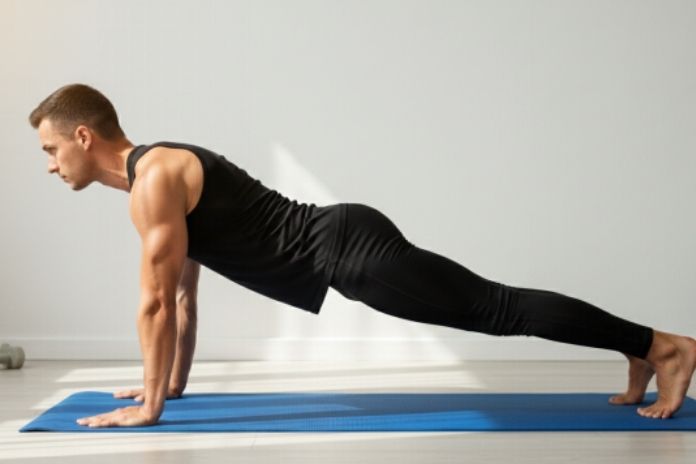
A plank may look effortless, just holding your body still, but those few seconds can reveal far more than you might expect. If you’ve been wondering how long you should hold a plank, or comparing your performance with plank time by age and average plank hold time, you’re actually looking at a key indicator of your core strength and endurance.
What defines a good plank time isn’t a fixed number. It varies based on your plank time by fitness level, overall conditioning, and consistency. Exploring different plank benchmarks, including the average plank time for men and women, can help you understand where you stand today.
In this article, let’s look into what your plank truly says about your strength, stability, and overall fitness.
- Plank time benchmarks vary by age and fitness level: general ranges go from 45–90 sec (ages 18–29) down to 15–30 sec (60+), with active individuals trending higher.
- Quality beats quantity: experts like Dr. Stuart McGill recommend short, repeated holds over marathon planks, and form breakdown is the real signal to stop.
- Once you hit ~60 seconds with good form, stop chasing time: progress through harder variations (side planks, shoulder taps, leg lifts) instead.
What Muscles Does a Plank Actually Work?
Before getting into timings, it helps to know what your body is actually doing during a plank. Planks are a type of isometric exercise, meaning you hold a position instead of moving through repetitions, and that hold activates multiple muscles at once.
The entire core switches on together, including the transversus abdominis (your deep stabilizing layer that supports the spine), rectus abdominis (the “six-pack” muscle), and obliques (which help with rotation and side stability). Alongside these, small spinal stabilizers like the erector spinae and multifidus (muscles that keep your spine aligned) are also engaged.
It doesn’t stop there. Your glutes, quads, and shoulder stabilizers work continuously to keep your body straight and steady.
Research from Penn State University suggests planks activate these core muscles more effectively than crunches or sit-ups, with less strain on the back. This full-body engagement is what makes plank time a meaningful indicator of core endurance and overall stability, especially as you age.
Read More: Sit-Ups vs. Crunches vs. Planks: Which Exercise Is Best for Your Core?
How Long Should You Be Able to Hold a Plank?
When it comes to how long you should hold a plank, there isn’t a single “perfect” number. Your ideal hold time depends on your age, sex, and level of activity. This variation exists because muscle endurance naturally declines with age, and differences in muscle mass and body composition between men and women can influence overall plank performance.
A 2023 study tested plank exercises in older adults, finding improvements in respiratory capacity, physical fitness, and balance, directly supporting reduced fall risk through better postural control.
Core Strength
Plank Time Benchmarks by Age
| Age Group | General Population | Regularly Active Individuals |
|---|---|---|
| 18–29 years | 45–90 seconds | 60–120 seconds |
| 30–39 years | 30–75 seconds | 60–90 seconds |
| 40–49 years | 25–60 seconds | 45–75 seconds |
| 50–59 years | 20–50 seconds | 30–60 seconds |
| 60+ years | 15–30 seconds | 25–45 seconds |
These ranges are based on fitness norms and expert recommendations, helping you understand where your plank time currently stands by age.
Core endurance naturally declines by about 10–15% per decade after the mid-30s. This is a normal physiological change, not a setback. A well-controlled 30-second plank in your late 50s can reflect better functional strength than a poorly held 90-second plank in your 20s.
Form always comes first. Maintaining a straight line from head to heels, engaging your core, and avoiding sagging or strain matters more than simply holding longer. While men may show slightly higher average plank hold time due to muscle distribution, the difference is modest, and with consistent training, many women match or exceed those averages.
Read More: At-Home Strength Exercises Without Equipment
What Do Fitness Experts Actually Recommend?
Holding a plank for longer isn’t always better, as benefits tend to plateau after about 60 seconds with proper form. According to Stuart McGill from the University of Waterloo, he says shorter, well-executed holds are more effective. Instead of increasing duration, he adds that it’s better to include controlled movements or variations. This helps engage your core more efficiently while maintaining proper form.
In contrast, Heather Milton from NYU Langone suggests that a 40–60 second hold is a practical and effective target for most adults. Strength coach Dan John adds that benefits tend to plateau beyond 2 minutes, recommending progression through variations like leg lifts or shoulder taps rather than extending time.
Together, these perspectives suggest a balanced approach. Focus on form, build gradually, and once you reach a solid hold, increase difficulty instead of just holding longer.
Proper Plank Form Essentials
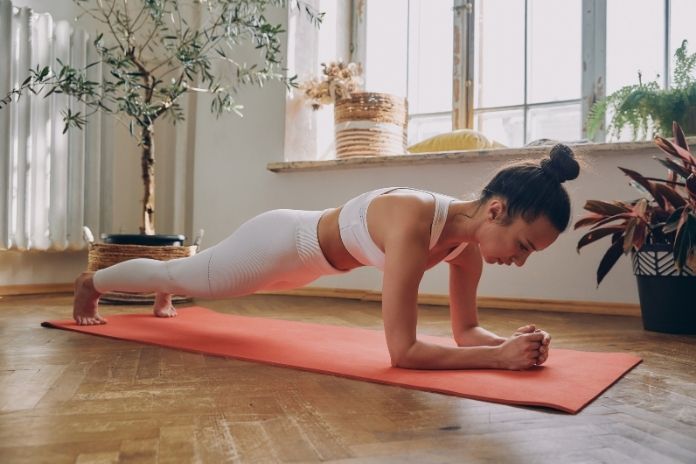
Plank duration only adds value when your form is correct. A 2025 study analyzed 117 adults and found that longer plank holds often correlate with fatigue-induced misalignment, not better strength. Surprisingly, those with low back pain held planks longer, suggesting compensatory poor form rather than protection.
How to Set Up a Proper Forearm Plank
- Position your elbows directly under your shoulders to keep joints aligned
- Keep your forearms parallel, with hands either flat or lightly clasped
- Gently draw your ribs inward to maintain a neutral spine
- Form a straight line from your heels through your hips to your head
- Engage your glutes and quads to stabilize your body
- Press evenly through your forearms and toes
- Breathe steadily throughout the hold without holding your breath
Signs Your Plank Has Reached Its Limit
A plank effectively ends when your form begins to break, even if the timer is still running. This may show up as your hips dropping or lifting too high, your lower back starting to arch, or your shoulders creeping toward your ears. You might also notice your breathing becoming uneven or strain appearing in your face. At this point, it’s better to stop and reset rather than continue with poor form.
Read More: Strength Exercises to Make Your Daily Walks More Powerful (and Protect Your Joints)
Why Holding Longer Isn’t Always Better
Once you’re able to hold a plank for around 60 seconds with proper form, pushing for longer durations doesn’t necessarily translate into better results. By this point, your core has already developed a solid base of endurance, and further increases in time lead to diminishing returns rather than meaningful strength gains.
Physiologically, muscle recruitment tends to plateau after this duration, meaning your core muscles are no longer being challenged in a new way. Instead, fatigue begins to accumulate, and the load gradually shifts towards passive structures like the spine and ligaments rather than active muscle engagement. This reduces training efficiency and may even compromise form over time.
A more effective approach is to increase the quality of the challenge rather than the duration. You can introduce controlled movements like lifting one hand at a time, alternating between forearm and high plank positions, raising one leg, or progressing into a side plank. Even small additions, such as light resistance, can significantly increase the demand on your stabilizing muscles and improve neuromuscular control.
A 2023 BJSM review highlighted that static isometric exercises like planks and wall sits are highly effective for lowering resting blood pressure. However, this reflects their cardiovascular benefits rather than how they should be progressed in training.
So, if you’ve crossed the 60-second mark with good form, it’s time to progress through variation and not duration.
Read More: Best 4-Day Workout Split: How to Train for Muscle, Strength, and Recovery
How to Improve Your Plank Time
Building core endurance takes consistency, and the right approach depends on where you currently stand.
Beginners (Under 20 Seconds): If you’re just starting out, focus on building a strong foundation. Use modified options like knee planks or elevated planks to reduce strain and learn proper alignment. Start with 3 sets of 10 to 15 seconds, performed 3 to 4 days per week. Gradually increase your hold time by about 5 seconds each week as your control and confidence improve.
Intermediate (20 to 45 Seconds): At this stage, progress to full forearm planks. The focus should be on maintaining proper form, keeping your core engaged, spine neutral, and breathing steadily. You can introduce small challenges, such as briefly lifting one arm or leg, to improve stability without compromising technique.
Advanced (60 plus Seconds): Once you can comfortably hold a plank for 60 seconds, increasing duration is no longer the priority. Instead, progress by adding variations like side planks or controlled movements such as shoulder taps or leg lifts to challenge your core more effectively and build functional strength.
Avoid planking immediately after waking, as your spine is more vulnerable then.
Read More: 15-Minute Wall Pilates Routine to Build Strength After 40
Conclusion
The plank is more than just a timed exercise. It reflects your core strength, endurance, and overall physical resilience. Understanding how long you should hold a plank, along with insights into plank time by age and the average plank hold time, can help you set realistic and achievable fitness goals.
Focus on proper form, steady progression, and consistency. With mindful practice and gradual challenges, planks can become a powerful tool for improving stability, supporting movement, and maintaining long-term health.
FAQs
Is a 1-minute plank good?
Yes, holding a plank for 60 seconds with proper form is a strong indicator of good core endurance for most adults. Experts often recommend 40–60 seconds as a practical target. Beyond this point, increasing duration alone offers limited benefits.
How long should a beginner hold a plank?
Beginners can start with 10–20 second holds, focusing on proper alignment and steady breathing rather than time. Performing 2–3 short sets with rest in between helps build confidence and control. As strength improves, gradually increasing the hold by a few seconds each week ensures steady progress.
Does plank time decrease with age?
Yes, plank endurance tends to decline with age, often by about 10–15% per decade after the mid-30s. This reflects natural changes in muscle strength and flexibility. However, regular training can slow this decline.
What is the plank world record?
The longest plank records are held by Josef Salek at 9 hours, 38 minutes, 47 seconds, and DonnaJean Wilde at 4 hours, 30 minutes, 11 seconds (set at age 58). While impressive, these are extreme feats and not practical fitness goals.
References
- National Center for Biotechnology Information. (2021). Efficacy of exercise interventions on prevention of sport-related concussion and related outcomes: A systematic review and meta-analysis
- Prevention. (2023). How long should you hold a plank?
- Yoga International. (n.d.). Three reasons to practice side plank instead of plank
- John, D. (n.d.). Exercise program design: Fundamentals (Part 2). OTP Books
- NYU Langone Health. (n.d.). Sports Performance Center
- American Council on Exercise. (2014). Reality check: Are planks really the best core exercise?
- Health. (2024). How long should you be able to hold a plank?
- Harvard Health Publishing. (2019). Straight talk on planking
- Evening Standard. (2024). How long should you hold a plank according to age?
- Edwards, M. K., Loprinzi, P. D., & others. (2023). Isometric exercise training and blood pressure: A systematic review and meta-analysis. British Journal of Sports Medicine, 57(20), 1317–1325
In this Article