



















Three weeks into a twice-weekly home workout routine, James still had no idea whether any of it was working. His weight had not changed. He did not feel dramatically different. The workout felt a little easier, but he assumed that was just his body getting used to going through the motions.
He was wrong. What James read as routine was actually adaptation, and adaptation is exactly what you are looking for in a progressive overload home workout. The problem is that most people measure progress incorrectly: they step on a scale, check the mirror, or wait for soreness that does not reliably come after the first few weeks. Actual strength and muscular adaptation show up in performance, not on a bathroom scale.
- Progressive overload means systematically increasing reps, slowing tempo, advancing to harder exercise variations, or reducing rest time to drive measurable adaptation.
- Body weight fluctuates daily due to hydration, food intake, and inflammation, while muscle gain and fat loss frequently offset each other without being reflected on the scale.
- Resistance bands or a weighted backpack provide a cost-effective way to continue progressive overload without a gym membership.
Read More: Top 10 Essential Strength Training Equipment for Home Workouts
What Progressive Overload Really Means in Home Workouts
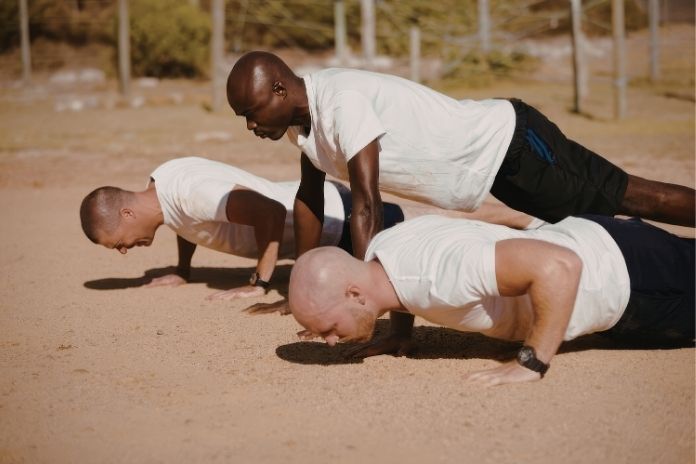
Progressive overload is the gradual increase of stress placed on the muscle over time, sufficient to force continued adaptation. In a gym, the most common method is adding weight. But weight is only one variable.
A 2022 study published in PeerJ by Dr. Brad Schoenfeld and colleagues compared two progressive overload protocols: one group increased load while keeping reps constant, and the other increased reps while keeping load constant.
Both produced comparable gains in muscle size and strength, confirming that repetition progression is a legitimate and equivalent driver of adaptation. At home, where external load is fixed or absent, the variables available for progression include repetitions, sets, tempo, rest intervals, range of motion, and exercise complexity.
Each of these meaningfully increases training demand on the neuromuscular system. Muscle adaptation does not care whether the resistance comes from a dumbbell or gravity acting on body position. The stimulus that triggers hypertrophy and strength gains is mechanical tension, which occurs when a muscle generates force near its capacity.
A 2021 systematic review and network meta-analysis published in Medicine and Science in Sports and Exercise found that low, moderate, and high training loads produced comparable muscle hypertrophy when sets were taken close to volitional failure. The key variable is effort proximity to failure, not the absolute weight involved.
Dr. Brad Schoenfeld, PhD, professor of exercise science at CUNY Lehman College and one of the world’s leading researchers on muscle hypertrophy, has stated that bodyweight exercises, including push-ups, pull-ups, and body-weight squats, are resistance exercises and that these exercises exert powerful forces on the muscle that are entirely capable of stimulating meaningful adaptation when performed with sufficient effort.
Volume and intensity are the two levers that determine whether a home workout produces adaptation or simply maintains it. Volume is the total work per session: sets multiplied by reps. Intensity, in the context of bodyweight training, is best understood as proximity to muscle fatigue.
A push-up set completed with five easy reps remaining is not the same stimulus as one completed with one or two reps remaining. Both volume and intensity need to increase progressively for adaptation to continue.
Why the Scale Isn’t a Reliable Measure of Workout Progress
Body weight is a composite number that includes muscle, fat, bone, water, and gut contents. It fluctuates by one to four pounds daily based on hydration, sodium intake, hormonal cycles, and food volume.
Someone gaining muscle while losing fat can show no scale change over months despite significant body composition improvement. Using the scale as the primary training progress metric produces false negatives for people who are training correctly.
Muscle tissue is denser than fat. An individual gaining half a pound of muscle while losing half a pound of fat stays at the same body weight while undergoing a meaningful change in body composition.
This is particularly common in the early weeks of a new program, when neuromuscular adaptations are rapid alongside any dietary changes the person is making. Tracking performance gives concrete, objective data that directly reflects what training is accomplishing.
How many push-ups before form breaks? How long can you hold an L-sit? Can you complete a Bulgarian split squat without your knee caving? These are measurable, repeatable indicators of muscular capacity that move in a consistent direction when training is working and plateau when it is not.
Sign #1: You’re Performing More Reps With the Same Exercise
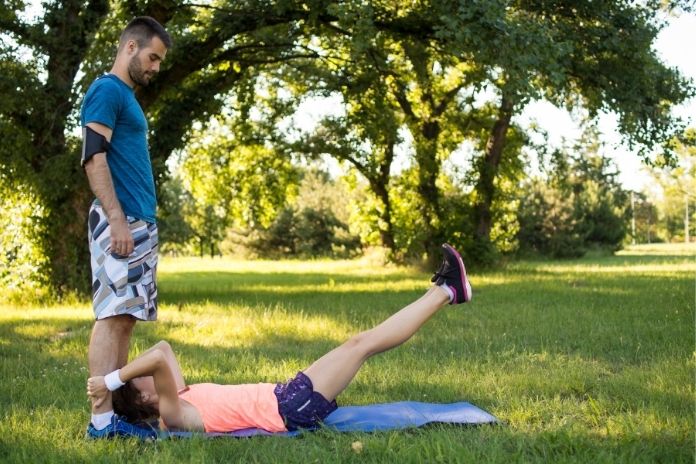
Increased repetition capacity in the same exercise at the same bodyweight is one of the clearest signs of progressive overload home workout success. It means the nervous system has become more efficient at recruiting motor units for that movement, and the muscle has become more resistant to fatigue. Both are adaptations that define training progress at the most fundamental physiological level.
Dr. Wayne Westcott, PhD, fitness research director at the South Shore YMCA and strength training consultant to the American Council on Exercise, has written extensively that muscle tissue is indifferent to the source of resistance: whether overload comes from an added plate or from the mechanical challenge of additional repetitions, the adaptive signal to the muscle is equivalent when effort is genuinely high.
A person who performed 8 controlled push-ups in Week 1 and now reliably performs 14 with the same form in Week 8 has meaningfully increased their training volume load. The total mechanical stress on the chest, anterior deltoid, and triceps across those additional six reps is real progressive overload, even though nothing about the exercise has changed except the person’s capacity.
The same applies to body-weight squats, inverted rows, and timed plank holds. One to three additional reps per set per week is a meaningful and sustainable rate of progression in a home workout context.
Over eight weeks, that translates to eight to twenty-four additional reps per set, a change representing genuine neuromuscular adaptation. Progress does not need to be dramatic week to week. It needs to be consistent over time.
The signal to advance to a more difficult exercise variation is straightforward: when you can consistently complete the top of your target rep range across all working sets for two consecutive sessions without reaching near-failure, the current variation is no longer providing sufficient stimulus. Comfort is a signal to progress, not permission to coast.
Read More: The Neural Gains Phase: Why You’re Getting Stronger Without Seeing a Single Muscle
Sign #2: The Same Workout Feels Easier (Lower Perceived Effort)

Perceived effort at the same workload decreasing over time is not evidence that the workout has stopped working. It is direct evidence that neuromuscular efficiency has improved. The body completes the same task using less physiological output because motor pathways have become more coordinated, the muscle produces force more efficiently, and cardiovascular recovery between efforts has improved.
Neuromuscular adaptation is the first phase of strength gain in any new training program. Before visible muscle growth, the nervous system learns to recruit motor units faster, synchronize their firing, and reduce co-contraction of antagonist muscles. This is why people get noticeably stronger in the first weeks of a program without visible muscle size changes.
The same push-up that felt extremely hard at 8 reps in Week 1 may feel moderate at Week 6 simply because neural communication between the brain and muscle has become dramatically more efficient. Reduced perceived effort at the same workload is a sign of adaptation. But if a workout feels easy and performance is also flat over weeks, that is undertraining, not adaptation.
The distinction is performance data: if reps per set are still slowly increasing, the workout is working, but should be progressed. If reps have been completely flat for four to six weeks and effort feels low, intensity or volume needs to increase.
Adding one variable at a time is the safest approach to increasing workout intensity at home. Slow the tempo by adding a three-second lowering phase. Reduce rest between sets from 90 seconds to 60 seconds. Add one additional working set to each exercise. Each change is sufficient to meaningfully increase demand without requiring any additional equipment.
Sign #3: You Can Perform More Challenging Exercise Variations
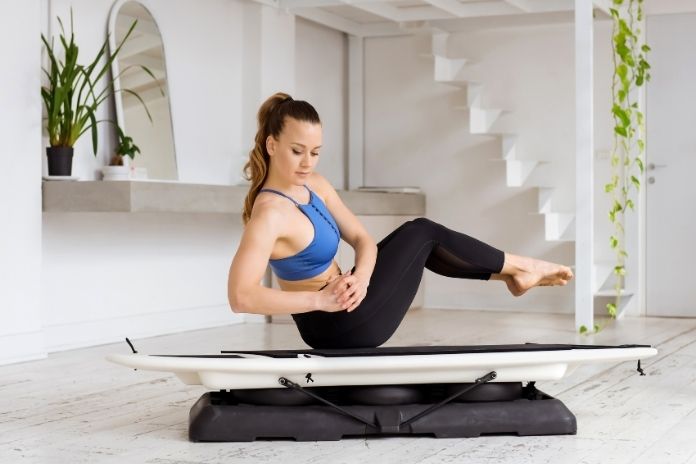
Advancement through exercise progressions is one of the most concrete signs of strength adaptation in a home workout. Each progression represents a genuine increase in mechanical demand on the target muscle groups.
The progression from knee push-ups to full push-ups represents a shift from approximately 54% of bodyweight as load to approximately 69%, a meaningful increase in mechanical stress to the chest, shoulders, and triceps. Moving from a standard squat to a Bulgarian split squat concentrates nearly full bodyweight through one leg while adding hip stability demand.
Transitioning from a flat push-up to a decline push-up with feet elevated increases upper chest and anterior deltoid activation by shifting the gravity vector. Performing a harder exercise variation that was previously impossible is a direct outcome of strength adaptation in the required muscles.
A 2022 umbrella review published in Frontiers in Sports and Active Living confirmed that progressive overload is consistently required to drive continued hypertrophic adaptation, and that exercise selection advancement is a valid method of increasing mechanical demand on muscle tissue over time.
Introduce a harder variation when you can meet the top of your current rep range with clean form across all working sets for two consecutive sessions. Do not add external load and change the variation simultaneously. Progress one variable per training block to accurately determine what is driving adaptation and to minimize injury risk.
Read More: At-Home Strength Exercises Without Equipment: That Actually Work
Additional Indicators Your Home Workout Is Working
Better control during challenging movements, including reduced wobble in a single-leg squat or sharper proprioception during a push-up, reflects real neuromuscular coordination gains that are invisible in the mirror but measurable in performance quality.
If you can sustain a longer eccentric phase on a squat or push-up than you could a month ago without breaking form, your muscle’s fatigue resistance has genuinely increased. Shorter recovery time between sets reflects improved cardiovascular and metabolic capacity from resistance exercise.
How to Apply Progressive Overload Without Weights
Increase repetitions gradually: add one to two reps per set until you reach the upper limit of your target range, then advance the variation.
Slow the Tempo: A three to four second lowering phase dramatically increases time under tension without requiring heavier resistance.
Add Extra Sets: a fourth set where you previously did three increases in total volume without changing exercise difficulty.
Reduce Rest Time Strategically: Dropping from 90 to 60 seconds between sets is a valid form of progressive overload for muscular endurance.
Introduce Unilateral Movements: Any single-limb version of a bilateral exercise roughly doubles the load per working limb and substantially increases the hypertrophy stimulus.
Common Mistakes That Prevent Progress at Home

Repeating the same routine for months without advancing any variable is the most common reason home workouts stop producing results. The body adapts to a given stimulus and stops responding once that stimulus no longer exceeds its current capacity.
Stopping too far from muscle fatigue, leaving five or more easy reps in reserve on every set, fails to provide a sufficient growth stimulus regardless of exercise selection.
Prioritizing duration over intensity, doing 45 minutes of easy movement rather than 25 minutes of hard training, produces cardiovascular benefit but does not drive meaningful strength or hypertrophy adaptation.
Ignoring lower body progression is equally common: many home practitioners focus heavily on upper body work while defaulting to easy bilateral squats for the legs, leaving one of the body’s largest muscle groups consistently understimulated.
Dr. Brad Schoenfeld has emphasized that proximity to muscle failure is one of the most critical variables determining whether a set produces a hypertrophic stimulus, noting in research that training volumes equated for effort proximity produce consistent results regardless of load. Stopping well short of that threshold makes many home workouts comfortable but ineffective for building strength.
When You Might Need More Resistance
When an experienced trainee can complete the most mechanically demanding available variation at 15 or more reps without reaching near-failure, bodyweight alone is no longer sufficient to drive further adaptation. External resistance becomes the necessary next step.
Resistance bands are the most versatile and cost-effective way to add progressive resistance to home training. A loop band used for banded push-ups or banded squats adds meaningful load without significant investment or space. A backpack loaded with books or water bottles serves the same function for pull-up progressions.
A 2024 study published in the International Journal of Sports Medicine confirmed that both repetition and load progression produced statistically equivalent gains in muscle size and strength, confirming that any method of increasing overload, including transitioning from bodyweight to light added resistance, produces the same adaptive outcome.
Practical Takeaway: A Simple Way to Track Progress Each Week
A simple workout log is the most useful tool for home-based progressive overload. At the end of each session, record the reps completed for each exercise and note perceived effort on a scale of one to ten. When an exercise consistently lands below seven in perceived effort, and reps are no longer increasing, that exercise needs to be progressed.
Advance one variable at a time: this week add reps, next block slow the tempo, and the block after that advance to the next variation. The signs of a working progressive overload home workout are clear when you know what to look for: more reps, lower perceived effort at the same workload, and advancement to movements that were previously out of reach.
None of these requires a gym, a scale, or equipment beyond your body and floor space. What they require is systematic tracking, honest effort close to muscular fatigue on every working set, and the discipline to adjust one variable at a time rather than overhauling everything at once.
Read More: Resistance Bands for Arm Strength: A Beginner’s Guide
FAQs
1. How often should I progress my home workout?
Progress one variable per two to four-week training block. Adding reps is the simplest starting point: aim for one to three additional reps per set per week until you reach the top of your target rep range. Once there, advance to a harder variation or adjust another variable such as tempo or rest period.
2. What should I do when bodyweight exercises get too easy?
When you can complete the most challenging available variation at 15 or more reps without reaching near-failure, bodyweight alone is no longer sufficient. Adding resistance through a loop band, a loaded backpack, or a weighted vest is the most practical next step. These options allow genuine progressive overload to continue at home.
3. Does soreness mean a workout is working?
No. Soreness, technically known as delayed onset muscle soreness (DOMS), reflects the novelty of a training stimulus, not its effectiveness. It is common when starting a new program or significantly changing an exercise, and diminishes as the body adapts. The absence of soreness after the first few weeks of training is normal and does not indicate that progress has stopped.
References
- Bernárdez-Vázquez, R., Raya-González, J., Castillo, D., & Beato, M. (2022). Resistance training variables for optimization of muscle hypertrophy: An umbrella review. Frontiers in Sports and Active Living, 4, 949021.
- Chaves, T. S., Scarpelli, M. C., Bergamasco, J. G. A., da Silva, D. G., Medalha Junior, R. A., Dias, N. F., Bittencourt, D., Filho, P. C. C., Angleri, V., Nóbrega, S. R., Roberts, M. D., Ugrinowitsch, C., & Libardi, C. A. (2024). Effects of resistance training overload progression protocols on strength and muscle mass. International Journal of Sports Medicine, 45(7), 504–510.
- Lopez, P., Radaelli, R., Taaffe, D. R., Newton, R. U., Galvão, D. A., Trajano, G. S., Teodoro, J. L., Kraemer, W. J., Häkkinen, K., & Pinto, R. S. (2021). Resistance training load effects on muscle hypertrophy and strength gain: Systematic review and network meta-analysis. Medicine and Science in Sports and Exercise, 53(6), 1206–1216.
- Plotkin, D., Coleman, M., Van Every, D., Maldonado, J., Oberlin, D. J., Israetel, M., Feather, J., Alto, A., Vigotsky, A., & Schoenfeld, B. J. (2022). Progressive overload without progressing load? The effects of load or repetition progression on muscular adaptations. PeerJ, 10, e14142.
- Schoenfeld, B. J. (n.d.). Faculty profile. CUNY Lehman College, Department of Exercise Sciences and Recreation.
- Westcott, W. L. (2012). Resistance training is medicine: Effects of strength training on health. Current Sports Medicine Reports, 11(4), 209–216.
- Khadem, K. (2021). Fat loss: Why the scale isn’t the best measuring tool. Muscle & Strength.
- Institute of Nutrition and Fitness Sciences. (2025, February 17). Why the scale is not the best way to measure progress.
- Size Stream. (2025). Why traditional scales fail to measure fitness.
- Vail Health. (n.d.). Body composition: Why it matters more than a number on the scale.
- Plana Performance. (n.d.). Why you shouldn’t solely rely on the scale to track your progress.
- Lab 51 Fitness. (n.d.). Tracking progress: The importance of measuring fitness beyond the scale.
- Trainerize. (n.d.). The scale isn’t always the key.
- Moms Into Fitness. (n.d.). Muscle vs fat: Why the scale doesn’t show your real progress (Podcast).
In this Article