















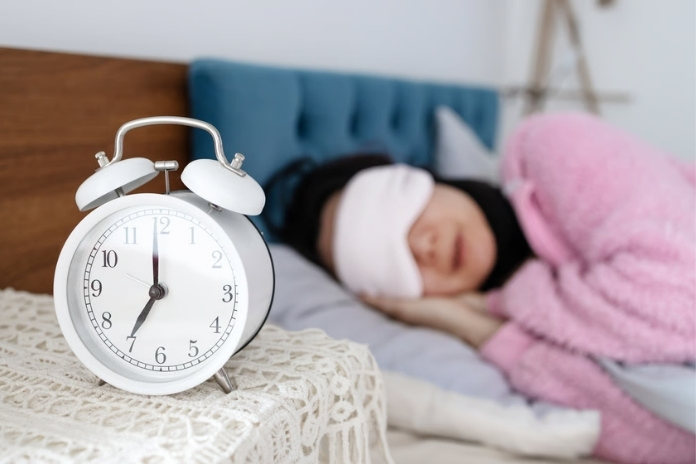
Most sleep advice is about getting 7 to 9 hours of sleep a night. But increasing evidence suggests that when you sleep may be just as important as how much you sleep. A 2024 study by UK Biobank of more than 88,000 adults found that sleep regularity was a better predictor of mortality risk than total sleep duration.
According to the National Sleep Foundation’s 2023 consensus statement, regular bedtimes and wake times are linked to greater alertness, better cardiovascular health, better metabolic health, better mental health, and lower inflammation. Taken together, these results suggest that keeping a consistent sleep schedule may be among the most influential sleep habits for long-term health.
When people seek to improve their sleep, they often begin with how many hours they spend in bed. Public health recommendations have long emphasized getting enough sleep every night.
A consistent sleep schedule has been linked to better cognitive performance, improved mood, stronger metabolic health, healthier immune function, reduced cardiovascular risk, and even lower mortality. While sleep duration remains essential, evidence increasingly suggests that when you sleep and how consistently you sleep deserve equal attention.
- A 2024 UK Biobank study of more than 88,000 adults found that sleep regularity predicted mortality risk better than total sleep duration.
- Consistent bedtimes and wake times are linked to better mental, cardiovascular, and metabolic health, according to the National Sleep Foundation’s 2023 consensus statement.
- Keeping your sleep schedule within the same 30-minute window each day may be one of the simplest and most effective ways to improve long-term health.
Read More: What Is Sleep Inertia and Why Do You Feel Groggy After a Nap?
The 2024 UK Biobank Finding — Regularity Over Duration
One of the most influential sleep studies published in recent years came from the UK Biobank, a large prospective cohort study involving more than 88,000 adults whose sleep patterns were measured objectively using wearable devices.
A study found that sleep regularity was a stronger predictor of mortality risk than sleep duration. Participants with highly irregular sleep schedules experienced significantly greater risks of all-cause mortality, even after researchers accounted for total sleep time and other health factors.
The finding challenges a long-standing belief that achieving seven to nine hours of sleep is the primary goal. While adequate sleep duration remains important, the study suggests that maintaining consistent sleep timing may independently influence long-term health outcomes.
Rather than viewing this information as alarming, sleep experts see it as empowering. For people already getting enough sleep but whose bedtimes vary widely throughout the week, improving sleep consistency may offer one of the highest-return changes they can make.
What the National Sleep Foundation’s 2023 Consensus Statement Established

Research findings gained additional weight in September 2023 when the National Sleep Foundation (NSF) released its first expert consensus statement focused specifically on sleep regularity.
The panel, chaired by Charles A. Czeisler, MD, PhD, Division Chief of Sleep and Circadian Disorders at Brigham and Women’s Hospital and Professor of Sleep Medicine at Harvard Medical School, reviewed the available evidence on sleep timing consistency and health.
Their conclusion was clear: maintaining consistent bedtimes and wake times is associated with improved outcomes across multiple dimensions of health and performance. Benefits were observed in alertness, cardiovascular health, metabolic health, inflammation, mental well-being, and overall daily functioning.
The statement marked an important shift in sleep medicine. Sleep regularity moved beyond being a simple sleep hygiene recommendation and became a formally recognized component of healthy sleep.
What Sleep Irregularity Does to the Body—The Mechanisms

Why does changing bedtime from night to night affect your health significantly? The answer lies in the body’s circadian system. This internal timing network is coordinated by the suprachiasmatic nucleus, a small region in the hypothalamus that acts as the body’s master clock.
The circadian system regulates much more than sleep. It helps coordinate hormone release, blood pressure, body temperature, immune activity, insulin sensitivity, digestion, and hundreds of physiological processes that follow a roughly 24-hour rhythm.
When sleep timing shifts repeatedly, the body experiences what scientists call circadian misalignment. Internal clocks receive conflicting signals, making it difficult to synchronize biological functions efficiently.
A 2025 systematic review examining 59 primary studies found moderate-certainty evidence linking sleep timing irregularity with higher depressive and anxiety symptoms, elevated body mass index, insulin resistance, hypertension, and increased risk of cardiovascular events.
The liver, pancreas, cardiovascular system, and immune system all rely on predictable timing cues. Irregular sleep schedules force these systems to repeatedly adjust, similar to traveling across time zones every few days.
Mental Health — The Most Consistent Association
Among all health outcomes associated with sleep regularity, mental health may have the strongest and most consistent evidence base. Studies using the Sleep Regularity Index have found that more consistent sleep schedules are associated with lower rates of depression and anxiety.
A UK Biobank analysis identified a nearly linear relationship between greater sleep regularity and reduced risk of mood disorders. The findings suggest that even modest improvements in consistency may provide meaningful mental health benefits.
The benefits appear to extend beyond emotional well-being. Moderate and high levels of sleep irregularity have also been associated with an increased risk of type 2 diabetes, even among people who consistently get the recommended amount of sleep.
Researchers have additionally linked irregular sleep patterns to cognitive decline and higher dementia risk, suggesting that the brain may be particularly sensitive to disruptions in sleep timing.
The Catch-Up Sleep Question — What the Evidence Now Says
For many adults, sleep irregularity is driven by weekends. People often stay up later on Friday and Saturday nights before sleeping in on Sunday morning. This pattern creates what researchers call social jetlag, a mismatch between the body’s biological clock and social schedules.
Given the evidence supporting sleep regularity, it might seem logical to avoid sleeping altogether. However, the National Sleep Foundation’s consensus panel offers a more nuanced perspective.
The panel concluded that when sleep debt has accumulated during the work week, extending sleep on non-work days by up to one or two hours may be beneficial. Naps can also help offset insufficient sleep.
How to Build a Consistent Bedtime Habit — What the Evidence Supports

Anchor Your Wake Time First
Sleep researchers consistently recommend focusing on wake time before bedtime.
A fixed wake time serves as the strongest circadian anchor because morning light exposure helps set the body’s master clock. Maintaining the same wake time every day, including weekends, can gradually stabilize bedtime naturally.
Limiting weekend sleep extension to less than 60 minutes also helps preserve regularity.
Use Light to Strengthen Your Circadian Rhythm
Light is the most powerful signal influencing circadian timing. Spending 10 to 15 minutes outdoors within the first hour after waking can reinforce healthy circadian alignment. Morning sunlight helps regulate cortisol, melatonin, and alertness throughout the day.
In the evening, reducing exposure to bright and blue-spectrum light from phones, tablets, and televisions can support the natural rise in melatonin that prepares the body for sleep.
Treat Sleep Timing Like Exercise or Nutrition
Many people view bedtime as flexible while treating exercise and diet as structured health habits. The evidence increasingly suggests that sleep timing deserves the same level of consistency. The benefits get significant over time when regular sleep becomes a daily routine.
Research has shown that women who stabilized their nightly sleep schedule for six weeks experienced benefits.
Aim for a High Sleep Regularity Index
Researchers commonly measure consistency using the Sleep Regularity Index (SRI), which assesses how similar sleep and wake times are from day to day. While most people will never calculate their SRI, studies suggest that sleeping within roughly the same 30-minute window each night and waking within the same 30-minute window each morning corresponds with high regularity scores.
Read More: What Is Sleep Inertia and Why Do You Feel Groggy After a Nap?
Conclusion
The emerging science of sleep suggests that better rest is not only about logging more hours in bed. Increasingly, evidence points to sleep regularity as a powerful predictor of long-term health, influencing everything from cardiovascular function and metabolic health to mood and longevity.
Rather than focusing solely on sleep duration, it may be time to shift attention toward protecting sleep timing. A consistent bedtime and wake time are not simply good habits. They are health behaviors that appear to compound benefits over time, much like regular exercise or a balanced diet.
Frequently Asked Questions
Q. Is sleep consistency more important than sleep duration?
The duration and regularity of sleep are not substitutes for one another. Both independently affect health. For people already achieving seven to nine hours of sleep, improving consistency may be the most impactful next step. The National Sleep Foundation’s 2023 guideline now recognizes sleep regularity as a core component of healthy sleep.
Q. Does it matter if I go to bed late as long as I am consistent?
Yes. A stable late bedtime is generally healthier than an inconsistent schedule. The circadian system adapts more effectively to a predictable routine than to frequent shifts in sleep timing. The healthiest approach combines consistency with sleep timing that reasonably aligns with the natural light-dark cycle.
Q. Why is sleeping in on weekends bad for health?
Large differences between weekday and weekend sleep schedules create social jetlag. This mismatch contributes to circadian misalignment, which can affect hormones, metabolism, immune function, and daily behaviors. However, sleeping in by two to three hours or more regularly can create meaningful circadian disruption.
In this Article