














You probably take all your supplements at once, most likely with breakfast, most likely without thinking much about it. And for some, that’s fine. But the best time to take supplements isn’t one-size-fits-all.
Two things determine whether your body actually absorbs what you swallow: the biochemistry of each supplement and how the nutrients around it either help or block that process. Supplement timing and what you take it with can mean the difference between full absorption and a dose that mostly passes through.
This is the evidence-based schedule for fat-soluble vitamins, water-soluble vitamins, magnesium, iron, probiotics, and more, including which combinations to separate and which to stack together.
- When you take supplements, matters: fat-soluble vitamins need dietary fat to absorb; taking them fasted wastes a significant portion of the dose.
- Research published in the Journal of Bone and Mineral Research confirms that taking vitamin D with the largest fat-containing meal of the day produces measurably higher serum 25(OH)D levels.
- Start with iron fasted in the morning, fat-soluble vitamins at breakfast, zinc at lunch, and magnesium glycinate 30 to 60 minutes before bed.
Read More: 11 Supplements That Help With Neuropathy: What Works and What Doesn’t
The Core Principle: Fat-Soluble vs. Water-Soluble
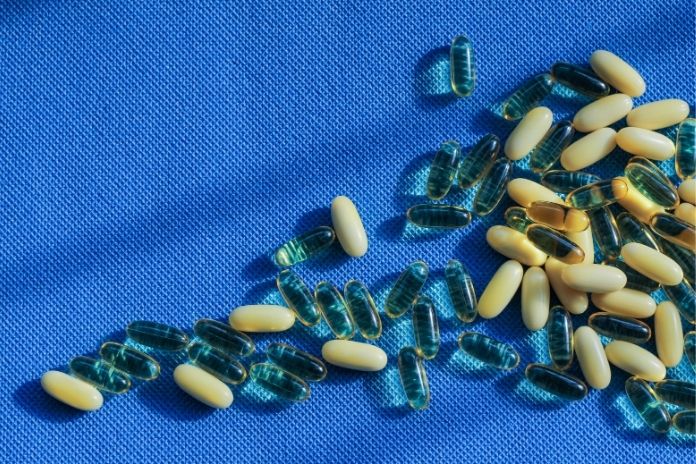
Every supplement timing decision starts here. It’s actually simple once you understand it. Fat-soluble supplements, vitamins A, D, E, K, CoQ10 (coenzyme Q10, a mitochondrial energy compound), fish oil, and curcumin dissolve in dietary fat, not in water. Without fat present in your gut, your intestinal lining can’t absorb it.
Think of it like trying to dissolve butter in a glass of cold water: it doesn’t work. You need the right medium. Taking a fat-soluble supplement on an empty stomach with water means your body absorbs only a fraction of the dose.
Water-soluble supplements like vitamin C and the entire B-complex family, including folate, B12, and B6, dissolve in water and don’t need food for absorption. Your body also doesn’t store them the way it stores fat-soluble vitamins. What it can’t use immediately, it excretes. Because of this, taking them in divided doses across the day is more effective than one large dose.
Morning on an Empty Stomach or With Breakfast
Some supplements work best before you eat. Others need fat to function.
Take food 30+ minutes before eating:
Iron: It is best absorbed on an empty stomach, ideally first thing in the morning, before coffee or breakfast. A 2021 review in Nutrients confirms that morning fasted iron absorption is significantly higher than iron taken with food or alongside calcium.
Pair it with vitamin C, either a glass of orange juice or a 250 mg supplement. Vitamin C converts iron into its more absorbable ferrous form and counteracts phytate inhibition. The critical rule: separate iron from coffee, tea, calcium, dairy, and zinc by at least one hour. Tannins in coffee and tea alone can cut iron absorption by up to 60%.
B-Complex Vitamins: These are water-soluble and absorbed quickly. Their mild stimulating effect on the nervous system also makes morning the right time slot. Taken at night, they can disrupt sleep in sensitive individuals, particularly high-dose B6 and B12.
Folate (B9): It follows the same logic. Fasted morning absorption is optimal, and morning timing avoids any potential interference with sleep.
Take with a fat-containing breakfast:
Vitamin D3 + K2 is the combination most worth taking together. D3 drives calcium absorption from the gut; K2 (menaquinone, the vitamin that activates calcium-directing proteins) sends that calcium into bones rather than allowing it to deposit in arterial walls. Both are fat-soluble, take them together with the fattiest meal of your day, typically breakfast or lunch.
Fish Oil/Omega-3s and CoQ10 are fat-soluble and follow the same rule. Both absorb significantly better with a fat-containing meal. Morning or lunch are equally valid windows—pick whichever you can be consistent about.
As Dr. Michael Holick, MD, PhD, professor of medicine at Boston University Medical Center and chair of the Endocrine Society’s vitamin D guidelines, explains in his widely cited work on vitamin D metabolism, fat-soluble vitamins require a lipid-rich environment for intestinal absorption, and supplementation taken with a meal containing fat produces substantially higher serum levels than supplementation taken while fasted.
Midday With Lunch
Zinc: If taken too fast, it can cause nausea in a notable portion of people. Lunch is the most practical and tolerable window. But keep this in mind: zinc and copper (both divalent cations) compete at the same intestinal transporter. If you supplement both, separate them by at least two hours.
Similarly, don’t take zinc and iron in the same sitting; they compete at the same absorption pathway. A 2022 study in Nutrients confirms this competitive inhibition is clinically significant at supplemental doses.
Turmeric/Curcumin: It is both fat-soluble and poorly absorbed without piperine (the active compound in black pepper). Research shows piperine increases curcumin bioavailability by up to 2,000% by inhibiting intestinal glucuronidation. Always take curcumin with a fat-containing meal and confirm your supplement contains piperine, or take it alongside black pepper.
Vitamin C (Second Dose): It can be taken at lunch. Because vitamin C is water-soluble and rapidly excreted, splitting your daily dose, half in the morning and half at midday, maintains more consistent plasma levels than a single large bolus.
Read More: Do Supplements Help Brain Zaps? What Science Says (and What Actually Works)
Evening With Dinner or Before Bed
Calcium: If you supplement it, it belongs at dinner. Here’s the critical interaction: calcium and iron compete at the same intestinal transporter, the DMT1 (divalent metal transporter 1). Taking them together reduces iron absorption by up to 50%. Keep them separated by your morning/evening split: iron at breakfast, calcium at dinner.
Magnesium Glycinate and Magnesium Threonate: These have the strongest case for evening timing of all supplements. As Dr. Andrew Huberman, PhD, professor of neurobiology and ophthalmology at Stanford University School of Medicine, states in his publicly available Sleep Toolkit, taking 145 mg of magnesium threonate or 200 mg of magnesium bisglycinate 30 to 60 minutes before bed can increase sleep depth and reduce sleep onset time.
It works by engaging the GABA (gamma-aminobutyric acid, the brain’s primary inhibitory neurotransmitter) pathway. Magnesium citrate is more neutral and can be taken with dinner if evening timing is inconvenient.
Vitamins E and K: If not included in your morning fat-soluble stack, these should be taken with dinner, and any fat-containing meal qualifies.
Supplement Timing Guide
Quick Reference Schedule
| Time | Supplement | With/Without Food |
|---|---|---|
| Early morning (fasted) | Iron + vitamin C | Empty stomach |
| Morning | B-complex, folate | Empty stomach or light meal |
| Breakfast | Vitamin D3 + K2, fish oil, CoQ10, vitamin A, vitamin E | Fat-containing meal |
| Lunch | Zinc, turmeric + piperine, vitamin C (2nd dose) | With food |
| Dinner | Calcium, magnesium citrate, vitamin K | With food |
| 30 to 60 min before bed | Magnesium glycinate/threonate | Light snack or fasted |
| 30 min before any meal | Probiotics | Before or with food |
Read More: Fenugreek vs. Iron Supplements: What Works Better for Energy and Digestion
Probiotics Any Time, But With These Rules
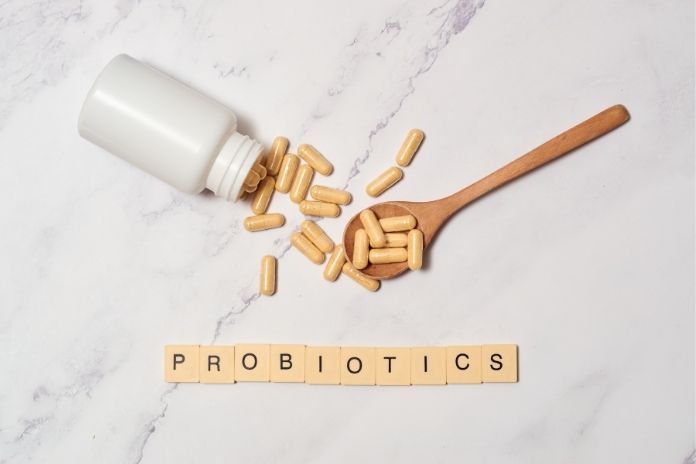
Probiotics need their own note because the timing debate is ongoing, and the answer matters for the survival of bacterial cultures. The most consistently supported recommendation: take probiotics 30 minutes before a meal or with a small amount of food.
This approach reduces stomach acid exposure, which kills a significant proportion of probiotic bacteria in transit, while the food provides prebiotic substrates that help bacteria establish in the gut.
Two Things to Avoid: Don’t take probiotics alongside antibiotics (separate them by at least two hours), and don’t swallow them with hot drinks, which can damage heat-sensitive bacterial strains.
Combinations to Stack Together vs. Separate
Take Together:
- Iron and vitamin C (vitamin C converts iron to the absorbable ferrous form)
- Vitamin D3 and K2 (complementary calcium metabolism); turmeric and black pepper (piperine dramatically increases curcumin absorption)
- Zinc with food (reduces nausea; no absorption benefit to fasting for zinc)
Take Separately by at Least Two Hours: Iron and calcium, iron and zinc, iron and coffee or tea, and zinc and copper. These pairs share absorption pathways and compete directly. Taking them together measurably reduces what you absorb of both.
Read More: Can Beverages Replace Supplements? What the Science Says About Getting Nutrients From Drinks
Final Word
You’re already spending money on supplements. The scheduling adjustments here cost nothing and take about 30 seconds to implement. Separate iron from calcium. Take vitamin D with a fat-containing meal. Move magnesium to the evening. That’s it. The stack doesn’t need to be complicated to work. It just needs to be timed.
- Supplement timing isn’t the most important factor in your stack, but it does produce real absorption differences for specific nutrients.
- Fat-soluble supplements need fat, iron needs an empty stomach, calcium and iron can’t share a time slot, and magnesium glycinate belongs in the evening.
- Get those four rules right, and you’re capturing most of the benefit that timing can offer.
FAQs About Supplement Timing
1. What’s the best time to take supplements if I can only take them once a day?
Morning with a fat-containing breakfast covers the most ground: fat-soluble vitamins absorb well, B vitamins are best taken in the morning, and you avoid evening stimulation from B-complex. Take iron separately on an empty stomach if it’s in your stack.
2. I keep reading about supplement timing. Does it actually make a real difference?
Yes, for specific supplements, it does. Vitamin D taken with a fat-containing meal produces measurably higher blood levels. Iron absorbed fasted can be up to 40% more bioavailable. Calcium and iron taken together reduce iron absorption by up to 50%. Timing matters most for these three.
3. Can I take magnesium and vitamin D at the same time?
Yes. Magnesium and vitamin D don’t compete and are actually complementary: magnesium is a cofactor in vitamin D metabolism. Take vitamin D with a fat-containing breakfast and magnesium glycinate before bed for the best results from both.
4. Why do I feel nauseous after taking my supplements in the morning?
Zinc and iron are the most common culprits when taken fasted. Zinc especially causes nausea without food. Move zinc to lunch with a full meal. If iron is the issue, take it fasted but with a full glass of water and vitamin C, not on a completely empty stomach if sensitivity is high.
5. What’s the best time to take vitamin D for maximum absorption?
Take vitamin D with the largest fat-containing meal of your day. A clinical trial published in the Journal of Bone and Mineral Research found this approach produced higher serum 25(OH)D levels than taking vitamin D fasted or with low-fat meals. Breakfast or lunch with eggs, avocado, or olive oil works well.
References
- Dawson-Hughes, B., Harris, S. S., Lichtenstein, A. H., Dolnikowski, G., Palermo, N. J., & Rasmussen, H. (2015). Dietary fat increases vitamin D-3 absorption. Journal of the Academy of Nutrition and Dietetics, 115(2), 225–230.
- Holick, M. F., Binkley, N. C., Bischoff-Ferrari, H. A., Gordon, C. M., Hanley, D. A., Heaney, R. P., Murad, M. H., & Weaver, C. M. (2011). Evaluation, treatment, and prevention of vitamin D deficiency: An Endocrine Society clinical practice guideline. Journal of Clinical Endocrinology and Metabolism, 96(7), 1911–1930.
- Huberman, A. (2021). Toolkit for sleep [Newsletter]. Huberman Lab.
- Lönnerdal, B. (2010). Calcium and iron absorption — mechanisms and public health relevance. International Journal for Vitamin and Nutrition Research, 80(4–5), 293–299.
- Mulligan, G. B., & Licata, A. (2010). Taking vitamin D with the largest meal improves absorption and results in higher serum levels of 25-hydroxyvitamin D. Journal of Bone and Mineral Research, 25(4), 928–930.
- National Institutes of Health Office of Dietary Supplements. (2023). Iron: Fact sheet for health professionals. U.S. Department of Health and Human Services.
- National Institutes of Health Office of Dietary Supplements. (2024). Vitamin D: Fact sheet for health professionals. U.S. Department of Health and Human Services.
- Niramitmahapanya, S., Harris, S. S., & Dawson-Hughes, B. (2011). Type of dietary fat is associated with the 25-hydroxyvitamin D3 increment in response to vitamin D supplementation. Journal of Clinical Endocrinology and Metabolism, 96(10), 3170–3174.
- Shakoor, H., Feehan, J., Al Dhaheri, A. S., Ali, H. I., Platat, C., Ismail, L. C., Apostolopoulos, V., & Stojanovska, L. (2021). Immune-boosting role of vitamins D, C, E, zinc, selenium and omega-3 fatty acids: Could they help against COVID-19? Maturitas, 143, 1–9.
- Troesch, B., Hoeft, B., McBurney, M., Eggersdorfer, M., & Weber, P. (2022). Dietary surveys indicate vitamin intakes below recommendations are common in representative western countries. Nutrients, 14(7), 1–19.
- Zuvarox, T., & Belletieri, C. (2023). Malabsorption syndromes. In StatPearls. National Library of Medicine.
In this Article