











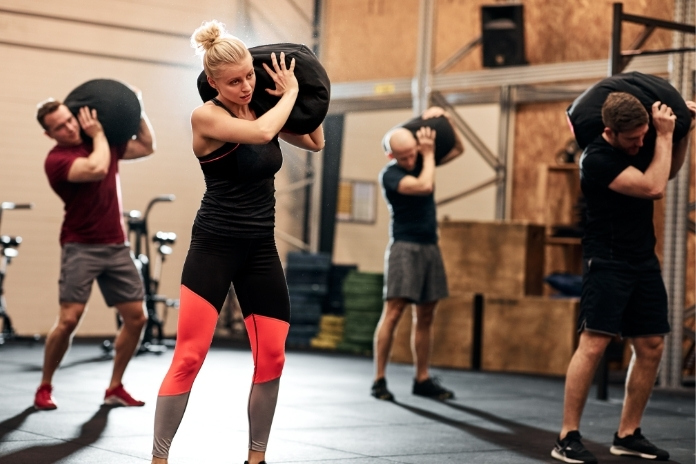
Sandbag exercises are incredibly underappreciated when it comes to increasing functional strength and cardiovascular fitness. You don’t want to snooze on sandbag workouts, even though barbells, dumbbells, racks, and equipment have earned their place in any upscale gym.
What is the reason to prefer a beautiful, well-polished barbell set over a cheap and dirty pile of dirt? In fact, a sandbag training workout is usually significantly more relevant to day-to-day life than the majority of traditional exercise equipment. Try these full-body sandbag workouts if you want to be an unstoppable person in daily life and a monster in the gym.
The cost and adaptability of sandbag exercises are two of their main benefits. You may do pushing, pulling, lifting, and carrying workouts without even breaking the bank by using a single sandbag in place of several other pieces of equipment.
This article will discuss efficient sandbag strength training regimens and sandbag exercises that will increase your power, stability, and endurance while keeping your workouts interesting and demanding.
Read More: One-and-Done: Total-Body Workout You Can Do 2x a Week
Why Train with a Sandbag?
With a gym packed with weights at your disposal, you might wonder, “What’s the point of training with sandbags?” The truth is that sandbags provide advantages and difficulties that other equipment cannot match.
You have to employ several stabilizing muscles since they are packed with sand, which makes every action harder and more efficient. You’re never really in a fixed position because of the moving sand within, which forces your body to adjust all the time.
You must maintain perfect form during sandbag workouts, whereas most strength training equipment makes the movement simpler. You cannot depend on the sandbags to direct your shape. Additionally, this increases body awareness and control, which you may use in your everyday activities and other strength training sessions—the epitome of functional fitness.
For starters, the sand is constantly shifting inside, so you (your core, your legs, your whole body) have to work harder to stabilize that resistance. Then you’ve got all the handles attached to the bag.
“The variety gives you endless grip options and movement possibilities,” says certified strength and conditioning specialist and physical therapist Dan Ogborn, Ph.D. “When you can play around with the way you hold and move weight, you engage new muscles and challenge them in alternative planes of motion, which is key to accelerating your results.”
Muscles Worked in Sandbag Training

One of the most significant benefits of doing the sandbag training is the ability it has to work multiple muscle groups at once, which is why it is such an effective full-body workout. Your body is constantly required to stabilize due to the shifting weight of the sand within the bag, which uses more muscles than regular weights ever will.
You can work your shoulders, arms, back, legs, and core, depending on what exercises you do. You get a total body workout because the shifting weight of the bag will require your stabilizing muscles to work harder.
With a combination of full-body strength training, conditioning, and a functional fitness program designed to replicate activities experienced during real-life activities, this versatile piece of fitness equipment will keep you guessing at the gym and challenge your balance, grip strength, overall strength, and cardiovascular capacity to maximize an all-around physical capacity.
Read More: How to Protect Your Knees During Workouts: Tips Every Active Person Should Know
The Advantages of Sandbag Exercises
Let’s examine why sandbags make an excellent addition to your home gym before doing these workouts.
- Unilateral motions for Balanced Strength: Sandbags are an excellent method to work on and build minor stabilizing muscles because of their unique weight distribution and one-handed grip. You may develop balanced strength by using each side of your body separately.
- Increased Forearm Strength and Grip: Grasping a flexible sandbag tests your forearm strength and grip, which improves performance on everyday jobs and in other training.
- It’s a Force of Nature: This piece of equipment is unique. Unlike dumbbells or kettlebells, which are metallic weights, sandbags have a changing center of gravity. It indicates that you are using your muscles differently than usual. You wind up having to change your equilibrium more often, which puts greater strain on your muscles. It’s excellent for your core as well.
- It offers a Complete Body Workout in a Shorter Time: More muscular usage is naturally encouraged by the sandbag’s ability to bend with gravity. Compared to other programs with similar effects, this offers a full-body workout in a significantly shorter amount of time.
- Improved Hand-Eye Coordination: Sandbag workouts often require you to concentrate and synchronize your motions, which sharpens your hand-eye coordination. It can lower your risk of falling and enhance your athletic performance.
- Add Resistance Anywhere: For an additional layer of resistance and intensity, you may comfortably balance a sandbag on your body, such as on your back when performing a plank, in contrast to a dumbbell.
Beginner-Friendly Sandbag Exercises

If you’ve not done sandbag exercises before, you don’t have to start heavy – you’ll be dealing with awkward movements and wanting to avoid injury while learning. Start light and take your time to learn the movement correctly. Here is a basic series of movements you can do with your sandbag:
1. Sandbag Deadlift:
- Set the sandbag on the ground, hold the handles firmly, bend at the hips, and lift it while keeping your back straight.
- It works the lower body and teaches good hip hinge mechanics.
2. Front Squat with Sandbag:
- Squat down and carry the sandbag at chest height.
- This move works the legs effectively while also challenging your core and upper body stability.
3. Carrying Sandbags:
- Hug the sandbag and walk.
- It may seem easy, but it will really work your legs, back, and grip strength.
4. Cleans with Sandbags:
- Explosively pick up the sandbag from the floor to your chest height.
- So good for coordination and power development.
5. Push-up with Sandbag (hands on bag):
- Place your hands on the sandbag for push-ups.
- Introduces instability that engages the core, shoulders, and chest during workouts.
Complete three sets of whatever exercise for 8–12 repetitions, changing the weight as needed.
Read More: 3 Brain Workouts That Are More Effective Than Crossword Puzzles
Intermediate to Advanced Sandbag Exercises

After nailing the basics, you can advance your skills with a more challenging sandbag routine. These exercises will also challenge your explosiveness, strength, and coordination, which will appeal to athletes and fitness enthusiasts looking to push themselves.
1. Sand bag swings and alternating hand catch: The “swing” targets the posterior chain, while also alternating the catches can enhance your agility and coordination, by keeping both your body and mind engaged.
How to perform it: Take a wide stance, placing the feet beyond your shoulder width, and hold the sandbag in one hand. The sandbag should swing between your legs as you flex at the hips and bend slightly at the knees. To get back to standing, push your hips forward and use the momentum this creates to swing your arm up. Let go of the sandbag once it comes up to chest level, then quickly catch it with your opposite hand. Continue using alternate hands to swing and catch.
2. Sandbag alternating pass-unders and reverse lunges: Sandbag pass-unders test your core and enhance coordination, while reverse lunges build strength in your lower body.
How to perform it: Lower your back knee to the floor in a lunge while taking a step back with one foot. At the lowest point of the lunge, transfer the sandbag from one hand to the other hand through your legs. To stand again, push up from your front foot. Repeat the passing action on the other side by bringing your other leg back.
3. Sandbag knee-to-elbow + overhead hold: This complex exercise works your upper and lower body by combining an overhead hold with knee-to-elbow crunches, which provides a full-body functional burn.
How to perform it: Hold a sandbag over your head with both hands while standing with your feet shoulder-width apart. Maintaining a straight back and tight core, elevate your left knee toward your chest while simultaneously lowering the sandbag toward your raised knee. Lower your left knee and drive the sandbag upward overhead. Keep switching, repeating with the right knee.
4. Sandbag pyramid plank switch: Prepare yourself to increase your mobility and core strength with this plank variant. Using the sandbag requires stability, control, and strong upper-body strength.
How to perform it: Hold a sandbag in your hands as you start in a high plank posture. To move the sandbag toward the area between your feet, grab it with one hand and push your hips up and back. Drag the sandbag back to the area between your hands as you move back into your starting position. Do it again.
This motion is more difficult than it seems to you, so try to adjust it by taking pauses as needed.
Tips for Safe and Effective Sandbag Training

Similar to any training program, you must perform sandbag exercises correctly and safely to make them effective. When you follow proper methods and guidelines, you reduce injuries and maximize the benefits of sandbag training.
- First, use the appropriate weight. A common mistake beginners make is jumping in with a heavy sandbag right away. Carry over the process of building your strength and stability into challenging exercises as you go. It establishes a solid foundation that enables the individual to perform the sandbag exercise effectively and safely.
- Next, pay attention to your posture and form. Avoid rounding your back, especially when shouldering, deadlifting, or cleaning. You can avoid lower back pain by keeping a neutral spine and engaging your core.
- Third, using high-quality sandbags is also essential. The best exercises are performed with sandbags that have safe fill methods, ensuring no leakage or movement, and provide a stable weight. Safe, durable equipment should reduce errors when performing the sandbag exercise.
Read More: How Often Should You Change Your Workout Routine?
Conclusion
Fitness can be easy, as you’ll see throughout this course using your sandbag. With one tool, you now have access to a broad spectrum of fitness that enhances your resilience, strength, and endurance. What is excellent about sandbag training is the simplicity and functionality of the exercise. Whether you are pushing, pulling, or carrying, each movement is taxing your body in a way that closely resembles the demands of real life.
As a functional fitness sandbag tool, it develops balance, stability, and coordination while enhancing raw strength. It is therefore ideal for athletes, busy people, or anyone who wants to work out smarter, not harder! Sandbags differ from traditional weights in that the shifting resistance keeps everything engaged throughout your workout, making the most of it!
References
- https://greatist.com/fitness/compound-exercises-sandbag-moves-for-strength
- https://www.amoskeagfitnessconcord.com/sandbag-weight-training-a-no-nonsense-guide-to-getting-started
- https://redefiningstrength.com/13-sandbag-exercises-full-body-workout/
- https://jackcityfitness.com/guide-to-sandbag-workouts/
- https://www.womenshealthmag.com/fitness/a19963155/sandbag-workout/
- https://www.panamclinic.org/staff-bio/dan-ogborn/
In this Article