











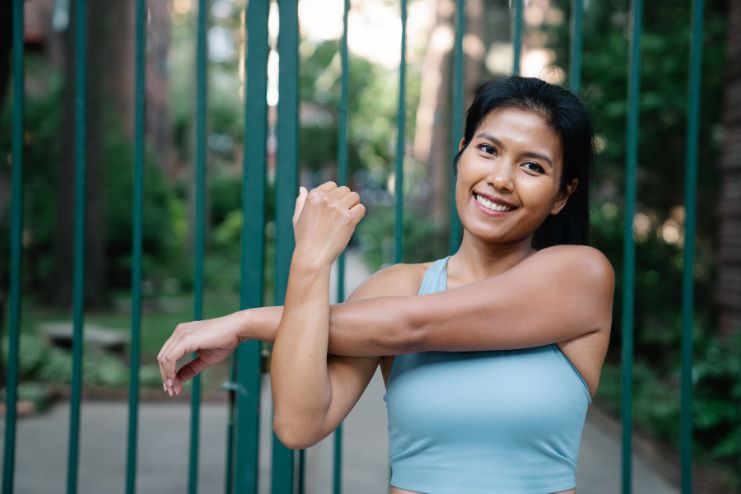
Ever notice how your non-dominant arm gives out first during workouts, leaving you frustrated and unbalanced? You’re not alone – research shows that the dominant limb is typically 11.6% stronger than the non-dominant limb, with some studies indicating strength differences can reach 10-15%.
While it’s natural for everyone to have a stronger arm, this imbalance can lead to poor performance, increased injury risk, and asymmetrical muscle development. Rather than simply adding more repetitions to your weaker side, the most effective approach is to isolate and specifically train your non-dominant arm. This unilateral training method helps retrain your nervous system and promotes muscle growth in the weaker limb.
Here are proven workout strategies to strengthen your non-dominant arm and create better balance between both sides of your body. Research indicates that unilateral training can produce greater strength gains than bilateral training for people with limb strength imbalances.
Read More: 14 Exercises For Underarm Fat – Keep Them Toned
Effective Exercises for Your Weaker Arm
1. Single-Arm Dumbbell Bench Press
Lie flat on an exercise bench while holding a dumbbell in your weaker arm. Position your arm so that your elbow is bent at 90 degrees and your upper arm is perpendicular to your torso. Press the weight up until your arm is fully extended, then slowly lower it back to the starting position.
Complete your desired number of repetitions before moving to the next set. Gradually increase the weight as you progress through your sets.
2. Single-Arm Incline Dumbbell Row
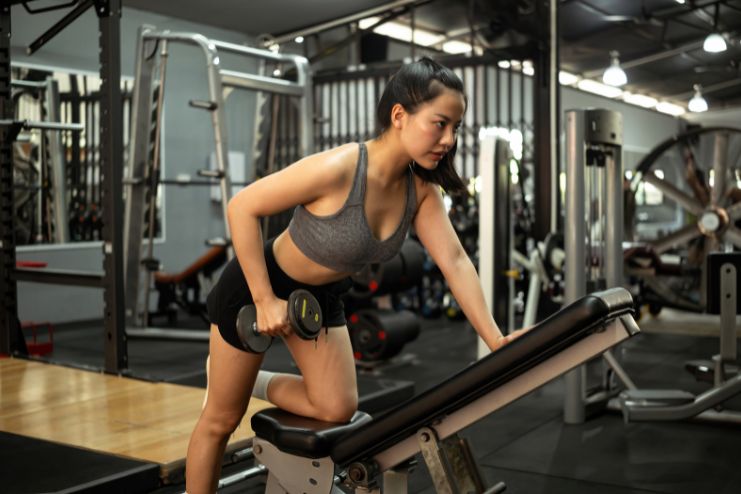
Set an exercise bench to a 30-degree incline and lie face down with your chin resting on the top of the backrest. Allow your arms to hang freely to establish the starting position. Using your weaker arm, lift the dumbbell by pulling your elbow back and up, keeping your arm close to your torso. Focus on squeezing your shoulder blade as you lift.
3. Single-Arm Dumbbell Shoulder Press
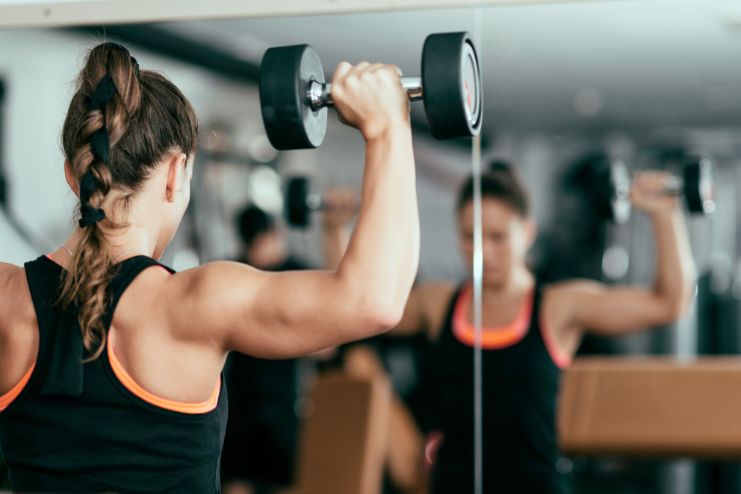
This exercise can be performed either seated or standing. Begin with your arm positioned so that your upper arm is parallel to the floor and your elbow is bent at 90 degrees. Press the dumbbell straight up above your head, keeping your arm close to your ear throughout the movement.
Slowly return to the starting position and repeat for your desired number of repetitions. Increase the weight for subsequent sets as your strength improves.
Read More: Amazing Exercises for Toned Arms
4. Single-Arm Neutral Grip Lat Pulldown
Using a single-handle attachment on a lat pulldown machine, perform the movement with your weaker arm only. Keep your palm facing down and pull the handle down until your elbow reaches your ribcage. Focus on engaging your lat muscle and controlling the weight throughout the entire range of motion, as unilateral rows significantly enhance scapular stabilization.
5. Single-Arm Incline Reverse Fly
Lie face down on a bench set to a 30-degree incline with your chin resting on the top of the backrest. Hold a dumbbell in your weaker arm and raise it out to the side, keeping your arm perpendicular to your torso. This exercise places significant demand on your rear deltoids and should be performed with lighter weights and controlled movement.
Training Tips for Success
Start with lighter weights: Your non-dominant arm will naturally be weaker, so begin with weights that allow you to maintain proper form throughout all repetitions.
Focus on form over weight: Proper technique is crucial for both safety and effectiveness. Master the movement pattern before increasing resistance.
Train consistently: Dedicate specific sessions to unilateral training rather than just adding it as an afterthought to your regular workout. Studies show that unilateral training can lead to an average strength increase of 7.8% in the untrained limb through cross-education effects.
Be patient: Strength imbalances developed over the years won’t correct themselves overnight. Consistent training over several months will yield the best results.
Listen to your body: If you experience pain or discomfort, reduce the weight or consult a fitness professional to ensure proper form.
Read More: How to Improve Arm Definition Without Lifting Heavy Weights
The Benefits of Unilateral Training
Training your weaker arm individually offers several advantages beyond just building strength. It helps improve overall body coordination, reduces injury risk by correcting muscle imbalances, and can even enhance performance in sports and daily activities. Additionally, unilateral training challenges your core stability and proprioception more than bilateral movements.
By incorporating these exercises into your routine and following proper progression principles, you’ll develop a stronger, more balanced physique while reducing the strength gap between your dominant and non-dominant arms.
Ready to Transform Your Weaker Arm?
Don’t let muscle imbalances hold you back any longer. Start incorporating these unilateral exercises into your workout routine today – even just 2-3 sessions per week can make a significant difference within 4-6 weeks. Your stronger, more balanced physique is waiting. Begin with lighter weights, focus on perfect form, and watch as your weaker arm transforms from a limitation into an asset.
Take action now: Choose two exercises from this list and add them to your next workout. Your future self will thank you for the balanced strength and reduced injury risk that comes from addressing these imbalances today.
References
- https://www.nature.com/articles/s41598-025-87413-w
- https://www.researchgate.net/publication/12827188_A_Comparison_of_Dominant_and_Non-Dominant_Hand_Strengths
- https://www.frontiersin.org/journals/physiology/articles/10.3389/fphys.2023.1128250/full
- https://pmc.ncbi.nlm.nih.gov/articles/PMC10133687/
- https://www.boxrox.com/7-unilateral-exercises-to-fix-muscle-imbalances-fast/
- https://www.muscleandmotion.com/unilateral-exercises/
- https://www.acefitness.org/resources/pros/expert-articles/7035/the-benefits-of-unilateral-training/
- https://www.usaweightlifting.org/news/barbend/2021/may/13/how-often-should-weightlifters-do-unilateral-work
In this Article