















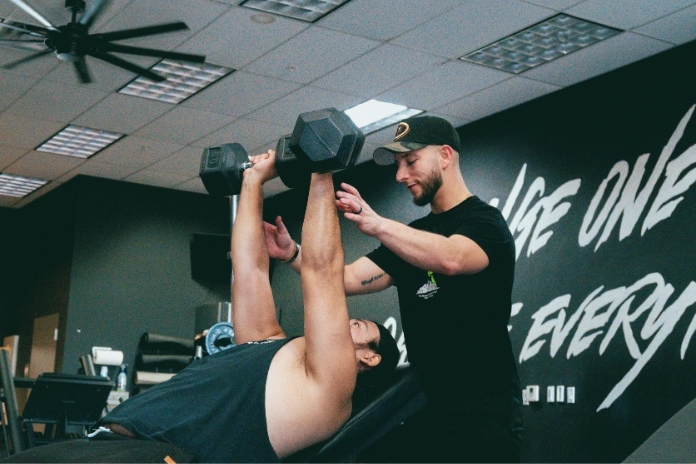
The strength training guidelines most people follow were written before smartphones existed. That changes now. Recently, the American College of Sports Medicine released its first major position stand on resistance training in 17 years, synthesizing 137 systematic reviews and data from more than 30,000 participants.
The conclusions rewrote several widely held resistance training rules. Three assumptions collapsed immediately: training to failure is not required for gains, complex periodization offers no meaningful advantage over simpler approaches, and specific equipment matters far less than previously thought.
What actually drives results is frequency, progressive overload, compound movements, volume, and consistency. The strength training guidelines below are drawn directly from the ACSM position stand, so you can start adjusting your program today.
Read More: Your Guide to Beginner Strength Training: How to Build a Sustainable Fitness Routine
1. Train Each Muscle Group at Least Twice a Week
How often should you lift weights? The ACSM position stand identifies training each major muscle group at least twice per week as the single most important frequency threshold. Below that, adaptation slows regardless of session quality. Beginners should target 2 to 3 days per week, intermediates 3 to 4, and advanced lifters 4 to 5. Allow at least 48 hours before reloading the same muscle.
Volume-equated studies show that 2 versus 3 sessions per week produce similar hypertrophy; what matters is hitting the weekly set target, not how many days it takes to get there. Full-body 3-day splits and upper/lower 4-day splits both satisfy the guideline.
2. Match Your Rep Range to Your Goal
How many reps to build muscle? The answer is more flexible than most sources suggest. For maximal strength, work 1 to 6 reps at or above 80 percent of your one-rep maximum. For hypertrophy, 6 to 12 reps at 60 to 80 percent of 1RM. For muscular endurance, 15-plus reps at below 60 percent with rest under 90 seconds.
The key insight: any rep range from 5 to 30 produces comparable hypertrophy, provided sets are taken close to failure, and weekly volume is sufficient. For general fitness, 8 to 12 reps per set remains the most practical choice, as it builds size and strength simultaneously with moderate fatigue.
3. Start with 2 to 3 Sets Per Exercise
How many sets for strength? The ACSM recommends 2 to 3 working sets per exercise at above 80 percent of 1RM. For hypertrophy, the more useful metric is total weekly volume: 10 or more working sets per muscle group per week is the threshold for consistent growth.
Beginners can gain from as little as 1 set per exercise, so starting low and progressing makes more sense than jumping to high volume. A dose-response relationship exists up to around 20 sets per muscle per week, after which recovery becomes the limiting factor. Three sets across 3 to 4 exercises per muscle group per week is an efficient path to the 10-set threshold.
4. Progressive Overload Is Non-Negotiable
Progressive overload is the systematic increase in training stimulus over time. Without it, the body adapts and stops responding. No program design or training modality substitutes for it, confirmed by every edition of ACSM guidelines.
The standard load increase is 2 to 10 percent per increment, applied when all prescribed reps are completed with good form across consecutive sessions. Adding reps, sets, reducing rest, slowing the eccentric phase, or increasing range of motion all count as valid overload methods.
Beginners can progress nearly every session, intermediates weekly, and advanced lifters monthly. No training log means no systematic overload.
5. You Do Not Need to Train to Failure, Stop 2 to 3 Reps Short

A 2022 meta-analysis in the Journal of Strength and Human Performance found no significant difference in strength or hypertrophy between sets taken to failure and sets stopped with reps in reserve. The ACSM position stand confirmed this finding. The recommendation: stop each set with 2 to 3 reps in reserve.
Stopping here preserves technique, limits central nervous system fatigue, and reduces injury risk on compound movements. Training every set to failure adds cardiovascular strain and session fatigue without producing additional adaptation. Occasional near-failure sets are fine; making failure the default for every set is not.
Read More: How to Structure Your Strength Training Program for Optimal Results
6. Slow Down the Lowering Phase, Eccentric Overload Is Underused
Every resistance exercise has a concentric phase, where the muscle shortens under load, and an eccentric phase, where it lengthens. Most lifters rush the lowering phase. The ACSM position stand identifies eccentric overload as one of the highest-return adjustments available for muscle growth.
The prescription: 3 to 4 seconds to lower the weight on every rep. No extra equipment, no added sets, no increased load. It is a tempo change that can be applied immediately to any program and is particularly useful for lifters who have plateaued without wanting to increase overall volume.
7. Match Your Rest Periods to Your Goal
Goal-specific rest periods are absent from most mainstream strength training content. The ACSM resolves this clearly. For strength and power, rest 2 to 5 minutes between sets. For hypertrophy, 1 to 2 minutes. For muscular endurance, 30 to 90 seconds.
Rushing rest between heavy compound sets is one of the most common program design errors. Performance drops, fatigue accumulates faster, and injury risk rises. Use a timer; perceived rest almost always underestimates actual time elapsed.
8. Equipment Type Matters Less Than You Think
The ACSM position stand is explicit: equipment type does not significantly affect strength or hypertrophy outcomes for healthy adults when volume and effort are equated. Barbells, dumbbells, cables, bands, and bodyweight all produce comparable adaptations. A well-structured home program can match gym-based results.
Equipment access is not a meaningful barrier to following the ACSM resistance training guidelines. Barbells do allow heavier absolute loads, making them practical for maximal strength work. Machines offer added stability for beginners or those returning from injury, but these are situational advantages, not categorical ones.
9. Prioritize Compound Movements, Then Add Isolation Work
Compound exercises recruit large amounts of muscle mass across multiple joints. Squats, deadlifts, bench press, rows, overhead press, and pull-ups are the foundation of any effective program. The ACSM sequencing guidelines are clear: train large muscle groups before small ones, multi-joint before single-joint, and higher intensity before lower intensity.
Isolation exercises are useful additions, not substitutes. A practical session structure: 3 to 4 compound movements followed by 2 to 3 isolation exercises. Fatigue from isolation work impairs compound performance; the reverse does not hold.
10. Consistency Beats Complexity

The headline finding from the ACSM position stand: the best resistance training program is the one you will actually stick with. The greatest gains come from moving from no training to any training, not from optimizing an already solid program.
Complex periodization, advanced techniques, and specific rep schemes produce marginal improvements that disappear without consistent execution. Simpler programs drive higher adherence. The practical minimum: 2 full-body sessions per week, 2 to 3 sets per exercise, 8 to 12 reps, progressive overload applied every session.
Read More: Why Consistency Matters More Than Intensity in Exercise for Longevity
The Bottom Line
The ACSM position stand is clear: less complexity, more consistency. Training to failure is unnecessary, specific equipment does not determine outcomes, and complex periodization matters less than showing up.
The most reliable set of strength training guidelines comes down to training each muscle group twice per week, applying progressive overload, prioritizing compound movements, and using goal-matched rest periods, executed consistently, week after week.
Frequently Asked Questions
Q. How many days a week should I do strength training?
The ACSM recommends training each major muscle group at least twice per week. For most people, that means 2 to 4 total training days. Full-body 3-day programs and upper/lower 4-day splits both satisfy this threshold.
Q. Is 3 sets of 10 reps still effective?
Yes. Three sets of 10 reps sit within the hypertrophy rep range, build both size and strength, and allow straightforward progressive overload. It is not the only effective structure, but it remains one of the most practical starting points.
Q. Do I need to train to failure to build muscle?
No. The 2022 meta-analysis and ACSM both show no meaningful advantage for training to failure over stopping with 2 to 3 reps in reserve. Failure increases fatigue and injury risk without producing additional adaptation.
Q. How long should I rest between sets?
For strength and power, rest 2 to 5 minutes. For hypertrophy, 1 to 2 minutes. For endurance, 30 to 90 seconds. Use a timer; most lifters underestimate how long they actually rest.
Q. Can I build muscle with bodyweight exercises?
Yes. The ACSM confirms that equipment type does not significantly affect outcomes when volume and effort are matched. Bodyweight training drives real gains when progressions are used, and sets are taken close to failure.
References
- Schoenfeld, B. J., Grgic, J., Van Every, D. W., & Plotkin, D. L. (2021). Loading recommendations for muscle strength, hypertrophy, and local endurance. Sports (Basel), 9(2), 32.
- Refalo, M. C., Helms, E. R., Trexler, E. T., Hamilton, D. L., & Fyfe, J. J. (2023). Influence of resistance training proximity-to-failure on skeletal muscle hypertrophy. Sports Medicine, 53(3), 649-665.
- Krieger, J. W. (2010). Single vs. multiple sets of resistance exercise for muscle hypertrophy. Journal of Strength and Conditioning Research, 24(4), 1150-1159.
- Franchi, M. V., Reeves, N. D., & Narici, M. V. (2017). Skeletal muscle remodeling in response to eccentric vs. concentric loading. Frontiers in Physiology, 8, 447.
- American College of Sports Medicine. (2026, March 17). ACSM unveils landmark 2026 resistance training guidelines—First update in 17 years.
- Currier, B. S., et al. (2026). Resistance training prescription for muscle function, hypertrophy, and physical performance in healthy adults: An overview of reviews.
- ScienceDaily. (2026, March 19). The best strength training plan might be simpler than you think.
- American College of Sports Medicine. (n.d.). Physical activity guidelines.
- Grgic, J., et al. (2021). Effects of resistance training variables on muscle hypertrophy: A systematic review.
- Mayo Clinic. (n.d.). Strength training: Get stronger, leaner, healthier.
- Marathon Handbook. (n.d.). Strength training tips.
- Mayo Clinic Health System. (n.d.). No matter your age or skill level, it’s never too late to start weight training.
In this Article