
















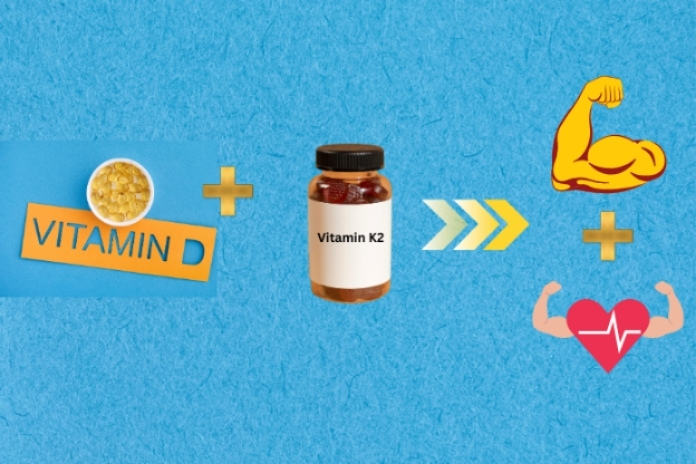
Vitamin D3 has become one of the most common supplements. People take it because blood tests show a deficiency or because someone said it’s “good for immunity and bones.” And this is true at some level, but the approach is incomplete.
This is because the body is not a simple box where you put calcium and expect stronger bones. Calcium needs direction. It needs regulation. Without that, extra calcium is just an extra load on the bloodstream.
This is where Vitamin K2 for calcium absorption comes in. Not as an accessory, not as a bonus, but as the other half of the mechanism.
Many people supplement D3 and then wonder why bone density doesn’t improve or why calcium levels are elevated on blood tests. The idea is not about “more vitamins.” It is about balancing D3 and K2 benefits. When one nutrient pushes a process, another nutrient may be needed to complete it. Calcium metabolism is one such system.
- The biochemical roles of Vitamin D3 and K2 are separate, yet interconnected.
- Why combining these nutrients may support bone strength and prevent unwanted calcium buildup elsewhere?
- Common dosage ranges for supplements and how to take them correctly.
- Which groups may need this pairing more than others?
- Practical considerations, including safety precautions.
How Vitamin D3 and K2 Work in the Body
The Role of Vitamin D3 (Cholecalciferol)

Vitamin D3 improves calcium absorption from food by around 30–40% or more, and that part works well. But the problem starts when people assume absorption equals utilization. It doesn’t.
Something less discussed:
When D3 supplementation raises blood calcium levels, the body expects the regulatory pathways that rely on Vitamin K2 to be available.
If those pathways are insufficient, the body may not efficiently incorporate the absorbed calcium into bone tissue.
So while D3 is essential, taking large amounts without considering related nutrients may not deliver the expected benefit.
The Role of Vitamin K2 (Menaquinone)
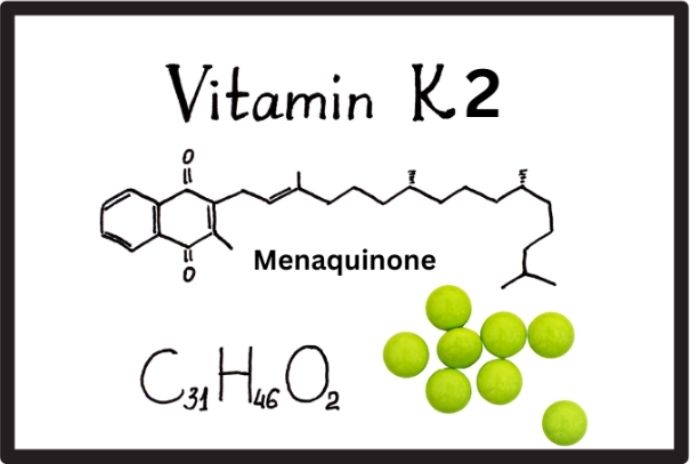
Several calcium-dependent proteins exist in the body, but they remain largely inactive until K2 is available to enable their function. One of these proteins, osteocalcin (related to body-building), helps the bone matrix take up and hold calcium effectively. Another, Matrix Gla Protein (MGP- related to calcium-blocking), works outside the bones and is responsible for preventing calcium from settling in places where it can cause harm, such as arterial walls or soft tissue.
When K2 intake is low, these proteins are produced but not fully activated. It means the calcium was absorbed, but your body wasn’t given the stimulus it needed to utilize it effectively.
Many food items contain only minimal K2 unless someone regularly eats natto, aged cheese, egg yolks, or organ meats. So, assuming that “diet will cover it” is usually just a wishful thought.
Read More: Best Gummy Prenatal Vitamins in 2025: Tasty, Nutrient-Rich Picks for Moms-to-Be
Why Vitamin D3 and K2 Work Best Together
The confusion around vitamin D has existed for decades. As family medicine specialist Matthew Goldman, MD, notes, “Initially, scientists found a compound, and they named it vitamin D1. But later, it was found that it is actually vitamin D2 mixed with other substances.”
A key clinical study by Inoue et al. (2000) looked at postmenopausal women with osteoporosis and found that combined vitamin D3 and K2 supplementation improved lumbar‑spine bone mineral density (BMD) more clearly than D3 alone, suggesting that together they are more effective at protecting bone health than either vitamin by itself.
Dr. Colin Smith, PhD, has also pointed out that most fortified foods still use vitamin D2, even though D3 has clearer biological benefits. He noted that people who avoid animal-derived supplements now have vegan D3 options, making it easier to choose a form that the body uses more effectively.
The Calcium “Traffic Director” Concept
Vitamin D3 increases calcium availability. This solves one problem: deficiency, but creates another: Where should the calcium go?
Vitamin K2 determines that.
A simple way to express this:
- D3 increases the volume of calcium “entering circulation.”
- K2 ensures calcium “arrives at the correct destination.”
Without K2, the body may store excess calcium in places it was never meant to go: arteries, joints, or soft tissue, especially when supplements are taken daily over long periods.
This is the reason: many clinicians now recommend taking D3 and K2 together as a pair, and not as two isolated nutrients.
Bone Health Synergy
Bone density depends less on the amount of calcium consumed and more on how efficiently it is placed inside the bone matrix. Studies comparing D3 alone vs. D3 + K2 consistently show better bone mineralization with the combination.
This becomes particularly relevant in:
- Older adults
- Women after menopause
- People with low dairy intake
- Individuals who get less or no sunlight exposure
These groups often have both: less calcium absorption and less bone deposition efficiency.
Heart and Vascular Benefits
Calcium deposition inside arteries is always harmful. Yet arterial calcification happens more frequently in people with high calcium intake and insufficient K2 activity.
K2 helps keep arteries flexible by enabling MGP to prevent calcium buildup. D3 alone does not protect arteries. And, the worst part is that long-term high-dose D3 without K2 might increase the risk of calcium build-up, especially when calcium supplements are also involved.
So the logic is simple:
- D3 improves availability.
- K2 prevents misplacement.
- The combination is safer and more complete.
Read More: Cold-Weather Immunity: Zinc, Vitamin D, Sleep, What Actually Helps
Signs You May Benefit From D3 + K2 Supplementation
This pairing becomes more relevant if:
- You spend most of the day indoors.
- You dislike or eat less fermented foods, cheese, or egg yolks.
- You already take calcium or Vitamin D supplements.
- Bone scan shows early decline.
- Family history includes arterial calcification or osteoporosis (a bone-damaging disease).
- You rely heavily on fortified foods rather than whole foods.
None of these directly indicates a deficiency, but they do indicate conditions in which the pairing of D3 and K2 is better than isolated supplementation.
One more point that often goes unnoticed is the difference between D2 and D3 in supplements and fortified foods. Dr. Colin Smith, PhD, has argued that D3 should be the preferred form and that plant-based consumers now have vegan D3 options, removing the need to rely on D2.
Read More: 6 Types of Fish That Naturally Boost Your Vitamin D Levels
How to Take D3 and K2 Together
Recommended Ratio and Dosage
A commonly seen balanced ratio for vitamin D3 K2 dosage is:
Daily Essentials
Recommended Vitamin Intake
| Nutrient | Suggested Intake | Notes |
|---|---|---|
| ☀️ Vitamin D3 Cholecalciferol |
1,000–6,000 IU | Based on deficiency levels and medical guidance |
| 🦴 Vitamin K2 (MK-7) Menaquinone-7 |
100–200 mcg | Often taken alongside D3 for calcium absorption |
MK-7 is generally preferred over MK-4 because it remains active longer. If you take a multivitamin, check labels. Many already include K1, not K2, for calcium absorption, and they are not interchangeable.
Best Time to Take
Both are fat-soluble, meaning absorption improves when taken with a meal containing fat, and not with coffee on an empty stomach. Timing does not matter as much as consistency.
Read More: The Interplay of Vitamin D Deficiency and Diabetes Risk
Pairing With Other Nutrients
Magnesium plays a role in activating vitamin D pathways. Zinc and Vitamin A contribute indirectly to bone metabolism.
As for calcium supplements, many individuals don’t require additional calcium, but rather improved calcium handling.
Read More: 8 Side Effects of Too Much Vitamin D That Can Be Dangerous
Safety and Precautions
- High doses of D3 without balance may push calcium levels too high.
- Anyone on warfarin or similar anti-blood-clotting medicines must speak to a clinician before using K2. This is non-negotiable.
- Kidney disease and parathyroid conditions (calcium-related disorders) require medical supervision.
- Third-party tested supplements are preferable to avoid inconsistent potency.
As Dr. Goldman notes, vitamin D is effective, but its strength is exactly why dosing matters. He emphasizes that checking with a clinician before starting or increasing supplements is the safest approach, particularly when higher doses are involved.
Read More: Top 3 At-Home Vitamin Deficiency Tests for Better Wellness
Conclusion
Vitamin D3 alone is not the full solution to bone health. It increases calcium absorption. Without Vitamin K2, the body may not place that calcium where it’s intended. If someone is supplementing D3 long-term, especially along with calcium, ignoring K2 is like building a structure with raw materials but no engineering.
Taken together, they support each other and improve results: D3 supports availability, and K2 supports correct placement. The combination of D3 and K2 supplement complete the process.
Key Takeaways
- D3 increases calcium absorption, but K2 prevents misplacement.
- Bone density improves more reliably when both are present.
- Diet alone often provides insufficient K2 compared to biological demand.
- Ideal supplementation includes MK-7 with Vitamin D3, taken with a meal containing fat.
- Balance, not high dosage, is the principle, especially if other calcium sources exist.

References
- Aaseth, J. O., Finnes, T. E., Askim, M., & Alexander, J. (2024). The Importance of Vitamin K and the Combination of Vitamins K and D for Calcium Metabolism and Bone Health: A Review. Nutrients, 16(15), 2420.
- Aguayo-Ruiz, J. I., García-Cobián, T. A., Pascoe-González, S., Sánchez-Enríquez, S., Llamas-Covarrubias, I. M., García-Iglesias, T., López-Quintero, A., Llamas-Covarrubias, M. A., Trujillo-Quiroz, J., & Rivera-Leon, E. A. (2020). Effect of supplementation with vitamins D3 and K2 on undercarboxylated osteocalcin and insulin serum levels in patients with type 2 diabetes mellitus: a randomized, double-blind, clinical trial. Diabetology & Metabolic Syndrome, 12(1).
- Hu, L., Ji, J., Li, D., Meng, J., & Yu, B. (2021). The combined effect of vitamin K and calcium on bone mineral density in humans: a meta-analysis of randomized controlled trials. Journal of Orthopaedic Surgery and Research, 16(1).
- Maresz, K. (2021). Growing Evidence of a Proven Mechanism Shows Vitamin K2 Can Impact Health Conditions Beyond Bone and Cardiovascular. Integrative Medicine: A Clinician’s Journal, 20(4), 34.
- Sizar, O., Khare, S., Goyal, A., Bansal, P., & Givler, A. (2023). Vitamin D Deficiency. PubMed; StatPearls Publishing.
- Wasilewski, G. B., Vervloet, M. G., & Schurgers, L. J. (2019). The Bone—Vasculature Axis: Calcium Supplementation and the Role of Vitamin K. Frontiers in Cardiovascular Medicine, 6.
In this Article