














Many people believe, ‘I work out, so sitting all day doesn’t matter. ‘ Prolonged sitting triggers inflammatory changes independent of exercise.
This article explains how it happens, why workouts don’t fully cancel it out, and practical steps to reduce the risk.
Why Sitting Is Considered a Health Risk—Even for Active People
Prolonged sitting means remaining in a seated position for extended periods, often more than 30-60 minutes without movement, while sedentary behavior encompasses low-energy activities like desk work or screen time.
Sitting differs from simply ‘not exercising’ because it actively impairs muscle function and circulation in ways that structured workouts do not address.
Researchers now treat sitting as its own independent risk factor for chronic low-grade inflammation, linked to higher levels of markers like TNF-α and lower anti-inflammatory IL-10, even in those who meet exercise guidelines.
“More than 10.5 hours of daily sedentary time significantly raises heart failure and cardiovascular death risks, even in those meeting exercise guidelines, due to direct metabolic disruptions,” – Dr. Shaan Khurshid, cardiologist at Massachusetts General Hospital
Read More: Do You Really Need to Avoid Nightshades for Inflammation?
How Sitting All Day Triggers Inflammation in the Body

Reduced Muscle Activity and Inflammatory Signaling
Muscle contractions release anti-inflammatory signals that suppress cytokines like IL-6 and TNF-α. When muscles stay inactive for hours, this suppression fails, allowing inflammatory pathways to activate and elevate markers such as IL-8.
Studies show that even healthy young adults experience this shift after just a few hours of uninterrupted sitting.
Impaired Blood Flow and Vascular Inflammation
Sitting slows circulation in the legs and hips, pooling blood and reducing oxygen delivery. Poor blood flow triggers endothelial dysfunction, promoting vascular inflammation through reduced nitric oxide and heightened oxidative stress.
This contributes to systemic effects, including elevated C-reactive protein (CRP).
Insulin Resistance and Metabolic Inflammation
Sitting impairs glucose uptake in muscles, leading to insulin resistance within hours.
This metabolic disruption links to higher inflammatory markers like IL-6 and tissue plasminogen activator (t-PA), fostering chronic low-grade inflammation.
Why Working Out Doesn’t Fully Cancel the Effects of Sitting
The ‘Active Couch Potato’ phenomenon describes fit individuals who exercise but sit excessively, facing elevated risks. Short workouts, like 30-60 minutes daily, cannot offset 8+ hours of sitting because inflammation responds to total daily movement patterns.
Research confirms sedentary time predicts higher TNF-α independently of moderate activity.
Read More: Is Inflammation the Root of All Chronic Diseases? What You Should Know
Signs Sitting-Related Inflammation May Be Affecting You

Prolonged sitting all day contributes to chronic low-grade inflammation through muscle inactivity and impaired circulation, even among those who exercise regularly.
Common indicators include persistent stiffness or achiness from reduced muscle activity and poor blood flow, which disrupts normal tissue repair processes.
Swelling in legs or ankles often signals vascular inflammation buildup, as sedentary behavior slows lymphatic drainage and promotes fluid retention in lower extremities.
Beyond physical discomfort, a sedentary lifestyle manifests in subtler ways that impact daily life and metabolic health. Low energy despite consistent workouts stems from elevated inflammatory markers like IL-6, which interfere with energy metabolism.
Difficulty losing fat or achieving metabolic improvements arises from insulin resistance and inflammation, where sitting impairs glucose uptake independently of exercise.
Physical Warning Signs
- Persistent Stiffness or Achiness: Muscles in the hips, back, and legs remain inactive, leading to tightness that worsens after hours of prolonged sitting health effects. This reflects reduced anti-inflammatory signaling from muscle contractions.
- Swelling in Legs or Ankles: Blood flow and inflammation issues cause edema, especially noticeable in the evenings in desk workers.
Metabolic And Energy Indicators
- Low Energy Despite Workouts: Inflammation from sitting elevates cytokines that promote fatigue, overriding exercise benefits.
- Stalled Fat Loss or Metabolic Health Gains: Sedentary behavior fosters insulin resistance, blocking fat metabolism and raising inflammatory markers like CRP.
These signs highlight why sitting too much, even if you exercise, demands attention to total daily movement, not just gym sessions.
Read More: Best Anti-Inflammatory Foods To Counter Inflammation
How Long Is Too Long to Sit Without Moving?
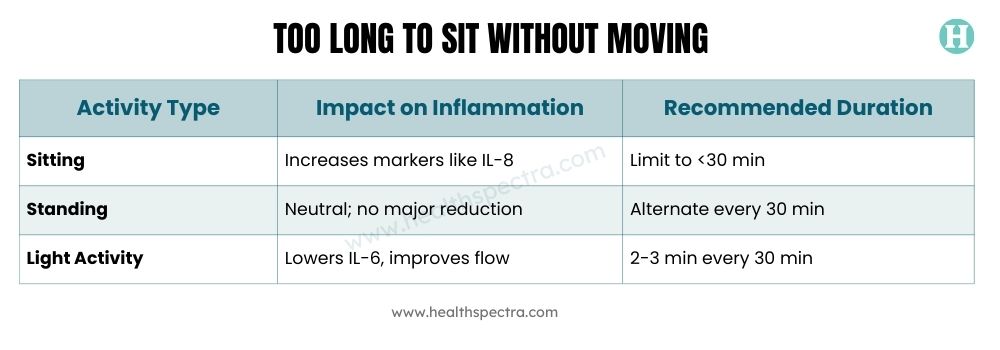
Research suggests uninterrupted sitting beyond 30 minutes raises inflammation risks, with meaningful effects after 60 minutes. Frequency of movement matters more than intensity, as light interruptions prevent cytokine spikes better than prolonged bouts
 Movement Snacks That Lower Inflammatory Load

Incorporate short walking breaks to boost circulation and muscle contractions. Light mobility or stretching activates anti-inflammatory pathways without high effort.
Muscle activation through simple moves outperforms passive standing by directly signaling cytokine reduction.
Why Low-Intensity Movement Is So Effective
Frequent motion upregulates anti-inflammatory responses and improves insulin sensitivity. No need to ‘break a sweat; light activity suffices to counteract sedentary effects.
Does Standing All Day Fix the Problem?
Standing reduces some circulation issues compared to sitting but still elevates inflammation if static.
Static standing lacks muscle engagement, failing to lower markers like those seen with dynamic movement. Changing positions regularly every 30 minutes proves more beneficial.
Read More: Can Too Much Sitting Really Shorten Your Lifespan? What Science Says
How to Build an Anti-Inflammatory Daily Movement Routine
Pair workouts with 2-3 minute breaks hourly for optimal metabolic health. Desk-friendly strategies include seated leg lifts or desk marches. Habit stack by linking breaks to emails or calls for consistency.
- Set phone reminders for movement every 30 minutes.
- Use a standing desk with position shifts.
- Walk during calls when possible.
Who Is Most at Risk From Sitting-Related Inflammation
Desk workers and remote employees face the highest exposure due to 8+ hour routines. Those with insulin resistance or joint pain experience amplified effects.
Older adults and limited-mobility individuals risk faster progression to chronic issues.
Read More: Why Sitting Too Long on the Toilet May Raise Your Risk of Hemorrhoids
When Sitting-Related Inflammation Becomes a Medical Concern

Watch for persistent swelling or circulatory symptoms like varicose veins. Chronic pain or stiffness warrants evaluation for underlying inflammation.
Seek medical advice if symptoms persist despite movement changes, as they may signal deeper issues like peripheral artery disease (PAD).
Read More: How To Offset Sitting All Day? 13 Stretches And Exercises To Practice
Key Takeaways
Prolonged sitting triggers independent inflammation through muscle inactivity and poor blood flow, even among those who exercise regularly. This creates the “active couch potato” effect, where workouts alone cannot fully offset 8+ hours of sedentary time.
Daily movement outperforms exercise in isolation. Frequent 2-3 minute low-intensity breaks every 30 minutes more effectively reduce markers like IL-6 and IL-8. Light activity also enhances insulin sensitivity and circulation without requiring intense effort.
For desk workers, actionable changes include limiting uninterrupted sitting to under 30 minutes and prioritizing muscle-activating moves like walking or stretching over static standing.
Watch for warning signs such as persistent stiffness, leg swelling, or low energy despite fitness routines. Seek medical evaluation for chronic symptoms to rule out deeper issues. Total daily movement becomes the cornerstone of an anti-inflammatory lifestyle.
References
- Bergens, O., Nilsson, A., Papaioannou, K. G., & Kadi, F. (2021). Sedentary patterns and systemic inflammation: Sex-specific links in older adults. Frontiers in Physiology, 12, 625950.
- Chung, L., Chen, M. L., & Miao, T. S. (2025). The association between sedentary behavior and MASLD in overweight and obese adults: Investigating the role of inflammatory markers using NHANES data (2017-March 2020). Frontiers in Nutrition, 12, 1579453.
- Cooper, A. R., Falconer, C. L., Walhin, J. P., Thompson, D., Page, A. S., Peters, T. J., Montgomery, A. A., Sharp, D. J., Dayan, C. M., & Andrews, R. C. (2014). Sedentary time and markers of inflammation in people with newly diagnosed type 2 diabetes. Nutrition, Metabolism and Cardiovascular Diseases, 24(9), 956–962.
- Esteghamati, A., Morteza, A., Khalilzadeh, O., Anvari, M., Noshad, S., Zandieh, A., & Nakhjavani, M. (2012). Physical inactivity is correlated with levels of quantitative C-reactive protein in serum, independent of obesity. Journal of Health, Population and Nutrition, 30(1), 66–72.
- Farah, B. Q., Ritti-Dias, R. M., Montgomery, P. S., Casanegra, A. I., Silva-Palacios, F., & Gardner, A. W. (2015). Sedentary behavior is associated with impaired biomarkers in claudicants. Journal of Vascular Surgery, 63(3), 657–663.
- Hoffmann, S. W., Schierbauer, J., Zimmermann, P., Voit, T., Grothoff, A., Wachsmuth, N. B., Rössler, A., Niedrist, T., Lackner, H. K., & Moser, O. (2024). Effects of interrupting prolonged sitting with light-intensity physical activity on inflammatory and cardiometabolic risk markers in young adults with overweight and obesity. Biomolecules, 14(8), 1029
- Henson, J., Yates, T., Biddle, S. J., Edwardson, C. L., Khunti, K., & Wilmot, E. G. (2013). Sedentary time and markers of chronic low-grade inflammation in a high risk population. PLOS ONE, 8(10), e78350
- Park, J. H., Moon, J. H., Kim, H. J., Kong, M. H., & Oh, Y. H. (2020). Sedentary lifestyle: Overview of updated evidence of potential health risks. Korean Journal of Family Medicine, 41(6), 365–373.
- Ridker, P. M., Rifai, N., Lowenthal, A. M., & Stampfer, M. J. (2001). Rapid reduction in C-reactive protein with cerivastatin among 785 patients undergoing percutaneous coronary intervention. Journal of the American College of Cardiology, 37(6), 1646–1652.
- Tehard, B., Sébire, G., & Clavel-Chapelon, F. (2006). Physical activity and breast cancer risk by hormone receptor status: Results from the E3N cohort study. Cancer Epidemiology, Biomarkers & Prevention, 15(2), 332–338.
- Thosar, S. S., Johnson, B. D., Johnston, G. F., & Wallace, J. P. (2014). Effect of prolonged sitting and breaks in sitting time on endothelial function. Medicine & Science in Sports & Exercise, 47(4), 843–849.
- Wennberg, P., Gustafsson, P. E., Dunstan, D. W., & Healy, G. N. (2013). Television viewing and high trans fatty acid and high saturated fatty acid dietary pattern clusters in the dietary inflammatory index. Nutrition Reviews, 71(10), 666–680.
- Yamagishi, K., Ikeda, A., Chei, C. L., Tanaka, M., Kitamura, A., Imano, H., Kiyama, M., Okada, T., Cui, R., Iso, H. (2013). Average daily television viewing time and incident hypertension: The circulatory risk in communities study (CIRCS). Journal of Human Hypertension, 27(10), 621–627.
- Yates, T., Khunti, K., Wilmot, E. G., Brady, E., Webb, D., Srinivasan, B., Henson, J., & Davies, M. J. (2012). Self-reported sitting time and markers of inflammation, insulin resistance, and adiposity. American Journal of Preventive Medicine, 42(1), 1–7.
In this Article