














- If your ankle feels “loose” after a sprain, it is likely due to incomplete ligament healing, delayed muscle reaction, and poor proprioception.
- Pain relief alone does not mean full recovery. Structured strength and balance retraining, along with habit modification, are required to prevent recurrent ankle sprains.
- Pain reduces in 2–3 weeks. So the person thinks they are healed. But ligament healing has phases. Full ligament remodeling can take 3–6 months
Many people say the same sentence in the clinic: “The swelling isn’t there, the pain has reduced, but still the ankle feels loose after a sprain.”
It is not severe pain. It is not a fracture. It is something in between, a strange ankle-giving-out feeling when walking on an uneven road, going up stairs fast, or even playing a sport. You trust your knee, you trust your hip. But ankle? Not fully.
This is not imagination. It is a real condition called “chronic ankle instability” (CAI). And it does not happen only to athletes. Office workers, homemakers, gym beginners, and anyone who has had 1–2 repeated ankle sprains can develop this.
If this is ignored, the sprain becomes a cycle. Each time milder but more frequent. Slowly, confidence reduces more than strength.
Let us understand what is really happening.
What Is Chronic Ankle Instability (CAI)?

Chronic Ankle Instability (CAI) is a condition where the ankle repeatedly gives way after an initial sprain, most commonly involving the outer (lateral) ligaments.
The key problem is not just “weak ligaments.” It is a failure of the ankle system, ligaments, muscles, nerves, and brain coordination to work together properly.
After a typical lateral sprain, the ligaments stretch or tear. If healing is incomplete or rehab is insufficient, the ankle never regains full mechanical and neuromuscular control. So, chronic ankle instability (CAI) is not only structural. It is partly mechanical and partly neurological.
Many patients are told:
- “It’s normal, sprain takes time.”
- “Wear a band and walk.”
- “Do some ankle rotations.”
But chronic ankle instability needs deeper correction than casual advice.
Why Your Ankle Still Feels “Loose”
1. Ligaments That Healed in a Stretched Position
Ligaments are like seat belts for your joints. They limit excessive movement. When a sprain occurs, especially an inversion sprain (foot rolling inward), ligaments such as the anterior talofibular ligament can stretch or tear. If:
- Swelling was not controlled properly,
- The ankle was not supported initially,
- Or loading started too early,
The ligament may heal in a slightly elongated position. It does not mean it is completely torn. It means its tension is reduced. Even 2–3 mm extra ligament laxity can change how stable the ankle feels.
Here is the issue: ligaments do not tighten on their own after healing. They remodel but do not fully shrink back without a proper loading stimulus. This creates mechanical looseness. But that is only one part.
2. Weakened Peroneal Muscles
The peroneal muscles (on the outer side of your lower leg) are your ankle’s emergency brakes. When your foot suddenly rolls inward, these muscles should react in milliseconds to pull it back.
After a sprain:
- Swelling inhibits muscle activation,
- Pain reduces reflex speed,
- Fear reduces natural loading.
Within 2–3 weeks, these muscles become weaker and slower.
Important point: It is not just strength that reduces. Reaction timing reduces. Studies show that in people with chronic instability, peroneal reaction time is delayed by milliseconds. It sounds small, but during sudden movement, those milliseconds matter. So your brain says “correct,” but muscles respond late. That delay feels like looseness.
3. Poor Proprioception and Balance Response
Proprioception means your joints’ sense of position. Ligaments are not just ropes. They have nerve endings that tell your brain:
- Where your ankle is
- How fast is it moving
- And in which direction
When ligaments are injured, these sensory receptors get damaged. If rehab does not include balance retraining, the brain never recalibrates fully. So what happens?
- You walk well on a flat surface.
- But on uneven ground, a small stone, a wet floor, an ankle suddenly misjudges position.
- Before muscles react, it slightly rolls.
This is why some people say, “I was just walking normally, and it twisted again.” It is not bad luck. It is incomplete sensory recovery.
4. Scar Tissue or Joint Impingement
Sometimes, the ankle does not feel loose because it is unstable. It feels loose because it is not moving correctly. After sprain:
- Small scar tissue bands may form inside the joint
- The capsule may thicken
- The synovium may remain inflamed
This creates:
- Slight block in certain movements
- Reduced dorsiflexion (bringing the foot upward)
- Altered joint mechanics
When one direction becomes stiff, another direction becomes overused. That overuse direction feels unstable.
Many patients with chronic sprains have limited ankle dorsiflexion. They cannot squat properly without lifting their heels. This restriction forces the ankle into compensatory positions during walking and sports. So instability sometimes starts from stiffness.
5. Returning to Activity Too Soon
This is the most common and least discussed cause. Pain reduces in 2–3 weeks. So the person thinks they are healed. But ligament healing has phases:
- Inflammatory phase (a few days): Bleeding, clotting, immune cell cleaning
- Proliferative phase (weeks): Body fills tissues with new cells
- Remodeling phase (months): Replacing weak collagens, building blocks of skin, with stronger tissues
Full ligament remodeling can take 3–6 months.
If sports, running, or heavy gym resumed in 3–4 weeks without structured rehab, you are loading an incompletely mature ligament. Each minor re-sprain adds micro damage. Over time, functional instability (a functionally unstable joint) sets in even if no major tear occurs again.
Dr. Veena Devaraju, an ankle surgeon, adds, “Instability is not limited to athletes. Adults of all activity levels can develop chronic ankle instability, especially after injuries that were never properly rehabilitated.”
Pain-guided return is not enough. Stability-guided return is required.
How to End the Cycle of Repeated Ankle Sprains

Breaking this cycle requires a structured plan, not random exercises.
1. Rebuild Strength and Stability Through Targeted Physical Therapy
Not just “alphabet with foot” or ankle circles (range-of-motion work). A proper rehab plan includes:
Phase 1: Mobility Restoration
- Restore dorsiflexion using a weight-bearing stretch
- Joint mobilization if required
- Control swelling completely
Phase 2: Strength with Endurance
- Resistance band eversion drills (peroneal strengthening exercises)
- Heel raises (both straight knee and bent knee)
- Slow eccentric control exercises
Phase 3: Neuromuscular Retraining
- Single-leg balance training, eyes open, then eyes closed, wobble board exercises (proprioceptive training of the ankle)
- Unstable surface training (only after base strength)
- Perturbation drills (external gentle pushes)
Phase 4: Sport-Specific Loading
- Side shuffles
- Controlled hopping
- Gradual cutting movements
Most people stop at phase 2. That is why instability persists. Consistency matters more than intensity. For proper ankle sprain recovery, aim for active recovery rather than passive rest.
2. Use External Support During High-Risk Activities
Ankle braces or taping are not a weakness. They:
- Reduce excessive inversion angle
- Improve proprioceptive feedback
- Reduce fear of movement
But a brace should not replace rehab. Use a brace during sports, trekking, and walking on uneven terrain. Avoid full-day dependency without exercise. Otherwise, muscles become lazy.
The thing is, bracing or taping provides short-term external stability. Wear proper footwear for firm heel counter and support your soles.
3. Modify Daily Habits That Delay Healing
Small daily habits keep the ankle irritated, such as
- Sitting cross-legged with the foot twisted inward for a long time.
- Wearing soft, worn-out footwear.
- Ignoring mild swelling after activity.
- Sudden weekend sports after a sedentary week.
Better habits:
- Supportive shoes with a firm heel counter.
- Ice after heavy activity if swelling appears.
- Avoid walking on uneven terrain too early.
- Warm up and stretch before workouts.
- Prioritize rest days and gradual progression.
- Regular calf stretching.
- Avoid long static positions that stress lateral ligaments.
Healing is not only gym-based. It is lifestyle-based.
Read more: 8 Early Signs of Bone Damage You Should Never Ignore
When to See an Orthopedic or Sports Medicine Specialist after Chronic Ankle Instability
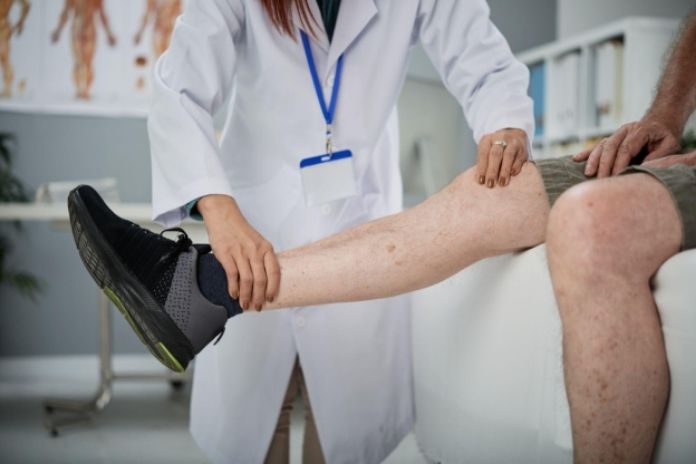
You should know when to see an orthopedic specialist to prevent the progression of chronic ankle instability:
- Ankle has given way more than 3–4 times over the past 6 months.
- Persistent swelling beyond 8–10 weeks.
- Locking or catching sensation.
- Severe stiffness limiting squatting or climbing stairs.
- Pain deep inside the joint, not just outside.
Dr. Jonathan Pajouh, an ankle surgeon, says, “If your ankle still feels wobbly or like it might roll, that’s your body telling you something isn’t right, and it’s worth checking out.”
Investigations may include:
- X-ray to rule out bony issues.
- MRI to check ligament integrity and cartilage.
- Stress radiographs in some cases.
In rare, severe mechanical instability, surgical reconstruction through the Modified Broström procedure may be required to tighten ligaments. But the majority improve with structured rehab. Early evaluation prevents long-term joint damage, such as early arthritis.
Read More: Is Inflammation the Root of All Chronic Diseases? What You Should Know
Daily Habits That Protect Your Ankle Long-Term
Ankle stability is not a one-time achievement. It is maintenance.
- Continue balance training even after recovery. Single-leg balance drills 2–3 times weekly, even after recovery.
- Maintain calf and peroneal strength.
- Warm up before sports properly.
- Replace worn shoes on time.
- Maintain a healthy body weight to reduce joint load.
- Do not ignore minor sprains. Even a small twist deserves 1–2 weeks of focused orthopedic rehabilitation.
An ankle is a small joint, but it still takes a full-body load. Take care of it.
Read More: Why Your Knees Hurt When Climbing Stairs (Even if You’re Young)
Final Thoughts
So now you know that an ankle that feels loose after a sprain is not a sign of a weak ankle after a sprain. It rather happens due to an incomplete recovery after repeated ankle sprains. The biggest mistake is assuming that the absence of pain equals healing.
Chronic ankle instability is not as dramatic as a fracture. But it slowly reduces performance, confidence, and joint health.
Correcting it requires patience, structured rehab, and habit change. The good news is that most cases improve significantly without surgery when treated properly. Your ankle does not need sympathy. It needs specific training.
- Chronic ankle instability is both a mechanical and neurological problem.
- Delayed muscle reaction time may be more important than pure muscle weakness in repeated ankle sprains.
- Limited ankle dorsiflexion is an under-recognized contributor to recurrent instability.
- Pain-free movement does not mean ligament remodeling is complete; biological healing may take months
- Many rehab protocols focus on strength but do not adequately measure proprioceptive recovery or reaction timing.
References
- Hertel, J., & Corbett, R. O. (2019). An Updated Model of Chronic Ankle Instability. Journal of Athletic Training, 54(6), 572–588.
- Hertel, J., & Corbett, R. O. (2019). An Updated Model of Chronic Ankle Instability. Journal of Athletic Training, 54(6), 572–588.
- Vaes, P., Duquet, W., & Gheluwe, B. V. (2024). Peroneal Reaction Times and Eversion Motor Response in Healthy and Unstable Ankles. Journal of Athletic Training, 37(4), 475.
In this Article