














You might feel anxious when you hear questions like, “Can you get herpes from sharing a drink?” These questions turn an everyday habit into something that suddenly feels risky. A shared bottle at a party, having a sip from a friend’s cup, or even accidentally using the same straw suddenly feels loaded with consequences. Since herpes is lifelong and considered taboo, people often overestimate how easily it spreads, especially through casual contact.
However, the reality is much less scary than many people perceive. Herpes is transmitted mainly by direct skin-to-skin contact and not through ordinary sharing of drinks or cups. Saliva can act under very specific conditions, but science suggests that herpes from sharing drinks is highly unlikely.
The key to understanding the reason is to look carefully at the behavior of the virus itself, what it needs to survive, and what actually creates real risks for transmission. In this article, let us learn more about herpes simplex virus transmission and whether you can get herpes from sharing a cup or a drink.
What is Herpes? A Clear, Practical Overview
Herpes is caused by the herpes simplex virus, commonly abbreviated as HSV. Two major HSV types infect humans.
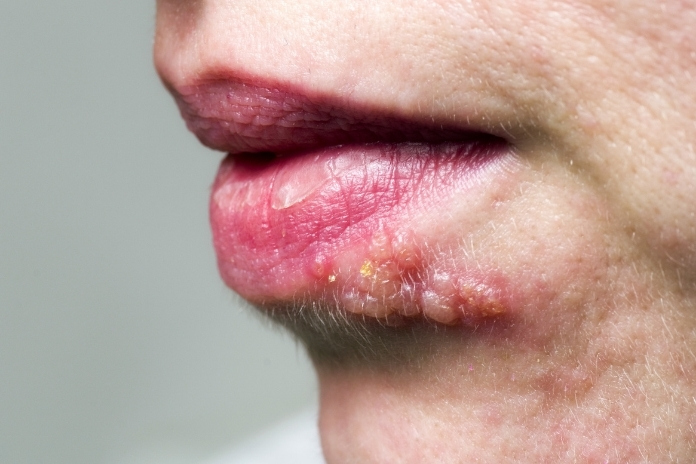
- Oral herpes is most commonly caused by HSV-1. It usually brings on cold sores or fever blisters around the mouth and lips. Although a lot of people do not show any visible sores while carrying HSV-1.
- HSV-2 is more often thought of in the context of genital herpes, though both types can infect either area through close contact.
Oral herpes is very common. About 60%-90% of adults worldwide carry HSV-1, which can be picked up during childhood through non-sexual contact. Most importantly, many individuals who have HSV-1 are asymptomatic. They might never develop a cold sore, and they could never even know that they carry the virus.
It is this silent presence that, in part, fuels confusion and fear about herpes transmission.
How Herpes Is Transmitted
Understanding the transmission of the herpes simplex virus requires recognizing what the virus needs to infect a new host.
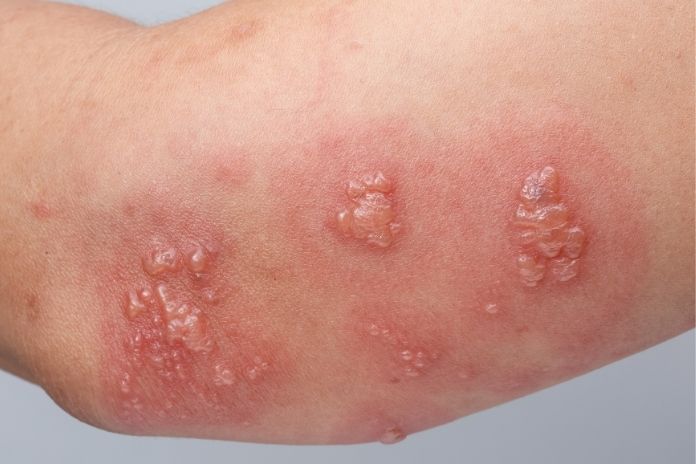
HSV is most effectively transmitted by direct contact with infected skin or mucous membranes. Examples include the following:
- Direct contact with an active cold sore.
- Kissing while the virus is actively shedding.
- Oral-genital contact.
The virus enters the body through tiny cuts in the skin or via mucous membranes, for instance, around the lips and mouth. This contact with skin, not with objects, is the common route of transmission.
The virus does not float freely and robustly in saliva in a way that makes casual exposure dangerous. Rather, HSV requires close, direct contact with living tissue.
This explains why intimate behaviors carry risk while everyday sharing does not. Dr. Beth Oller, MD, a family physician who specializes in women’s health and obstetrical care in Stockton, KS, says, “One of the biggest [myths] about herpes is that patients had to have gotten it from their current partner. Actually, herpes can activate years after you initially came into contact with it.”
Read More: 17 Home Remedies For Herpes That Work Wonders
Can You Get Herpes from Sharing a Drink?
The short answer is simple: you are extremely unlikely to get herpes from sharing a drink.
From a biological perspective, HSV is a fragile virus. Once it leaves the human body, it loses the capacity to cause infection. Particularly, exposure to air, temperature changes, and hard surfaces such as glass or plastic significantly reduces viral survival.
Herpes would be highly unlikely to be transferred through sharing drinks because several uncertain conditions would have to occur simultaneously:
- A high viral load would be needed in this case.
- The virus would have to remain viable outside the body.
- It would have to reach another person’s mucous membranes almost immediately.
These conditions are rare in real-world settings. That is why medical experts continue to say that casual sharing of drinks is not a meaningful route of herpes transmission.
When Sharing a Drink Could Carry Some Risk

Though the risk is low, it is not entirely zero. Sharing a cup in certain situations can increase the risk of oral herpes slightly.
This can happen in the case of a person having an active cold sore that is producing a lot of virus. If that sore directly came in contact with the rim of a cup, and another person used that same cup immediately afterwards, putting their mouth on the same spot, then there would be a theoretical risk.
Even in this instance, the chances of transmission are much less than those from kissing or direct skin-to-skin contact. The virus has a short window for its survival outside the body. Even then, exposure does not mean infection.
This is an important detail: ‘possible does not mean probable.’
Why Saliva is Normally Not Enough
One of the biggest myths regarding herpes infection is that it is highly contagious through saliva. However, HSV1 is only transmitted when there is enough viral load to reach the vulnerable tissue under the right conditions.
Saliva dilutes the virus rather than concentrates it. Once saliva is exposed to air or a surface, the virus begins to degrade rapidly. This is why scientists differentiate between a detectable virus and an infectious virus.
While HSV particles may be present in saliva and sometimes detected through laboratory tests, their realistic chances of causing infection are low in everyday situations. Most viruses detected outside the body have already lost the ability to infect another person.
Read More: 11 Ways to Heal Cracked Mouth Corners & Relieve Pain!
What About Sharing Utensils, Straws, Or Lip Balm?

Sharing utensils or straws carries a similar risk profile to sharing drinks. It is very low in most circumstances. Brief contact with the lips followed by environmental exposure does not favor viral survival.
Nevertheless, personal things that tend to come into contact with the lips, like lip balm or toothbrushes, present a somewhat greater risk if used directly following contact with an active cold sore. These items may maintain moisture and repeated exposure, which slightly improves conditions for the virus.
Healthcare guidance focuses more on avoiding the sharing of personal lip products during outbreaks, rather than trying to avoid shared objects altogether.
Asymptomatic Shedding: What It Does and Doesn’t Mean
Asymptomatic shedding will have periods when the virus is released from the skin without symptoms. This concept often instills more fear because it sounds unpredictable.
Asymptomatic shedding does play a role in herpes transmission, but mainly in prolonged skin-to-skin contact. It does not mean that the virus is constantly spreading through casual contact or shared items.
Asymptomatic shedding does not make everyday activities such as sharing a drink high-risk for contagiousness. The type and closeness of contact still play a key role in the contagious period for herpes.
Understanding this decreases needless fear while still acknowledging real transmission routes.
How to Reduce the Risk Further

Reducing the risk of herpes transmission does not require extreme behavior changes.
Simple and evidence-based precautions you can take:
- Avoid sharing beverages or any lip products while cold sores are active.
- Be aware of close contact during outbreaks.
- Adopt proper hygiene practices.
There is simply no scientific reason to avoid all casual sharing when no sores are present. Overavoidance often only increases anxiety and reinforces stigma without making any real improvement in health.
When to Consult with a Doctor

You must visit your healthcare provider if:
- You get cold sores frequently or severely, or
- If you notice new or unusual oral symptoms or
- You have questions about herpes testing and contagious periods.
Medical guidance provides much-needed clarity, reassurance, and treatment options when required.
Read More: 8 Working Ways to Get Rid of Cold Sores Overnight
Final Takeaway
It is highly unlikely to get herpes through sharing drinks. Herpes is contracted directly through skin-to-skin contact, rather than casual contact from sharing a cup, bottle, or utensil.
The risk becomes greater when cold sores are active. However, it is still low compared to kissing or other contact. Understanding how HSV transmission really occurs replaces fear with facts. This also cuts down on any unnecessary stigma associated with a common virus, such as herpes.
When in doubt about herpes transmission, rely on reputable medical resources rather than myths or fear generated by social media. If you have any questions, speak with your healthcare provider and only choose the information that reduces your anxiety and does not increase it.
References
- Centers for Disease Control and Prevention. (n.d.). Herpes simplex virus. World Health Organization.
- National Center for Biotechnology Information. (2006). Herpes simplex viruses. In Viral Infections of Humans: Epidemiology and Control (pp. 223–226). National Institutes of Health.
- National Center for Biotechnology Information. (2020). Herpes simplex virus type 1 infections. In StatPearls. StatPearls Publishing.
- National Center for Biotechnology Information. (2013). Human herpesviruses: Biology, therapy, and immunoprophylaxis. In The Human Herpesviruses (2nd ed.). National Institutes of Health.
- National Institutes of Health. (2018, June). Herpes can happen to anyone. NIH News in Health.
- National Institutes of Health. (2023). Herpes simplex virus: Immune response mechanisms. Journal of Clinical Virology, 165, Article 105403.
- Narayana Health. (n.d.). Cold sore prevention, complications, and risks.
- Virology Research Services. (2024, December 11). Herpes simplex virus: Understanding HSV-1 and HSV-2.
In this Article