















Hair thinning in women is often treated casually – “maybe stress,” “maybe shampoo change,” “maybe age.” But when the hair starts showing the scalp at the part line or volume becomes half of what it used to be, it is not just a random change. Androgenetic alopecia in women, also known as female pattern hair loss, is one of the most common yet least openly discussed conditions affecting women across all ages.
This article goes past the usual “it’s hormones” explanation and focuses on what actually happens, why it’s different from hair loss in men, and what women can realistically expect from treatment.
Key Takeaways – What You’ll Learn
- How female pattern hair loss develops and why it works differently from men
- Subtle signs women often miss until thinning becomes visible
- Evidence-based treatments and what they actually achieve
- Lifestyle and hair-care choices that support overall scalp health
What Is Female Pattern Hair Loss (Androgenetic Alopecia in Women)?
Female pattern hair loss occurs when hair follicles shrink over time. This miniaturisation (follicle shrinkage) is largely genetic and linked to hormone sensitivity. Once the follicles get smaller, the hair they produce is lighter, shorter, and less dense. It’s still androgenetic alopecia – the same broad category as male pattern baldness, but the pattern is different.
The classic sign in women is diffuse thinning over the top of the scalp and a widening part line. Unlike male pattern baldness, women usually retain their frontal hairline.
Dermatologist Dr. Mary Gail Mercurio notes,
“Many women don’t notice hair loss as a bald spot. Instead, it starts with subtle changes – a part that looks wider than before or a ponytail that suddenly feels thinner. These are often the earliest signs of female pattern hair loss.”
FPHL can start at any time in adulthood, but it becomes more noticeable in your 40s, especially around menopause, when hormone levels change.
Causes and Risk Factors of FPHL in Women
Most women blame stress or a bad shampoo at first, but the real reasons for female pattern hair loss run deeper:
1. Genetic Predisposition
If close family members – on either the mother’s or father’s side – had hair thinning, the chances increase. Genetics influences how sensitive hair follicles are to hormones, especially androgens (male-type hormones).
2. Hormonal and Androgen-Linked Factors
Androgenetic alopecia in women is not about “excess male hormones.” Instead, it’s about the hair follicles being more sensitive to normal hormone levels.
- A key androgen is DHT (dihydrotestosterone), which shortens the growth phase of hair.
- Research shows that female pattern hair loss becomes notably more common after menopause because estrogen declines, shifting the balance so that androgens have greater influence on follicles.
- Women with PCOS(ovarian hormone disorder) may see earlier or more noticeable thinning because of slightly higher androgen levels.
3. Other Contributing Factors
The causes of female hair thinning are not always purely hormonal. Triggers include:
- Age-related reduction in follicle activity
- Unhealthy diet
- Thyroid disorders
- High stress and poor sleep
- Harsh hair treatments (straightening, tight hairstyles, frequent colouring)
Lifestyle and environmental factors do not cause female pattern baldness on their own, but they can accelerate progression.
How It Presents: Signs and Symptoms of Androgenic Alopecia
Women usually notice:
- A part line that looks slightly wider than before
- Hair loses volume even if the length is the same
- A “see-through” zone at the crown (top back scalp) under bright light
- More miniaturised, baby-fine strands on top of the scalp
FPHL is different from other types of hair loss:
- Telogen effluviumcauses sudden shedding
- Alopecia areatagives round bald patches
- Traction alopeciaaffects the hairline from tight hairstyles
FPHL is a gradual reduction in density, not sudden shedding.
Dermatologist Dr. Rodney Sinclair explains, “Female pattern hair loss tends to progress slowly and diffusely, which is why both patients and clinicians often underestimate how long follicle miniaturisation has been happening before the changes become noticeable.”
Psychologically, even mild thinning can feel severe. A noticeable part line often affects confidence more than the actual hair count suggests.
Read More: Best Shampoo for Menopausal Hair Loss: What to Choose, What Works & Why
Diagnosing Female Pattern Hair Loss
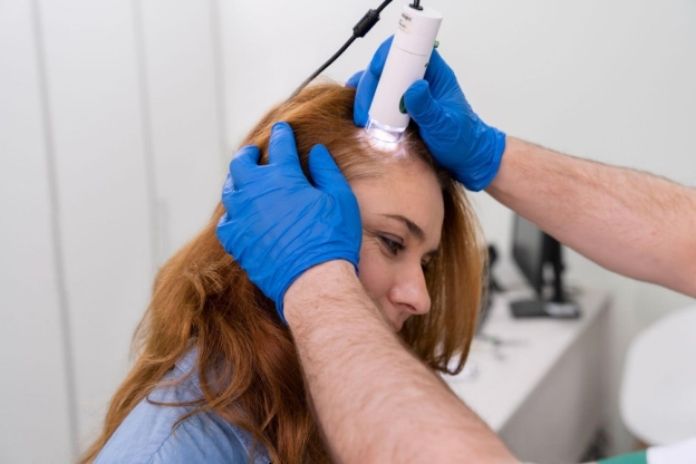
A dermatologist typically checks:
- Pattern and distribution of thinning
- Miniaturised hair under magnification
- Family history
- Duration and progression
Tests may include:
- Blood tests(iron, ferritin, thyroid, vitamin D, sometimes hormones)
- Trichoscopy for close-up follicle patterns
- Scalp biopsyin uncertain cases
Early diagnosis matters because treatments work best on active follicles, not on those that have been inactive for a long time.
Read More: How to Tell If Your Hair Is Healthy: Signs to Look For (And Fixes…
Treatment Options and What Results to Expect
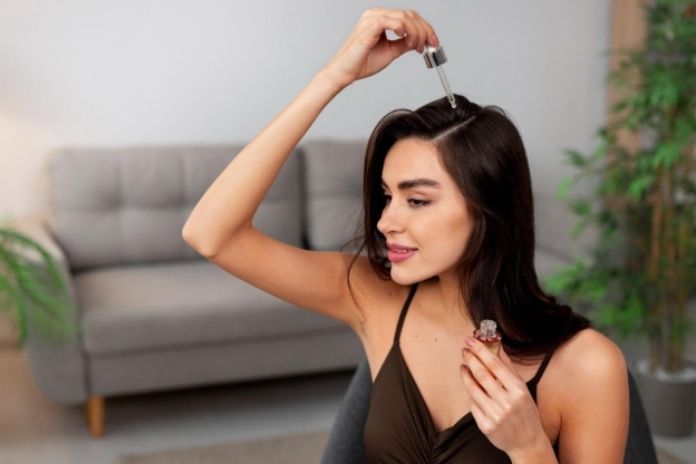
Once female pattern hair loss is identified, the next question is what can actually be done – and what results women can realistically expect.
1. Proven First-Line Therapies
Minoxidil (Topical)
This is the only FDA-approved medication for female pattern hair loss.
Minoxidil helps by:
- Extending the growth phase
- Increasing blood flow to follicles
- Improving hair diameter
It does not fix hormonal causes, but supports existing follicles to function better. The 2% and 5% solutions are used in women, and 5% foam is common.
Results take:
- 2–3 months to reduce shedding
- 4–5 months for maximum effect
Studies also show that combining minoxidil with microneedling or platelet-rich plasma (PRP) improves outcomes compared to minoxidil alone.
Hair Care Adjustments
Simple changes help protect existing hair:
- Gentle detangling
- Avoiding tight ponytails
- Minimising heat exposure
- Using less damaging colouring methods
Healthy hair habits do not cure FPHL, but reduce breakage, making hair appear denser.
2. Additional Treatment Options
Anti-Androgens
Medicines like spironolactone or certain hormonal treatments may help women who have:
- PCOS
- Elevated androgens
- Acne or unwanted facial hair alongside scalp thinning
These should be taken only under medical supervision.
Low-Level Laser Therapy (LLLT)
Laser devices (such as caps and combs) can help some patients by stimulating follicles, though responses vary from person to person.
A 2024-2025 meta-analysis also showed a significant increase in hair density with LLLT (compared to placebo) in alopecia patients.
Hair Transplantation
Less common in women because thinning is diffuse, and donor areas may also be miniaturising. Still an option for carefully selected cases.
Emerging Research
Newer treatments target inflammation or early miniaturisation pathways. Dermatologists may suggest clinical trials depending on availability.
Managing Expectations
- Progress is slow, and consistent treatment is required.
- Complete reversal is rare, so the goal is to slow progression and improve density.
- Some women respond strongly to treatment, others moderately.
- Maintenance is lifelong – stopping treatment leads to gradual loss again.
Understanding these parameters helps reduce frustration later.
Read More: How to Naturally Slow Down Age-Related Hair Loss
Supporting Hair Health and Lifestyle Strategies

While not curative alone, these reinforce treatment results:
1. Nutrition
A 2023 systematic review found many women with AGA had low:
- B vitamins
- Iron/ferritin
- Vitamin D
- Zinc
Add:
- Iron-rich foods if ferritin is low
- Adequate protein intake for keratin production
- Vitamin D and zinc sources
Avoid taking sugary drinks and alcohol: These were positively correlated with hair loss in large reviews.
Consistent nutrition supports healthy hair cycles.
2. Avoiding Hair Damage
- Reducing heat styling
- Avoiding frequent chemical straightening
- Using conditioners to reduce friction and breakage
Miniaturised hair breaks easily, so prevention helps maintain visible volume.
3. Stress and Sleep
Chronic stress may increase shedding phases. Good sleep and stress reduction techniques support hormonal balance.
4. Cosmetic Support
While waiting for treatments to work, women can use:
- Volumising powders or sprays
- Strategic haircuts
- Hair fibres for events
- Wigs or toppers, if desired
These do not interfere with medical treatments.
Read More: Itchy Scalp But No Dandruff? Possible Causes and Fixes
When to See a Specialist
Consult a dermatologist if:
- Hair loss is rapid or suddenly severe
- There are bald patches instead of diffuse thinning
- There are signs of hormonal problems, such as irregular periods or unwanted facial hair
- It’s causing emotional distress or affecting day-to-day confidence
Prompt evaluation ensures correct diagnosis and early intervention.
Read More: Is It Normal to Lose Hair in the Shower? Here’s When to Worry
Final Thoughts
Hair thinning in women is never just a reflection of poor care or ageing alone. It is a biological change that deserves proper evaluation, awareness, and an evidence-based approach. With increasing recognition of androgenetic alopecia in women, more treatment modalities and better diagnostic tools are becoming accessible. Women do not have to wait for severe thinning; early action makes a real difference.
Quick Recap
- Female pattern hair loss is common, progressive, as well as genetically influenced.
- It shows up as a widening part along with thinning on top.
- Early treatment provides better outcomes.
- Minoxidil, lifestyle adjustments, and medical supervision form the best strategy.
- Managing expectations ensures long-term satisfaction with treatment.
References
- Badri, T., Nessel, T. A., & Kumar D, D. (2020). Minoxidil. PubMed; StatPearls Publishing.
- Blume-Peytavi, U., Shapiro, J., Messenger, A. G., Hordinsky, M. K., Zhang, P., Quiza, C., Doshi, U., & Olsen, E. A. (2016). Efficacy and Safety of Once-Daily Minoxidil Foam 5% Versus Twice-Daily Minoxidil Solution 2% in Female Pattern Hair Loss: A Phase III, Randomized, Investigator-Blinded Study. Journal of Drugs in Dermatology : JDD, 15(7), 883–889.
- Cleveland Clinic. (2023a, May 3). Female pattern baldness: Symptoms and treatment.
- Cleveland Clinic. (2023b, August 30). Alopecia Areata: Causes, Symptoms & Management.
- Gomes, N., Silva, N., & Teixeira, B. (2025). Assessing the relationship between dietary factors and hair health: A systematic review. Nutrition and Health.
- Ho, C. H., & Zito, P. M. (2019, May 18). Androgenetic Alopecia. Nih.gov; StatPearls Publishing.
- Hughes, E. C., & Saleh, D. (2019, July 3). Telogen Effluvium. Nih.gov; StatPearls Publishing.
- Khutsishvili, N., Rudnicka, L., Ovcharenko, Y., Starace, M., Buchukuri, I., Pataraia, S., & Lortkipanidze, N. (2023). Trichoscopy – a valuable tool for identifying conditions mimicking androgenetic alopecia. International Journal of Dermatology, 63(1), 23–31.
- Perez, S. M., Vattigunta, M., Kelly, C., & Eber, A. (2024). Low-Level Laser and LED Therapy in Alopecia: A Systematic Review and Meta-Analysis. Dermatologic Surgery.
- Pulickal, J. K., & Kaliyadan, F. (2021). Traction Alopecia. PubMed; StatPearls Publishing.
- Rayner, D. G., McMullen, E., Mundle, K., Pham, M., Sibbald, C., & Donovan, J. (2025). Bi-directional association between female pattern hair loss and polycystic ovary syndrome: A systematic review and meta-analysis. JAAD International, 23, 24–26.
- Wang, R., Lin, J., Liu, Q., Wu, W., Wu, J., & Liu, X. (2024). Micronutrients and Androgenetic Alopecia: A Systematic Review. Molecular Nutrition & Food Research.
- Xia, Y., Chen, H., Chen, Y., & Chen, Z. (2025). Relative efficacy of minoxidil in combination with other treatments for androgenic alopecia: a network meta-analysis based on randomized controlled trials. Frontiers in Medicine, 12.
In this Article