














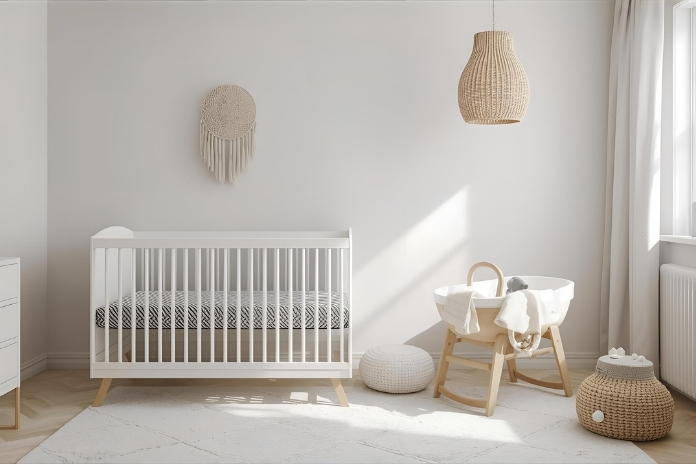
One of the many important decisions that a new or expectant parent must make is where would their newborn sleep. Making a practical choice will help the infant sleep better during the first few months of their life.
Although this may seem like a minor decision, it has a significant impact on your peace of mind as well as on the safety and comfort of your baby. You will want to buy the best crib or bassinet for your child’s safety, while also considering one that fits your lifestyle and budget. It is also essential to know which bassinet or crib meets your needs.
Our article will discuss pros and cons of each bassinet or crib, give you professional safety tips, and also discuss some important factors to help you make an educated decision.
Read More: Best Cribs for Short Moms: Top Picks That Are Safe, Stylish, and Easy to Reach
What Is a Crib and What Is a Bassinet?
Your infant can sleep safely in a crib or a bassinet. However, there are some significant differences between the two. Let’s take a closer look.
Crib: A baby crib is a little bed. Infants of all sizes can safely use cribs when parents follow the product safety rules. To make it easy to lie down and pick up your infant, cribs are often rectangular and constructed out of wood slats with a side that can be raised or lowered.
Most cribs remain stationary by design, while some manufacturers make others foldable. Cribs are usually more expensive than bassinets due to their size and use of materials.
Bassinet: A baby bassinet is a little, raised bed for infants who are:
- Younger than five months.
- Less than twenty pounds.
- They are not yet able to roll over by themselves.
Your infant should stop sleeping in a bassinet as soon as they achieve any of the above milestones. However, because bassinets are often oval-shaped and compact, they are an excellent choice for parents who want the flexibility to move the bed easily from room to room depending on where their baby is napping. Bassinets are frequently lighter and more portable due to their size and shape.
Bassinets might have a rocking or swinging base, wheels, or a stationary frame. They often have a small mattress inside and are made of mesh, cloth, or wood.
Safety Standards and Sleep Recommendations

Which is safer, a bassinet or a crib? Unfortunately, the answer to that question is not that simple.
The American Academy of Pediatrics (AAP) encourages the parents to obtain a bassinet or a freestanding crib for their child. The American Academy of Pediatrics discourages the use of co-sleepers and other sleeping devices attached to the parents’ bed.
However, the AAP does not actually distinguish between a bassinet and a play yard or crib. But the American Academy of Pediatrics does recommend that parents and caregivers follow all basic safe sleep guidelines for their babies, regardless of the parents’ choice.
AAP Safe Sleep Guidelines:
- The sleeping area should be completely free of any loose items, such as the baby’s clothes, blankets, or stuffed animals.
- The baby should never be put to sleep face down or sideways, but instead on their back in their own crib or bassinet.
- Avoid using any sleeping aid, including sleep positioners.
- No sharing a bed or putting the infant in a chair or any other posture while they sleep.
- No bumpers for cribs.
- Share a room with the infant until they are at least six months old.
Read More: Top 9 Baby Products Every New Parent Needs: Essentials for Baby Care
Pros and Cons: Bassinet vs Crib
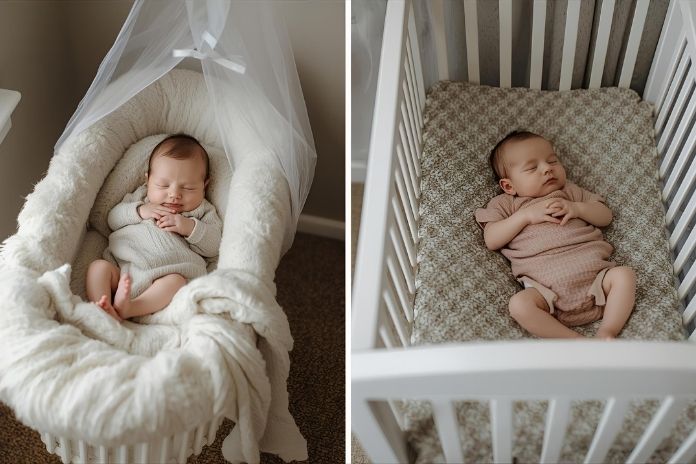
Both a bassinet and a crib have benefits and drawbacks that you should weigh when deciding which is best for your newborn. Now let’s examine those.
Pros of Bassinets:
- Your newborn infant will have a smaller sleeping place instead of a spacious crib after passing through a confined womb.
- Simple mobility allows you to transfer your infant around the house easily.
- Not as heavy as a crib.
- Ideal for sharing a room.
- Ideal for tiny living areas.
- Not as costly as a crib.
- Laying your infant down will be easier.
- Some people can use them as sleepers under the bed.
- Some come with music or motion built in.
Cons of Bassinets:
- Higher center of gravity and smaller size could be a tipping hazard
- Can be used for just a couple of months
- Not economical
Pros of Crib:
- It’s a robust and stable design (reduced chance of falling)
- Used for a prolonged period of time, even years
- Mattresses in standard sizes are readily available
- Extensive range of sizes, colors, shapes, and styles
- Adaptable to twin beds, child beds, and day beds
- You can adjust the mattress height to accommodate your baby’s growth
Cons of Crib:
- Heavyweight (may be challenging to move)
- Your bedroom might not accommodate it
- Assembly is more difficult
- Lifting the infant in and out could be challenging
When to Move from Bassinet to Crib
If you decide to get your baby a bassinet, these suggestions can make the switch to a new bed easier.
Start with Naps: Begin by taking a nap. Put your infant to sleep in the crib until they get accustomed to it. After that, please focus on the transition at night until they are consistently sleeping in their crib.
Develop a Nightly Ritual: Now is the ideal moment to develop an evening habit, such as taking a bath, reading a book, cuddling, or sleeping, if you haven’t already. Every baby thrives on a consistent nighttime schedule. As you do these things every night, your baby will begin to learn that sleep and their crib are on the horizon.
Sleep in Your Baby’s Room: Sharing your baby’s room can also help ease the transition from the bassinet to the crib. You can stay with your infant for a few nights if there is a bed, a couch, or an air mattress in the room.
Remain Close By: You don’t have to spend the entire night uncomfortable watching your infant sleep. Staying around when they fall asleep, however, can be beneficial. For instance, after putting your baby in the crib, give them time to settle in while you’re still in the room. The chair approach to sleep training is the next step. When your baby cries, this method helps them fall asleep without needing to be lifted.
Put your infant down and sit in a chair near the crib to employ this method. You can use your voice to soothe them if they start crying. Every night, slowly slide the chair in the direction of the door until you are ultimately out of the room.
Provide Comfort: As previously discussed, it’s best not to place blankets or plush animals in your baby’s cot until they are at least a year old. Instead, create a cozy environment by turning down the lights or playing white noise to aid in your child’s sleep.
Read More: Sucking The Baby’s Pacifier By A Parent May Prevent Allergies, New Study Suggests
How to Choose the Best One

How can you decide which is safest for your family if the American Academy of Pediatrics does not formally endorse either a crib or a bassinet? You may consider several variables when making your selection, including:
The Size and Growth of your Baby: A bassinet may first seem like a more sensible option, but whatever bassinet you select for your newborn will have a weight limit. For example, some bassinets only allow a maximum weight of 15 to 20 pounds.
Your newborn will outgrow the bassinet very fast if they weigh more than 10 pounds. Another thing to keep in mind is that your newborn can outgrow the bassinet in terms of development, even if they weigh less than the weight restriction.
Cost: You will still have to purchase a crib, because most bassinets will not last your baby more than a couple of months. Therefore, consider the budget when making your decision. Can you afford to buy a crib and a bassinet? Or would it be more cost-effective to buy the crib and keep it?
Space: Consider how much room you have for your infant. A bassinet might be more suitable for a smaller living and sleeping space because cribs are often larger than bassinets. If your baby will initially sleep in your room, a bassinet may be a better option than a crib. Manufacturers design some cribs for tiny areas, so not all of them are large.
Conclusion
Selecting the right bed for your baby’s initial sleeping sessions consists of more than just purchasing a piece of furniture. Between the stability and endurance of a crib and the intimacy and convenience of a bassinet, each choice has something special to offer. There is no such thing as a perfect solution, just that which is best for your family’s schedule, and the kind of place where peace may prevail.
Think of this choice as the foundation for your baby’s very first dreams.Safety is the primary factor, whether they are sleeping soundly in a crib made to grow with them or snuggled in a comfortable bassinet next to your bed.
Read More: No Breast Milk after Birth: Causes, Solutions, and When to Seek Help
FAQs
Can a newborn use a crib from day one?
Yes, a baby can sleep in a crib from the moment they are born because both cribs and bassinets are secure places for them to sleep.
How long can a baby safely use a bassinet?
Until they reach the weight restriction specified by the manufacturer or the ability to roll over, push up, or sit up on their own, a baby can safely sleep in the bassinet for approximately four to six months. To guarantee safety, the transition should occur sooner if the baby grows too large or active for the bassinet.
Which is better for SIDS prevention — crib or bassinet?
When parents take all precautions—placing the infant on their back on a level, firm surface with a fitted sheet and no loose objects—neither a crib nor a bassinet inherently prevents SIDS.
What’s a bedside sleeper/sidecar crib?
A bassinet or cot that fastens directly to an adult bed is called a bedside sleeper, or sidecar crib, and it enables a baby to sleep close to their parents in a secure, private area.
Can used cribs or bassinets be safe?
Purchasing a used crib is perfectly OK as long as it complies with current safety standards and is complete. Using a secondhand frame is certainly fine, and terrific for saving money, but you should buy a new mattress for it.
References
- https://www.parents.com/bassinet-or-crib-for-baby-8630932
- https://publications.aap.org/patiented/article/doi/10.1542/peo_document088/79989/Safe-Sleep-and-Your-Baby-How-Parents-Can-Reduce
- https://health.clevelandclinic.org/when-and-how-to-sleep-train-your-baby
- https://www.uchicagomedicine.org/forefront/pediatrics-articles/sids-prevention-safe-sleep-for-infants
In this Article