














Your fitness goals don’t end when you become forty. Continuing to exercise and selecting motions that assist in preventing the natural consequences of aging are more crucial than ever.
You’ll be relieved to learn that you don’t need to lift large weights or jump a lot to get healthy and strong if your objective is to increase your strength, but you’re concerned about high-impact exercises damaging your joints.
Instead, low-impact Pilates exercises can help you tone and strengthen your muscles. This training method incorporates small, bodyweight motions that target particular muscles.
“Once you hit 40, your body starts losing muscle mass at about 8% each decade,” Brittni Johnson, a certified Pilates instructor with the fitness and wellness app BetterMe, explains. “That means getting weaker, stiffer, and less steady on your feet, which makes simple daily tasks harder than they used to be.”
You can improve your general strength, balance, and mobility in as little as 15 minutes each day.
Read More: Advanced Pilates Challenge: 10 Intense Exercises for Seasoned Practitioners

Expert Choice: Best At-Home Yoga Studio
Experience over 2,400 world-class yoga classes from the comfort of your home. YogaDownload offers expert-led programs and flexible membership options for every fitness level.
*Purchases through this link support our research at no extra cost to you.
Why Strength Training After 40 Is So Important
Most women already know that strength training makes us look better and is essential for bone density. However, remember that strength training also enables us to continue doing the things we love for many years.
Strength exercise also improves our body composition by increasing lean tissue and decreasing fat. Strength training is a true game-changer for fat loss, even if we typically turn to cardio for this purpose. Increasing your resting metabolism (BMR) makes your body more effective for burning fat throughout the day, not just when you work out. Strength training combined with regular walking is the best way to lose fat, especially beyond the age of 35, when hormones make it more difficult.
Sarcopenia is the process by which our bodies start to lose muscle mass, and it can begin as early as our 30s. Sarcopenia is the term used to describe progressive loss of muscle mass, strength, and function that becomes more apparent as people age, particularly beyond the age of 40. In addition to impairing mobility, this illness can also jeopardize general health and independence, increasing the risk of fractures and falls.
Wall Pilates is one type of Pilates that will improve your at-home routine. It uses a wall or other sturdy surface that you can lean on to support your joints, as the name implies. Additionally, you can alter the surface to make some movements harder or easier.
This mat-based exercise strengthens the deeper stabilizer muscles, including the core, glutes, and smaller muscles around your hips and spine. As you age, maintaining strength in these areas will benefit your posture, mobility, and balance.
What Is Wall Pilates?
A low-impact workout version called “Wall Pilates” uses a wall to provide additional resistance.
With traditional Pilates, you exercise on a mat or a reformer machine, using your body weight or the machine for resistance. With wall Pilates, you press your body — such as your back, arms, legs, feet, or sides — against a wall as you move, said Courtney Virden, pelvic floor specialist and founder of pelvic floor programs, the iCORE Method. This provides extra support and resistance while you move and exert force against the wall.
Wall Pilates routines often include the repetitive motions you do in a mat or reformer session.
The hundred, the single-leg stretch, and the crisscross are a few examples.
The potential of wall Pilates to enhance alignment is one of its most significant benefits. Many people suffer from poor posture as a result of improper exercise technique or extended periods of sitting. By serving as a point of reference, the wall assists you in maintaining appropriate posture and preventing needless strain. It can ultimately lead to stronger muscles, increased flexibility, and improved posture.
Read More: 7 Intermediate Pilates Moves to Take Your Practice to the Next Level
15-Minute Wall Pilates Routine (Step-by-Step)
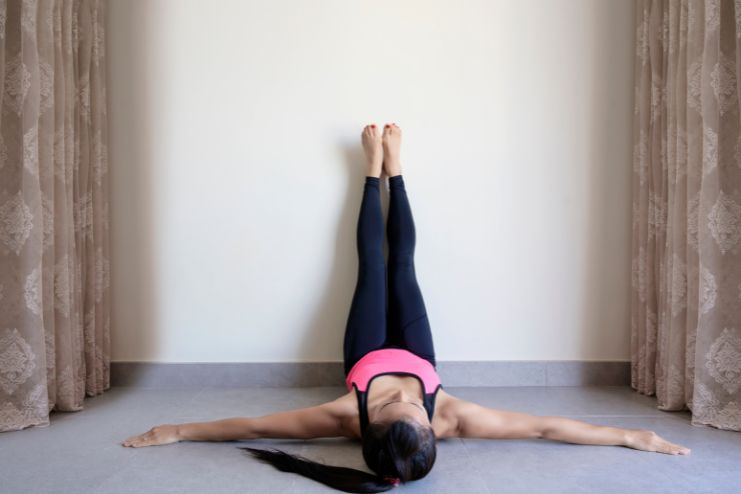
All you need is a wall and fifteen minutes to increase your strength and mobility. Here’s a short, professional-recommended routine you can do at home:
Required equipment includes a wall and a yoga or pilates mat.
How it operates: Stretches like Thread-the-Needle and Cat-Cow can help you warm up. Do the prescribed number of repetitions for each of the wall Pilates exercises as you advance through them. Do the circuit one or two more times after you’ve finished all five exercises.
Single-Leg Knee Crunch:
- Lying on your back, sit approximately a foot from a wall. To position your legs on the tabletop, keep your feet flat on the wall.
- Your toes should just be hanging off the wall as you extend your left leg diagonally. To activate your core, raise your arms above your head, and push your lower back into the floor. It is where you begin.
- Curl your shoulders off the floor and bring your left knee in toward your chest. Next, bring your arms close to your hips by drawing them toward the wall.
- Return to the beginning position after gradually releasing the crunch. One rep, that is.
- Perform 15 repetitions, then switch to the right leg.
Wall Bridge and Calf Raise:
- Lying on your back, place yourself approximately one foot from a wall. With your legs on the tabletop, put your feet flat on the wall. It is where you begin.
- Lift your hips off the floor and activate your glutes and hamstrings by pressing your feet into the wall. Don’t arch your back, please.
- Raise your heels off the wall to balance on your toes and perform a calf raise once your body is in a straight line from shoulders to knees.
- To return to the starting position, do the reverse; lower your heels to the wall and then your hips to the floor—one rep.
- Rep min is 15.
Marching Bridge:
- Lying on your back, take a seat approximately a foot from a wall. With your legs on a tabletop, place your feet flat on the wall. To raise your hips off the floor and align your body from shoulders to knees, press your feet against the wall. Try not to round back. It is the beginning point.
- Lift your left foot off the ground and pull your knee in toward your chest while keeping the hip position rigid (don’t let your hips tilt or sink). Stop when your thigh is perpendicular to the torso, maintaining the same knee bend, which only bends at the hip.
- To put your left foot back to the wall, reverse the motion. One rep, that is. Do the same with your right leg.
- Perform ten repetitions per leg.
Calf Raise and Wall Sit:
- Keep your back to the wall as you stand. With your back against the wall, lower yourself into a squat by putting your feet roughly a foot forward. With your feet together, try to have your hips and your knees bent at a 90-degree angle. With your palms facing each other, raise your arms to shoulder height. It is where you begin.
- With your biceps by your ears, move your arms forward and overhead while also maintaining a squat stance so they tap the wall.
- To execute a calf raise, first lift your heels off the ground after you lower your arms and return to the start. Next, bring your heels back down to ground level. That is one rep.
- Rep 15.
Read More: Full-Body Pilates: 6 Dynamic Moves for a Total-Body Workout
Expert Tips for Safety and Results
Proper form and control are key to maximizing the benefits of wall Pilates while also keeping your body safe. Safety is paramount when it comes to exercising, and it is essential in wall Pilates. Keep in mind a few things:
- Keep your alignment and core engaged during exercises. Do not allow fatigue to compromise your form.
- Listen to your body, and do not push yourself too hard. If it does not feel right, stop and reassess.
- Pay attention to your breath! Breathe deeply and firmly when you breathe and time your movement with your breath. Your friend is the oxygen!!
- If squats or bridges create pain, lessen the hold time or range. Listen to your body and do not ignore any discomfort!
- If you are in pain or discomfort, please stop the exercise and talk to a certified Pilates instructor/medical professional.
Expert Choice: Best At-Home Yoga Studio
Experience over 2,400 world-class yoga classes from the comfort of your home. YogaDownload offers expert-led programs and flexible membership options for every fitness level.
*Purchases through this link support our research at no extra cost to you.
Who Should Try This Routine?

While wall Pilates is a versatile workout for many individuals, it is particularly suitable for those looking to stay active and do not need to invest in expensive equipment.
- Adults over 40
Wall Pilates is especially suitable for individuals in their 40s or above who are looking to maintain bone health and muscle strength without overstressing their joints. Because wall Pilates is low-impact, it provides a sustainable means of exercise that will help you keep your independence, balance, and mobility in the long run.
- Beginners seeking to Develop Consistency
Because wall Pilates is a more moderate introduction to exercise compared to traditional workouts or more intense muscle training, it provides beginners or individuals hesitant about committing to typical muscle training workouts with a less intimidating workout for overall muscle strengthening and toning. Using the wall offers a basis for good form and alignment.
Read More: Top 5 Pilates Props to Enhance Your Workout Routine
Conclusion
Being fit after turning 40 doesn’t have to be complicated or high-impact; check out Wall Pilates. Wall Pilates takes Pilates to a whole new level of accessibility using a wall as a prop. At the same time, you move towards strengthening your muscles and providing postural benefits while also protecting your joints.
You can practise it for as little as fifteen minutes a day, and research has shown it can be a safe way to strengthen, improve balance, and increase mobility, particularly for the longer term.
Its simplicity—no fancy equipment, no gym fee, no long learning curve—makes it so appealing! Wall Pilates is a long-term approach that works with any busy lifestyle, whether your goal is to maintain your bone density, become a stable mover, or feel more resilient in your daily life.
References
- https://currently.att.yahoo.com/health/wellness/fitness/exercise/articles/no-dont-gym-heres-15-070000956.html
- https://www.tomsguide.com/wellness/workouts/no-you-dont-need-the-gym-heres-the-15-minute-wall-pilates-routine-that-builds-strength-and-mobility-after-40
- https://www.fitandwell.com/news/this-15-minutes-wall-pilates-routine-will-help-you-build-strength-while-protecting-your-joints
- https://www.clubpilates.com/instructors/pacificpalisades-clubpilates-pacific-palisades-ca-brittni-johnson
- https://www.momsintofitness.com/why-strength-training-is-important/
- https://www.goodrx.com/well-being/movement-exercise/wall-pilates-exercises
- https://www.prevention.com/fitness/workouts/g61973700/wall-pilates-workout-exercises/
- https://www.linkedin.com/in/courtney-virden-978202195
- https://www.tomsguide.com/wellness/fitness/i-tried-a-15-minute-wall-pilates-workout-here-are-my-honest-thoughts
- https://www.popsugar.com/fitness/wall-pilates-workout-49156526
- https://fitflexfly.com/what-is-wall-pilates/
In this Article