














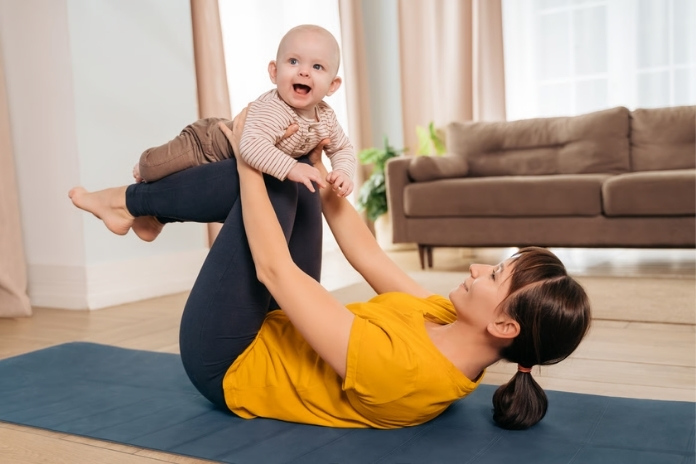
You’ve been cleared to move again – but where do you actually start? Here are 10 safe, gentle exercises designed for postpartum bodies, plus a simple weekly plan to put them into practice.
After delivery, many new moms feel a deep desire to reconnect with themselves – physically, emotionally, and mentally. The good news: you don’t need to go hard to feel better. Intentional, gentle movement can meaningfully support healing, ease anxiety, and restore a sense of groundedness during this delicate transition.
But postpartum recovery isn’t linear, and it’s deeply personal. This guide covers when it’s safe to start, which exercises are right for where you are now, and how to build a sustainable weekly routine – without pressure or comparison.
- Start slow: most providers recommend waiting 6 weeks before structured exercise, and clearance is non-negotiable after a c-section.
- The 10 exercises below are low-impact and pelvic-floor safe. Begin with breathing and walking, and build from there.
- A simple weekly routine is included so you know exactly what to do and when.
When Is It Safe to Start Postpartum Workouts?
Most healthcare providers recommend waiting around six weeks postpartum before resuming physical activity – but that’s a general guideline, not a universal green light. Your readiness depends on:
- Type of delivery (vaginal birth vs. c-section)
- Whether there were complications such as heavy bleeding or tearing
- Your individual healing pace
If you had a cesarean section, your abdominal muscles and incision site need more time to heal. Starting too early risks putting undue pressure on weakened muscles or reopening the wound.
Before anything beyond gentle walking or breathing exercises, get explicit clearance from your doctor or midwife – especially if you’re experiencing:
- Persistent pain during or after movement
- Increased vaginal bleeding after light activity
- Pelvic pressure or a heavy dragging sensation
- Dizziness, nausea, or extreme fatigue even after short efforts
- Leaking urine or stool during simple exercises
Just as a toddler wouldn’t ride their parent’s ten-speed bicycle, each individual needs different tools and pacing to reach the same destination. Every postpartum journey is unique and cannot follow a one-size-fits-all approach.
–Dr. Amanda P. Williams, OB-GYN and women’s health advocate
Read More: Postpartum Pelvic Health: Healing and Recovery After Childbirth
Listen to Your Body
Postpartum Recovery Timeline
| Stage | Safe to do | Avoid |
|---|---|---|
| Days 1–7 | Diaphragmatic breathing, gentle Kegels, short walks at home | All structured exercise C-section: rest and wound care only |
| Weeks 2–4 | Daily breathwork + pelvic floor, walks gradually to 15–20 mins, seated cat-cow | Lifting beyond baby weight Traditional core exercises |
| ~Week 6 | Provider clearance check. If cleared: glute bridges, wall push-ups, squats, postnatal yoga | Running, HIIT, heavy lifting C-section clearance may be 8–10 weeks |
| Weeks 6–12 | 3–4 sessions/week combining the 10 exercises, baby-and-me classes, gradual progression, consider a pelvic floor PT session | High-impact exercise without further clearance |
| Week 12+ | Running and higher-impact cardio (if pelvic floor stable), heavier strength training, most pre-pregnancy activities | Anything causing pelvic floor symptoms — pause and reassess |
10 Gentle Postpartum Exercises
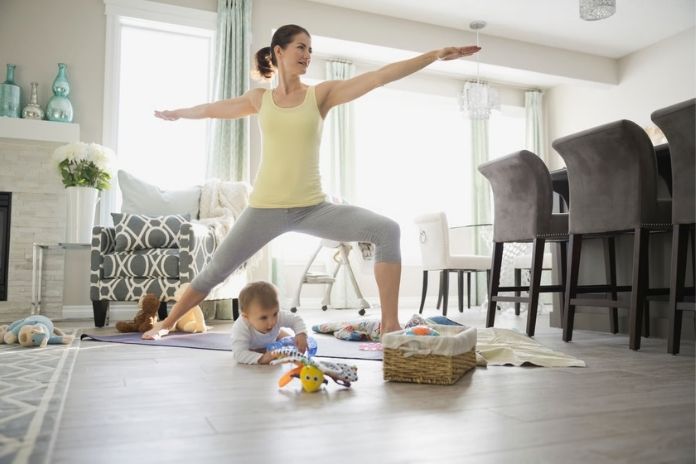
These movements are designed to support healing, not push through it. The goal isn’t intensity – it’s intention. Start with whichever feels accessible, and add more only when your body asks for it.
1. Walking
Good for: All stages, even the first week. Start with a few minutes at home.
The most underrated postpartum exercise. Fresh air, light movement, and natural light do more for circulation, digestion, and mood than most people expect.
Tip: Use a stroller for support, or carry the baby in a carrier once medically cleared. Stroller walks count.
⚠️ Watch out for: Increasing vaginal bleeding or pelvic heaviness after walking – these are signs to cut back and check with your provider.
2. Pelvic Floor Exercises (Kegels)
Good for: Bladder control, prolapse prevention, core stability. Can begin in the first days postpartum.
These muscles stretched significantly during pregnancy and birth – in either delivery type – and need dedicated, regular attention.
How to do it: Tighten the pelvic muscles as if trying to stop urination. Engage for the exhale breath, release for the inhale. Repeat 10 times, several sets daily. “Imagine pulling a blueberry up as you exhale, and releasing the blueberry as you inhale,” suggests Jenn Menzer, Master Personal Trainer & Prenatal Fitness Specialist.
⚠️ Watch out for: Bearing down instead of lifting up, or holding your breath. If you feel pressure or bulging, you may be doing these incorrectly – a pelvic floor PT can assess in one session.
3. Diaphragmatic Breathing
Good for: Deep core reconnection, stress reduction, pelvic floor coordination. Begin immediately postpartum.
Also called belly breathing, this is the most foundational postpartum recovery tool – and the most skipped. It retrains the diaphragm, core, and pelvic floor to work together again after pregnancy disrupted their coordination.
How to do it: Lie on your back, knees bent. Inhale deeply through your nose, letting your belly rise. Exhale through pursed lips, gently drawing your belly in. 5–10 minutes daily.
⚠️ Watch out for: Chest breathing instead of belly breathing – if your shoulders rise but your belly stays flat, you’re not reaching the pelvic floor. Place a hand on your stomach to check.
4. Glute Bridges
Good for: Glutes, lower back, and hips. A safe early-weeks floor exercise.
This floor-based movement rebuilds your posterior chain – the muscles that support you every time you stand up from a chair, pick up the baby, or carry a car seat.
How to do it: Lie on your back, knees bent, feet flat. Push through the feet to lift the hips while pressing the arms into the earth. Hold 3–5 seconds, then lower. 10–15 reps.
⚠️ Watch out for: If you notice pressure or coning through your midline, don’t push through it. Scale the movement by reducing the range of motion or taking a break. Keep your ribs stacked over your hips, maintain a neutral spine, and avoid arching your back.
5. Bodyweight Squats
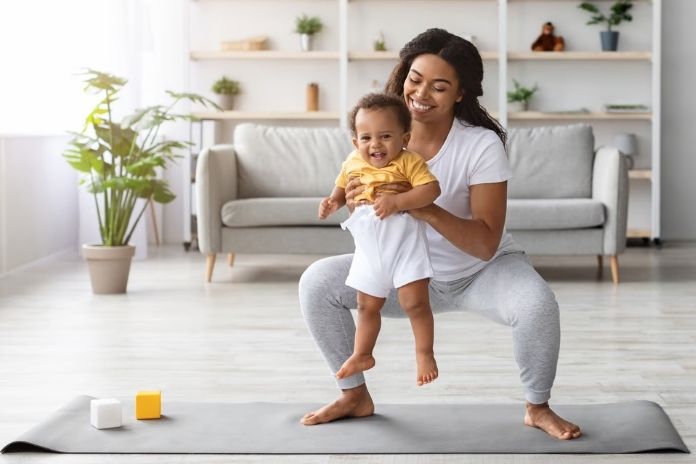
Good for: Quads, hamstrings, glutes. Introduce after pelvic floor feels stable.
Squats are one of the most functional movements for a new parent – you do the motion hundreds of times a day without noticing.
How to do it: Stand feet shoulder-width apart. Lower as if sitting in a chair. Keep weight in heels. 2–3 sets of 10–12 reps.
⚠️ Watch out for: Leaking urine during squats – this is common but not normal and is a signal that your pelvic floor needs more recovery time before loading this movement.
6. Postnatal Yoga
Good for: Flexibility, anxiety, body awareness, mental health support.
Postnatal yoga is adapted specifically for postpartum bodies – slower, breath-focused, and kinder to healing joints than general yoga classes.
Good poses to start: Child’s pose, bridge pose, legs up the wall, supported seated twists
⚠️ Watch out for: Deep twists or inversions in the early weeks – save those for further along in recovery. Stick to restorative poses until your provider says otherwise.
7. Seated Cat-Cow Stretches
Good for: Spinal mobility, upper back pain, posture reset. Safe from the early weeks.
New parents spend enormous amounts of time hunched over feeding, carrying, and rocking. This simple seated stretch counteracts that pattern.
How to do it: Sit upright. Inhale and arch your back, lifting your chest (cow). Exhale, round your spine (cat). Slow and intentional, 10 times.
⚠️ Watch out for: Rushing the movement. The breath is what makes this therapeutic – tie the arch to the inhale and the rounding to the exhale.
8. Wall Push-Ups
Good for: Upper body and posture. Does not strain the healing core.
These let you rebuild shoulder and chest strength without placing pressure on the abdomen or pelvic floor – a key distinction from floor push-ups in the early weeks.
How to do it: Stand facing a wall, hands shoulder-width apart. Bend elbows to bring chest toward the wall, then push back. 2 sets of 10–15 reps.
⚠️ Watch out for: Wrist discomfort – common postpartum due to hormonal changes affecting joints. Try a wider hand placement or reduce reps if it flares up.
9. Side-Lying Leg Lifts
Good for: Outer hips, pelvic stability, lower body strength. Fully floor-based and low-pressure.
These build the outer hip strength that’s essential for carrying, walking, and reducing lower back strain.
How to do it: Lie on your side. Bottom leg bent, top leg straight. Lift and lower the top leg slowly. 10–12 reps per side.
⚠️ Watch out for: Swinging the leg up instead of lifting with control. Slower is harder – and more effective.
10. Baby-and-Me Movement
Good for: Bonding, functional strength, making movement feel less like a chore.
Turn part of your day with the baby into intentional movement. No setup required.
Examples:
- Gentle baby chest press (lift baby slowly above your chest while lying down)
- Seated twists while holding the baby
- Light squats with baby in a carrier
⚠️ Watch out for: Using this as your only exercise and skipping the foundational work above. Baby-and-me movement is a supplement to – not a replacement for – pelvic floor and breathing exercises.
A Simple Weekly Postpartum Fitness Routine
Once you’ve received medical clearance (typically around 6 weeks, but always individualized), this plan gives you a practical structure. Adjust based on your energy and recovery pace — repeating a week is not failure, it’s listening.
Listen to Your Body
Weekly Postpartum Fitness Routine
| Phase | When | Daily | 2–4x Per Week |
|---|---|---|---|
| Phase 1 | Weeks 1–2 | Diaphragmatic breathing (5–10 mins), Kegels | Walking 10–15 mins (stroller counts) |
| Phase 2 | Weeks 3–4 | Breathing + pelvic floor, light stretching, or cat-cow | Glute bridges, wall push-ups, bodyweight squats (if pelvic floor stable) |
| Phase 3 | Week 5+ | Walks or cat-cow | Postnatal yoga or baby-and-me class, strength + light cardio + breathwork (increase only when ready) |
“Your readiness to run can depend on the work you do in those first three months postpartum to help strengthen your pelvic floor and improve your core stability.”
–Gwen Smith, PT, DPT, pelvic floor physical therapist at Hinge Health
Tips for Safe and Effective Postpartum Exercise
- Start small. Five to 10 minutes of intentional movement is enough in the early weeks.
- Hydrate frequently. Especially if breastfeeding, drink water before, during, and after movement.
- Prioritize sleep over exercise. Rest is a powerful part of recovery. Your body heals better when rested.
- Support gear, if helpful. Postpartum wraps or belly bands can offer extra core comfort during light movement.
- Avoid comparisons. Your friend’s timeline and your pre-baby self are not your benchmarks.
- Consistency beats intensity. Gentle, regular movement matters more than one hard workout a week.
- Consider a pelvic floor PT. Even one session can be game-changing – they assess what’s actually happening internally and give guidance no article can fully replicate.
When to Pause or Modify Workouts
A 2026 research summary recommends that postpartum women start with 120–150 minutes weekly of moderate activity (like walking) plus pelvic floor exercises, progressing gradually only if pain-free, with no high-impact movement until cleared.
Stop and consult your provider if you notice:
- Vaginal bleeding that increases after movement– a sign of doing too much too soon
- Dizziness or nausea– don’t push through these symptoms
- Sharp abdominal or pelvic pain– any pain beyond mild discomfort deserves assessment
- Coning or bulging at your midline during exercise– may indicate diastasis recti; pause core-pressuring exercises until evaluated
- Leaking urine or stool– common, but not something to exercise through without guidance
Read More: Postpartum Care: Navigating the Fourth Trimester with Confidence
Emotional and Mental Health
While your body is healing, so is your heart and mind. The postpartum phase brings immense emotional change – shifting hormones, disrupted sleep, and the responsibility of caring for a new life. It’s no surprise that many moms experience mood swings, anxiety, or symptoms of postpartum depression.
Incorporating gentle movement into your day can offer structure and a sense of control, even when everything else feels unpredictable. It’s not about getting your body back – it’s about reconnecting with yourself in a new role.
Your emotional recovery deserves the same care and attention as your physical one. Taking a few moments for yourself each day is not selfish. It’s essential.
In Closing
Returning to movement after childbirth isn’t about snapping back – it’s about slowly reconnecting with your body, honoring what it’s been through, and moving forward with compassion.
Start with breath. Let each gentle workout be an act of care, not comparison. Progress in postpartum fitness isn’t measured by weight loss or streaks – it’s seen in better sleep, deeper breaths, fewer aches, and the return of confidence in your own skin.
Every mom’s path is different. Trust yours.
FAQs
Q: Can I work out if I had a C-section?
Yes, but only after your doctor gives clearance – typically 6–10 weeks or more. Start with breathwork, mobility, and posture before introducing strength or cardio. Avoid anything that strains the incision site.
Q: Do I need to lose weight before I start exercising?
Absolutely not. Exercise postpartum is about healing, function, and energy – not weight loss. Your body just did something extraordinary. It deserves care and movement at every size and stage.
Q: Will exercising affect my milk supply for new moms?
Moderate exercise paired with adequate hydration and nutrition won’t negatively impact milk production. Movement can increase oxytocin, which supports both mood and milk flow. Feed or pump before a workout to avoid discomfort.
Q: What if I feel ready before the 6-week mark?
Diaphragmatic breathing and Kegels are safe to begin almost immediately. Short walks are generally fine once you feel comfortable. For anything more structured, wait for clearance – “feeling ready” and “being structurally healed” can be very different things postpartum.

About the Reviewer: Dr. Nalisha Sornil
Dr. Nalisha Sornil is a dedicated homeopathic doctor and freelance medical writer with a passion for transforming complex medical knowledge into clear, meaningful insights. With a background in healthcare and experience in medical content development, she focuses on creating educational and evidence-informed health content that empowers readers to make informed decisions about their well-being.
Read more →
About the Expert Reviewer: Jenn Menzer, Certified Master Personal Trainer
Jenn Menzer is a Phoenix-based Certified Master Personal Trainer, Functional Strength Coach, Pre/Postnatal Fitness Specialist, and Pain-Free Performance Specialist with more than 20 years of experience helping people move better, get stronger, and stay active for life. She holds certifications in multiple areas of fitness and wellness and earned a bachelor's degree in Psychology from New York University and a master's degree in Counseling Psychology from Northeastern University. Learn more at jmenzer.com.
Read more →References
- Juice & Toya. (n.d.). Full body postpartum strength workout (get strong & fit after pregnancy) [Video].
- Sydney Cummings Houdyshell. (n.d.). Full-body postpartum workout (20-minute tone after pregnancy) [Video].
- Pregnancy and Postpartum TV. (n.d.). 30-minute full body strength: Postpartum workout (dumbbells + DR safe abs and core) [Video]. YouTube.
- Mayo Clinic. (n.d.). Exercise after pregnancy.
- Health Service Executive. (n.d.). Exercise: 0–12 weeks after birth.
- Apollo Pharmacy. (n.d.). Safe postpartum exercises to start.
- Better Health Channel. (n.d.). Postnatal exercise. Victorian Government.
- American College of Obstetricians and Gynecologists. (n.d.). Exercises after pregnancy [Infographic].
- Body Ready Method. (n.d.). Postpartum home workout: Safe return to exercise.
- UT Southwestern Medical Center. (n.d.). Workouts after pregnancy.
- Flo Health. (n.d.). Exercises after normal delivery.
- [Author unknown]. (2026). [Title unknown]. PMC.
- Smith, G. (n.d.). Postpartum running: When and how to return safely. Hinge Health.
In this Article