















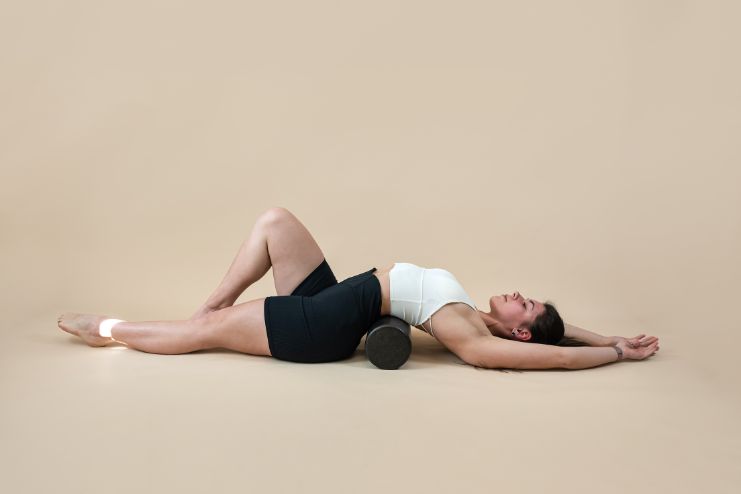
You stretch, you strengthen, you foam roll after your workouts—but what if a secret tissue in your body is the answer to quicker recovery, improved mobility, and less injury?
Enter fascia, the network of connective tissue that’s gradually dominating the recovery and fitness world. Previously dismissed as simple “packing material” between muscles, fascia is now the darling of the physical performance and wellness industries. From professional athletes to office employees with sore backs, everyone’s familiar with fascia training—and for a very good reason.
This article explains why fascia is finally getting the attention it deserves, how fascia-centered training differs from conventional exercise, and what methods can help you move and feel better every day. Whether you lift, run, practice yoga, or simply want to reduce stiffness upon waking, understanding fascia might be your missing link.
Read More: Does Foam Rolling Help Recovery? What The Science Says
What Is Fascia?
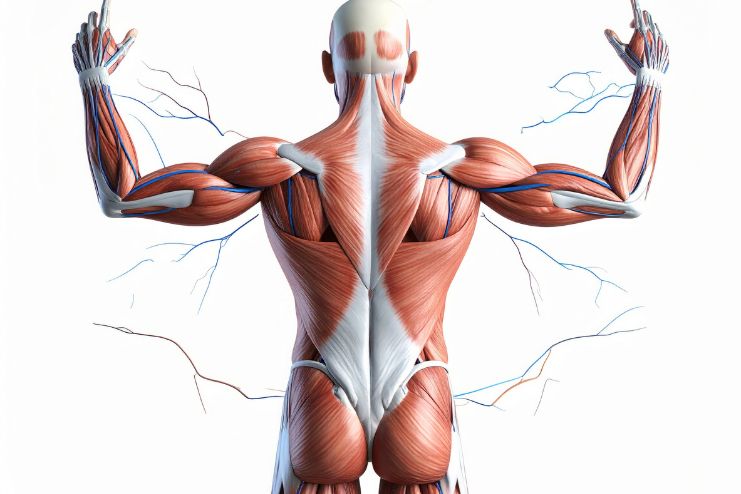
Fascia is a strong, web-like structure of connective tissue that encircles and pervades your muscles, bones, nerves, and organs. Imagine a stretchy full-body bodysuit—one that forms, supports, and links all of you.
When it’s healthy:
- Glides easily, so muscles and joints can move without drag
- Stabilizes posture and transmits force throughout the body
- Adjusts to stress, storing and unloading energy like an elastic
- But when fascia is dehydrated, inflamed, it becomes tight, resulting in:
- Decreased mobility
- Long-term tension or pain
Although strength is the focus of muscle-centric training, fascia adapts to hydration, elasticity, and movement in all directions. It requires alternative attention—and that’s what fascia training addresses.
Why Fascia Training Is on the Rise
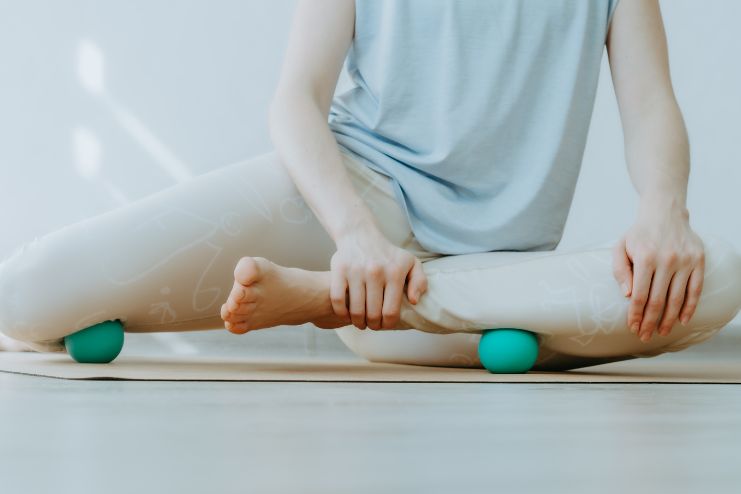
There’s a new trend in fitness: from pushing harder to recovering smarter. This has made us more interested in focusing on the movements under the muscles, namely, fascia.
Why fascia training is on the rise:
- Science-based function in flexibility, proprioception, and prevention of injury
- Using new recovery tools and methods, making fascia work effectively (foam rollers, vibration balls, mobility apps)
- Growth of holistic fitness (yoga, functional training, physical therapy) that naturally utilizes fascia-friendly movement
- The rising popularity of vibration therapy, myofascial release, and dynamic mobility flows in gyms and clinics.
Fitness is no longer just about effort—it’s about smart recovery. Fascia work closes the gap that traditional stretching and strength training frequently miss.
Read More: The Link Between Flexibility and Longevity – How to Keep Your Body Young
Benefits of Fascia-Focused Training

Fascia training isn’t just a fad—it yields significant benefits that can improve your body’s overall well-being and performance on a day-to-day basis.
- Enhanced Mobility and Flexibility: Supple fascia enhances the way muscles glide across each other, and this enables smoother joint mobility and overall flexibility.
- Faster Recovery: Fascia work reduces post-workout soreness by promoting blood flow and lymphatic drainage, and aids in tissue repair quickly.
- Less Chronic Stiffness: Fascia tends to accumulate stress and tension. Myofascial release and stretch-based movements ease areas of tension and facilitate better tissue glide.
- Improved Alignment and Posture: Healthy fascia helps maintain the body in balance by spreading load and tension evenly throughout the system, highly beneficial for individuals with desk jobs.
- Lower Injury Risk: Conditioned fascia functions as a shock absorber. It aids in the support of joints and soft tissues, making sprains, overuse injuries, and strains less likely.
- Improved Body Awareness: Fascia uses a variety of sensory nerves. Exercise strengthens it to improve proprioception (awareness of your body’s position in space), enhancing coordination and control.
Fascia vs. Muscle Training: What’s the Difference?

Understanding the difference between fascia and muscles is essential to creating a well-rounded training regimen. Most training exercises the muscle fibers using repetitive under-load contraction. Fascia, on the other hand, responds better to other conditions.
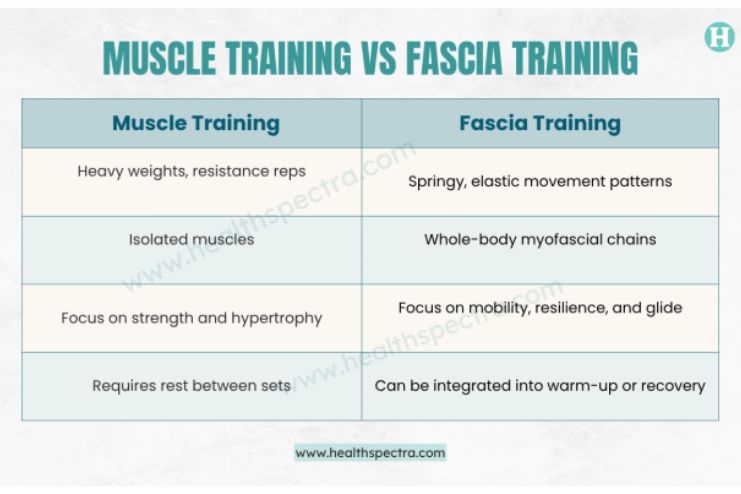 In short, muscles generate force, and fascia transmits and absorbs force. Training both together equals a stronger, more adaptive body.
Read More: How to Boost Endurance Without Running: Top Workouts for Stamina
Key Techniques in Fascia Training
Fascia-based routines utilize special tools and styles of movement that enhance elasticity, hydration, and release. These are the most effective techniques:
1. Dynamic Stretching and Springy Movements:

These simulate natural loading and unloading of fascia. Try:
- Multi-directional lunges
- Soft bouncing in yoga poses
- Arm and leg swings
- Spinal waves or “cat-cow” flow
These exercises enhance the fascia’s elasticity and maintain hydration by inducing movement of interstitial fluid.
2. Myofascial Release (Foam Rolling, Balls):
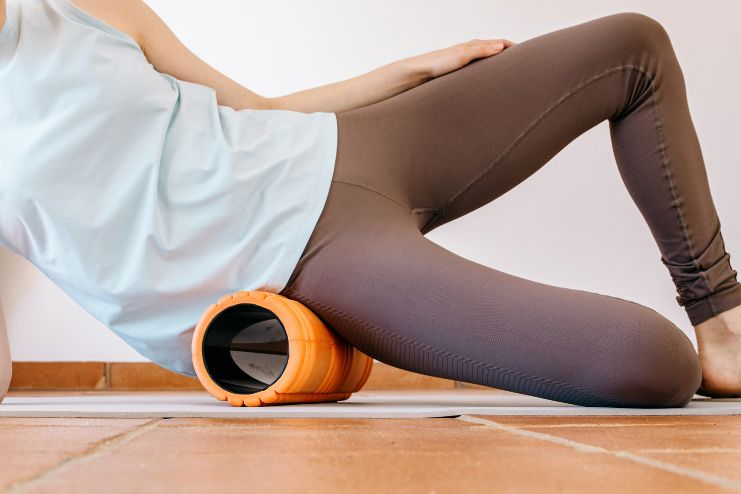
By self-pressuring the tight areas, you break up adhesions and enhance circulation. Best performed:
- Post-workout to release built-up tension
- On “trigger points” such as calves, glutes, upper back, and quads
- Slowly, for 30–60 seconds on tender areas
3. Fascial Stretch Therapy (FST):
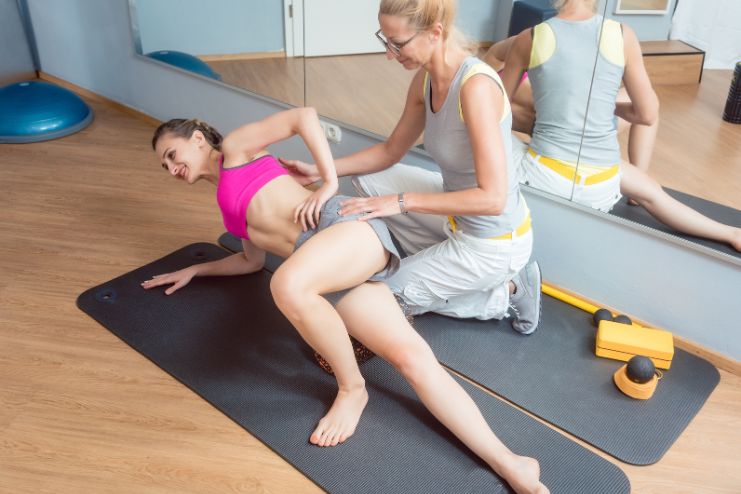
An assisted therapy performed by skilled therapists that:
- Focuses on long fascial lines over joints
- Applies traction to decompress entrapped tissues
- Increases flexibility and joint function
It’s frequently used by pro athletes and injury-prone individuals for deeper work on fascia.
4. Whole-Body Movement Practices:
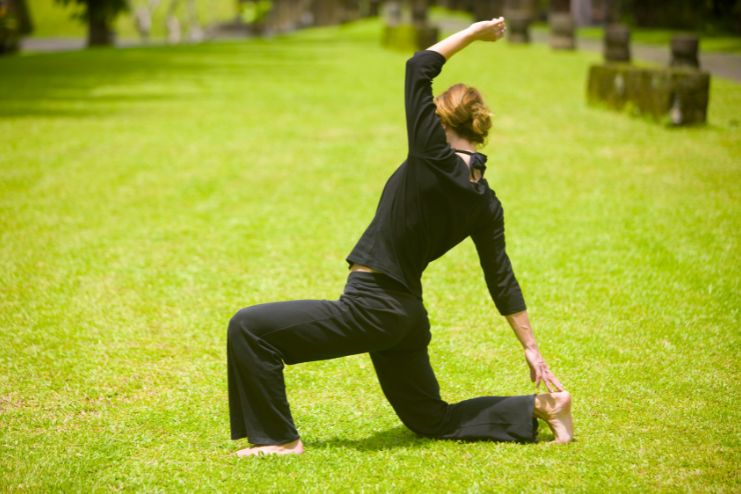
Practices such as Yoga, Qi Gong, and Animal Flow are inherently fascia-friendly:
- Promote spiraling, flowing movements
- Integrate breath with movement
- Enhance full-body coordination and energy flow
These exercises are excellent both as active recovery and everyday mobility.
When and How to Add Fascia Work to Your Routine
One of the best things about fascia training is how versatile it is. You don’t have to take extra hours—you can add it to your existing routine.
Best times to incorporate fascia-driven exercises:
- Morning: Light mobility or yoga to alleviate stiffness
- Pre-workout: Dynamic movements to prepare tissues
- Post-workout: Foam rolling and stretches to recover
- Rest days: Dedicated 20–30 minute fascia sessions
Aim for 10–20 minutes, 3 to 4 times per week. You’ll likely notice improved movement and reduced soreness within weeks.
Tools and Products Gaining Popularity

The fascia training market is exploding with tools designed to make recovery easier and more effective:
- Foam rollers: Standard, textured, vibrating
- Massage balls: Great for hard-to-reach areas
- Massage guns: Quick, powerful myofascial release
- Stretch straps or bands: Assist with deeper fascia line stretching
- Hydration rollers: To enhance fluid exchange in fascial tissue
Choose what suits your needs and budget—consistency is worth more than the gadget.
Buy foam rollers here.
Is There Any Scientific Evidence?
Fascia research is still evolving, but early findings are promising:
As per a specific study, fascia is a “sensory organ” that contains high concentrations of proprioceptors and mechanoreceptors.
Foam rolling and myofascial release are shown to enhance flexibility and decrease muscle soreness.
MRI research indicates that hydrated fascia enhances tissue slide and recovery rate.
Additional intense research is necessary, but actual application in sports therapy and clinical rehabilitation yields excellent outcomes in pain reduction, mobility improvements, and performance improvement.
Final Thoughts

Fascia training is not some fad wellness trend—it’s a revolution in the way we approach fitness, mobility, and recovery. We’ve spent years exercising muscles and neglecting the connective tissue that ties everything together. That’s about to change.
By incorporating fascia-specific movements into your routine, you’re not only avoiding injuries—you’re investing in long-term movement health. If you’re an elite athlete or just trying to feel good after sitting at a desk, fascia care can make your workout more efficient and your recovery more thorough.
Train smarter. Recover faster. Move better—with fascia on your side.
References
- https://pmc.ncbi.nlm.nih.gov/articles/PMC10135675/
- https://pmc.ncbi.nlm.nih.gov/articles/PMC4637917/
- https://www.researchgate.net/figure/A-Example-of-a-fascia-dissection-based-on-medically-precise-terminology-This_fig1_333700193
- https://www.helsana.ch/en/blog/body/exercise/fascia-training.html
- https://www.acefitness.org/resources/everyone/blog/5624/foam-rolling-101/
- https://fitness.edu.au/the-fitness-zone/the-role-of-fascia-in-mobility-and-performance/
In this Article