















Hand pain, stiffness, or tingling can feel small at first, but over time, these symptoms can seriously disrupt daily life. Tasks that once felt automatic, gripping a pen, turning a doorknob, typing on a keyboard, or even holding a phone, suddenly become uncomfortable or frustrating. For many people, two conditions often sit at the center of this struggle: trigger finger and carpal tunnel syndrome.
At a glance, they can look similar. Both affect how your hand moves and feels, and both can cause pain that lingers or flares up when you try to use your hands. Because of this overlap, it’s common for people to mistake one condition for the other or assume they’re part of the same problem. In reality, they’re quite different. Trigger finger is tied to tendon issues that cause locking or catching of the finger, while carpal tunnel syndrome stems from nerve compression in the wrist.
A large genome‐wide association study (GWAS) found that trigger finger and carpal tunnel syndrome share at least one genetic locus (called DIRC3) that is associated with both.
Why does this matter? Because effective relief depends on knowing what you’re really dealing with. Treatments that help one condition won’t necessarily help the other. Understanding the key differences, what triggers them, how they manifest, and the best ways to manage them can save time, ease frustration, and, most importantly, restore hand function, allowing you to use your hands without constant discomfort.
Quick Take: Key Differences at a Glance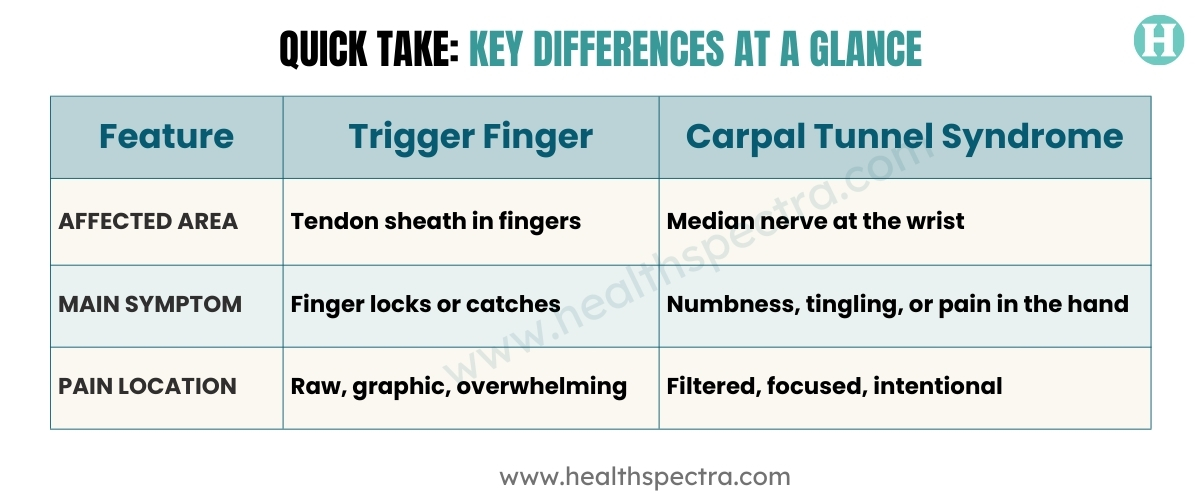 What is Trigger Finger?

Trigger finger, medically known as stenosing tenosynovitis, is a condition where the tendons in the fingers become inflamed, leading to difficulty in smooth tendon movement. This inflammation can cause the affected finger to lock or catch in a bent position, often accompanied by pain and a clicking sensation. The condition is most common in the ring finger and thumb.
Dr. Kristin Sandrowski, a specialist in hand conditions, notes, “Trigger finger is an inflammation of the tendons that flex or bend our fingers. The finger can start to click and get stuck to the point where you physically have to open it with your other hand. It can be very painful.”
Risk factors for trigger finger include repetitive gripping activities, diabetes, and rheumatoid arthritis. The condition is often more prevalent in individuals over 40 years of age.
Read More: 12 Trigger Finger Exercises For Faster and Effective Pain Relief
What Is Carpal Tunnel Syndrome?

Carpal Tunnel Syndrome (CTS) develops when the median nerve, a major nerve that travels from the forearm into the hand, gets squeezed or compressed as it passes through the wrist. The nerve runs through a narrow passageway called the carpal tunnel, which is surrounded by bones and ligaments. When this tunnel becomes crowded or inflamed, pressure builds on the median nerve, leading to the hallmark symptoms of CTS.
These symptoms often include tingling, numbness, burning, or pain in the hand and fingers. The thumb, index, middle, and part of the ring finger are usually affected, while the little finger is spared, a detail that often helps distinguish CTS from other conditions.
Many people notice symptoms are worse at night, sometimes waking them from sleep, or flare up during activities that involve gripping, typing, or repetitive wrist movements. Over time, untreated CTS can cause weakness in the hand, making it harder to grip objects or perform fine motor tasks.
Dr. Kristin Sandrowski explains, “Carpal tunnel syndrome is a compression of the nerve at the level of the wrist. The pressure on the nerve causes pain, numbness, and tingling.” (St. Vincent’s Medical Center).
Several factors can raise the risk of developing CTS. Repetitive hand and wrist motions, such as typing, assembly line work, or prolonged use of vibrating tools, are well-known triggers. Biological factors also play a role: pregnancy, arthritis, diabetes, and thyroid disease can all increase the likelihood of nerve compression. Age is another factor; much like trigger finger, CTS most commonly appears in people over 40.
The good news is that carpal tunnel syndrome can often be managed effectively once diagnosed. Early recognition is key, as starting treatment before the condition progresses can prevent long-term damage and restore normal hand function.
Read More: 12 Home Remedies For Carpal Tunnel – Get Rid Of The Numbness!
Symptoms: How They Differ
Although both trigger finger and carpal tunnel syndrome affect how the hand functions, the way their symptoms show up is quite different. This is often the clearest way to tell them apart. Trigger finger tends to cause problems with movement, how the finger bends and straightens, while carpal tunnel syndrome is more about sensations like tingling, numbness, or weakness caused by nerve compression. Let’s break it down.
Trigger Finger:
- Locking or catching: The affected finger may lock in a bent position and then suddenly release, often with a snapping sound.
- Pain: Discomfort is typically felt at the base of the finger on the palm side.
- Stiffness: The finger may feel stiff, especially in the morning.
Carpal Tunnel Syndrome:
- Numbness and tingling: These sensations often occur in the thumb, index, middle, and half of the ring fingers.
- Pain: Discomfort may be felt in the wrist and can radiate up the forearm.
- Weakness: Affected individuals may experience weakness in the hand, leading to difficulty gripping objects.
The primary distinction lies in the nature of the symptoms, such as trigger finger involves mechanical locking of the finger, whereas carpal tunnel syndrome is characterized by nerve-related sensations.
Causes and Risk Factors

Understanding what leads to trigger finger and carpal tunnel syndrome is key to both prevention and treatment. While the two conditions affect different parts of the hand, they share some overlapping risk factors. The main distinction lies in what’s being affected: tendons in trigger finger versus the median nerve in carpal tunnel syndrome. Let’s take a closer look.
Trigger Finger:
- Tendon inflammation: Repetitive gripping or overuse can lead to inflammation of the tendons.
- Medical conditions: Diabetes and rheumatoid arthritis increase the risk.
- Age: Individuals over 40 are more susceptible.
Carpal Tunnel Syndrome:
- Nerve compression: Repetitive wrist motions can cause swelling, leading to pressure on the median nerve.
- Medical conditions: Pregnancy, arthritis, and thyroid disease are associated with a higher risk.
- Age: Similar to trigger finger, CTS is more common in individuals over 40.
Both conditions highlight how lifestyle and health factors interact. Repetitive hand use, chronic medical conditions, and aging are shared risk factors, but the difference lies in which structure, tendon, or nerve is affected. Recognizing these underlying causes not only helps explain why symptoms occur but also guides the right preventive and treatment strategies.
Diagnosis: How Doctors Tell Them Apart
Because trigger finger and carpal tunnel syndrome can both cause hand discomfort, doctors rely on specific exams and tests to pinpoint which condition is present. The focus of the diagnosis is to determine whether the problem stems from tendon mechanics (as in trigger finger) or nerve compression (as in carpal tunnel syndrome). Here’s how physicians typically make the distinction.
Trigger Finger:
- Physical examination: A doctor may observe the finger’s movement and look for signs of locking or catching.
- Medical history: Understanding the patient’s activities and any underlying conditions helps in diagnosis.
Carpal Tunnel Syndrome:
- Tinel’s sign: Tapping over the median nerve at the wrist may produce tingling sensations in the fingers.
- Phalen’s maneuver: Holding the wrists in flexion for 60 seconds may reproduce symptoms.
- Electrodiagnostic tests: Nerve conduction studies can assess the severity of nerve compression.
Accurate diagnosis is essential for effective treatment. In many cases, doctors combine physical exams, patient history, and diagnostic tests to clearly separate trigger finger from carpal tunnel syndrome. This ens
Treatment Options for Each Condition

ures that the chosen treatment addresses the right underlying cause and prevents unnecessary delays in recovery.
Once a diagnosis is confirmed, treatment focuses on relieving symptoms, preventing progression, and restoring normal hand function. Both trigger finger and carpal tunnel syndrome can often be managed with conservative approaches at first, but more advanced cases may require medical or even surgical intervention. While there are some overlaps, the strategies differ because one targets tendons and the other addresses nerve compression.
Trigger Finger:
- Rest and activity modification: Avoiding activities that exacerbate symptoms can help reduce inflammation.
- Splinting: Wearing a splint can keep the finger in a neutral position, reducing strain.
- Medications: Nonsteroidal anti-inflammatory drugs (NSAIDs) can alleviate pain and inflammation.
- Corticosteroid injections: These can reduce inflammation and provide relief.
- Surgery: In severe cases, a surgical procedure may be necessary to release the tendon sheath.
Carpal Tunnel Syndrome:
- Wrist splints: Wearing a splint, especially at night, can keep the wrist in a neutral position and alleviate symptoms.
- Activity modification: Adjusting hand positions and taking regular breaks can reduce strain.
- Medications: NSAIDs can help manage pain and inflammation.
- Corticosteroid injections: These can reduce swelling and pressure on the median nerve.
- Surgery: In cases where conservative treatments fail, surgical intervention may be required to release pressure on the median nerve.
Treatment plans should be tailored to the individual’s specific condition and needs.
When to See a Doctor
Consult a healthcare professional if you experience:
- Persistent pain or discomfort in the hand or wrist.
- Numbness or tingling sensations that don’t improve.
- Difficulty performing daily tasks due to hand weakness.
- Symptoms that interfere with sleep or quality of life.
Early diagnosis and intervention can prevent the progression of these conditions and improve outcomes.
Conclusion
Trigger finger and carpal tunnel syndrome may seem similar at first glance; they both interfere with daily tasks and cause pain or discomfort in the hand, but they are very different in origin and treatment. Trigger finger arises from tendon inflammation, leading to stiffness and the characteristic locking or catching of a finger. Carpal tunnel syndrome, on the other hand, is rooted in median nerve compression at the wrist, producing numbness, tingling, and even weakness in the hand.
Recognizing these distinctions is more than just a matter of terminology. It’s the foundation for choosing the right treatment and avoiding unnecessary delays in recovery. What works for one condition, like tendon release for trigger finger, will not help with nerve compression in carpal tunnel syndrome, and vice versa.
If you notice persistent pain, stiffness, tingling, or weakness in your hands, don’t ignore it or try to self-diagnose. A qualified healthcare professional can evaluate your symptoms, run the right tests, and create a treatment plan tailored to your situation. Early intervention can prevent complications, restore hand function, and allow you to get back to everyday activities without constant discomfort.
Taking your symptoms seriously is the first step toward relief and long-term hand health.
References
- https://www.oreilly.com/library/view/switching-to-the/9781449372927/ch01s08.html
- https://glance.com/articles/android-tv-vs-google-tv-whats-the-difference-and-which-is-better
- https://www.mayoclinic.org/diseases-conditions/carpal-tunnel-syndrome/symptoms-causes/syc-20355603
- https://my.clevelandclinic.org/health/diseases/4005-carpal-tunnel-syndrome
- https://orthoinfo.aaos.org/en/diseases–conditions/carpal-tunnel-syndrome/
- https://www.hopkinsmedicine.org/health/conditions-and-diseases/carpal-tunnel-syndrome
- https://www.ncbi.nlm.nih.gov/books/NBK448179/
- https://www.mayoclinic.org/diseases-conditions/trigger-finger/symptoms-causes/syc-20365100
- https://my.clevelandclinic.org/health/diseases/7080-trigger-finger
- https://orthoinfo.aaos.org/en/diseases–conditions/trigger-finger/
- https://www.ncbi.nlm.nih.gov/books/NBK459310/
- https://www.assh.org/handcare/condition/trigger-finger
- https://www.sciencedirect.com/science/article/pii/B9780323901086000053
- https://www.nhs.uk/conditions/carpal-tunnel-syndrome/
- https://emedicine.medscape.com/article/327330-overview
- https://www.healthline.com/health/carpal-tunnel-syndrome
- https://www.healthdirect.gov.au/carpal-tunnel-syndrome
In this Article