













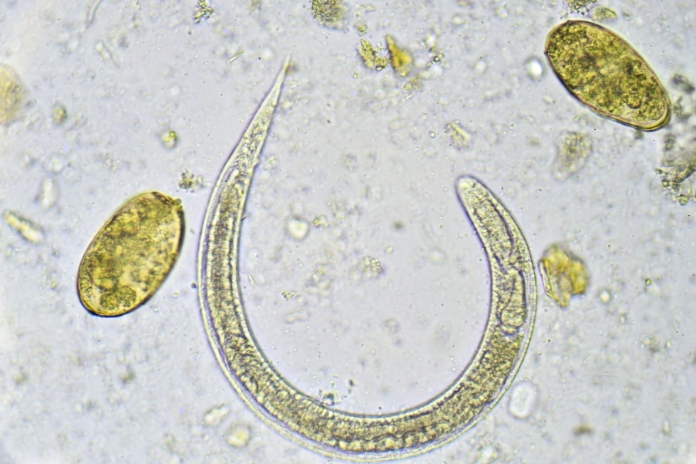
Imagine a parasite that can stop you from feeling pain, a being that can precisely and unnervingly alter your nervous system. According to recent research, a parasitic worm that can burrow into the skin could serve as an inspiration for the future generation of medicines and possibly offer a good substitute for opioids.
Schistosoma mansoni evades the immune system’s pain sensors by inhibiting epidermal neurons, which facilitates its evasion. We could use the chemicals causing this suppression to develop new medications if we could identify them.
According to scientists, this skill evolved as a means of survival over time. They add that discovering the chemicals causing this nerve inhibition may someday aid in the development of novel painkillers.
Read More: 5 Types of Infections That You Must Know in Detail
Meet the Parasite
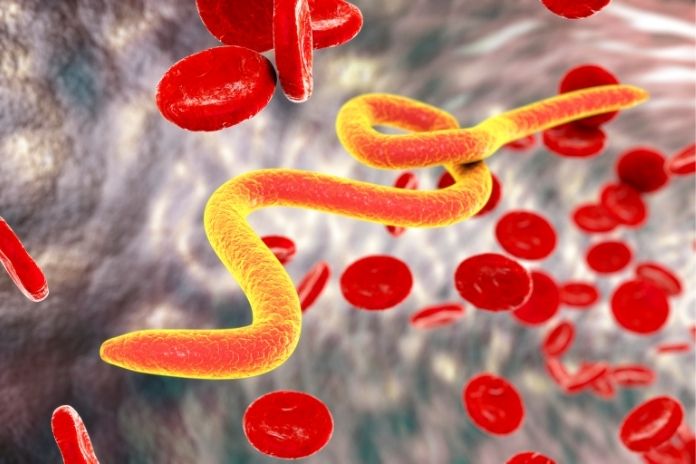
Researchers from Tulane School of Medicine set out to determine why the parasitic worm Schistosoma mansoni doesn’t itch or produce pain when it pierces the skin in this new study. Their research shows that S. mansoni lowers the activity of TRPV1+, a protein that communicates with the brain and signals heat, pain, or itching.
TRPV1+ controls immunological responses in a variety of situations, including infection, allergies, cancer, autoimmunity, and even hair development, as part of pain-sensing in sensory neurons.
To prevent signals from reaching the brain, the researchers discovered that S. mansoni creates chemicals that decrease TRPV1+. It enables S. mansoni to infect the skin mainly undetected. S. mansoni probably developed the chemicals that block TRPV1+ to increase its chances of survival.
“If we identify and isolate the molecules used by helminths to block TRPV1+ activation, it may present a novel alternative to current opioid based treatments for reducing pain,” said Dr. De’Broski R. Herbert, Professor of Immunology at Tulane School of Medicine, who led the study. “The molecules that block TRPV1+ could also be developed into therapeutics that reduce disease severity for individuals suffering from painful inflammatory conditions.”
The study also found that to initiate host defense against S. mansoni, TRPV1+ is required. When TRPV1+ is activated, immune cells that cause inflammation, such as neutrophils, monocytes, and gd T cells, are quickly mobilized.
How the Worm Switches Off Pain
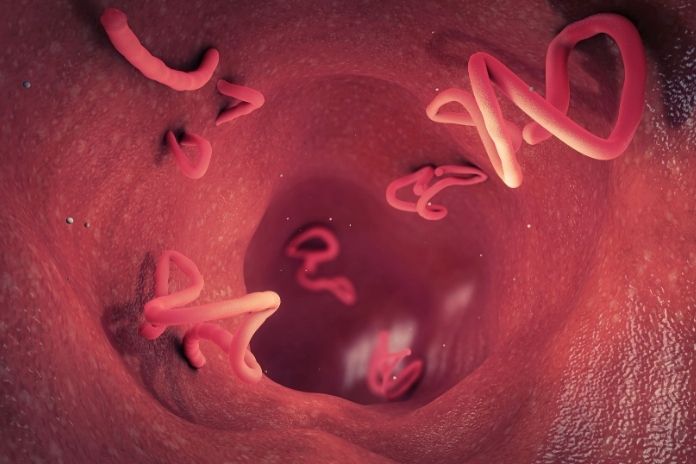
What if it were possible to turn off pain? Imagine a scenario where it was possible to switch off pain. Not emotional pain. We’re talking about an eventuality you get involved in when you slice your arm open or even get a bruise, and you barely feel a thing, even though you can see it. Researchers have revealed that Schistosoma mansoni, the parasite responsible for this disease, affects millions of people worldwide.
This parasite, which causes schistosomiasis, enters the human body undetected and disconnects the neurons that give us the ability to perceive pain. Yes, we are aware that you are considering how simple it would be to have this illness and never have muscle soreness again, but the truth is that painlessness is really harmful! Are you interested in learning what we know about this worm and what we could learn from it?
When a person bathes in contaminated water, this parasite enters the body through the skin or other openings. Still, it does so extremely covertly and doesn’t create any discomfort, burning, or itching. You do not feel any pain. As stated before, the human does not notice the existence of the worm in any parts of the brain.
The worm secretes chemicals that inhibit TRPV1+ neurons that alarm us to some burn, pain, or irritation, and to pull away automatically from the injury part. If you “hack” them, then the body stays silent, and there is no alarm to tell you that you are hurting yourself. Also, there is no immune system response without an alarm.
Read More: Parasite Cleanse Diet: Foods To Eat And Avoid
The Strange Relationship Between Parasites and Humans
Although most people think of parasites as dangerous intruders, science has shown that humans and parasites have a much more complicated connection.
Researchers used mice to examine this parasite because there were still a lot of unanswered questions. While some did not receive the parasite, others did.
They kept certain mouse groups uninfected as controls while infecting other groups with the pathogen. Blinding is a study approach that helps ensure more accurate reporting of results, as opposed to results that can be skewed by the scientists’ expectations. The researchers gave each group a letter, but did not know which group was infected.
The researchers subsequently administered a test to assess pain tolerance to the infected and control groups. A heat source was placed over each mouse’s paw; it wasn’t hot enough to burn them after a short exposure, but it was intense enough to be painful. The researchers noted the time it took for each mouse to remove its paw.
As though it didn’t affect them, the sick mice persisted longer without reacting. Researchers also confirmed that the burning substance in chili peppers, called capsaicin, did not actually damage their neurons.
All of this happened because the worm had “turned off” their pain sensors when they turned off their defensive response!
Expert Opinions

The parasitic worm’s evolutionary strategy of surreptitiously penetrating its victims’ skin may offer new options to opioid-based painkillers.
Nowadays, moderate to severe pain, coughing, and diarrhea are all treated with opioids. Long-term use can result in dependence and detrimental effects on one’s physical and mental health, even though they can offer excellent relief.
In a technique probably evolved to improve its own survival, researchers found that the worm, Schistosoma mansoni, inhibits neurons in the skin to avoid detection.
According to the Tulane School of Medicine researchers, the chemicals that cause this reduction of feeling may aid in the creation of novel medications.
Helminths, a type of worm known to live for many years in their animal hosts, are the source of the parasitic ailment schistosomiasis. People who swim, fish, or wash their clothing in freshwater bodies like lakes, ponds, and rivers may become infected with their larvae.
“While bacteria often cause painful cutaneous reactions, host skin invasion by the human parasitic helminth Schistosoma mansoni often goes unnoticed,” the authors of the paper stated.
“The individuals who are infected with [these] parasitic worms, like in the Appalachia regions of the
U.S. and other areas of the U.S. south and southern hemisphere countries, do not feel the infection as it is occurring, although the parasites are quite large (hundreds of microns),” paper author and immunologist Professor De’Broski R. Herbert, told Newsweek.
Read More: 12 Symptoms Of Trichomoniasis That Help You Treat It Earlier
Conclusion
Recently, some of the most interesting medical findings may be from a parasite that can reduce pain. While this seems uncomfortable or gross, this parasite is a small worm, and its survival strategy may have an essential connection for us: it makes proteins that reduce inflammation and lessen pain signaling.
It is a natural process; however, it may inspire safer and more effective methods for reducing pain.
The take-home message is basic but essential: the strangest finds in nature may yield change in medicine. Additionally, while much work remains, this discovery suggests that the natural world may offer solutions to challenges that humans have been grappling with for a long time.
References
- https://scitechdaily.com/this-parasitic-worm-can-turn-off-your-pain-and-itch-sensors/
- https://news.aai.org/2025/08/11/parasitic-worms-evolved-to-suppress-neurons-in-skin/
- https://www.iflscience.com/this-parasitic-worm-could-hold-the-key-to-new-alternatives-to-opioid-treatments-80380
- https://www.sciencedaily.com/releases/2025/08/250811104224.htm
- https://medicine.tulane.edu/departments/microbiology-immunology/faculty/debroski-r-herbert-phd
- https://unionrayo.com/en/scientist-worm-body-turns-out-pain/
- https://www.fcfdu.org/how-a-worm-invades-the-body-without-triggering/
- https://www.yahoo.com/news/articles/parasitic-worm-turn-off-ability-190043499.html
- https://www.newsweek.com/parasitic-worm-opioid-treatments-alternative-pain-schistosoma-mansoni-2112848
In this Article