












It sounds almost too simple: Sit down on the floor. Stand back up. No hands. No knees. Just your body doing the work. At first glance, it feels like a childhood game, but this quick test, called the Sitting-Rising Test (SRT), is anything but play. Behind its simplicity lies a surprisingly powerful tool that’s been making waves in the fitness and medical world for what it can reveal about your health, and maybe even your future.
The SRT was first developed by Brazilian exercise scientist Dr. Claudio Gil Araújo and his team as a way to assess overall physical fitness without expensive equipment or lengthy testing. In a single move, it quietly checks four things your body depends on every day: strength, flexibility, balance, and coordination.
These aren’t just “fitness goals”, they’re the building blocks of independence, mobility, and resilience as you age. And here’s the part that catches everyone’s attention: research suggests that the ease, or struggle, with which you get up from the floor could correlate with your risk of illness, injury, and even mortality.
While no single test can predict exactly how long you’ll live, the SRT offers a quick, eye-opening snapshot of how well your body is holding up against the wear and tear of time.
What Is the Sitting-to-Standing Test?

The Sitting-to-Standing Test (SRT) is deceptively simple. On paper, it’s just about getting down to the floor and back up again. In practice, it’s a quick but powerful snapshot of your balance, mobility, coordination, and strength, without needing any fancy gym equipment.
Here’s how it works:
- Start position – Stand barefoot on a flat surface, feet comfortably apart.
- Sit down – Lower yourself into a cross-legged or any comfortable seated position on the floor.
- Stand up again – Return to your original standing position.
The twist? You have to do it without using your hands, arms, knees, or any other part of your body for extra support. That means no pushing off the floor, no bracing on your thighs, and no grabbing nearby furniture for balance.
Scoring
You start with 10 points, 5 for sitting, 5 for standing. Each time you use a hand, forearm, knee, or other support, you lose 1 point. A loss of balance or noticeable wobble costs you half a point. The final score ranges from 0 to 10. Higher scores indicate better functional fitness, which often reflects a younger biological age and lower risk of falls or mobility issues later in life.
It might sound like child’s play, but this small test actually challenges multiple systems at once: muscles, joints, core stability, and proprioception (your body’s awareness of its position in space). That’s why researchers use it as a quick measure of overall physical resilience.
The Research Behind It

So, is the sitting-rising test just a fun party trick, or is there real science backing it? Turns out, researchers have been digging into this for over a decade, and the numbers are hard to ignore. Multiple long-term studies across thousands of adults show a clear pattern: the lower your score, the higher your risk of dying sooner. Let’s look at what the research says.
The 2012 Study
In 2012, researchers in Brazil conducted a study involving over 2,000 adults aged 51 to 80. Participants were followed for an average of 6.3 years. Those with the lowest SRT scores (0–3) were five to six times more likely to die during the study period than those with the highest scores (8–10). In fact, for every single point increase in the score, there was a 21% improvement in survival odds, even after adjusting for age, sex, and body mass index.
The 2025 Follow-Up
A more recent follow-up study in 2025 tracked 4,282 adults aged 46–75 for about 12 years. The findings reinforced the earlier results: participants scoring between 0 and 4 had a 3.8 times higher risk of death from natural causes and a six times higher risk of cardiovascular death compared to those with perfect scores. Mortality risk increased progressively with lower scores.
What the Test Measures

The SRT is not just about raw strength. It’s a compact snapshot of how well your body works as a whole. It reflects a blend of physical abilities that are deeply tied to your independence, quality of life, and even longevity:
- Muscle Strength – Strong legs and a stable core are the engine that powers you up from the floor. Without them, you rely more on your arms or external support, which the test penalizes. This strength also helps with everyday actions, climbing stairs, carrying groceries, or getting out of a chair without a struggle.
- Balance – Lowering yourself down and standing back up without wobbling isn’t just about looking graceful; it’s a sign your body can react quickly to keep you upright. Good balance lowers your risk of falls, which are one of the biggest threats to mobility as we age.
- Joint Mobility – The hips, knees, and ankles need enough freedom of movement to let you sink into a cross-legged or similar position without strain. Tight joints can make the test harder and often point to underlying stiffness or injury risk.
- Coordination and Body Awareness – This is your brain and body working in sync. Every part of the movement, from shifting weight to placing your feet, has to happen in the right sequence. It’s the kind of coordination you use daily without thinking, whether stepping over a puddle or crouching to pick something up.
Together, these abilities represent functional fitness, your body’s ability to handle the physical demands of everyday life with ease, efficiency, and minimal risk of injury.
Read More: 18 Best Exercises For Balance – Get Your Posture Fixed
How to Perform the Test at Home
If you want to try it yourself:
- Wear comfortable clothing and go barefoot on a flat, non-slippery surface.
- Start standing upright.
- Without using your hands or knees, lower yourself into a cross-legged or similar seated position.
- Stand back up in the same way.
- Have someone nearby to spot you for safety.
Scoring: Begin with 10 points. Deduct one point for each use of a hand, knee, forearm, or other support. Deduct half a point for unsteadiness.
Safety Note: If you have balance issues, joint problems, or recent injuries, skip this test or modify it under the guidance of a physical therapist.
Interpreting Your Score
- 8–10 points: Excellent functional fitness and mobility for your age.
- 6–7.5 points: Average, with potential areas for improvement.
- Below 6 points: Indicates reduced functional fitness and a higher risk of mobility-related issues, worth discussing with a healthcare professional.
It’s important to remember: A low score does not mean you are destined for a shorter life. It simply signals that your current physical abilities could benefit from targeted training.
Improving Your Sitting-to-Standing Score
If your score isn’t where you’d like it to be, don’t worry, this is one of those rare fitness tests where improvement is possible at almost any age. The key is to work on the specific skills the test demands: strength, balance, mobility, and coordination.
Strength Training
- Add squats and lunges to your routine to build lower-body power for the upward push.
- Try step-ups on a sturdy platform or bench to boost leg strength and stability.
- Use resistance bands or light weights if you want extra challenge.
Core Stability
- Strong core muscles help you stay upright and controlled as you move.
- Incorporate planks, bird dogs, and dead bugs to strengthen your midsection.
- Think of your core as the “bridge” between your upper and lower body; it keeps everything aligned.
Balance Work
- Practice single-leg stands to improve stability.
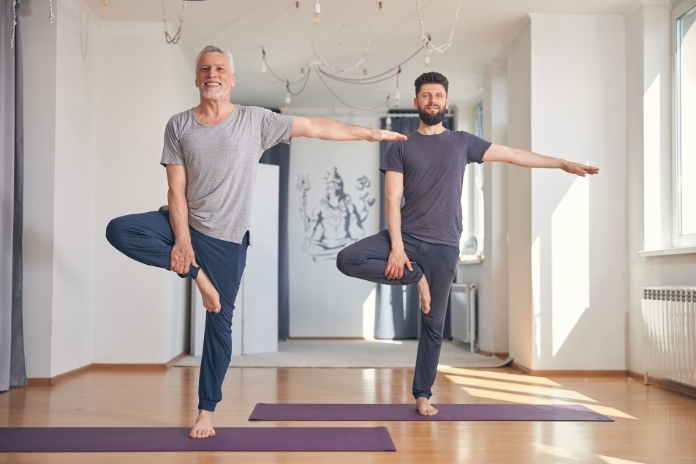
- Try yoga poses like the tree pose or warrior III for an extra challenge.
- Walk heel-to-toe in a straight line to train both balance and coordination.
Flexibility
- Stretch your hips, hamstrings, and calves daily to keep your range of motion smooth.
- Use hip-opening moves like the pigeon pose or the butterfly stretch.
- Flexible joints make it easier to move in and out of the sitting position without strain.
When you train these areas consistently, you’re not just improving your SRT score; you’re making daily activities like getting out of a chair, bending to tie your shoes, or picking something up off the floor feel easier and safer.
“Functional assessments like the sit‑to‑stand or Timed Up & Go provide actionable insight, because they test strength, balance, coordination, and mobility directly. The good news? All of these traits are trainable, even later in life.” – Based on a 2019 Frontiers in Physiology review showing that these abilities improve with targeted training.
Limitations of the Test
While the SRT is a useful screening tool, it has limitations:
- Not a direct measure of lifespan – It’s a marker of physical capability, not a prediction.
- Influenced by non-fitness factors – Age, arthritis, past injuries, or body proportions can affect your score.
- Not suitable for everyone – Those with severe mobility issues or recent surgeries should avoid it.
- Study populations were specific – The original research focused on generally healthy adults, so results may vary in different groups.
It’s best to view the SRT as one piece of the health puzzle, alongside other assessments like cardiovascular fitness tests, strength evaluations, and medical check-ups.
Real-Life Applications Beyond the Test
The Sitting-to-Standing Test (SRT) may seem like a neat party trick or a curious health experiment, but its true value lies in how it mirrors your everyday physical capability. The ability to lower yourself to the floor and rise back up without support is not just a measure of strength; it’s a blueprint for how you move, function, and protect yourself in the real world.
1. Preventing Falls and Minimizing Injury.
One of the biggest risks as we age is losing the ability to recover from an unplanned fall. Falls are the leading cause of injury-related hospitalizations in older adults, and while many people focus on avoiding them entirely, equally important is being able to get up afterward.
If you can transition smoothly from sitting to standing without using your hands, you’re not just demonstrating leg and core strength; you’re showing you can stabilize yourself after a stumble. That capability can make the difference between quickly regaining your footing and suffering a prolonged, dangerous period on the floor waiting for help.
2. Preserving Independence for Longer.
Mobility is freedom. From getting out of bed in the morning to stepping out of a low car or crouching down to tie your shoes, your ability to perform these movements without assistance defines how independently you can live. The SRT essentially distills many of these micro-movements into one task.
Strong legs, a stable core, and good balance aren’t just about athletic performance; they’re the foundation for cooking your own meals, doing household chores, and navigating your day without relying on someone else’s arm. For many people, maintaining these skills means delaying or even avoiding the need for assisted living.
3. Keeping Up With the Fun Stuff.
Functional movement isn’t just about survival; it’s about enjoyment. If you can comfortably get up and down from the floor, you’re far more likely to join in with your kids or grandkids during playtime, tackle a hike that involves sitting on a rock for a break, or participate in a yoga class without dreading the transitions.
These experiences add richness to life, but they demand a combination of strength, flexibility, and coordination, exactly the elements the SRT measures. Without them, people often begin quietly withdrawing from physical activities, not because they lack interest, but because they fear discomfort, strain, or embarrassment.
4. Translating Test Results Into Action.
A good SRT score confirms your current functional fitness, but a low score is not a death sentence; it’s an opportunity. The movements required for a high score can be trained and improved with targeted exercises like bodyweight squats, lunges, hip stretches, and balance drills.
These same exercises not only raise your SRT score but also make everyday actions easier and safer. Think of the test as both a snapshot and a roadmap: it tells you where you are, and points toward where you can go if you want a stronger, more mobile future.
Ultimately, the SRT’s power lies in showing that small, everyday movements matter just as much as the big workouts. Being able to rise from the floor gracefully is more than a measure of fitness; it’s a reflection of how prepared you are to live fully, independently, and without physical hesitation.
Bottom Line
The Sitting-to-Standing Test might look like a simple party trick, but in reality, it’s a quick and revealing snapshot of your overall physical health. It captures three pillars of functional fitness in one motion: strength, balance, and flexibility, and reflects how well your body works as a unit.
If you score high, it’s a sign you’re moving well, your muscles and joints are working together efficiently, and your risk of falls or mobility loss is lower. If you score low, it’s not a verdict; it’s feedback. It’s your body telling you that certain areas need attention, and the sooner you address them, the more control you’ll have over your health trajectory.
No, it’s not a magic number that tells you exactly how many years you’ll live. But with research linking better SRT performance to lower mortality risk, the message is hard to ignore: staying strong, supple, and steady isn’t just about looking fit, it’s about protecting your independence, your confidence, and your quality of life for decades to come.
In other words, every rep you do now is an investment your future self will thank you for.
References
- https://www.physio-pedia.com/30_Seconds_Sit_To_Stand_Test
- https://www.bbc.com/future/article/20250404-sit-to-stand-the-simple-test-that-reveals-how-youre-ageing
- https://www.everydayhealth.com/healthy-living/sitting-to-standing-test-may-predict-how-long-youll-live/
- https://en.wikipedia.org/wiki/Sitting-rising_test
- https://valdhealth.com/news/the-sit-to-stand-test-a-key-assessment-tool-in-modern-rehabilitation-and-fitness
- https://www.physio-pedia.com/Five_Times_Sit_to_Stand_Test
- https://darebee.com/fitness/guide-to-the-stand-to-sit-test.html
- https://www.injurymatters.org.au/programs/stay-on-your-feet/information-for-health-and-community-workers/falls-screening-and-assessment-tools/sit-to-stand-tests/
- https://timesofindia.indiatimes.com/life-style/health-fitness/health-news/want-to-know-how-long-youll-live-this-10-second-sit-stand-test-might-have-the-answer/articleshow/122030530.cms
- https://www.cdc.gov/steadi/media/pdfs/STEADI-Assessment-30Sec-508.pdf
- https://fortune.com/well/2023/03/23/can-sit-stand-test-predict-how-long-you-will-live/
- https://www.bodi.com/blog/sit-stand-test?srsltid=AfmBOopWpjqm3FB9Qa-oDzkxJ3ppmi7qpDyhfwpoa69plAiuaYhximNj
- https://www.nbcnews.com/health/health-news/quick-not-easy-test-can-predict-long-live-study-suggests-rcna213626
In this Article