
















A cough that becomes louder, more irritating, and more stubborn after evening is a very specific kind of problem.
Most people assume it is simple, maybe a weather change, or a mild cold, or an allergy. But if the cough behaves in a pattern, especially worsening after 8 PM, it often has less to do with infection and more to do with body mechanics.
Night cough is not always about the lungs. Sometimes, it is about timing.
If you notice that your throat feels normal in the morning but starts acting up after dinner, or you cough more when you lie down, then the cause might not be what you think.
One overlooked reason is silent reflux, reflux that does not feel like heartburn but still irritates your throat.
Let’s understand why evenings make coughing worse.
Why Your Cough Gets Worse After 8 PM

Nighttime cough is not random. The body changes after sunset in small ways, and those changes can turn a mild irritation into an annoying cough cycle.
1. Gravity Stops Helping
During the day, you are upright. Gravity is quietly functioning, keeping stomach contents down and helping mucus drain normally. But once you lie down, that pattern is gone.
Any acid mist, throat mucus, or postnasal drip has a much easier path upward. Even a small reflux episode becomes more noticeable at night.
“If mucus lands on the vocal cords in the throat, or if you inhale some mucus and it enters the lungs, it triggers a wet cough that produces phlegm or mucus,” explains Dr. Neil Bhattacharyya, an otolaryngologist.
This is why many people say, “I don’t cough much all day… but once I sleep, it starts.” It is not just an imagination. It is a position problem.
2. Saliva Production Slows Down
Saliva is not only for digestion. It is also a natural throat cleaner. It washes away irritants and neutralizes small acid exposure. At night, saliva production drops significantly. That means:
- The throat stays dry
- Irritation stays longer
- The cough reflex becomes sensitive
This is why a nighttime cough feels more scratchy, more repetitive, almost like the throat is stuck in a loop.
3. Late Dinners Feed the Problem
Eating late is one of the most common triggers people ignore.
If you eat at 9 PM and lie down at 10:30, the stomach is still working. Pressure builds, reflux becomes easier, and the throat gets exposed silently.
Not everyone gets a burning sensation. Many get only a cough. Certain habits worsen it:
- Heavy meals
- Oily food
- Overeating “just at night”
- Tea or coffee late evening
Night cough is sometimes the body’s delayed reaction to dinner timing.
4. Postnasal Drip Adds to the Irritation
Postnasal drip means mucus from the nose slowly dripping down the throat.
At night, it pools more because swallowing is slower. That mucus irritates the back of the throat and triggers coughing.
Sometimes reflux and postnasal drip happen together, making it confusing. People treat it as cold, but it continues for weeks.
If the cough is dry, repetitive, and worse lying down, postnasal drip may be part of it but not the only cause.
Read More: Smoker’s Flu: Symptoms, Causes, How Long It Lasts, and What Helps
Cold vs. Silent Reflux: How to Tell the Difference
This is where most people get stuck. A cold cough usually follows a clear timeline:
- Starts with a sore throat
- Becomes a productive cough
- Improves in 7–10 days
Silent reflux cough behaves differently:
- No fever
- No major congestion
- Lasts for weeks
- Worse after meals and bedtime
- It feels like throat irritation, not chest cough
Here is a simple comparison:
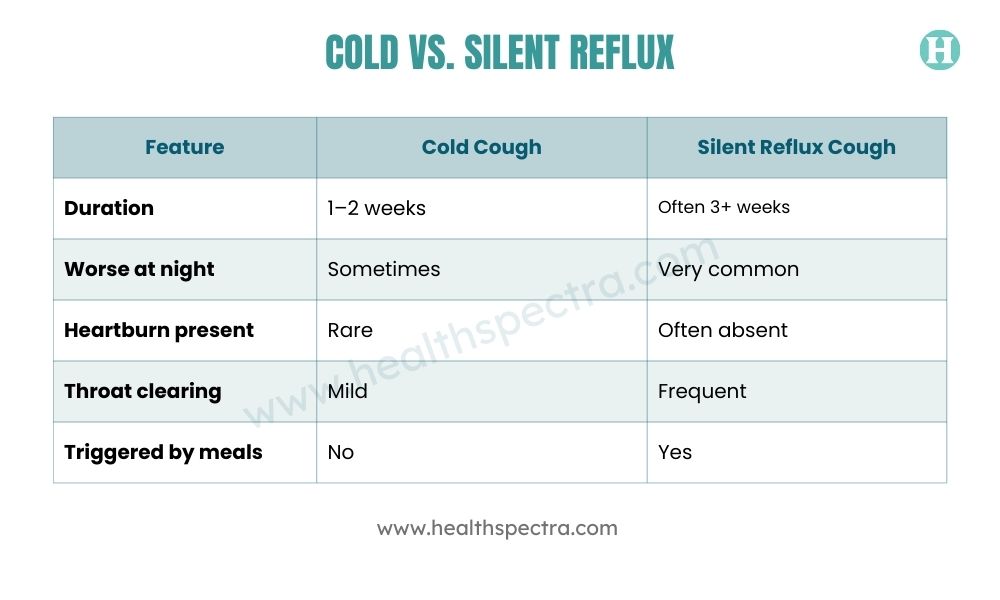 Silent reflux is sneaky because it does not present itself like typical acidity.
Read More: 5 Natural Home Remedies To Prevent Cough
Common Symptoms of Silent Reflux You Might Be Overlooking
Silent reflux is also called laryngopharyngeal reflux (LPR). It affects the throat more than the stomach.
People miss it because symptoms look unrelated. Some overlooked signs:
- Constant throat clearing
- A feeling of something stuck in the throat
- Dry cough without mucus
- Hoarseness in the morning
- Voice fatigue after speaking
- Cough triggered by laughing or talking
- Sore throat without infection
- Bad breath despite oral hygiene
One key clue: symptoms are often worse after dinner, not after spicy food alone. It is about timing and posture more than just food type.
Read More: How to Treat a Dry Cough with Ayurvedic Medicines
How to Calm the Nighttime Cough

Relief is possible, but it needs small, consistent adjustments, not random syrups.
“The best way to sleep when you have a chronic cough is to control the cause when you’re awake,” says sleep medicine specialist Dr. Sanja Jelic.
That means what you do in the evening, your meal timing, posture, and trigger exposure, matters more than any single pillow adjustment.
1. Elevate Your Head While Sleeping
Raising the head reduces reflux flow.
Use a wedge pillow and extra support under the mattress. Avoid sleeping flat after a heavy meal. Just stacking pillows may bend the neck, so proper elevation is better.
2. Avoid Eating 3 Hours Before Bed
This is one of the most effective steps. Your stomach needs time to empty. If bedtime is 11 PM, try dinner before 8 PM. Not easy always, but even partial change helps.
3. Limit Trigger Foods
Trigger foods vary from person to person, but common ones are:
- Fried snacks
- Chocolate
- Mint
- Tomatoes
- Citrus fruits in the late evening
- Carbonated drinks
Instead of removing everything, start by reducing evening exposure.
4. Stay Upright After Meals
Do not lie down immediately after eating. Even sitting upright for 30–45 minutes can reduce night cough episodes. Night reflux is often posture-driven.
5. Use a Cool-Mist Humidifier
Dry air makes the throat even more reactive. A humidifier helps by reducing dryness, calming irritated throat lining, and lowering cough reflex sensitivity.
Especially useful in AC rooms.
Read More: 15 Home Remedies To Stop Coughing At Night – Get Some Sleep In
When to See a Doctor

Do not ignore a cough if:
- Lasts more than 3 weeks
- Comes with weight loss
- Blood in sputum
- Breathing difficulty
- Chest pain
- Severe voice change
- Choking episodes at night
Night cough is usually benign, but persistent symptoms need evaluation.
“There are a lot of reasons you may have a cough, so just don’t ever hesitate to talk to your doctor if you have concerns,” encourages Dr. Elizabeth Rainbolt, a family medicine physician. “We can discuss symptoms and come up with a treatment plan that brings you some relief.”
Read More: How to Stop Uncontrollable Coughing at Night: Causes, Relief & When to Seek Help
How Doctors Diagnose and Treat Silent Reflux
Diagnosis is often clinical. Doctors may ask about the timing of the cough, meal relation, throat symptoms, and voice changes.
Sometimes tests include the following:
- Laryngoscopy (throat examination)
- pH monitoring
- Trial of reflux medication
Treatment may involve:
- Lifestyle correction first
- Acid suppression for a short duration
- Alginate-based barrier medications
- Addressing nasal allergy if present
Important point: long-term medicine without habit change gives partial relief only.
Read More: Persistent Cough vs. Lung Cancer: When to Worry
Protecting Your Throat Long-Term

LPR improves when habits become consistent.
Helpful practices:
- Avoid food right before sleep
- Maintain a healthy weight
- Gentle walking after meals
- Keep a symptom-food diary
- Hydrate throughout the day
- Avoid constant throat clearing (it worsens irritation)
The throat heals slowly, but it heals.
Read More: Morning Cough: When It’s Normal and When to See a Doctor
Final Thoughts
A cough after 8 PM is often not “just a cold.” The evening brings together gravity changes, slower saliva, dinner habits, and throat irritation, making silent reflux a hidden but common cause. The good part is that many cases improve with simple daily corrections.
Instead of treating it like an infection for weeks, it is worth asking: “Is my throat reacting to what happens after dinner?” That question alone saves time.
- Nighttime cough is often a timing problem, not only a virus problem..
- Silent reflux can irritate the throat without causing heartburn at all.
- Posture and late meals are bigger triggers than people realize
- Most reflux cough advice online focuses on acidity, but research is still limited on why some people cough without heartburn; this is an active clinical gap
- Persistent night cough deserves evaluation, especially if lasting beyond 3 weeks.
FAQs
1. Can silent reflux cause a cough without an acidic feeling?
Yes. Acid reflux without heartburn is very common in LPR because the throat reacts even to small reflux amounts.
2. Why does the cough increase only at night?
Lying down removes gravity support and increases throat exposure.
3. Is a nighttime cough always reflux?
No. Asthma, allergies, postnasal drip, and infections can also cause it.
4. How long does a silent reflux cough last?
It can last weeks or months if triggers continue. Improvement usually takes a few weeks after lifestyle correction.
5. Is postnasal drip vs. silent reflux easy to differentiate?
Not always. Both can coexist. Reflux cough often worsens after meals and lying down.
In this Article