













The Core Question About Pineapple Cores
When you cut open a pineapple and carve out the central fibrous cylinder – the part many people toss aside – you might be overlooking something worthwhile. The core of the pineapple is surprisingly rich in compounds that may do more than add chewiness. Could that fibrous center actually help your digestion? Let’s examine what’s inside the core, particularly bromelain, and explore what science has to say about its effects, as well as when it’s worth consuming – or skipping.
What’s in the Pineapple Core? Nutrition & Enzyme Highlights
First, what do we mean by the “core”? It’s essentially the central cylinder inside the fruit, often judged as too fibrous or hard to eat, and therefore discarded. But here’s what studies show about its content:
Key Compounds
- Bromelain (proteolytic enzyme)– Bromelain is present in measurable amounts in the “core” of the pineapple. This natural enzyme helps break down proteins – the same one credited for pineapple’s mild tenderizing effect. Analyses of different fruit parts show that the core often has stronger enzymatic activity than the softer flesh.
- Fiber/Roughage– Because the core is more structural (less juicy), it tends to have more fibrous material. Research on pineapple byproducts also suggests these tougher parts of the fruit, including the core, are naturally high in dietary fiber.
- Sugar/Carbohydrate– Despite its firm texture, the core still carries a little sweetness from glucose and fructose, just less pronounced than in the outer flesh. For instance, one study found that the core had higher glucose and fructose levels than the peel/crown in one test.
Why might the core have higher enzyme/fibre content?
The core is structurally the inner support of the fruit, so it is more fibrous. Additionally, because many people discard it, it has a less processed and less consumed history; however, research on by-products reveals that the same proteolytic enzymes (i.e., those that break down proteins) found in the flesh are also present in the core. For instance, one paper found no significant difference in proteolytic activity between bromelain extracted from the core vs pulp.
In short, the core is a legitimate source of active enzyme (bromelain) and fibre, which are two elements that, in theory, might support digestion.
Can Pineapple Core Really Support Digestion? What the Research Says
So, does all that translate into a meaningful digestive benefit if you simply eat the core?
How bromelain is believed to support digestion
Bromelain is a mixture of proteolytic enzymes that can break down protein molecules. In theory, this might help the digestive process – especially when protein breakdown is required. Also, proteolytic enzymes sometimes exert anti-inflammatory effects, which could indirectly support gut health. For instance, studies mention that bromelain may support digestion and act as an anti-inflammatory.
What core-specific research shows (and what it doesn’t)
- Studies focused on pineapple by-products (including cores) show that the enzyme extracted from the core has strong proteolytic activity: e.g., the paper on extraction and characterisation reported that the core extract had similar activity on caseins as pulp extracts.
- One study used an in-vitro digestion model (INFOGEST) and found that extracts from pineapple core improved the bioaccessibility of phenolic compounds in a coffee/milk matrix – implying the core’s bromelain may be functional in digestion-mimicking conditions.
- However – and this is key – there are very few human studies showing that eating the core of a pineapple leads to measurable improvements in digestion (e.g., less bloating, improved absorption) in ordinary diet conditions. Most research focuses on enzyme extraction, industrial uses, or food-matrix experiments, not on the simple act of eating the core vs. not eating it.
- Also, conditions such as enzyme stability (storage, heat, pH) matter. For example, a study of pineapple core storage found bromelain activity dropped with longer storage times before extraction.
Read More: 7 Important Health Benefits of Pineapple Juice
So what’s the verdict?
The evidence suggests: yes, the pineapple core could support digestion – because it offers fibre + an active proteolytic enzyme. But you cannot confidently claim that eating pineapple core by itself will resolve indigestion or act as a digestive cure; it’s a myth.
Pineapple is a supportive element, not a standalone fix. And, it is more accurate to say: “Including the pineapple core may give you a modest boost in digestive support, as part of a broader healthy diet.”
Read More: 10 Natural Remedies to Boost Digestive Health from the Comfort of Your Home
How to Eat Pineapple Core (If You Choose) and Practical Tips
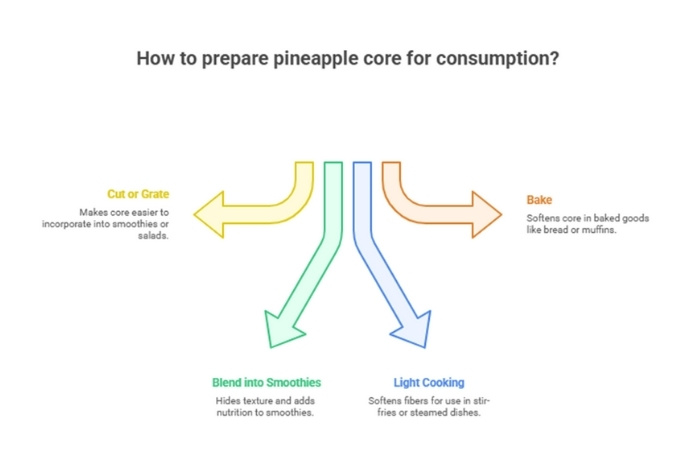
If you decide to include the core, here are some practical tips to make it palatable and beneficial.
- Cut it finely or grate it: The core is tougher and fibrous. Grating or thin-slicing it makes it easier to incorporate into smoothies or salads.
- Blend into smoothies: You can chop the core and throw it into the blender along with the fleshy pineapple, some yogurt or water, maybe other fruits – this hides the texture.
- Light cooking/boiling: Boiling or lightly sautéing the core can soften the fibres. For example, you might toss those core pieces into a stir-fry, or just steam them before using.
- Chop and bake: Some people include core chunks in baked dishes (pineapple bread, muffins) where the fibrous part softens during baking.
- Use leftover core as part of a “waste-reduction” approach: Since many discard it, using the core helps reduce food waste while adding nutrition.
Portion and preparation suggestions
- Start with a small amount (like one slice’s core) to test how your digestion handles the extra fiber and enzymes.
- Mix with the flesh: Never rely solely on the core – eating the whole pineapple gives you flavour, juiciness, and traditional nutrients too.
- Choose a ripe pineapple: Because it will have less of the extremely tough texture, the core may still be fibrous, but less harsh.
- Remove extremely woody parts: if the core is extremely hard (some pineapples have very dense cores), you may still remove the innermost cylinder and use the outer core ring only.
Storage note
- Because enzyme activity weakens with time/storage (in extracted research) and heat also denatures it, eating fresh fruit/core is better. If the pineapple is old, or you cook the core thoroughly (high heat/long time), then the bromelain may be largely inactive.
- If you are including the core as part of a digestive-support habit, remember that variation and consistency matter more than a single “super-food” fix.
Read More: 10 Side Effects of Pineapple
Who Should Be Cautious – And When It Might Not Make a Big Difference
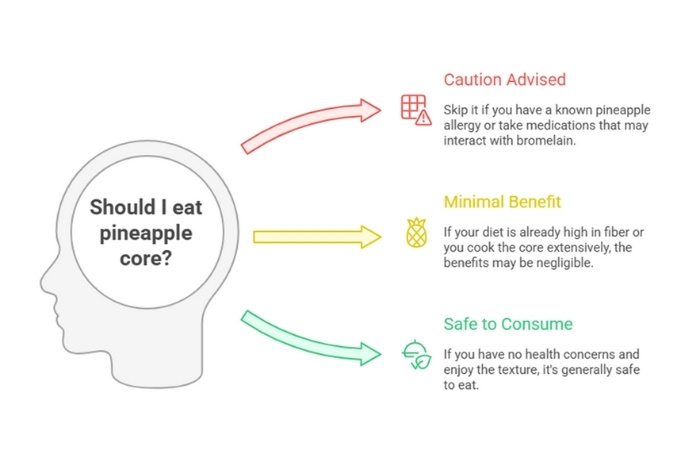
Including the pineapple core is generally safe, but there are circumstances where caution or diminished benefit applies.
- Digestive disorders: If you have sensitive gut issues that react to high-fibre or tough foods, the fibre in the core might irritate you.
- Risk of fibre build-up:Eating large amounts of very fibrous pineapple core – especially without adequate water intake – may, in rare cases, lead to the formation of compact fibre masses (known as phytobezoars) in the digestive tract.
- Allergy or sensitivity: If you are allergic to pineapple or experience mouth/throat irritation, the bromelain may increase that issue because it’s proteolytic.
- Medication interactions: Bromelain at high-dose supplement levels may interact with some medications (e.g., blood thinners). While eating a pineapple core is a far lower dose, still worth noting if you’re on such medicines. (As with any enzyme/active compound.)
- Very fibrous texture: If the core is extremely woody and you just dislike the texture, the benefit may be offset by your unwillingness to persist with it.
When the benefit may be minimal
- If your overall diet is already rich in fibre and you digest well, the incremental benefit from including the core might be modest. It’s a nice addition, not a dramatic shift.
- If you habitually cook or heat the pineapple core at high temperatures (such as grilling for a long time or canning), you may inactivate much of the bromelain, thereby reducing the “enzyme benefit” aspect.
- If you plan to replace good digestive habits (chewing properly, varied diet, adequate fluids, balanced meals, good gut microbiome) with just eating the pineapple core, it will never do that. It can always be a supplement, not a substitute.
Read More: The Pineapple Core Hack: Why You Should Stop Throwing It Away
Key Takeaway
The pineapple core is not waste. It has a valuable enzyme (bromelain) and fibre, and both of them may support your digestion. Eating them can be a smart, low-cost tweak to your diet. But it isn’t a magic fix for digestive problems. The benefit exists, yes – but as part of a broader digestive-health strategy. If you’re open to it, incorporating the pineapple core is easy and potentially beneficial. Just don’t rely on it alone to solve complex digestive issues.
FAQs
Q1. Is it safe to eat a pineapple core every day?
Yes, for most healthy people, it’s safe – the core is edible. But “every day” matters less than overall diet variety and ensuring you tolerate the tougher texture/fibre.
Q2. Does eating the pineapple core give you the same benefits as a bromelain supplement?
No. The pineapple core does contain bromelain, but nowhere near the levels found in supplements. So, it is a mild, food-based source – helpful for gentle digestion support, not a clinical dose.
Q3. Can the pineapple core reduce bloating and indigestion?
Potentially yes – via improved protein breakdown and fibre support – but results will vary by individual, digestion status, overall diet, and how the core is prepared. It’s not guaranteed.
Q4. How much pineapple core should I eat to get benefits?
A practical approach: include the core as part of the pineapple you already eat. For example, if you buy one medium pineapple, use the core (thin-slice or grate) rather than discarding it. There is no defined “core serving size” in research yet.
Q5. Are there any drawbacks if I eat the pineapple core?
Yes! But the risk is small. The core’s texture is mostly hard, and you can find it tough to chew, and its fibre may even irritate sensitive stomachs. Those allergic to pineapple might feel mouth irritation, and heating or overripe cores lose most of their bromelain.
References
- Chiarelli, P. G., Martinez, B., Nakamura, T., & Solval, K. M. (2024). Enhancing Bromelain Recovery from Pineapple By-Products: A Sustainable Approach for Value Addition and Waste Reduction. Foods, 13(4), 589–589.
- Fissore, A., Marengo, M., Santoro, V., Grillo, G., Oliaro-Bosso, S., Cravotto, G., Dal Piaz, F., & Adinolfi, S. (2023). Extraction and Characterization of Bromelain from Pineapple Core: A Strategy for Pineapple Waste Valorization. Processes, 11(7), 2064.
- Kocakaplan, Z. B., Ozkan, G., Kamiloglu, S., & Capanoglu, E. (2024). Valorization of Pineapple (Ananas comosus) By-Products in Milk Coffee Beverage: Influence on Bioaccessibility of Phenolic Compounds. Plant Foods for Human Nutrition.
- Roha, S., Zainal, S., Noriham, A., & Nadzirah, K. (2013). Determination of sugar content in pineapple waste variety N36. International Food Research Journal, 20(4), 1941–1943.
- Santos, D. I., Martins, C. F., Amaral, R. A., Brito, L., Saraiva, J. A., Vicente, A. A., & Moldão-Martins, M. (2021). Pineapple (Ananas comosus L.) By-Products Valorization: Novel Bio Ingredients for Functional Foods. Molecules, 26(11), 3216.
- Sethia, Y., Polak-Szczybyło, E., & Tabarkiewicz, J. (2025). Bromelain in Obesity Therapy: A Review of Anti-Inflammatory and Metabolic Mechanisms. International Journal of Molecular Sciences, 26(17), 8347–8347.
- Syukri, D., Rini, N., Kusuma, L. M., Sari, Rahmayani, N., & Sugianti, C. (2025). Impact of pineapple core storage duration on the properties of the developed bromelain. BIO Web of Conferences, 171, 01019–01019.
In this Article