












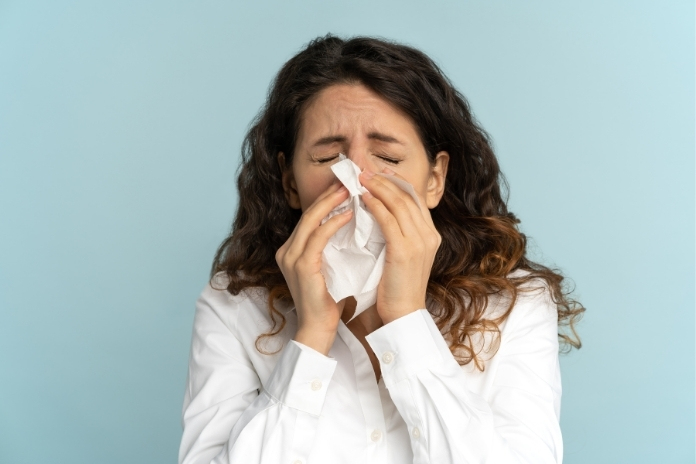
Sneezes are strange little explosions of the body, sudden, loud, messy, and often impossible to predict. Most of the time, they’re nothing more than a fleeting nuisance. But in certain settings, a quiet office, a packed subway car, or mid-conversation with your boss, letting one rip feels unthinkable. That’s when the temptation kicks in: clamp your nose, seal your lips, and try to force the sneeze back inside.
It seems like a harmless bit of etiquette, the polite thing to do when you don’t want to draw attention or spray germs. But here’s the twist: stifling a sneeze doesn’t just stop sound; it traps a huge amount of pressure inside your head, throat, and chest. For most people, that pressure disperses without issue. Yet on rare occasions, it’s been known to cause surprising injuries, from ruptured eardrums to small tears in blood vessels.
“The whole point of sneezing is to get something out of your body, like viruses and bacteria, so if you stop that, those may end up in the wrong part of the body.” – Dr. Zi Yang Jiang, UTHealth.
So should you worry? Not really, but it helps to know what’s happening under the surface. This article breaks down what your body goes through when you hold in a sneeze, looks at the unusual but real risks doctors have documented, and offers straightforward advice on what to do instead when the urge strikes.
Why Do We Sneeze?

Sneezing is a protective reflex. Tiny irritants (dust, pollen, pepper, pathogens) stimulate receptors in the nasal cavity and send a signal along sensory nerves to a brainstem “sneeze center.” That center coordinates a rapid inhalation followed by an explosive exhalation driven by the diaphragm, chest muscles, and throat. The whole point is to forcefully clear the airway. The reflex is complex and wired through cranial nerves and brainstem respiratory centers; it’s not just “sudden coughing.”
There’s also a popular number you may have heard, that sneezes travel at 100 mph (or much faster). That figure is an oversimplified myth. Real measurements in volunteer studies show typical exit velocities far lower (many studies report sneeze velocities in the low single-digit to mid single-digit meters/second range). In short, a sneeze is forceful, but the widely quoted supersonic numbers are not supported by the best measurements.
“Suppressing the sneeze by holding the nose or mouth leads to a noticeable increase in pressure, about 5 to 24 times that during a normal sneeze.” – Dr. Erich Voigt, MD, NYU Langone.
Read More: Sneezing and Sniffling? How to Know If It’s a Cold or Allergies
What Happens When You Hold in a Sneeze?
When a sneeze is allowed to happen, the air leaves the mouth and nose, and the built-up pressure is released into the open air. If you block both the nose and mouth (or clamp the nose and close the mouth), the pressure the body generates to expel air has to go somewhere, and it can be redirected inward toward sinuses, the middle ear (via the eustachian tube), the throat, or even into soft tissues of the neck and chest.
That sudden rise in internal pressure is the reason doctors call stifling sneezes a potentially dangerous manoeuvre in extreme cases.
Mechanically, this is related to the same principle behind Valsalva-type maneuvers: increasing intrathoracic and intravascular pressure transiently can stress delicate tissues and vessels. For most people, this produces nothing worse than discomfort; in rare situations, it has been linked to specific injuries (see next section).
Possible Risks of Holding in a Sneeze

Serious complications from holding in a sneeze are uncommon, but they’re not just an urban myth. Doctors have published case reports showing that, in rare instances, trapping all that pressure can lead to real damage. These range from ruptured eardrums to blood vessel injuries, unusual, yes, but worth knowing about if you’ve ever tried to stifle a sneeze mid-meeting.
A. Ear damage
If you prevent the sneeze from escaping outward, air can be forced through the eustachian tube into the middle ear. That sudden pressure spike can injure the tympanic membrane (eardrum) or cause middle-ear barotrauma, pain, hearing changes, ringing, and in some reported cases, a ruptured eardrum. Most eardrum perforations heal on their own but may need ENT follow-up. Published case reports and ENT reviews describe sneezing with a pinched nose as one uncommon cause of tympanic membrane perforation.
B. Sinus and eye blood-vessel injuries
The same Valsalva-type pressure increase can burst tiny superficial blood vessels. That’s why people sometimes get a bright red patch on the white of the eye (a subconjunctival hemorrhage) or a nosebleed after forceful sneezing or straining. These events usually look dramatic but are benign and resolve over days to weeks; however, patients on blood thinners or with uncontrolled hypertension should treat any unusual bleeding more cautiously.
Read More: How to Treat Sinusitis Naturally: Easy Home Remedies That Work
C. Throat, larynx, or tracheal tears
There are documented case reports where attempting to stifle a sneeze (pinching the nostrils and closing the mouth) caused a tear in the pharynx or even the trachea. For example, the BMJ published a 2018 case in which a man developed a perforation of the pyriform sinus (a part of the throat) with air tracking into the neck and chest after he tried to stop a powerful sneeze; he required hospital care but recovered with conservative management.
More recently, a 2023 BMJ case series described a spontaneous tracheal tear after a stifled sneeze, again rare, but real. These reports are why many ENT and emergency physicians warn against blocking both the mouth and nose during a sneeze.
D. Brain and eye pressure, aneurysm risk (very rare)
The big fear you may have heard about is a ruptured brain aneurysm triggered by a sneeze. Sneezing does temporarily raise intracranial and intrathoracic pressures, and there are isolated case reports of subarachnoid hemorrhage (bleeding around the brain) temporally linked to a very forceful sneeze.
But these are exceedingly uncommon and generally occur in people who already have a rupturable aneurysm or other vascular vulnerability. For otherwise healthy people, the risk of causing a brain bleed by stifling a single sneeze is vanishingly small.
How Rare are Serious Complications?
Important context: the injuries above are described in case reports, the medical literature’s way of documenting unusual, one-off events. Case reports don’t tell us how often something happens in the general population; they tell clinicians “this did happen once (or a few times), so be aware.”
For the vast majority of people, stifling a sneeze will cause nothing more than temporary discomfort. That said, the existence of these cases means clinicians reasonably advise not to deliberately block a sneeze, especially by closing both nose and mouth, because the pressure spikes can, on rare occasions, cause tissue damage.
What Doctors Recommend

The medical consensus is straightforward: don’t actively stifle sneezes by pinching both nose and mouth. Let the reflex happen, but do it safely. Public-health guidance from sources like the CDC and NHS recommends covering your mouth and nose with a tissue or sneezing into the crook of your elbow to prevent spreading germs; dispose of tissues and wash your hands.
These measures protect other people without putting pressure back into your head or neck. If you must suppress a sneeze momentarily (for safety while driving, for example), try a gentler option: cover with your elbow or a tissue rather than sealing your nose and mouth.
A direct line from the BMJ case report authors: “Halting sneeze via blocking nostrils and mouth is a dangerous manoeuvre and should be avoided, as it may lead to numerous complications such as pneumomediastinum, perforation of tympanic membrane and even rupture of cerebral aneurysm.” That’s not scaremongering, it’s caution based on observed injuries.
When to See a Doctor
After a stifled sneeze, most people will feel fine or have mild throat or ear discomfort that resolves. See a doctor promptly if you have:
- Severe ear pain, sudden hearing loss, or ongoing drainage from the ear (possible eardrum perforation).
- Intense throat pain, difficulty swallowing, a hoarse voice, or a “popping” sensation in the neck were common features in throat-perforation case reports.
- New, severe headache, dizziness, fainting, or vision changes after a sneeze warrant emergency evaluation to rule out a vascular event.
Minor broken blood vessels in the eye or small nosebleeds usually heal on their own, but if bleeding is heavy, recurrent, or accompanied by other symptoms, seek medical advice.
Frequently Asked Questions (FAQs)
Can holding in a sneeze cause a stroke?
Extremely rare. A few case reports link stifled sneezes to subarachnoid hemorrhage (a type of stroke), usually in people with hidden vascular weaknesses. For most healthy individuals, the risk is virtually nonexistent.
Can your eyes pop out if you hold in a sneeze?
No, that’s a myth. Eye muscles and connective tissue are too strong for that. The real risk is a subconjunctival hemorrhage, tiny blood vessels breaking in the eye’s white area. It looks dramatic, but heals on its own.
Why do people stifle sneezes in public?
Mostly for social reasons: embarrassment, etiquette, or avoiding spreading germs. In quiet spaces or meetings, people often suppress sneezes to avoid disruption. Doctors suggest proper sneeze etiquette, into a tissue or elbow, over holding it in.
Is sneezing too hard dangerous?
For most people, no. A powerful sneeze is usually harmless, just noisy. In rare cases, it can aggravate an existing issue, like ear barotrauma, vessel rupture, or throat tears, but these are exceptional, isolated reports.
Conclusion
Sneezing isn’t just a quirk of the body; it’s a protective reflex designed to clear irritants from your airways. For almost everyone, it’s over in seconds and leaves nothing behind but relief, or maybe a little embarrassment if it happens in a crowded room. Still, the way we handle sneezes matters.
When you deliberately block one by clamping your nose and sealing your mouth, you’re forcing all that pressure back into delicate spaces like your ears, throat, and even blood vessels in your head. Most of the time, your body absorbs it without issue. But in rare situations, that redirected force can cause genuine harm, from a ruptured eardrum to a torn throat lining, and in very unusual cases, even bleeding in the brain.
The takeaway is simple and doctor-backed: don’t fight nature. Let the sneeze out, but do it smartly, into a tissue or the bend of your elbow to protect others. And if you ever notice red-flag symptoms afterward, severe ear or throat pain, sudden hearing changes, difficulty swallowing, a blinding headache, or vision problems, it’s time to get checked out right away.
References
- https://pmc.ncbi.nlm.nih.gov/articles/PMC5787004/
- https://casereports.bmj.com/content/16/12/e255633
- https://pubmed.ncbi.nlm.nih.gov/25685569/
- https://pmc.ncbi.nlm.nih.gov/articles/PMC3613375/
- https://www.ijorl.com/index.php/ijorl/article/download/1088/693/5448
- https://www.ncbi.nlm.nih.gov/books/NBK551666/
- https://www.ncbi.nlm.nih.gov/sites/books/NBK482348/
- https://www.cdc.gov/hygiene/about/coughing-and-sneezing.html
- https://www.ncbi.nlm.nih.gov/books/NBK557887/
- https://www.lung.org/blog/sneeze-versus-cough
- https://www.oxfordhealth.nhs.uk/news/flu-as-cases-rise-catch-it-bin-it-kill-it/
- https://www.cdc.gov/hygiene/about/coughing-and-sneezing.html
In this Article