












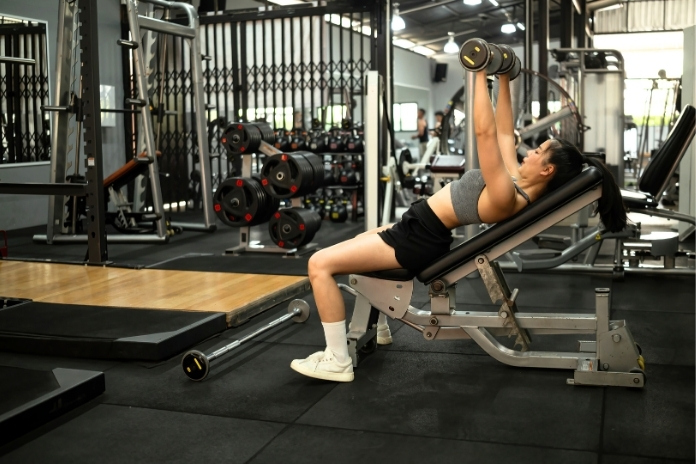
Most strength-training programs are heavily biased toward pressing movements (bench presses, push-ups, overhead lifts). These exercises deliver an awe-inspiring chest and strong front shoulders, but often at the expense of shoulder imbalance.
Even though it’s a great compound lift to help develop overall strength, many have no idea that bench pressing is pulling them away from their natural posture by neglecting rear delts (or their small but essential partners that help to stabilize movement and control balanced shoulder movement) over time, as the front delts and chest learn to take over.
As the rear delts weaken, the shoulders lose their structural equilibrium, placing excessive strain on the rotator cuff. It not only limits performance but also increases the risk of your shoulder pain and injury in both daily activities and training.
In this article, we’ll explore why rear delts are often overlooked, how muscular asymmetries affect shoulder mechanic, early warning sign of rotator cuff strain, and practical exercise and posture fixes to restore balance and protect your shoulders.
Read More: Daily Exercises to Transform Your Core Beliefs
Why the Rear Delts Are the Unsung Heroes of Shoulder Stability
Often, the rear deltoids get neglected in shoulder exercises. Sometimes people overlook them, and almost everyone who goes to the gym ignores them in favour of the more obvious anterior and lateral deltoids. So learning what rear delts are and why they’re essential, you can change the way you work out.
The Role of the Posterior Deltoids
The posterior deltoids, also known as rear delts, are located at the back of the shoulders, alongside the front (anterior) and side (lateral) deltoid muscles. In keeping with their Greek letter namesake, they are shaped like triangles and significantly improve shoulder mobility and stability.
So what do these elusive muscles actually do? For the most part, they assist in externally rotating the shoulder joint and moving the arm horizontally. It means that every time you reach behind to grab something or lift something over your head, your rear delts are doing a ton of stabilizing. Ignoring them can increase your risk of future injuries and cause imbalances.
Enhancing your overall shoulder health is the goal of strengthening the rear delts, not only for show. Exercises that target these muscles can improve posture, ease the pain of pressing exercises like overhead lifts and bench presses, and even enhance performance in sports that require upper-body strength.
Posture, Pressing, and Pain
Modern training and lifestyle patterns compound poor shoulder mechanics. The front delts and pecs are over-facilitated from heavy bench pressing and chest-dominant exercises, while the pulling muscles wind up under-trained.
This leads the body into a posture with reduced shoulder space and an increased risk of rotator cuff impingement, driven by a physical chain of rounded shoulders and a forward head posture.
To curve the other way, balanced pulling strength is required. Upper back and rear-delt strengthening exercises help correct posture and restore alignment whilst protecting the shoulders from chronic strain. Pulling should equal or exceed pressing volume for healthy shoulders in the long run.
“Your body is a very smart mechanism,” explains Julia Falamas, program director and certified trainer at Epic Hybrid Training. She adds “Your workout becomes easier and easier, and then eventually it stops being effective.”
How Strong Rear Delts Protect the Rotator Cuff
Besides improving the appearance of your shoulders, strong rear delts are a critical mechanism for protecting your rotator cuff. These muscles allow your shoulders to maintain ideal mechanics when properly developed, putting less stress on the smaller, more fragile rotator cuff tendons.
One of the most notable benefits of having sufficient back delts is improved joint alignment.
Whether in flag or neutral postures, they help to center the humeral head in the shoulder socket, providing the proper support to prevent rotator cuff inflammation that often follows errant rubbing or pinching of the soft tissues therein.
Additionally, rear delts are essential for controlling external rotation. They counteract the significant internal rotation torque imparted by the chest and front delts during pressing and pulling workouts. This immobilizing effect allows for a greater range of shoulder motion, helps you transfer force more smoothly, and reduces the loading of the rotator cuff.
Read More: At-Home Strength Exercises Without Equipment: That Actually Work
The Best Rear Delt Exercises for Shoulder Protection
1. Face Pulls

Face pulls engage numerous muscle groups and are relatively safe and effective, making them one of the finest rear-delt exercises for beginners. This exercise primarily targets your rear deltoids, but it also engages your middle trapezius, rhomboids, and shoulder external rotators.
The pulling motion directly combats round shoulders and forward head posture. Face pulls have many advantages beyond just increasing muscular mass. This exercise relieves upper back strain, improves posture, and increases shoulder mobility. Frequent face-pull exercises can significantly reduce headaches and neck pain caused by poor posture.
Face pulls are especially helpful for preserving proper shoulder alignment for women who spend a lot of time at computers or staring at phones.
Detailed Instructions:
Step 1: To set up for this exercise, attach a rope handle to cable machine at chest height (a resistance band anchored at chest height will also work if you don’t have a cable machine). Stand roughly an arm’s length from the anchor.
Step 2: Use your both hands to grasp the rope in a overhand grip, with your thumbs pointing toward your face. Stretch your arms fully in front of you, palms down. Hold back these two positions until the cable or band begins to feel taut.
Step 3: Keep your shoulders back and your chest up to engage core and maintain proper posture. For stability, place your feet shoulder-width apart. To target the appropriate muscles, this starting position is essential.
Step 4: Drive your elbows wide and high to pull the rope toward your face. As you draw the rope closer to your forehead, concentrate on tearing it apart. With your arms at the finish position, your elbows should stretch out to the sides to form a “W”.
Step 5: At the top, squeeze your shoulder blades and hold for a second (you’ll see your upper back muscles and posterior delts nicely here). A quick pause at the top is an excellent way to activate those muscle fibers a little more.
Step 6: Slowly extend your arms in front of you to return to the starting position.
2. Bent-Over Reverse Flyes
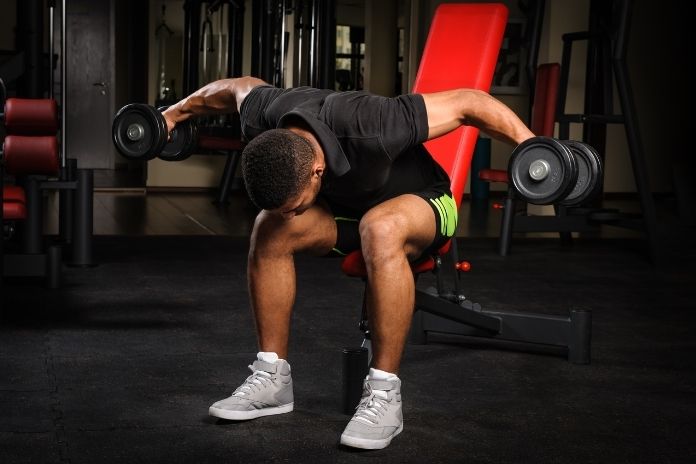
Bent-over reverse flies add balance and a core challenge to traditional rear delt exercises. This move primarily targets your rear delts. It also targets your glutes, erector spinae, and deep core, these will also work to keep you properly positioned.
Because it simulates real-world tasks that require proper posture when reaching or lifting, the bent-over position makes this exercise extremely effective. This exercise is invaluable for building the endurance needed to maintain an appropriate posture for extended periods of standing or walking, as well as for strengthening the posterior chain generally.
Detailed Instructions:
Step 1: Grab a pair of the light dumbbells (3–8-pound range) in your hands and stand with feet shoulder-width apart, arms hanging at your sides with palms facing one another.
Step 2: Bend over, pressing your butt back to hinge at the hips. Keep your chest lofty and knees slightly bent. Your torso should be anywhere between 60 and 70 degrees off the ground.
Step 3: With your palms facing you, let your arms hang straight down. The dumbbells should be directly under your shoulders, and your elbows should be slightly bent. Brace your core to maintain this position.
Step 4: Pull both arms out to your side at the same time until your arms are parallel to the ground. Instead of using your arms, however, focus on squeezing your shoulder blades together.
Step 5: Keep your posture bent over while holding the top position for one to two seconds. Engage your upper back muscles and posterior delts strongly. During this time, try not to let your torso lift.
Step 6: Now gently lower the weights back to the starting position. You will want to keep your back delts tight throughout the entire rep, and it should take you 2 to 3 seconds to fall.
Step 7: Do 10–12 of these three times. Watch your posture throughout.
3. Reverse Pec Deck Fly
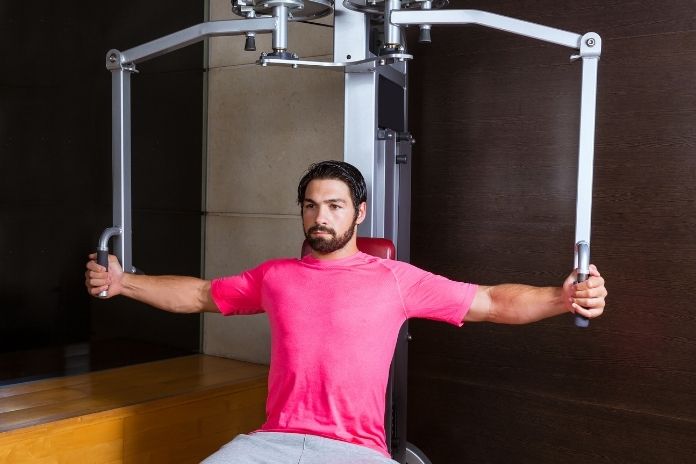
The reverse pec deck fly (also referred to as rear pec deck fly or reverse pectoral fly) is an isolation exercise done on a pec deck machine that is said to hit the upper back, including the traps and rhomboids, and posterior deltoids (shoulders).
The reverse fly action used in this exercise works the muscles differently than regular presses or front essential motions.
Detailed Instructions:
Step 1: Make sure the handles are level with your shoulders by adjusting the seat height.
Step 2: Place your palms together and grasp the handles. Your arms should be in alignment with your torso, and elbows should be slightly bent.
Step 3: Keep your arms at shoulder height as you push the handles outward and backward. At the top of the movement, focus on squeezing your shoulder blades together.
Step 4: Return your arms to the starting position while maintaining control over the movement. To keep the muscles taut, don’t let the weights decrease too quickly.
Step 5: Press the handles backward while exhaling, then inhale as you return to the starting position.
Read More: 10 Exercises to Tone Every Inch of Your Body (No Equipment Needed)
4. Band Pull-Aparts

The most practical rear-delt exercises are band pull-aparts, which require only a resistance band and are perfect for travel, office breaks, or at-home workouts. This movement improves scapular stability by targeting your rhomboids, middle trapezius, and, of course, your rear delts.
Band pull-aparts are great for getting rear-delt work in, regardless of when you’re able to make it to the gym. To address poor posture and ease forward head position, you can do some of these sets throughout the day.
Detailed Instructions:
Step 1: Pick a band with a medium resistance and hold it between both hands for roughly shoulder-width. Your arms should be extended straight out in front of you at chest height, palms facing down.
Step 2: While standing, position your feet shoulder-width apart and engage your core muscles. Utilize your body’s natural alignment; do not hunch or roll forward towards the floor. Your shoulders should remain back and down throughout the entire exercise; keeping your shoulder blades down will engage the correct muscles.
Step 3: With your arm straight in front of you, imagine pulling your band apart and squeezing your shoulder blades together. Stretch the band apart and repeat it, keeping your arms straight throughout.
Step 4: Continue the movement until you stretch your arms out to your sides and fully contract your upper back and rear delts. The band should be covering your chest.
Step 5: Keep your back delts taut while holding peak position for at least two to three seconds. This more extended hold period enhances postural endurance and increases muscle activation.
Step 6: Slowly let your hands drift back together, staying firm, and return to the starting position, keeping the band under high tension.
Step 7: Aim for two to three sets of 15 to 20 repetitions.
5. Single-Arm Dumbbell Row
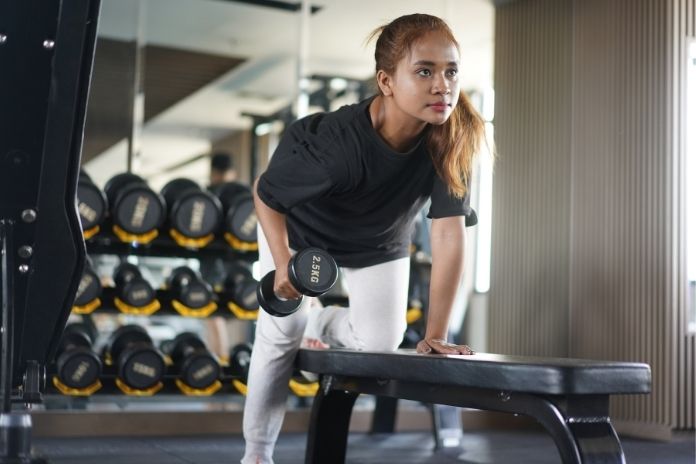
The single dumbbell row is unilateral isotonic exercise, meaning only one side of body is used to contract the muscles. Although it’s customary to perform the single arm cable row with one knee on a bench, you can alternatively bend with one arm resting on your knee.
By providing optimal core and spinal stabilization, the single-arm dumbbell bench row allows you to lift heavier loads. The latissimus dorsi (Lats) is the primary muscle group worked during a single-arm dumbbell row.
Detailed Instructions:
Step 1: Take a knee position on the bench with your back at a 90-degree angle and your opposite foot firmly planted on the ground.
Step 2: Using the hand opposite the knee on the bench, grab the dumbbell.
Step 3: Position your other hand on the bench and hold onto the outside of your knee.
Step 4: Stretch your shoulders and lats while looking straight ahead, letting the dumbbell hand hang.
Step 5: With your hand firmly gripping the handle, draw the weight back while maintaining your elbow tucked close to your body and your back straight to prevent further movement.
Step 6: Contract and squeeze your shoulder blades, holding the position for at least 1 to 2 seconds.
Step 7: Slowly and carefully return dumbbell until your shoulder and lats feel stretched while maintaining straight back, then once again repeat.
Key Training Tips for Strong, Balanced Shoulders
It’s very important to train intelligently and maintain muscular balance than to lift the heaviest weights to develop sturdy shoulders. Rather than maximal loading, the rotator cuff and rear delts respond best to controlled, high-quality movement.
- As you gain strength, progressively increase the weight. Achieving proper form should take precedence over increasing weights. Use your full range of motion during controlled movements.
- Include a range of exercises to target all the shoulder muscles. Pay attention to your body and take days off when necessary.
- You can use these exercises as a dedicated shoulder workout or as part of your upper-body program.
- Pick resistance or weights that will push you to complete the required number of repetitions (usually 8–12 for strength increases). You can keep pushing your muscles by increasing the weight or resistance as you gain your strength.
Bonus: Rear Delt Training for Better Bench Press Performance
Exercises like Face Pulls, Bent-Over Dumbbell Raises, and Cable/Band Rear Delt Flies hit these critical muscles through isolation and the rowing movement. Having stronger rear delts help your bench press by improving your shoulder stability, preventing some forward rotation as you press, and creating a more powerful base.
To create more stability and power through a more rigid press, work on relatively high-rep (10-15+ reps) controlled movements in an externally rotated position.
Read More: Low Impact Workouts That Burn Calories: 10 Exercises That Torch Fat
Conclusion
Balance, not brute strength, is the route to healthy, strong shoulders. Disregarding your rear delts can easily lead to poor posture and shaky shoulders, resulting in terrible rotator cuff pain, even if pressing through 3 shirts a day has earned you an admirable chest and front delts.
As we’ve learned, rear delts are key to shoulder joint stability and alignment, external rotation health, and scapular position during everyday and exercise activities.
References
- Craig Lindell PT, DPT, CSCS. (2022, September 7). How to improve bench press: Break through that plateau!
- M&S Team. (2020, June 13). 5 tips to help a bench press plateau.
- Beaumont, J. (2019, July 18). The breaking the push plateau shoulder exercises.
- Charlie Hancock. (2025, April 23). Don’t skip the rear delts: The underdog muscle that deserves your attention.
- Ward, T. (2023, August 16). Rear delts are the shoulder muscles you need to stop sleeping on.
- Kathryn Alexander. (2023, August 23). Best rear delt exercises: Strengthening your shoulders.
- Lancaster Orthopedic Group. (2024, April 4). 7 best shoulder workouts for strength and stability.
- Godman, H. (2023, December 1). 3 easy ways to strengthen your shoulders.
In this Article