













Creatine loading and cycling spark endless debate among gym-goers and athletes, often fueled by outdated myths rather than evidence.
Before diving into those debates, it helps to understand what creatine actually is. Creatine is a naturally occurring compound your body makes from the amino acids glycine and arginine, primarily in the liver and kidneys.
You also get small amounts from foods like red meat and fish. The body stores most of its creatine in skeletal muscle as phosphocreatine, which helps rapidly regenerate energy during intense efforts. Supplementing with creatine monohydrate replenishes those stores beyond what diet alone can provide, supporting stronger, more consistent performance.
This article cuts through the confusion, highlighting what is backed by science, what is optional, and practical protocols for most users seeking muscle creatine saturation without unnecessary risks.
What Is Creatine Loading and Why Was It Popularized?
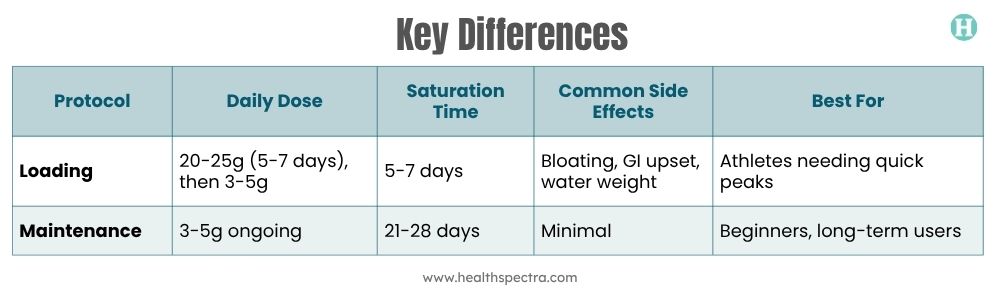
The creatine loading phase involves high daily doses of creatine monohydrate, typically 20–25 grams split into 4–5 servings over 5–7 days. This approach originated from early 1990s research aiming to rapidly boost phosphocreatine stores in muscles, which fuel the ATP energy system during short, high-intensity efforts like weightlifting or sprints.
The goal was faster saturation of muscle creatine levels, allowing quicker performance gains compared to steady dosing. Pioneering studies showed loading could elevate muscle creatine by 20–40% in under a week, popularizing it among bodybuilders and athletes chasing immediate results.
It is worth noting that creatine monohydrate remains the most studied and recommended form. Other commercial options like creatine HCl, Kre-Alkalyn, and buffered creatine exist, but none have demonstrated superior results in well-controlled research.
The International Society of Sports Nutrition (ISSN) consistently identifies creatine monohydrate as the most effective and cost-efficient supplementation protocol available.
Read More: 5 Best Detox Supplements for Liver Support and Toxin Removal
Does Creatine Loading Work? What the Science Shows
Loading effectively raises muscle creatine and phosphocreatine stores faster than low doses, with studies confirming peaks within 5–7 days. Short-term benefits include improved strength output and total work in repeated high-intensity sets, as seen in resistance training trials.
However, long-term outcomes match those from maintenance dosing alone. Both approaches reach full saturation, but loading simply accelerates the process by 3–4 weeks. Research emphasizes that final muscle creatine levels and performance adaptations depend on total intake over time, not the speed of initial uptake.
Is Creatine Loading Necessary for Most People?
For most casual users, beginners, or those prioritizing tolerance, loading is optional. Steady 3–5 gram daily doses achieve identical saturation over about 28 days, as confirmed by the landmark Hultman et al. study comparing loading to continuous low dosing. Athletes in competitive seasons might benefit from faster gains, but everyday gym enthusiasts see no edge in enduring high doses.
Busy professionals or intermittent trainers often skip loading to avoid hassle, since consistent low dosing supports ongoing ATP replenishment without disruption. Modern supplementation protocols favor simplicity for sustainable adherence.
What Are the Downsides of Creatine Loading?

High doses heighten the risk of digestive discomfort, including nausea, diarrhea, and cramping, due to the gut’s limited absorption capacity. Temporary water retention follows, drawing fluid into muscles and causing 2–6 pounds of scale weight gain, which can feel like bloating.
It is important to understand that this fluid shift is not a negative sign. Creatine pulls water into muscle cells as part of the same mechanism that supports phosphocreatine stores and performance.
This intracellular water is actually a sign the supplement is working, not a side effect to avoid. The weight added during loading is overwhelmingly water retained within muscle tissue, not fat.
These effects subside during the maintenance phase, but higher doses also amplify creatinine levels temporarily without proportional benefits.
Dr. Darryn Willoughby, a sports nutrition expert and co-author of multiple ISSN creatine position papers, advises that taking 3–5 grams daily is the most effective, simple way to supplement, with strength and size gains on par with loading over time.
To compare approaches clearly, consider this table summarizing key differences based on research:
 What Is Creatine Cycling and Why Do People Do It?
Creatine cycling means alternating supplementation periods, such as 8–12 weeks on followed by 4 weeks off, stemming from fears of tolerance, kidney strain, or reduced natural production. The practice echoed early steroid protocols, mistakenly applied to creatine despite entirely different mechanisms.
People cycle for perceived “resets” or to gauge necessity, but this myth persists from supplement marketing rather than data. Muscle creatine stores drop during off-periods, and any performance benefits built up during supplementation begin to reverse within weeks.
Read More: Can the Kidneys Repair Themselves? What Science Says
Is There Any Scientific Reason to Cycle Creatine?
Long-term studies, spanning up to 5 years, show that continuous creatine monohydrate use safely maintains saturation without suppressing endogenous production, which occurs naturally at around 1–2 grams daily. No evidence links daily dosing to tolerance, organ damage, or diminished efficacy.
Creatinine levels rise mildly with supplementation but remain harmless in healthy kidneys. A 2025 meta-analysis confirmed that any elevation in serum creatinine reflects normal metabolic turnover, not renal impairment, and that creatine does not compromise kidney function in healthy individuals. Cycling lacks any scientific support for enhancing safety or results.
Who Might Consider Cycling Creatine?
Those with digestive sensitivity may try short off-periods to gauge tolerance, though evidence favors dose adjustments over full stops. Individuals reassessing supplements periodically can choose to cycle based on personal preference, but it is not required for efficacy.
Context, like pre-existing gut issues or trial phases, matters, yet most users sustain benefits without interruption.
Preference-Based Options
- Short breaks of 2–4 weeks as a self-assessment period.
- Lower doses during “off” periods to minimize store depletion.
A Smarter Alternative to Loading and Cycling
The simplest and most evidence-backed protocol is daily low-dose creatine at 3–5 grams of creatine monohydrate, achieving full saturation steadily while minimizing side effects. This approach matches loading’s end results with better tolerability, making it ideal for consistent creatine daily use.
Steady dosing supports muscle creatine saturation over time, fueling phosphocreatine stores reliably without the peaks and crashes of high-dose phases.
One practical tip that research consistently supports: taking creatine alongside carbohydrates or a combination of carbohydrates and protein improves how much your muscles retain.
A classic study by Steenge et al. found that pairing creatine with roughly 50 grams of protein and carbohydrates boosted whole-body creatine retention by about 25% compared to taking creatine alone, an effect driven by insulin-mediated uptake into muscle. Taking your daily dose with a post-workout meal or protein shake is a simple way to put this to work without any extra effort.
Read More: Do You Need Creatine Even If You Don’t Lift Heavy? Benefits Explained
How Long Does It Take to See Results Without Loading?
Muscle saturation typically reaches its maximum in 21–28 days at 3–5 grams daily, with performance boosts like added reps or improved strength emerging around weeks 2–4 alongside consistent training. Patience yields the same gains as loading, often with less initial discomfort.
Factors like baseline diet influence timelines. Vegetarians, who typically carry lower baseline muscle creatine levels due to less dietary intake from animal foods, often respond faster and more noticeably to supplementation than omnivores. Consistency is still the key driver of results regardless of diet.
Safety Considerations for Long-Term Creatine Use

Prioritize hydration, aiming for at least 3–4 liters of water daily, to support fluid balance and kidney function during long-term creatine use. Those with pre-existing kidney conditions, those taking medications that affect kidney function, or anyone who is pregnant should consult a doctor before starting.
Dosage consistency matters far more than cycling, with research affirming safety at doses up to 30 grams daily for years in healthy adults. The ISSN’s 2017 position stand confirmed that short- and long-term supplementation is safe and well tolerated in healthy individuals across all age groups.
Beyond muscle performance, emerging research points to broader benefits of creatine supplementation that appeal to non-athletes. A 2024 systematic review and meta-analysis found that creatine monohydrate may support memory and attention in adults, with the clearest benefits seen in older adults and individuals under metabolic stress, such as sleep deprivation.
Creatine supports brain energy metabolism by increasing phosphocreatine availability in neural tissue, the same mechanism that helps muscles during high-intensity exercise. While more research is needed to establish dosing recommendations for cognitive benefit, this growing evidence has made creatine increasingly relevant for people well beyond the gym.
“Creatine loading speeds up muscle saturation but offers no long-term edge over steady 3–5 gram daily dosing, which achieves the same results without the bloating or GI upset many experience during high-dose phases. Simplicity wins for sustainable gains.”
Dr. Jose Antonio, physiologist and co-founder of the International Society of Sports Nutrition
Read More: Can You Mix Creatine with Coffee? What Happens When You Combine Them
The Practical Takeaway on Creatine Loading and Cycling
Loading accelerates saturation but adds side effects. Cycling offers no proven edge over daily dosing. Most people thrive on 3–5 grams consistently, skipping the hype for simplicity.
Here is a quick-reference guide to choosing your protocol:
Option A (With Loading): Take 20–25 grams of creatine monohydrate per day, split into 4–5 equal doses, for 5–7 days. Then reduce to 3–5 grams per day to maintain elevated stores. Best for athletes approaching a competition who need faster saturation.
Option B (Without Loading): Start at 3–5 grams per day from day one. Expect full muscle creatine saturation in approximately 3–4 weeks. Best for most people, including beginners, casual gym-goers, and anyone sensitive to higher doses.
- Skip loading and cycling if your priority is ease and tolerance.
- Load briefly before competitions; maintain otherwise.
- Tailor to your goals: steady dosing for long-term sustainability, loading for a faster start.
Creatine loading and cycling are optional strategies, not requirements. Consistent daily dosing at 3–5 grams unlocks the full benefits of enhanced strength, power, and recovery with fewer downsides, proving that simplicity is the most effective long-term approach to creatine daily use and muscle creatine saturation.
References
- Antonio, D., et al. (2021). Short-term creatine loading improves total work and repetitions in strength-trained men during resistance exercise: A randomized, double-blind, placebo-controlled trial. Journal of the International Society of Sports Nutrition, 18(1), 19.
- Forster, M., et al. (2021). Meta-analysis examining the importance of creatine ingestion strategies on lean tissue mass and strength gains during resistance training. Nutrients, 13(6), 1912.
- Kreider, R. B., et al. (2025). A short review of the most common safety concerns regarding creatine supplementation. Frontiers in Nutrition, 12.
- Steenge, G. R., Simpson, E. J., & Greenhaff, P. L. (2000). Protein- and carbohydrate-induced augmentation of whole body creatine retention in humans. Journal of Applied Physiology, 89(3), 1165–1171.
- Wu, S. H., et al. (2022). Creatine supplementation for muscle growth: A scoping review of randomized clinical trials from 2012 to 2021. Nutrients, 14(6), 1255.
- Antonio, J., et al. (2017). Common questions and misconceptions about creatine supplementation: What does the scientific evidence really show? Journal of the International Society of Sports Nutrition, 14, 18.
- Kreider, R. B., et al. (2017). International Society of Sports Nutrition position stand: Safety and efficacy of creatine supplementation in exercise, sport, and medicine. Journal of the International Society of Sports Nutrition, 14, 18.
- Del Favero, S., et al. (2023). Is it time for a requiem for creatine supplementation-induced anabolic fast twitch myonuclei accommodation? Journal of the International Society of Sports Nutrition, 20(1), 2194255.
- Antonio, J., et al. (2021). Common questions and misconceptions about creatine supplementation: What does the scientific evidence really show? Journal of the International Society of Sports Nutrition, 18(1), 13.
- Pashayee-Khamene, F., et al. (2024). Creatine supplementation protocols with or without training interventions on body composition: A GRADE-assessed systematic review and dose-response meta-analysis. Journal of the International Society of Sports Nutrition, 21(1), 2380058.
- Tan, B., et al. (2023). The effects of creatine supplementation combined with resistance training on regional measures of muscle hypertrophy: A systematic review with meta-analysis. Nutrients, 15(9), 2116.
- Kreider, R. B., et al. (2007). International Society of Sports Nutrition position stand: Creatine supplementation and exercise. Journal of the International Society of Sports Nutrition, 4, 6.
- International Society of Sports Nutrition. (2017). ISSN position stand: Safety and efficacy of creatine supplementation.
- Forbes, S. C., et al. (2023). Creatine supplementation and endurance performance: Surges and sprints to win the race. Journal of the International Society of Sports Nutrition, 20(1), 2203857.
- Barranco-Gil, D., et al. (2024). High-dose short-term creatine supplementation without beneficial effects in professional cyclists: A randomized controlled trial. Journal of the International Society of Sports Nutrition, 21(1), 2340574.
- Hultman, E., et al. (1996). Muscle creatine loading in men. Journal of Applied Physiology, 81(1), 232–237.
- Prokopidis, K., et al. (2024). The effects of creatine supplementation on cognitive function in adults: A systematic review and meta-analysis. Frontiers in Nutrition, 2024.
In this Article