

















Many people prepare themselves for cravings when they quit smoking. What they don’t expect is to feel sick. Head heavy. Body aching. Throat irritated. Mind dull. Sleep disturbed. This strange phase often leads to confusion, fear, and questions. ‘Did quitting damage my body?’ ‘Why do I feel worse after stopping something harmful?’
This experience is commonly called the smoker’s flu. It feels like influenza, but it is not an infection. It is not contagious or dangerous either. It is a short-term physiological response to nicotine withdrawal and internal readjustment.
The problem is not that smoker’s flu happens after quitting. The problem is that it is poorly explained, oversimplified, and often dismissed.
This article breaks it down clearly, without the recycled internet clichés.
What Is Smoker’s Flu?
Smoker’s flu is a non-medical term used to describe a cluster of physical and mental symptoms that appear after quitting smoking or reducing nicotine sharply.
Important points to understand clearly:
- It is not a virus.
- It is not an infection.
- It does not mean immunity is weak.
- It does not mean quitting is harming you.
It is simply the body responding to the sudden absence of nicotine, a substance it had adapted over the years.
Calling it “flu” could be misleading. There is no germ involved. What you are experiencing is withdrawal, along with recovery happening at the same time. That overlap is what makes it uncomfortable.
Why Smoker’s Flu Happens

Smoker’s flu is not caused by one system alone. It happens because multiple systems adjust simultaneously once nicotine is eliminated from the body.
1. Nicotine Withdrawal: More Than a Habit Issue
Nicotine directly affects the brain’s chemical balance.
- Increases dopamine (reward and motivation)
- Alters cortisol(stress response)
- Influences norepinephrine (alertness)
- Suppresses appetite and fatigue signals
When nicotine intake is suddenly stopped, the brain does not “reset” instantly. It enters a temporary deficit state:
- Neurotransmitter levels drop suddenly
- Stress hormones fluctuate
- Blood vessels change tone
- Heart rate and blood pressure adjust
Nicotine withdrawal symptoms are not psychological weaknesses; they are neurochemical readjustments:
- Irritability
- Brain fog
- Headaches
- Low energy
2. Respiratory System Recovery: The Hidden Work
Smoking damages tiny hair-like structures in the lungs called cilia. These cilia normally move mucus and debris out of the airways.
While smoking, cilia are paralyzed or damaged, and mucus builds up silently.
However, after quitting, cilia starts functioning again, and mucus starts moving.
This leads to:
- Increased cough
- Chest tightness
- Throat irritation
This recovery begins far sooner than most people expect.
Dr. James Gill, Locum GP & Honorary Clinical Lecturer, explains, “Even stopping smoking for just 24 hours is seen to have a huge improvement in the function of remaining cilia. The longer you’ve stopped smoking, the greater your recovery. So it is never too late to stop smoking.”
Many people mistake those symptoms for a lung infection. In reality, it is lung cleaning. Respiratory specialists consistently reassure patients that this phase is expected and temporary.
3. Inflammation and Nervous System Shifts
Nicotine suppresses certain inflammatory signals. When it is removed:
- Mild inflammation may increase temporarily
- The nervous system becomes more sensitive
- Pain perception can rise briefly
This explains body aches, chills, and sleep disturbance, even without fever.
Common Symptoms of Smoker’s Flu
Not everyone experiences all symptoms. Intensity varies widely depending on smoking history, nicotine dependence, and stress levels.
Commonly reported symptoms include:
- Persistent fatigue
- Headaches or head pressure
- Brain fog or slow thinking
- Irritability or low mood
- Increased coughing
- Chest tightness
- Sore or dry throat
- Mild body aches
- Disturbed sleep or vivid dreams
Important Clarification: Smoker’s flu does not usually cause a high fever. If fever is present, another illness should be considered.
How Long Does Smoker’s Flu Last?
For most people, smoker’s flu follows a predictable pattern. The typical timeline includes:
- Day 1-3:Symptoms may start or intensify
- Day 4-10:Peak discomfort for many people
- Week 2-3:Gradual improvement
- Week 4 onward:Most symptoms fade significantly
Some symptoms resolve faster, such as headaches, irritability, and sleep issues, while others may linger, like cough, mucus clearance, and mild fatigue.
What Affects Duration
How long the smoker’s flu lasts depends on:
- Years of smoking
- Cigarettes per day
- Nicotine strength used
- Stress levels
- Sleep quality
- Use of nicotine replacement therapy
There is no fixed deadline. But progress should be gradual, not worsening.
Smoker’s Flu vs Real Flu or COVID
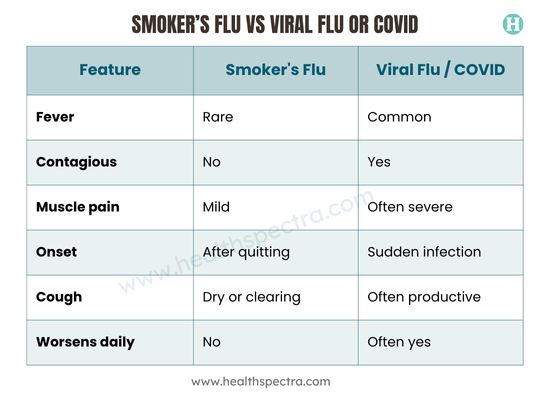 Confusion is common, especially during respiratory illness seasons.
Key differences:Quick Note: If symptoms escalate instead of stabilizing, medical evaluation is needed.
What Helps Ease Smoker’s Flu Symptoms

There is no instant cure. But symptoms are manageable.
1. Hydration
Quitting smoking changes fluid balance and mucus consistency. Water helps:
- Thin respiratory mucus
- Reduce headaches
- Support detox pathways
From a lung perspective, hydration directly affects how uncomfortable the cough feels. “Drinking enough water will help thin out mucus, making it easier to cough up,” says Dr. Raed Alalawi, MD, a pulmonologist at Banner Health.
During this phase, warm fluids are often better tolerated than cold ones.
2. Sleep and Rest
Fatigue is not laziness. It is part of nervous system recalibration. Short naps are acceptable. But overexertion is not helpful in this phase.
3. Gentle Movement
Light walking or stretching:
- Improves circulation
- Reduces stiffness
- Boosts mood chemicals
Avoid intense workouts if fatigue is strong.
4. Nutrition
Skipping meals worsens symptoms.
Focus on:
- Regular meals
- Protein intake
- Fruits and vegetables
- Steady blood sugar
Heavy junk food often increases inflammation and fatigue.
5. Nicotine Replacement Therapy (If Used)
Patches, gum, or lozenges can:
- Reduce withdrawal intensity
- Smooth symptom peaks
Using NRT is not a failure. It is harm reduction.
Read More: Can You Get the Flu Twice in One Season? What Doctors Want You to…
What Usually Makes Symptoms Worse

Certain habits unintentionally increase discomfort:
- Dehydration
- Poor sleep routine
- Excess caffeine
- High stress exposure
- Skipping meals
- Constant symptom monitoring
- Trying to push through exhaustion
Withdrawal symptoms amplify when the body is already stressed.
Read More: Zinc for Cold and Flu: Evidence-Based Benefits and Dosage
When to Call a Doctor
Medical evaluation is important if any of the following occur:
- Persistent fever
- Chest pain
- Shortness of breath
- Coughing up blood
- Symptoms worsening after two weeks
- Existing lung or heart disease
Smoker’s flu should improve, not escalate. Worsening is a warning sign.
Read More: 16 Home Remedies For Stomach Flu – Get Relief At Home
Is Smoker’s Flu a Sign Quitting Is Dangerous?
No. This is a critical misunderstanding. Smoker’s flu does not mean quitting harms the body. Discomfort does not equal damage. Respiratory specialists emphasize that these symptoms are temporary and not a sign of harm. As Dr. Ian Hall, Consultant in Respiratory Medicine, explains:
“Although some people do notice a slight increase in their cough when they stop smoking, it is temporary, and there are obvious long-term benefits from stopping smoking. There is no evidence that anyone who stops smoking is at more risk of transmitting disease, so I would always recommend that smokers stop smoking.”
Smoker’s flu means:
- The brain is adjusting
- The lungs are clearing
- The nervous system is recalibrating
These processes are uncomfortable but protective, not harmful. From a broader medical perspective, the short-term discomfort of quitting is small compared to the long-term gains.
Dr. Tom Wingfield, Honorary Consultant Physician, puts it plainly:
“There is high-quality evidence that smoking cessation leads to significant health benefits. Smoking cessation at any time represents a huge opportunity to improve people’s life expectancy. Decreasing smoking rates at a country level can have a huge positive public health impact. Now is as good a moment as any to give up, and smokers might be more receptive to stop at the present time.”
Read More: How to Avoid Secondhand Smoke When Living With a Smoker
Tips to Get Through Smoker’s Flu Without Relapsing
- Expect symptoms before they appear
- Plan lighter days during early quitting
- Avoid testing cigarettes to check symptoms
- Use support, people, or tools
- Remember that symptoms do not mean quitting failed
Most relapses happen not because symptoms are unbearable, but because they are unexpected.
Final Takeaway
Smoker’s flu is not an illness; it is a transition. It feels unpleasant because the body is changing direction after long-term nicotine exposure.
For most people, symptoms are temporary, improvement is gradual, and long-term health gains are substantial.
Patience, symptom management, and realistic expectations make the difference between relapse and recovery.
- Smoker’s flu is a withdrawal-and-recovery overlap, not a disease.
- Coughing after quitting smoking often signals lung cleaning, not damage.
- Severity varies widely; absence of symptoms does not mean quitting failed.
- Nicotine replacement can reduce symptom intensity without delaying recovery.
- Research gap in long-term data comparing smoker’s flu severity between abrupt quitting and gradual nicotine tapering; an area needing clearer clinical guidance.
References
- Bruijnzeel, A. W. (2012). Tobacco addiction and the dysregulation of brain stress systems. Neuroscience & Biobehavioral Reviews, 36(5), 1418–1441.
- Cleveland Clinic. (2021). Nicotine Withdrawal: Symptoms, Treatments & Other Remedies. Cleveland Clinic.
- Mayo Clinic. (2025). Coughing more after quitting smoking: What’s the deal? Mayo Clinic.
In this Article