












Carpal Tunnel Syndrome (CTS) is not a result of sudden pain or numbness that you start to experience. The symptoms develop gradually. These might be a faint tingling while typing, a pins-and-needles sensation when holding a phone, or numbness in your fingertips upon waking up.
Most of the time, people dismiss the symptoms of carpal tunnel syndrome. The reason is that pain in the wrist is considered a normal part of life, especially in cases when one is typing, texting, driving, cooking, or generally using the hands.
CTS is beyond a mere strain. The primary reason for CTS is the compression of the median nerve that runs through a narrow passage in your wrist called the carpal tunnel. Since this tunnel is inflexible and packed with tendons, even slight swelling or repetitive motion can lead to inflammation.
The symptoms are often mild when the pressure is minimal, but they need to be diagnosed early for the right treatment. Intervention at an early stage can stop nerve damage, maintain hand strength, and prevent the symptoms from progressing into chronic pain or long-term disability.
It is important to know about the first signs of CTS. As soon as you see them, they can be changed. If you notice them at the last stage, it can be challenging to treat.
In this article, we will discover the very first warning signs, how they differ from the usual wrist pain, why they can be easily overlooked, and what you should do if you notice the pattern.
Read More: Wrist Fractures: Most Common Types and What Recovery Looks Like
How CTS Develops — A Quick Primer on the Underlying Mechanism

Understanding early symptoms is easy if we know the wrist structure.
The median nerve is formed in the forearm. After passing through the wrist, it travels through the carpal tunnel, a small bony passage covered by a strong ligament, to reach the hand. This nerve helps in:
- Sensory perception from the thumb, index, middle, and half of the ring finger.
- Motor control of muscles at the base of the thumb.
- Ultra-fine movements such as gripping a pen, holding a key, or fastening jewelry.
However, this tunnel is already narrow. Along with the median nerve, nine flexor tendons run through it. Since there’s no space to expand, even a small amount of inflammation, fluid retention, or tendon irritation can raise the pressure in the area.
Once that pressure exceeds the capacity of the median nerve, it gets impacted. This disruption results in tingling, numbness, or pain.
Studies indicate that repetitive wrist movements, awkward wrist posture, prolonged gripping, pregnancy, thyroid problems, arthritis, or even heredity (having a naturally smaller tunnel) can be the causes of the compression.
We must understand that early CTS doesn’t happen overnight. The growth is gradual.
Initially, the nerve is only irritated, not damaged, thus symptoms disappear and appear. People shake their hands, massage their wrists, or change position, and the discomfort goes away. But that momentary relief simply shows that symptoms have not yet become chronic.
This slow progression is precisely why early symptoms are faint. This is why several people are unaware that something serious is happening.
Common Early Symptoms of Carpal Tunnel Syndrome

The first signs of CTS are distinguishable when you know the right information. Here are a few early CTS symptoms you must not ignore:
1. Tingling, Pins-and-Needles, or Numbness in the Thumb, Index, and Middle Finger
Often, these are the very first signs that people are aware of, and usually, they do not feel pain. It is a tingling sensation, or a slight numbness in the thumb, index, and middle fingers, yet a strange feeling.
These fingers are the ones that correspond exactly to the median nerve. Therefore, this pattern is the most significant diagnostic clue.
People say it is:
- ‘My fingers feel like they are going to sleep.’ There is a quite unfamiliar electric tingling.
- ‘My fingertips are a little numbed or dull. I have to shake my hand to wake it up.’
The sensation may be for a short or longer duration. You may feel better by changing the hand position, stretching the wrist, or shaking the hand. These are temporary remedies that most people take as a sign that there is nothing seriously wrong.
2. Intermittent “Electric-Shock” or Burning Sensation
Since the median nerve is sensory, its irritation can bring about deeper, nerve-based sensations that may feel different from muscle pain. The most common and noticeable symptoms include:
- Very fast, electric-zap-like sensations.
- Warm, tingling sensation slowly spreading in the palm.
- Brief, sudden ‘jolts’ when gripping something.
- A burning feeling that travels from the fingers to the wrist.
Such sensations are usually accompanied by activities like typing, holding a tool, or gripping a steering wheel.
They can be concerning as they originate from inside the wrist and not the skin or muscles.
3. Symptoms Triggered by Specific Activities
During the early phase, symptoms are linked to activities. They start or worsen when the wrist is in a certain position or is used for a repetitive task.
We often come across statements of people experiencing tingling and numbness while:
- Holding a phone during a long call.
- Tightening the lid of a jar.
- Typing or texting for a long period of time.
- Holding a steering wheel.
- Reading a book.
- Chopping vegetables.
- Doing hair or makeup.
- Sewing, knitting, or using a vibrating tool.
Prolonged wrist flexion or repetitive movement causes pressure in the tunnel, leading to nerve symptoms. The activity-linked pattern is one of the main indications that you have early CTS and not just wrist fatigue.
4. Night-Time or Early-Morning Symptoms
One of the earliest and most typical symptoms of CTS is nighttime numbness and tingling.
During sleep, the wrist is naturally bent without the person being aware of it. Hence, the pressure inside the carpal tunnel increases upon bending. Since the median nerve is compressed for hours, one wakes up with symptoms.
What people usually say is:
- They wake up with ‘dead’ or numb fingers. To get back the feeling, one needs to shake or squeeze the hand.
- Stiffness in the fingers after waking up.
- Quite a strong tingling sensation upon waking.
- Symptoms disappear after 15 to 30 minutes of movement.
It is often the point when people first start to look for information online and come across CTS.
5. Weakness or Clumsiness in the Hand
At the beginning of carpal tunnel syndrome, the weakness is very subtle. However, if you observe closely, you can notice the weakness. The median nerve is responsible for the muscles located at the base of the thumb, the ones in charge of grip and pinch strength. When the nerve is irritated, these muscles weaken.
Maybe you have experienced that:
- You find it hard to hold a phone tightly.
- You start dropping objects unintentionally.
- You lose precision while buttoning up clothes.
- You find it difficult to hold utensils, pens, or makeup tools.
- Your hand is getting tired of doing what used to be effortless.
Orthopedic experts mention that people mostly misinterpret this clumsiness as being caused by stress or tiredness. Thus, not realizing that it could be nerve-related.
6. A Feeling of Swelling or Fullness (Even Without Visible Swelling)
Several early CTS patients have reported a peculiar internal sensation as if their fingers were swollen, tight, or heavy, although there was no visible swelling. The sensation is due to nerve conduction changes and pressure in the tunnel.
You might feel:
- Stiff fingers
- Puffy or “thick” fingertips
- The palm feels full
- Difficulty in bending fingers smoothly
This symptom is often overlooked, and people think that it is just tiredness, whereas it is actually an early neurological signal.
Read More: Is Inflammation the Root of All Chronic Diseases? What You Should Know
Why Early Symptoms Are Often Overlooked or Misinterpreted

It is very normal for people to experience early CTS symptoms for several months or even years before they realise. Here’s why:
- Symptoms are not always present. In the early stages of CTS, swelling and nerve pressure are not constant. You may have symptoms one day and be completely fine the next. This on-off pattern makes people think it is nothing serious.
- Handshaking temporarily relieves the discomfort. This relief trick gives people the false impression that the symptoms are caused by a bad posture or temporary pressure and not by nerve irritation.
- Symptoms look like everyday strains. Activities such as continuous typing, lifting kids, cooking, or cleaning can tire the hand. Fatigue caused by these activities is what people take CTS for, especially those who have desk jobs or lead active lifestyles.
- CTS develops slowly. There is no sudden event, no serious injury, but increasing nerve irritation gradually. People have the natural ability to adjust, compensate, and disregard discomfort, which is why the symptoms stay under the surface.
Dr. Robert C. Kramer, MD, a hand surgeon in Beaumont, specializes in hand surgery and care of the wrist, shares his thoughts on the above. ‘’Carpal tunnel syndrome is often misdiagnosed, because it’s a common diagnosis,” Dr. Kramer says. Adding, “It is characterized by numbness and tingling in your thumb, index, middle, and just the side of your ring finger by the middle finger.”
When to Suspect It’s Not Just Wrist Pain — Key Red Flags for CTS
If you are trying to determine whether your symptoms are due to CTS or hand strain, consider these patterns. These are specific to median nerve compression:
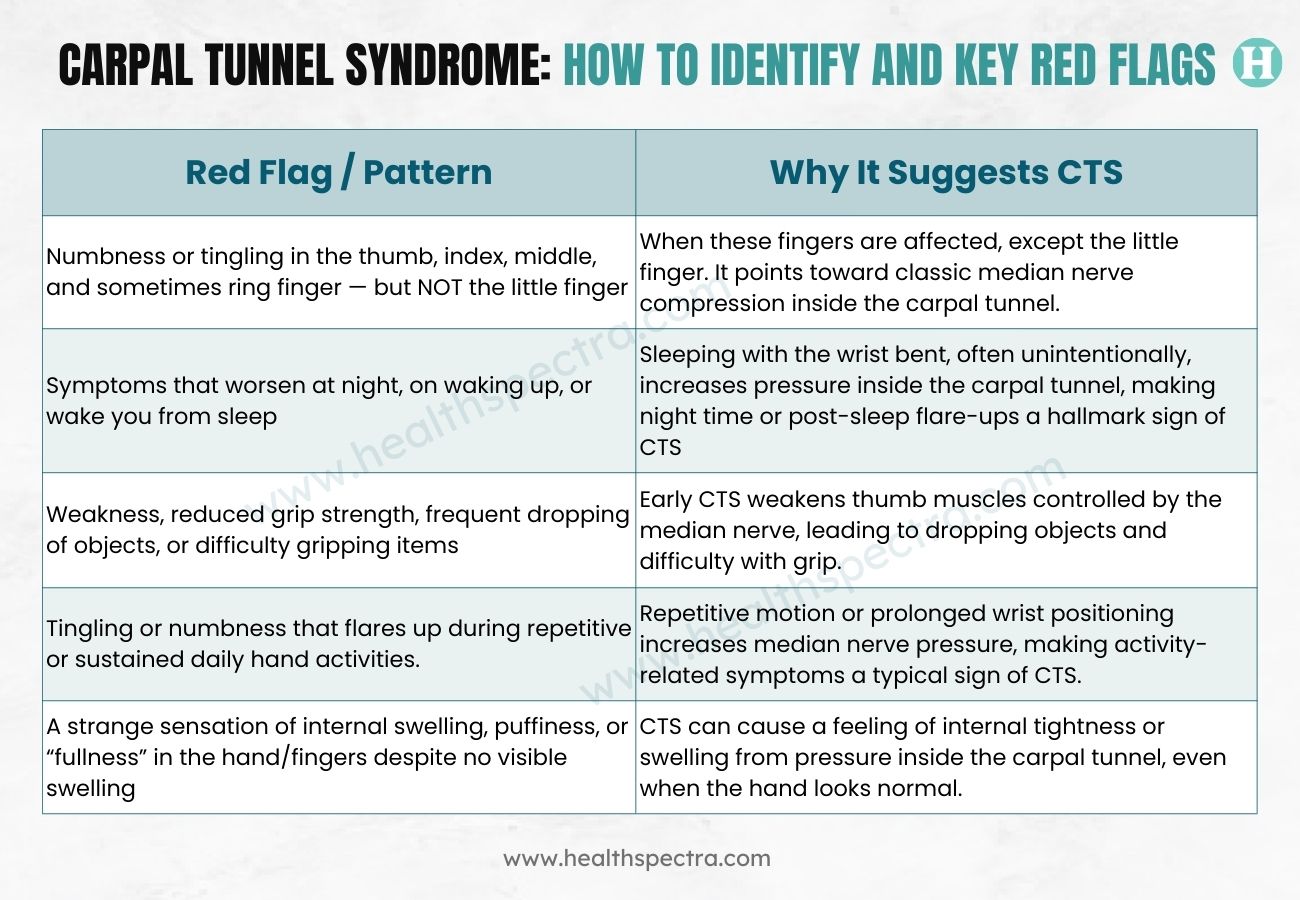 If you consistently notice two or more of these patterns, early CTS should be your consideration.
Read More: Tingling in Hands at Night: Carpal Tunnel or Vitamin Deficiency?
What to Do If You Notice Early Symptoms
If you observe early signs, there is no need to panic, but you should take them seriously, as early treatment is very effective.
1. Change the way you use your hand and wrist. Here’s what you can do:
- See if you could change the way you type, grip, text, cook, or hold things.
- Give yourself a break every 20-30 minutes.
- Try not to bend your wrist too much.
2. Keep an eye on and record your symptoms. Try to write down:
- Things that cause symptoms
- Which fingers are affected
- If symptoms occur during the night
- How often tingling or numbness happens
This information can be helpful for a doctor in identifying early CTS.
3. Wear a wrist splint at night.
A wrist brace that supports the wrist in a neutral position keeps it from bending during sleep, thus avoiding nerve compression throughout the night.
Many people report significant improvement in CTS symptoms in a few weeks of using a wrist splint.
- If symptoms persist or get worse, seek medical help.
A doctor can perform tests such as Phalen’s test, Tinel’s sign, or nerve conduction studies to identify CTS early, when the treatment is the easiest and the most effective.
Why Early Diagnosis & Treatment Can Prevent Long-Term Damage
If no treatment is given, the long-term pressure on the median nerve may result in:
- Permanent numbness
- Continuous weakness
- Gripping difficulties
- Loss of thumb muscle mass
- Reduction of fine motor skills
- Chronic nerve damage that cannot be fully healed
Certain studies indicate that damage to the median nerve leads to slow and sometimes incomplete recovery.
Early diagnosis has several benefits, including:
- Symptoms that can be reversed.
- Prevention of nerve damage.
- Better hand function.
- Preventing the need for surgery.
- Long-term strength of grip and dexterity.
Consider early CTS as a warning and make modifications immediately. Doing this prevents the long-term consequences that could affect your work and promotes overall quality of life.
Conclusion — Early Symptoms to Watch For & What You Should Do
Carpal Tunnel Syndrome usually starts subtly with tingling, numbness, or a “pins-and-needles” feeling in the thumb, index, and middle fingers, pain during sleep, or occasional weakness. In fact, these initial symptoms may be so faint that one might simply ignore them, but they are a loud call from the median nerve being compressed.
It is essential to recognize these symptoms first, especially when they occur during repetitive hand use or upon waking, to stop the disease from further development.
The good news is that early CTS is generally very sensitive to treatment with wrist splints, ergonomic changes, and activity modifications. Thus, relieving discomfort, protecting hand strength and dexterity, and lessening the chance of permanent nerve damage can be achieved by a prompt response.
Understand the subtle signals and get medical help as soon as you notice the first symptom. Consult a doctor to examine the condition and preserve your hand health in the long run.
References
- Jayadi, A., Wardhana, A., & Sari, E. P. (2023). Carpal Tunnel Syndrome among workers and its associated factors. Journal of Workplace Safety, 3(2), 87–95.
- Pederson, W. C., & Mackinnon, S. E. (2023). Carpal Tunnel Syndrome. In StatPearls. StatPearls Publishing.
- Khosrawi, S., & Shayesteh, A. (2024). A narrative review of diagnostic challenges and updates in Carpal Tunnel Syndrome. Diagnostics, 6(4), 94.
- LeBlanc, M. R., Côté, P., & Wong, J. J. (2023). Carpal Tunnel Syndrome. In StatPearls. StatPearls Publishing.
- Brunswick Chiropractic. (n.d.). Think you have carpal tunnel? Here are the most common symptoms to watch for.
- Padua, L., Coraci, D., Erra, C., & Pazzaglia, C. (2024). Carpal Tunnel Syndrome: Clinical update and advances in diagnosis and management. Nature Reviews Disease Primers, 10, Article 52.
In this Article