














Why Compare Procapil and Minoxidil?
Most people don’t start comparing hair serums because they enjoy reading ingredient lists. Usually, it’s after one thing: hair strands on the pillow, in the shower drain, or on a hairbrush that suddenly looks too clean.
Two products show up again and again in that search: Procapil and Minoxidil comparison. Both give results.
They’re popular, but they do two completely different jobs.
- Minoxidil is FDA-approved and backed by decades of clinical research.
- Procapil for hair growth sounds gentler, with ingredients from plant sources, peptides, and claims like “strengthens roots.”
So, which one, Procapil or Menoxidil, actually works?
This article clears the confusion without unrealistic promises.
What Is Procapil?
Most people discover Procapil because they want something milder than Minoxidil, something that doesn’t need lifelong usage.
Composition
It’s a patented ingredient complex made of three components:
- Biotinyl-GHK– a peptide linked with biotin
- Apigenin– a plant flavonoid (commonly derived from citrus)
- Oleanolic Acid– a plant-based compound believed to help reduce DHT’s impact.
Together, these ingredients aim to work on the root rather than force growth.
How Procapil Works
Instead of pushing follicles to grow faster, Procapil focuses on creating a better environment for hair to grow.
It is claimed to:
- Reduce the harmful effects of DHT on hair follicles
- Improve microcirculation around the scalp
- Strengthen the follicle structure
- Extend the natural growth phase (anagen)
The idea isn’t rapid regrowth; it’s rebuilding the foundation so hair becomes stronger over time.
Dermatologist Öykü Çelen reinforces this approach, noting that Procapil-based products are beneficial for everyone as part of regular hair care, whether or not they’ve undergone a hair transplant.
Evidence and Effectiveness
Here’s the truth:
Research on Procapil for hair growth is limited and mostly manufacturer-funded. While the early signs are promising, it cannot yet be called a strong clinical solution.
It works best when:
- Hair loss is mild or just starting
- You want maintenance or supportive hair loss treatment options
- You’re avoiding stronger medications
It’s not ideal for someone with noticeable patches, aggressive hair thinning, or advanced pattern baldness.
Read More: 5 Products That Stimulate Hair Growth in Men
What Is Minoxidil?
Minoxidil is not introduced as a “gentle option.” It’s introduced as “this works as long as you commit.”
FDA-Approved Hair Growth Treatment
Minoxidil is approved to treat androgenetic alopecia in both men and women.
It comes in:
- 2%
- 5%
- 10%
- Liquid or Foam
5% is the most commonly recommended strength.
Hair-loss expert Dr. Rodney Sinclair provides useful clarity on strengths and frequency. In his experience, twice-daily 5% minoxidil tends to produce faster initial improvement than twice-daily 2%, although the long-term difference becomes minimal after a year of consistent use. He also notes that once-daily 5% performs similarly to twice-daily 2%.
For female patients, he typically advises starting with the 5% solution twice a day for the first six months, then shifting to once daily.
How Minoxidil Works
Minoxidil isn’t blocking hormones. It works mechanically by expanding blood vessels and increasing oxygen and nutrient supply to hair follicles.
It:
- Enlarges miniaturized follicles
- Enhances hair diameter over time
- Restarts dormant follicles
- Pushes more hair into the growth phase
Evidence and Effectiveness
Minoxidil isn’t perfect, but it’s proven.
- Thousands of published clinical trials
- Decades of dermatology use
- Works best for crown thinning, receding hairline, and genetically driven loss
Most people see changes in 8–16 weeks, although full results may take up to 12 months.
Read More: Is It Normal to Lose Hair in the Shower? Here’s When to Worry
Key Differences: Procapil vs Minoxidil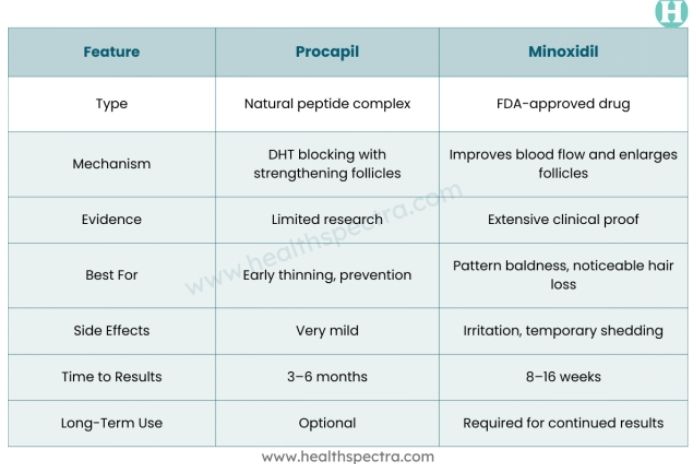 How Effective Are They?
Effectiveness of Procapil
Procapil for hair growth is not a miracle serum. But it has value.
- Helps improve hair texture and thickness.
- Works better when used early.
- Ideal for someone not ready for medication.
- Best performance when combined with lifestyle and supportive hair loss treatment options.
Think of it as maintenance, not recovery.
Minoxidil Effectiveness
Minoxidil has measurable outcomes:
- 17–70% of users see visible regrowth
- Helps even moderate to advanced thinning
- Works as long as it’s used consistently
It is a long-term solution; stopping it means hair gradually returns to its baseline.
Read More: Is It Normal to Lose Hair in the Shower? Here’s When to Worry
Side Effects and Safety
Procapil
Usually safe. Most users tolerate Procapil very well.
Possible mild side effects:
- Light redness: A bit of redness usually shows up when the scalp isn’t used to a new active ingredient. It settles once the skin adjusts and is rarely a sign of irritation.
- Itching: Mild itching is mostly your scalp responding to increased circulation or a new formula. It typically improves within a few days of regular use.
- Temporary sensitivity: Some people experience slight tenderness, especially if the scalp is already dry or has recently been treated. Giving a day’s break or reducing frequency usually calms it down quickly.
No systemic effects because it doesn’t alter internal hormone levels. It rarely triggers shedding because it doesn’t push follicles aggressively into a new cycle.
Minoxidil
Side effects depend on formulation and skin sensitivity.
Common side effects:
- Initial shedding (usually temporary): This happens because Minoxidil pushes weak, miniaturized hairs out so new, stronger ones can grow in. It’s unsettling, but it’s actually part of the treatment working.
- Scalp dryness and flaking: The alcohol and propylene glycol in some formulas can dry out the scalp, leading to flakes. Switching to foam or adding a gentle moisturizer often helps.
- Irritation: Some people react to the vehicle (especially in the liquid version) rather than the minoxidil itself. Redness or burning usually eases when switching formulations.
Less common:
- Unwanted facial hair (if product spreads to skin): If the solution drips or transfers to the sides of the face, those areas may experience stimulation too. Applying carefully and washing hands prevent this.
Very rare:
- Heart palpitations: In rare cases, a small amount is absorbed into the bloodstream and temporarily affects heart rate. It’s uncommon, but anyone feeling this should stop and speak to a doctor.
- Lightheadedness: This can happen if the body absorbs more Minoxidil than expected, slightly lowering blood pressure. Using the correct dose and applying only to a dry scalp minimizes the risk.
These usually happen if applied excessively or used incorrectly.
Read More: Best Shampoo for Menopausal Hair Loss: What to Choose, What Works & Why
Which One Should You Choose?
You don’t need to guess; match based on your condition:
Choose Procapil If:
- Hair is just starting to thin
- You want something mild and maintenance-friendly
- You prefer non-medicated solutions
- You prefer a gentler or “cleaner ingredient” approach
- You want a secondary product with Minoxidil
- Your scalp gets irritated easily
Choose Minoxidil If:
- Hair thinning is visible or progressive
- You have pattern baldness
- You want clinically proven regrowth
- You can commit long-term
Hair transplant surgeon Dr. Jerry Cooley echoes this approach. He explains that when he sees clear miniaturization, especially when it’s widespread across the scalp, he recommends topical or oral minoxidil. In his practice, nearly 70% of patients use oral minoxidil for this reason.
However, he notes that someone with a very simple pattern, such as only frontal recession without significant thinning, is usually not the right candidate for oral minoxidil.
Read More: How to Tell If Your Hair Is Healthy: Signs to Look For (And Fixes…
Can You Use Procapil and Minoxidil Together?
Yes, and many dermatologists actually recommend it.
- Minoxidil stimulates growth
- Procapil strengthens the hair environment and minimizes DHT impact
Think of it as growth along with support. This combination may help improve results and reduce the “weak hair regrowth” issue some minoxidil-only users report.
Ideal order:
- Apply Minoxidil
- Let it dry
- Apply Procapil for hair growth
How Long Until You See Results?
- Procapil:
- Hair strength → 8–12 weeks
- Visible change → 3–6 months
- Minoxidil:
- Shedding → first 2–6 weeks
- New growth → 2–4 months
- Results → 6–12 months
Hair treatments take patience. The mistake most people make? They stop too early.
Final Thoughts
Both work, but in different ways.
- Minoxidil is regrowth-focused
- Procapil is support and maintenance-focused
It’s not about which one is “good” or “bad.” It’s about whether it matches your hair-loss stage, expectations, and level of consistency.
- Minoxidil gives stronger regrowth results.
- Procapil for hair growth is most effective for early thinning or prevention.
- One is medication, the other is a supportive complex.
- Side effects are higher with Minoxidil, but so is effectiveness.
- Combination use is often the most effective strategy.
References
- https://www.ncbi.nlm.nih.gov/books/NBK482378/
- https://journals.lww.com/ijot/fulltext/2025/01000/topical_alternatives_for_hair_loss__beyond_the.3.aspx
- https://pubmed.ncbi.nlm.nih.gov/34159872/
- https://onlinelibrary.wiley.com/doi/10.1111/jocd.16102
- https://pubmed.ncbi.nlm.nih.gov/30794366/
- https://pubmed.ncbi.nlm.nih.gov/37292551/
In this Article