
















“Trauma dumping” is everywhere right now, on Instagram captions, TikTok confessionals, and even in casual texts. You’ll hear lines like “Sorry for the trauma dump lol” or “This might be a bit much, but…” thrown around with a mix of guilt and nervous laughter.
But here’s the thing: trauma dumping isn’t just a buzzword or an online trend. It points to something deeper, an emotional experience that many of us have felt but never quite had the language for. It’s when someone shares intense, often deeply personal pain without context, consent, or care for how it lands on the other person. And it’s more common than we think.
Maybe you’ve done it yourself, spilled something heavy in the middle of a casual conversation, only to realize too late it wasn’t the right time or place. Or maybe you’ve been on the receiving end, unsure how to hold space without being overwhelmed, confused, or even hurt by what’s being shared.
So what’s the difference between honest emotional expression and trauma dumping? Is it wrong to open up? Are we becoming too sensitive, or not sensitive enough?
This article breaks it down. We’ll unpack what trauma dumping really means (and what it doesn’t), how it differs from healthy venting or vulnerability, the emotional impact it can have, and how to communicate pain without crossing boundaries. Whether you’re someone who tends to overshare or someone who feels drained by others’ emotional unloading, this guide will give you tools to navigate those moments with more clarity and care.
Because the goal isn’t to bottle things up, it’s to learn how to release them responsibly.
What Is Trauma Dumping?

At its core, trauma dumping is the unsolicited, unfiltered sharing of deeply distressing experiences, often in the wrong place, at the wrong time, with the wrong audience. It’s not the act of being open or seeking support. It’s the lack of consent, context, and emotional attunement that makes it overwhelming.
For example, telling a graphic story about abuse to a new coworker during lunch, or unloading childhood trauma in a casual group chat, crosses the line. The content might be valid, even important, but the delivery feels abrupt and emotionally one-sided.
Trauma dumping tends to feel like a verbal flood, with little regard for how the listener is doing. There’s no pause to check in, no shared space for mutual connection. It can leave others feeling emotionally hijacked, triggered, or unsure how to respond, especially if they didn’t expect the conversation to turn that intense.
This is not the same as opening up during a trusted heart-to-heart. Vulnerability, when mutual and respectful, strengthens relationships. But trauma dumping skips consent. It assumes availability without asking for it.
It’s also worth noting: trauma dumping can happen online, too. Rants on social media or comment sections filled with graphic details, especially when unrelated to the topic, can emotionally overwhelm strangers who didn’t opt in to that level of intimacy.
A June 2025 article from Integrative‑Psych defines trauma dumping as the spontaneous and unsolicited sharing of trauma, often leaving the listener feeling emotionally burdened or triggered. It emphasizes that trauma dumping shifts the relationship from mutual support to one-sided emotional labor
Bottom line: Trauma dumping is more about the how than the what. It’s not inherently wrong to share pain, but how you do it, and with whom, matters deeply.
The Difference
It’s important to draw a clear line between trauma dumping and healthy emotional expression. Here’s how they differ:
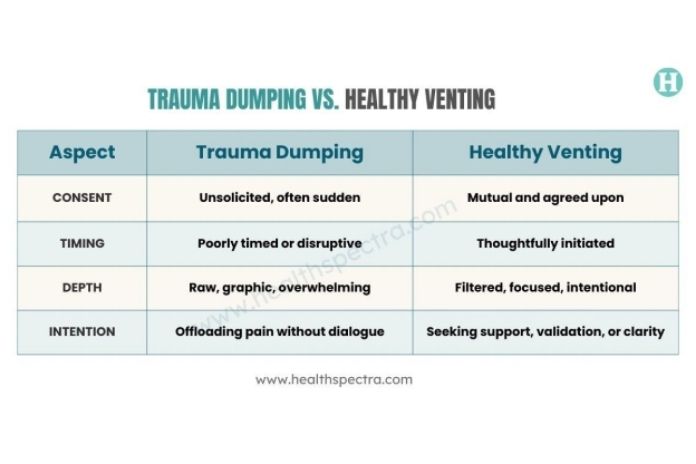 Venting is part of emotional health. But when it becomes trauma dumping, it shifts from mutual communication to a form of unregulated release.
Why Trauma Dumping Can Harm Relationships
Even when it’s unintentional, trauma dumping can quietly unravel connections. One person becomes the emotional sponge, the other the consistent spiller. Over time, this imbalance creates friction. The listener may start feeling emotionally drained, helpless, or resentful, not because they don’t care, but because they’re constantly put in a therapist’s seat they never signed up for.
The problem is, trauma dumping doesn’t leave space for mutual exchange. Conversations become one-sided. Check-ins stop being check-ins and start feeling like emotional unloading zones. And when someone feels like they’re only valued for how much they can “handle,” they begin to pull away.
In close relationships, this dynamic can be especially damaging. Friends stop responding. Partners become withdrawn. People don’t always say, “You’re overwhelming me.” They just detach, quietly and gradually. And you’re left wondering why the bond you relied on feels thinner and colder. That’s the slow cost of unchecked trauma dumping.
Read More: 10 Habits That Secretly Drain Your Mental Energy
Why People Trauma Dump

Trauma dumping often stems from unmet emotional needs, specifically, the need to feel heard, validated, or understood. When someone carries unresolved pain for too long without support, it can spill out in ways that feel overwhelming to others. They may not realize they’re overloading someone; they’re just trying to offload what’s been heavy inside for far too long.
Sometimes, people trauma dump because they’ve never had a safe outlet. Maybe their past experiences with vulnerability were dismissed or punished, so they now speak without filters, fearing they won’t get another chance. Or they might confuse intensity with intimacy, believing that sharing something raw or painful quickly will bring them closer to someone.
It’s also common in individuals with anxiety, PTSD, or other trauma-related conditions where emotional regulation is difficult. The urgency to talk through distress can override social context or timing.
But here’s the thing: trauma dumping isn’t about being “too emotional” or “too much.” It’s about misdirected communication. It’s a signal that someone needs help, but they’re reaching out in a way that can unintentionally harm others or push them away.
People who have experienced trauma often feel isolated or different from others. By sharing their experiences, they may be seeking someone who can validate their feelings.
Understanding this can foster more compassion. It reminds us that behind every trauma dump is a person craving relief. But at the same time, it reinforces the need for healthy boundaries, both in how we express pain and in how we receive it.
Healing doesn’t happen in a flood. It happens in the slow, steady work of building emotional safety for yourself and the people around you.
In her book “How to Do the Work,” Dr. Nicole LePera explains, “When people feel unheard for too long, their pain will eventually find its way out, often in unregulated, overwhelming bursts. Trauma dumping isn’t a character flaw; it’s an emotional regulation challenge rooted in unmet needs.”
Signs You May Be Trauma Dumping
We often don’t realize we’re trauma dumping until we see the discomfort in someone else’s eyes, or feel it in their distance afterward.
Here are some telltale signs you might be unintentionally trauma dumping:
- Oversharing with acquaintances or strangers: Opening up to someone you barely know with deeply personal, traumatic details.
- Talking at someone instead of with them: Monologuing without giving the other person room to respond or process.
- Missing social cues: Not noticing when someone becomes silent, awkward, or tries to change the subject.
- Repetitive sharing: Telling the same traumatic story multiple times to different people without any new insight or resolution.
- Post-disclosure guilt: Feeling relieved in the moment, but later regretting the way or place you shared it.
These behaviors are often rooted in unprocessed trauma. They’re not character flaws, but they’re a signal that more intentional, structured support may be needed.
Why Trauma Dumping Can Be Harmful

Trauma needs space to heal; dumping it doesn’t always help. While opening up can be a healthy part of recovery, trauma dumping skips the processing and lands heavily on whoever’s nearby. It’s not about bad intentions. It’s about unfiltered emotion dropped into the wrong setting. And that can have real consequences, for both the listener and the one sharing.
a. To the Listener
Being on the receiving end of trauma dumping can be deeply uncomfortable and even triggering.
- Emotional Overwhelm: The listener might feel flooded by intense emotions or past memories of their own.
- Boundary Violation: Especially when the context is informal (work, public spaces, first meetings), this oversharing can feel invasive.
- Guilt or Pressure: Listeners might feel responsible to “fix” the situation or provide immediate emotional support they’re not equipped to give.
Unlike healthy sharing, trauma dumping typically occurs without warning and often leaves the listener feeling overwhelmed, uncomfortable, or burdened by information they weren’t prepared to receive.
Even if the trauma dumper doesn’t intend harm, the impact on the listener is real and can lead to emotional burnout or distancing.
b. To the Person Dumping
Trauma dumping isn’t just hard on the listener; it can also backfire for the person sharing.
- Reliving the trauma: If you do not workyour trauma constructively, then the nervous system gets stuck in a loop.
- Relationship strain: Friends, partners, or coworkers may begin to avoid deeper conversations out of fear of being “dumped on.”
- Delayed healing: Constantly offloading pain without reflection or guidance can stall real progress that typically comes from therapy.
Ultimately, trauma dumping isn’t processing; it’s reliving without resolution.
Common Scenarios Where Trauma Dumping Happens

Trauma dumping doesn’t always look dramatic. It often occurs in seemingly mundane or everyday situations:
- First dates or early friendships: Sharing too much too soon, possibly as a way to bond, test someone’s reaction, or self-sabotage.
- Social media: Posting raw, emotional stories in comments, captions, or stories without a support system to respond.
- Workplace conversations: Confiding in a colleague during a lunch break or meeting, catching them off guard.
- Online forums: Anonymous or semi-anonymous spaces can invite emotionally intense oversharing without boundaries or feedback.
In all these cases, what’s missing is consent. Even well-meaning listeners may not be prepared or able to engage with your trauma in that moment.
How to Set Healthy Boundaries If Someone Is Trauma Dumping
If someone trauma dumps on you, you’re allowed to protect your emotional space without guilt.
Here’s how to respond with compassion and clarity:
Use respectful but firm language:
- “I care about you, but I’m not in a place to have this conversation right now.”
- “This sounds really heavy. Have you spoken to a therapist about it?”
- “Can we talk about this another time when I’m more present to really listen?”
Redirect the conversation: Point them toward resources like crisis lines, online therapy platforms, or supportive communities that are equipped to handle distressing content.
Remember: boundaries are not rejection. They’re about mutual safety. A real friend, partner, or coworker will understand and respect that.
What Healthy Emotional Sharing Looks Like

Here’s the thing: vulnerability is not the enemy. People want to support you, but they also need emotional safety and mutual respect. Healthy emotional sharing feels inviting, not overwhelming.
It starts with consent. Asking something as simple as, “Is it okay if I talk about something heavy?” sets the tone. It gives the other person the chance to prepare emotionally or let you know they’re not in the right space to hold that weight. That’s not rejection, that’s respect.
Also, focus on how you feel rather than recounting every triggering detail. Saying “I’ve been feeling anxious lately” opens the door, without making the listener feel like they’re stuck in a retelling of your entire trauma history.
Pay attention to time. If you’ve been speaking nonstop for 20 minutes, maybe pause. Ask how they’re doing. Healthy sharing is a two-way flow; it breathes, it listens, and it values both voices in the room.
In her book “Daring Greatly,” Dr. Brené Brown writes, “Vulnerability is sharing with people who have earned the right to hear your story. It’s about mutual trust and boundaries, not oversharing to be heard, but sharing to be seen, respected, and connected.”
Cultural and Social Factors That Blur the Lines
Trauma dumping doesn’t always come from emotional immaturity. Sometimes, it’s shaped by the culture around us. Social media platforms blur boundaries. Oversharing becomes a currency; posts that bare your soul often go viral, while nuanced, private healing rarely gets noticed. So people start to believe: the more I bleed online, the more I’ll be seen.
For others, especially in cultures where emotional expression was discouraged, they weren’t taught how to “soft launch” their feelings. When they finally open up, it spills out fast and unfiltered. It’s not about manipulation; it’s about desperation to feel heard after years of silence.
Then there’s trauma bonding, people connecting over shared pain in tight-knit online or peer groups. While those spaces can feel validating, they can also normalize constant emotional unloading without accountability.
Bottom line: context matters. Trauma dumping isn’t always about attention-seeking. Often, it’s about survival habits shaped by environments where healthy emotional regulation was never modeled.
What to Do If You Realize You’ve Been Trauma Dumping

It takes courage to admit when we’ve crossed a line, even unintentionally. If you suspect you’ve been trauma dumping, don’t shame yourself. Use it as a moment to reflect and recalibrate.
Here’s how:
- Ask yourself why you shared: Were you hoping for comfort, connection, or just release? Did it feel impulsive or intentional?
- Pause before speaking or posting: Consider the person, time, and context. Are they emotionally available? Is this a good moment?
- Journal your thoughts: Sometimes, getting it out on paper can ease the urge to trauma dump and help you process on your own terms.
- Seek therapy: A mental health provider is trained to hold space for your pain, without being harmed by it. That’s their role and their training.
Recognizing the need for support is a strength, not a weakness.
Trauma Dumping Isn’t a Character Flaw, It’s a Cry for Help
No one trauma dumps just to be difficult. It often stems from loneliness, emotional neglect, or a desperate need to feel seen and validated. But even the most legitimate pain needs structure to heal.
Boundaries aren’t barriers; they’re bridges to better communication and connection. The goal isn’t to shut people down, but to create space where vulnerability is safe and welcomed, not forced.
Read More: How to Build Mental Resilience for Life’s Toughest Moments
Final Thoughts
Trauma deserves to be heard, but not at the cost of someone else’s emotional safety, including your own.
If you’ve been trauma dumped before, it doesn’t mean you’re damaged or needy. It means something inside you was aching for release. What matters now is recognizing that pain needs the right space to be held, with consent, care, and structure. Therapy, self-awareness, and genuine relationships can offer that.
And if you’ve ever felt emotionally cornered by someone else’s unfiltered pain, you’re not selfish for needing boundaries. You’re human. Protecting your peace doesn’t make you heartless; it makes you whole.
Understanding trauma dumping isn’t about shame. It’s about growth. It’s about learning how to share responsibly, listen ethically, and build connections that hold space without collapsing under the weight.
Because healing isn’t just about being heard. It’s about being held, in ways that are safe, mutual, and real.
References
- https://www.newportinstitute.com/resources/co-occurring-disorders/trauma-dumping/
- https://health.clevelandclinic.org/what-is-trauma-dumping
- https://www.charliehealth.com/post/what-is-trauma-dumping
- https://dictionary.cambridge.org/dictionary/english/trauma-dumping
- https://www.forbes.com/health/mind/trauma-dumping/
- https://www.dictionary.com/browse/trauma-dumping
- https://www.verywellmind.com/what-is-trauma-dumping-do-you-do-it-5205229
- https://www.myndlift.com/post/trauma-dumping-what-it-is-and-how-to-overcome-it
- https://www.weljii.com/blog/understanding-trauma-dumping-definition-and-strategies-to-address-it/
- https://www.betterup.com/blog/trauma-dump
- https://www.quora.com/What-is-trauma-dumping-and-how-should-people-handle-it
- https://en.wikipedia.org/wiki/Emotional_dumping
- https://www.lifebulb.com/blogs/what-is-trauma-dumping-examples-signs-and-how-to-stop
- https://houstondbtcenter.com/trauma-dumping/
- https://www.calm.com/blog/trauma-dumping
In this Article